The pandemic has had many repercussions on the still-maturing employee experience (EX) market. One result is the growing focus on supporting the deskless, frontline workers, many of whom still worked during shutdowns, or needed to pivot quickly to support different business models. These are the workers in industries such as manufacturing, healthcare, grocery, transportation, travel, and retail who are often disconnected from corporate headquarters, some even lacking tools like a corporate email.
Two recent research reports discovered different levels of misalignment between frontline workers and the executives in the companies they work for. The Deskless Report 2022 from Axonify and Nudge demonstrates there are many misalignments between different levels within an organization in regards to where people think the company is, in terms of employee experience issues.
- 65% of corporate leaders believe their communication is effective, while only 35% of frontline workers agree.
- 75% of corporate leaders believe their organization invests in new technologies for frontline workers, yet only 39% of frontline workers agree.
- Only 39% of workers feel heard, a large drop from 59% last year.
- 42% of frontline workers are considering quitting their jobs, up from 36% last year.
Other recent research points to some areas with a closing perception gap, while other issues still need focus. WorkForce Software’s 2nd Annual Workforce Experience Gap study showed that perception gaps between employers and employees are narrowing in the areas of job training, pay rates, schedule flexibility and employee recognition. Other key findings include:
- 79% of employees surveyed say they prefer an organization that offered more flexibility over one that did not. 39% of employees and 43% of managers report their companies do not offer flexible scheduling.
- 18% of employees report that they rely on fellow team members’ knowledge on how to complete work tasks, and 21% must still locate physical employee-only areas like employee break rooms to access documents and guides.
- 46% of employees say they would prefer to receive training and information via mobile phone, yet only 20% receive this training option. While 45% of employees prefer to use a single mobile app for workplace communications, only 14% reported having access to an integrated mobile solution.
- 75% of employees answered that they would choose to work for an employer who regularly asked for feedback over one who did not. 33% reported they provided feedback either once a year or never.
Many EX solutions work across the board, for all types of workers. However, for frontline workers, often a different approach and focus needs to be applied. These workers are sometimes not as connected to the rest of the company as other employees. Shift-based workers have less opportunity for connection. Managers are under a lot of pressure. Rewards and recognition programs might not be leveraging technologies that are easy for dispersed, deskless workers.

There are many supporting technologies in the EX ecosystem that can help address some of these issues.
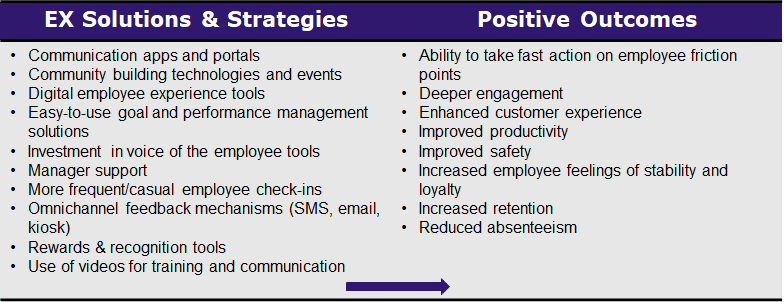
Vendors in the employee experience segment that support companies with large frontline workforces are seeing success when rolling out some of these technologies.
In the retail segment, designer footwear and accessories brand Kurt Geiger, needed a tool that would allow for fast communications with store and field teams that was also user-friendly for associates and managers. The company wanted to choose a technology that would feel consumer-grade for its Gen Z workers, being similar to the social media apps that they were using daily. The company deployed WorkForce Experience, an offering from WorkForce Software. It has a social media-like interface that is very user friendly. Positive benefits Kurt Geiger has seen include:
- Training videos through the app from lead product designers, enabled team members to convey the company’s brand and product story more consistently
- Store workers have a platform to share their thoughts and be heard; there is a lot of interaction, allowing for more connection and camaraderie
- Corporate can receive information from locations faster and easier, such as photos of promotions and displays
- Daily updates and announcements can be shared with individual teams
- Field team members can communicate and manage tasks directly with their stores, and associates have a direct line to their managers when they need advice
Related Article: 5 Questions with Sandra Moran, CMO, WorkForce Software
In the manufacturing industry, Wabash National wanted to improve communications and enhance culture for its 6,500 dispersed employees. Some of the challenges the company faced included large, loud environments making in-person direct communications and information sharing difficult, its HR team struggling to keep up with benefits and policy questions and employees often feeling misalignment with company, team, and individual goals. With senior leadership support, the company partnered with Limeade to create the Wabash@Work app. The company started with six app channels: Manufacturing, HR, Quality, Safety, Leadership Messages, and Company Announcements. The app team selected employee writers for each of the company’s groups who were empowered to post one message a day, ranging from safety alerts to employee shout-outs. Employees were especially attracted to the kudos feature, which gave them the ability to send other workers messages of encouragement. Program results of the phased rollout include:
- Three weeks into the rollout at its first location, which was the largest operation with over 3,000 employees, the app had nearly 2,000 users (over 61% of the workforce) and was averaging 900 daily views.
- Two weeks after launch, the app communications team logged 164 kudos, primarily peer-to-peer praise for performance.
- In a two-week period, HR answered 102 questions through the app, helping them track the metrics and tailor future posts to convey exactly what employees want and need to know.
A 2022 Microsoft report stated, “a culture of caring is the new currency on the frontline.” That is true in many ways, but I would add that having frontline workers’ fundamental needs such as scheduling and payroll met, offering opportunities have their voices heard, having the ability to receive and give recognition, and having clear, relevant and omnichannel communications are critical factors.
Author Information

As a detail-oriented researcher, Sherril is expert at discovering, gathering and compiling industry and market data to create clear, actionable market and competitive intelligence. With deep experience in market analysis and segmentation she is a consummate collaborator with strong communication skills adept at supporting and forming relationships with cross-functional teams in all levels of organizations.
Sherril holds a Master of Business Administration in Marketing from University of Colorado, Boulder and a Bachelor of Arts in Psychology from Rutgers University.