Analyst(s): Brendan Burke
Publication Date: February 11, 2026
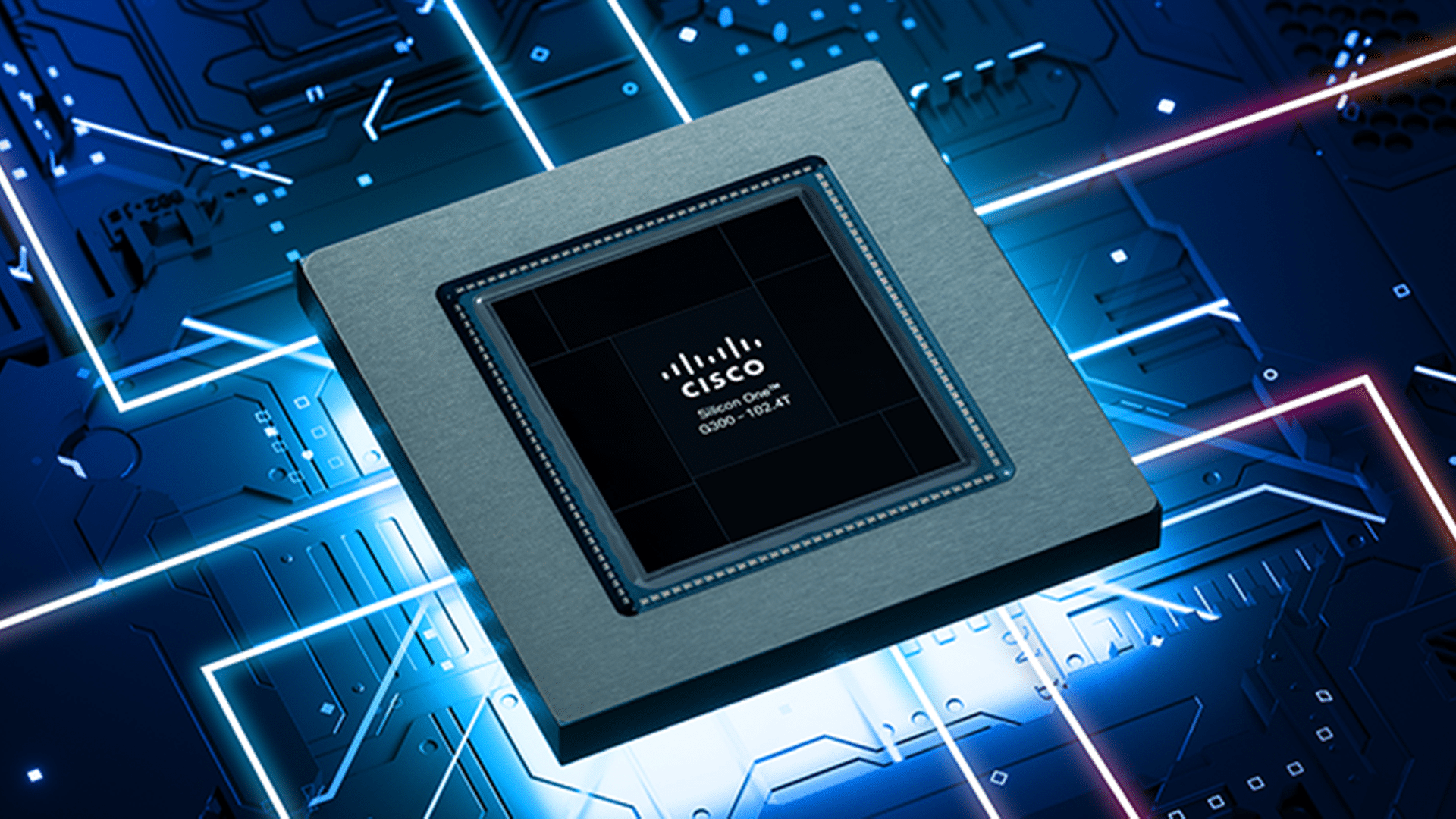
Cisco announced the Silicon One G300 switch chip and 1.6T pluggable optics designed to optimize AI cluster performance through enhanced buffering and programmability. This launch signals a strategic push to lower total cost of ownership for hyperscalers and enterprises building massive scale-out and scale-up AI infrastructure.
What is Covered in this Article:
- Cisco Silicon One G300 and its 102.4 Tbps capacity
- Cluster Optimized Routing features, including shared buffering
- Introduction of 1.6T OSFP and 800G Linear Pluggable Optics
- New liquid-cooled Nexus systems for high-density AI clusters
- Adaptive Packet Processing for post-deployment feature updates
The News: Cisco announced a comprehensive update to its AI infrastructure portfolio at Cisco Live Amsterdam, headlined by the Silicon One G300, an Ethernet switch chip delivering 102.4 Tbps bandwidth. The G300 supports standards-based 1.6 Tbps Ethernet ports utilizing on-chip integrated 200 Gbps SerDes. This launch targets the agentic era of AI, addressing the shift from centralized training to distributed inference and agentic workflows. The portfolio includes the new Cisco Nexus 9000 and 8000 series systems, which leverage the G300’s high radix scaling to enable flatter, more efficient networks.
Complementing these are new 1.6T OSFP optics and 800G Linear Pluggable Optics (LPO) that reduce power consumption by 50% per module. Beyond the data center fabric, Cisco expanded its Silicon One P200 portfolio with new fixed and modular systems for scale across core routing, introduced AgenticOps capabilities via an AI Canvas for natural language network management, launched a native Splunk integration for Nexus Dashboard, and established sovereign Critical National Services Centers in Europe to address strict data residency requirements.
Will Cisco’s Silicon One G300 Be the Backbone of Agentic Inference?
Analyst Take: Cisco’s latest announcements represent a calculated move to assert dominance in the AI networking fabric by attacking the specific bottlenecks of GPU cluster efficiency. As AI workloads shift toward agentic inference, where autonomous agents continuously interact across distributed environments, the network must handle unpredictable traffic patterns, unlike the structured flows of traditional training. Cisco is leveraging its vertical integration strategy to address the reliability and power constraints that plague these massive clusters.
By emphasizing programmable silicon and rigorous optic qualification, Cisco aims to decouple network lifespan from rapid GPU innovation cycles, ensuring infrastructure can adapt to new traffic steering algorithms without hardware replacements. The G300 is a bid to make Ethernet the undisputed standard for AI back-end networks.
Silicon Architecture: Buffer Management and Traffic Steering
The G300’s fully shared packet buffer architecture addresses a critical pain point in AI networks where microbursts can stall expensive GPU resources. Unlike designs that partition memory per port, Cisco’s approach embeds a massive 252MB of packet buffer directly into the silicon, allowing the entire buffer to absorb congestion from any port dynamically. Simulations cited by Cisco indicate this can lead to a 33 percent increase in network throughput without adding physical capacity. This efficiency gain directly translates to lower capital expenditure per deployed GPU for data center operators.
Crucially, the G300 supports Adaptive Packet Processing, allowing it to handle mixed traffic flows simultaneously. For instance, a single switch can apply packet spraying for AI training jobs while using different load balancing profiles for inference, dynamically classifying traffic based on quality-of-service metrics. This unique flexibility allows operators to use a single hardware design for the transition of training clusters to inference, which is becoming more valuable with the usage of NVIDIA Blackwell clusters for post-training and inference workloads.
Optics and Power Efficiency
The introduction of 800G Linear Pluggable Optics (LPO) demonstrates the pragmatic need for power reduction in modern data centers. Cisco claims a 50 percent power saving per module and a 30 percent reduction in overall system power. However, LPO adoption has historically been hindered by interoperability challenges. Link flaps and errors can devastate AI cluster performance; Meta has estimated that such failures can reduce GPU infrastructure performance by up to 40 percent.
Cisco’s counter is its rigorous qualification process, effectively acting as a guarantor of link performance. In a recent internal test, Cisco acquired 35 different optics from various suppliers that claimed standard compliance; none passed Cisco’s initial qualification tests. This underscores the value of Cisco’s validated ecosystem for customers unwilling to risk the stability of billion-dollar clusters.
Liquid Cooling and System Density
The new liquid-cooled Nexus systems supporting the G300 silicon reflect the physical reality of next-generation data centers. As rack power densities climb past 100kW, air cooling becomes untenable. The G300’s high bandwidth density allows a single G300-based liquid-cooled system to replace six prior-generation 51.2T air-cooled systems. This 6x consolidation significantly reduces the number of required interconnects, power supplies, and rack space, resulting in a claimed 70% improvement in energy efficiency. The ability to support 512 ports in a single device also simplifies network topology, reducing the number of hops and associated latency.
Programmability as Future-Proofing
The G300’s P4-programmable architecture provides a hedge against obsolescence, enabling the network to adapt to new standards without hardware replacement. Cisco demonstrated this capability with the Ultra Ethernet Consortium (UEC) 1.0 specifications, which were implemented on the previous-generation G200 silicon years after the chip was designed. This hot-swap capability allows operators to deploy hardware today and roll out new congestion-control or telemetry features via software updates later, a critical advantage in the fast-evolving AI landscape.
Beyond silicon, Cisco is extending this future-proofing to the operational layer with the introduction of the AI Canvas for data center networking. Built on the Cisco Deep Network Model, AI Canvas enables operators to interact with the network using natural language, visualize complex multi-tiered flows, and troubleshoot issues across the entire fabric. By enabling human-in-the-loop agentic workflows, AI Canvas turns the network into a dynamic system that reasons alongside human operators, supporting uptime metrics that are increasingly valuable in the gigawatt era of AI data centers.
AI’s Ethernet Transition
Cisco’s G300 launch is a comprehensive response to the utilization limits of GPU clouds. By vertically optimizing the stack from the transistor to the optical transceiver, Cisco is making a strong case that Ethernet can match or exceed InfiniBand’s performance for AI workloads while retaining its operational advantages. The G300’s architecture delivers a 33% increase in network utilization and a 28% reduction in job completion time, effectively neutralizing InfiniBand’s historical performance arguments while retaining Ethernet’s superior operational agility and cost structure. As the industry pivots to the Agentic Era, the G300 reinforces that Ethernet is the only logical foundation for gigawatt-scale AI infrastructure.
What to Watch:
- Neocloud and Sovereign AI Adoption: Monitor whether Cisco’s full-stack architectures successfully drive adoption among AI cloud operators and sovereign providers.
- Shift from Training to Inference: Track the deployment of G300 systems to see if they effectively manage the bursty, unpredictable traffic patterns of distributed inference workloads better than rigid InfiniBand alternatives.
- Agent Performance at Scale: Assess the real-world efficacy of AI Canvas in preventing latency bottlenecks during the massive increase in machine-to-machine communication generated by autonomous agent workflows.
- Timeline Execution for H2 2026: Watch for the H2 2026 availability target for G300 systems, which is critical for capitalizing on the rapid iteration cycles of the next wave of GPU cluster buildouts.
Read the full press release on the Cisco Newsroom website.
Disclosure: Futurum is a research and advisory firm that engages or has engaged in research, analysis, and advisory services with many technology companies, including those mentioned in this article. The author does not hold any equity positions with any company mentioned in this article.
Analysis and opinions expressed herein are specific to the analyst individually and data and other information that might have been provided for validation, not those of Futurum as a whole.
Other insights from Futurum:
Is 2026 the Turning Point for Industrial-Scale Agentic AI?
Cisco’s “End of Gold”: A High-Stakes Pivot to Skills-First Architecture
Cisco Q1 FY 2026: AI Demand Lifts Outlook and Orders
Author Information

Brendan is Research Director, Semiconductors, Supply Chain, and Emerging Tech. He advises clients on strategic initiatives and leads the Futurum Semiconductors Practice. He is an experienced tech industry analyst who has guided tech leaders in identifying market opportunities spanning edge processors, generative AI applications, and hyperscale data centers.
Before joining Futurum, Brendan consulted with global AI leaders and served as a Senior Analyst in Emerging Technology Research at PitchBook. At PitchBook, he developed market intelligence tools for AI, highlighted by one of the industry’s most comprehensive AI semiconductor market landscapes encompassing both public and private companies. He has advised Fortune 100 tech giants, growth-stage innovators, global investors, and leading market research firms. Before PitchBook, he led research teams in tech investment banking and market research.
Brendan is based in Seattle, Washington. He has a Bachelor of Arts Degree from Amherst College.