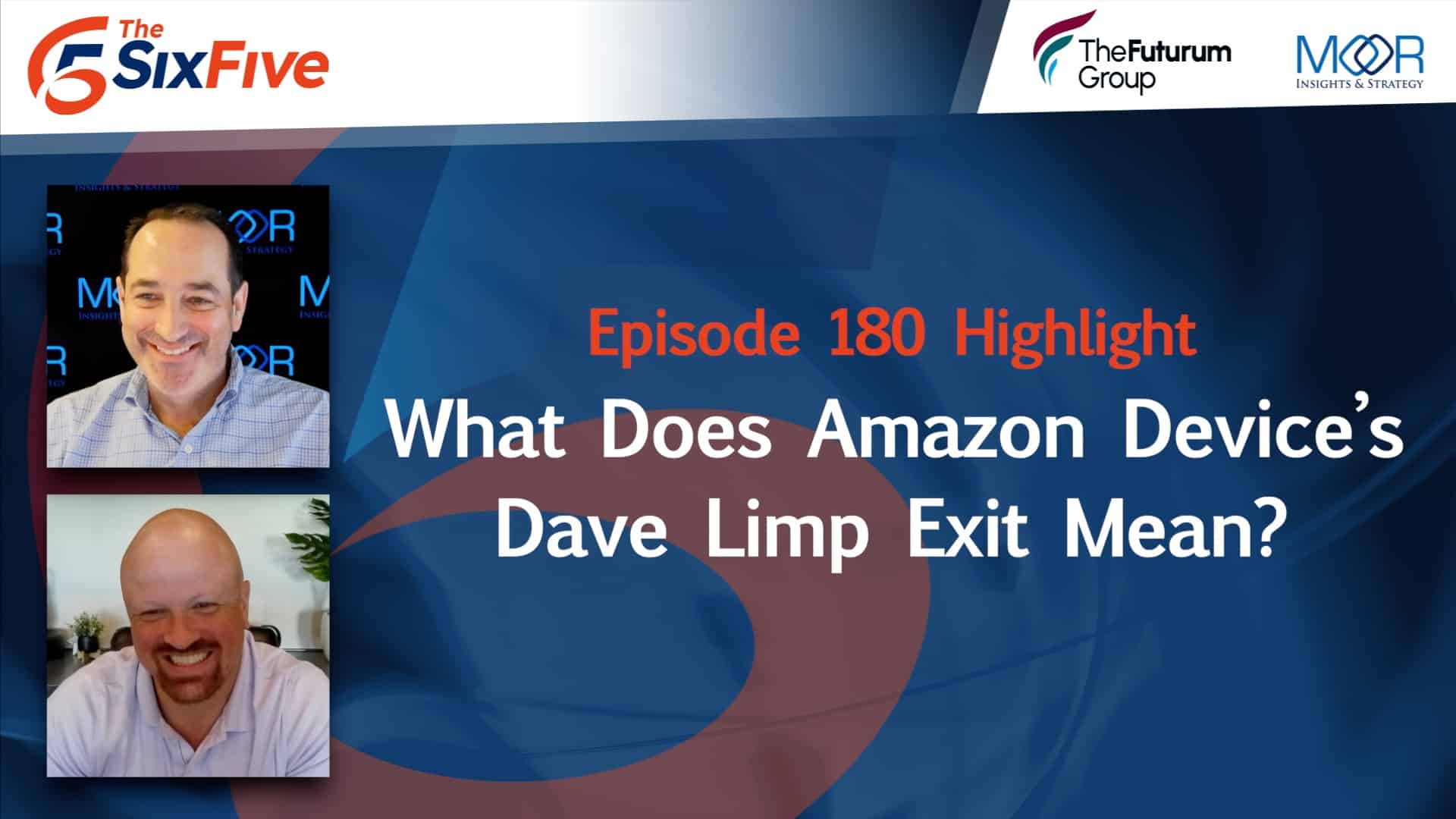
The Six Five Team discusses the exit of Amazon’s senior vice president of devices and services, Dave Limp.
If you are interested in watching the full episode you can check it out here.
Disclaimer: The Six Five Webcast is for information and entertainment purposes only. Over the course of this webcast, we may talk about companies that are publicly traded and we may even reference that fact and their equity share price, but please do not take anything that we say as a recommendation about what you should do with your investment dollars. We are not investment advisors and we ask that you do not treat us as such.
Transcript:
Patrick Moorhead: Dave Limp exiting from Amazon, and he was the leader of the devices group and he had been there for 14 years. And pretty much everybody who is listening on here, I am sure has used one of their products, a Kindle, Alexa, Echo. Now, he bought the Ring capability, but quite frankly he made it a lot better. And I think I’ve single-handedly bought 50 Ring cameras since its existence, so I’m a pretty big stakeholder here. Dave said in a blog post, “it was time to go.” No details. The only piece of detail he said is that he won’t be doing it in consumer electronics, which was interesting because he’s been in the CE space for over 30 years. He’s an ex-Apple and an ex-Palm guy.
So I then look to Andy Jassy and his statement to see if he could add some color on this, because quite frankly, you need to look at the Alexa business, and you, this is not me talking to Andy Jassy, but the company needs to figure out, hey, do we measure this as a standalone profit driver? Do we look at this as a profile creator to serve you better ads, to either buy their stuff or other people’s stuff? So for instance, if you’re talking to it, and I have video and pictures, it knows a lot about you.
Is it a frictionless way to buy stuff? I know that my Alexa devices, particularly Echo devices, ask me nonstop, hey, do you want to buy something? Did you know you could buy something on this? Potentially that was one of the big drivers, because if you look at the history of Amazon all the way to one click shopping and back in the early days when it started, back in the 2000s, actually late ’90s, it was all about how fast the checkout process was. So this whole idea that you could tell your device to go buy stuff or create a list and then go do that. And by the way, the final way I think needs to be up there is a future service expansion opportunity.
But yeah, Andy didn’t give a lot of insights about that. It wasn’t, hey, we’re going to strategically relook at it, but he said, hey, I believe those businesses will add customer value, and he’s excited and quite optimistic of what’s being built.
And when I talk about the new services, I like to look at it like this. So the home service opportunity I think for Amazon is pretty immense. And ADT only has a market cap of about $5 billion, but then again, they’re only around 10% of the market. So let’s say the security market is 10X that size, but I think it’s bigger than home security. Think of robotic automation in the home. Our nation’s, I think, biggest spend issue that’s out of control is healthcare. People keep getting sicker diabetes, what elder care could a potential future Amazon robot provide to the US? In Japan, where they have more people dying than people being born.
So that’s that, that I want to end with. There’s a lot of people leaving the executive staff under Andy Jassy, right? The worldwide consumer lead, Dave Clark, left, the media leader, Jeff Blackburn, left, Charlie Bell left, Alicia Bowler Davis left, and corporate affairs under Obama who had been in here for a long time, Jay Carney, left. So the chief communications person and communication strategist are all gone. So I’m really interested to see if these moves is an Amazon that’s going to go off the rails with all of these senior leaders in here, or is this a scenario where Amazon did such a good job with culture and training in the Amazon way that was started under Jeff Bezos that it almost doesn’t matter who you plug into these roles, it’s just going to keep moving forward.
Daniel Newman: Yeah, I think it’s the latter with an asterisk. I mean, a company that’s this big is always going to be bigger than any one person, even any group of people. How many people that are clicking buy on Amazon knew who their chief communications officer was? They don’t. So Amazon’s built something that’s so much bigger than that. It’s just like Andy was so imperative to AWS, but it’s gone on under Adam. It just keeps going on, and because it’s built an ecosystem, it’s built a community, it’s built a user base.
Having said all that, I want to touch on devices and I’ll touch on what you said about the corporate leadership. On the devices side. I think the Devices is a data play, not a product play. I think the company has been able to utilize this to leverage and understand its consumer at a rate that’s just exponentially greater than what Walmart or Target or any of these other companies will ever build to understand the consumer and its behaviors. It’s basically now become an integrated part of your home. They’ve done it at a very low price, been able to gather that data.
Amazon has been endlessly investing in improving its supply chain and making delivery times shorter in terms of putting green trucks, and it’s always sort of been dilutive to the company’s earnings on the e-commerce side. But that’s what you do when you’ve got a golden goose, which is AWS, and it’s always had the ability then to take its massive operating profits and enable to invest it in its future endeavors. That’s the cycle and that’s why I think the breakup is probably pretty unlikely. Having said that, if they did break it up, e-commerce would be on a much more level playing field, because it would have to invest very differently.
But you mentioned healthcare. I mean look, Alexa and its ability to understand health wellness, to be able to identify people’s potential health issues and quickly document them. I mean, they’re building for the future. The ability to use a camera inside of your home to see that you’re ill and be able to order you chicken soup, Tylenol, or to see that it’s something more serious and to schedule you a telehealth visit, and this is where Amazon’s going.
And so Alexa’s always been more of an enabler of that, it’s a data play more than a product play. The things they’ve kind of tried to get into that are a little bit more traditional, the Fire Phone and stuff like that, kind of never stood a chance. It just never did. They did okay with the Kindle, that was the inroad, the digital book, and so that was as far as it went. Some of these “robots” things. To me it’s more about showing that we’re an innovative technology company and because you do a 100-something-billion a quarter, there’s some projects, some testing, but it’s always going to be about the data. I know I got-
Patrick Moorhead: Can I ask you a question though? They’ve had this data for a decade. Are they going to just find some new way to do something with it? Do they need generative AI to take it? I mean, it’s been out there forever.
Daniel Newman: I think they’re already doing it.
Patrick Moorhead: What we buy, they know what my face looks like.
Daniel Newman: But how have they grown every quarter at such a high rate? I mean, look at their revenue quarter to quarter to quarter to quarter, they’re getting better and better and more prescriptive. It’s Miyagi judo mind tricks. It’s not so obvious to you, but the point is you’re going there and your ability to buy everything you need and getting it right, you know what I mean? It’s happening faster and faster.
Patrick Moorhead: Yeah, the layoffs though, Amazon Devices group went down probably 50%.
Daniel Newman: No, it’s nothing more than a play-
Patrick Moorhead: If it’s so amazing, why cut it? Why gut it?
Daniel Newman: I just think maybe the kind of data, the amount of data and the amount it wants to focus on actually cutting edge versus just enabling the data, which is my take. I mean, you have your take. I have mine. I’ll tell you one more thing.
Patrick Moorhead: I’m asking questions.
Daniel Newman: Yeah, I’m genuinely telling you-
Patrick Moorhead: Am I not allowed to ask questions on this show?
Daniel Newman: No, you’re not allowed to challenge me. I’m always right. But in all seriousness, I think we’re probably more in alignment than not. I just mean like, look, it’s been a tough year. The street wants more profitability. They don’t get enough benefit out of the cost. They don’t need to be innovating in terms of the hardware product itself as much as you might think. What they need to do is to get more of these into more homes so they can get better data and get better insights to keep delivering more stuff to everybody’s door. And then ultimately the kind of stuff, right? So it’s not just knickknacks, it becomes your electronics, it becomes your healthcare needs, it becomes your food and grocery, and eventually it can potentially be everything. And that of course will always put them in the limelight of everything from cool tech news to antitrust discussions.
The only thing I’ll say about Andy and the team is anytime a new CEO comes, I give it a year to two years in, the whole executive teams tend to get washed out. This was a group of people that all wanted to be the next Jeff Bezos, and probably a lot of them thought maybe they were the person that should have been next in line, and when they realized it wasn’t them, I can’t think of a company, Pat, where this doesn’t happen. When a new CEO comes in, within a year or two people figure out, am I part of the plan? Am I not part of the plan?
Patrick Moorhead: I know Apple was pretty consistent.
Daniel Newman: But it’s Apple. I mean, are you even allowed to leave? I thought you were chained to your desk.
Patrick Moorhead: Google was pretty consistent.
Daniel Newman: I can’t remember that.
Patrick Moorhead: No, this is a great conversation.
Daniel Newman: I can’t proclaim that. I think it changes a lot. I can give you plenty of examples where it did change.
Patrick Moorhead: Yeah, during times of struggles, 100%. Amazon has this seven-year, if you’re going to invest big, it doesn’t pay back in seven years, it’s off. And that’s kind of where I think we are. I don’t know what off means, I think it could be a significant reduction in investment. And by the way, we saw a huge reduction in investment from Google in the same space, in all of their smart home stuff.
Author Information

Daniel is the CEO of The Futurum Group. Living his life at the intersection of people and technology, Daniel works with the world’s largest technology brands exploring Digital Transformation and how it is influencing the enterprise.
From the leading edge of AI to global technology policy, Daniel makes the connections between business, people and tech that are required for companies to benefit most from their technology investments. Daniel is a top 5 globally ranked industry analyst and his ideas are regularly cited or shared in television appearances by CNBC, Bloomberg, Wall Street Journal and hundreds of other sites around the world.
A 7x Best-Selling Author including his most recent book “Human/Machine.” Daniel is also a Forbes and MarketWatch (Dow Jones) contributor.
An MBA and Former Graduate Adjunct Faculty, Daniel is an Austin Texas transplant after 40 years in Chicago. His speaking takes him around the world each year as he shares his vision of the role technology will play in our future.