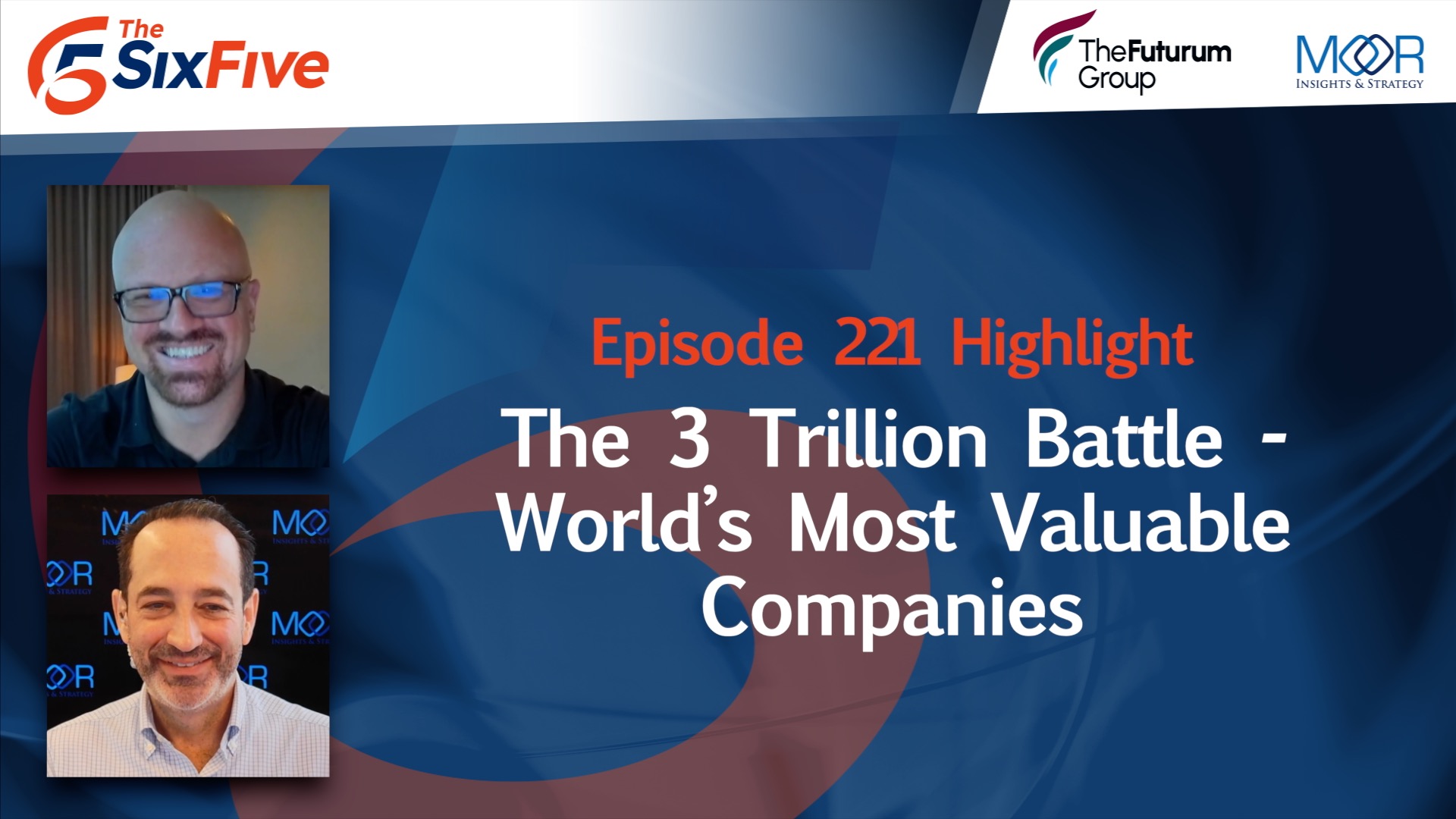
The Six Five team discusses the 3 trillion battle – world’s most valuable companies.
If you are interested in watching the full episode you can check it out here.
Disclaimer: The Six Five Webcast is for information and entertainment purposes only. Over the course of this webcast, we may talk about companies that are publicly traded and we may even reference that fact and their equity share price, but please do not take anything that we say as a recommendation about what you should do with your investment dollars. We are not investment advisors and we ask that you do not treat us as such.
Transcript:
Daniel Newman: Dude, you’ve been on every channel, on every network in the last-
Patrick Moorhead: Stop it, Dan, you’re the king of broadcast, get out of here. I think you did six of these and you spent an entire-
Daniel Newman: You had a killer 24 hours.
Patrick Moorhead: You spent the entire last weekend pontificating on X on what’s going to happen. But it has been pretty amazing. In one week three people have had the top spot.
Daniel Newman: And it’s created a lot of buzz and interest in the market. And so we’ve been brought in, I guess I talked to the New York Times, I talked to the Associated Press, I talked to CNBC in Asia, you did CNBC in the US, you did Yahoo Finance. And basically we asked the same question by everybody and it is the same thing. And like I said, there’s so much interest in this. So I’m going to just give my quick breakdown. I don’t think this is a topic we need to spend a ton of time. There’s a lot of our commentary already on the record here about this particular topic, Pat, but here it is. NVIDIA is not on top because of its sales of GPUs. Just be very clear about that. And the reason there are investors that are confident and the reason that the analysts keep raising the price targets is because of what they’ve been able to accomplish from a full stack standpoint and then from a partnership standpoint, they’ve basically built from top to bottom the entire AI layer.
And then they’ve made every single hyperscaler and OEM bet their farm on NVIDIA. And so if you look at how Intel gained market share early on with the CPU and the data center, it was saturation and at the point after, even when Intel started to be see more competition and see more flaws in what it was doing, it still took years and years and years to shed market. So if you look at NVIDIA, and first of all, you cannot assume they’re going to botch execution at some point. You have to assume they’ve executed well, they’ve got a yearly cadence, they’re continuing to innovate, they’re building libraries, they’re building partnerships, they’re building new capabilities like NIMs, which is part of solving that private AI thing, that makes it more durable. Where I’m concerned, Pat, is the saturation they have with a small number of customers is incredible.
It’s so dense with their five biggest customers. I do think AMD and what they built with ROCm the abstraction layers up with PyTorch, JAX that you can do more development up there. I think some of the enterprise capabilities that we’re seeing from companies like IBM and Red Hat to be able to do private AI and deploy it in containers using other hardware create some risk. I think pricing power for NVIDIA’s valuation to stick, they have to keep this pricing power and keep growing at this rate without much disruption. So it is possible though. And that’s the thing is when people say, “Is it possible?” Yes, it’s possible. Are they number one? Here’s what I’m going to say. If I had to order these three companies, I put Microsoft at one. It’s just so diversified between its consumer, its Copilot+, its Azure AI, its relationship with open AI, the software SaaS layer that they have, platform layers, Windows, the stickiness of the mass market and the devices and then the productivity tools is just so big. Company’s so well run.
Apple I think obviously is where I said something like Jensen will create AI and then Apple will make it consumable. What do I mean by that? The most basic consumption of AI in the apps will happen on people’s iPhones all day long. And I think that is enough to keep Apple up there and top. But we just talked about the vision profile. I think Apple’s become a bit boring. They’ve lost their market and innovation leadership, but they know how to make money. Tim Cook knows how to make money and you know what? In the market that is really, really important. So if I had to order them 1, 2, 3 right now, Microsoft one, NVIDIA two, Apple three. But having said that, NVIDIA has, I think the biggest risk with how fast it has ascended of having a just as quick descent, not back to 1 trillion or anything, but I could see it if the conditions or competition starts to rise, I could see it back in the two or two and a half in a short order because like I said, the density and concentration risks there are so different than the other two.
Patrick Moorhead: Yeah, real quick, I’m going to give NVIDIA opportunities to grow and then some risks here. So first and foremost, you’re going to see a lot. Well, let me give you precursors of what I’m looking for.
Daniel Newman: Yeah, please.
Patrick Moorhead: Like we saw with the dotcom boom and bust, there’s the build out and then there’s the downstream profitability that companies are making off of all that infrastructure build. And when you saw a lot of the dot coms not making money, going out of business. Now there was a lot of bad VC money going out to these startups, but it was an absolute bust. And Cisco at the time was the builder of internet and they were the NVIDIA of the age. I think the canary in the coal mine are the enterprise software companies. The SAPs, the ServiceNow, the Adobes, the SalesForces, that’s one. If they can’t make incremental profit dollars on this, this thing collapses on itself.
Daniel Newman: I love that you’re saying this, dude.
Patrick Moorhead: No, I appreciate that. And then there’s the consumer version of that, which are the Googles and the Apples. And then finally you have the enterprises that develop their own applications on these and they are trying to drive incremental profit dollars off that. If those don’t all come together, they don’t all three have to hit, but two out of three have to hit, this thing is going to fall right on its face. So those are the things to look for. Now, NVIDIA still has a lot of opportunity for growth and the biggest area is enterprise, exactly what we’ve been talking about with HPE, with Dell, with Lenovo, with Pure Storage. This is the untapped infrastructure opportunity right now. I do think we’ve got pretty much a guaranteed six to nine months of infrastructure growth even on the public cloud side.
So the risk that you’re looking at is in looking at the next 12 months. Now with that said, reality and perception could be very different things. If NVIDIA stubs its toe somewhere and the perception then all bets are off. AMD and Intel are very much competitive factors in the public cloud, not so much in private cloud acceleration. Now software is going to be everything. We haven’t even seen Intel’s enterprise AI GPU, that’s not going to be out until probably late 2025.
Daniel Newman: Yeah, I love the analysis there, Pat. I’ve probably put four or five long, long-winded tweets for all five of my viewers.
Patrick Moorhead: I don’t know, we have 3,300 concurrent X viewers right now. I’m feeling pretty good about that.
Daniel Newman: What’s up, X? Appreciate all you tuning in. But no, in all serious, I’ve just been belaboring consumption layer. I keep talking about the consumption layer, the consumption layer. Who’s using this? I get it because Pat, I said that this morning. I’m like Kohaus is sold out through 26, 3 nanometers sold out through 26, Apple, Qualcomm, NVIDIA, AMD, they’re absolutely going to make as many AI chips as can be made right now. They’re going to get sold into these hyperscale data centers. But who is consuming it? And by the way, who makes money? Who else makes money?
Author Information

Daniel is the CEO of The Futurum Group. Living his life at the intersection of people and technology, Daniel works with the world’s largest technology brands exploring Digital Transformation and how it is influencing the enterprise.
From the leading edge of AI to global technology policy, Daniel makes the connections between business, people and tech that are required for companies to benefit most from their technology investments. Daniel is a top 5 globally ranked industry analyst and his ideas are regularly cited or shared in television appearances by CNBC, Bloomberg, Wall Street Journal and hundreds of other sites around the world.
A 7x Best-Selling Author including his most recent book “Human/Machine.” Daniel is also a Forbes and MarketWatch (Dow Jones) contributor.
An MBA and Former Graduate Adjunct Faculty, Daniel is an Austin Texas transplant after 40 years in Chicago. His speaking takes him around the world each year as he shares his vision of the role technology will play in our future.