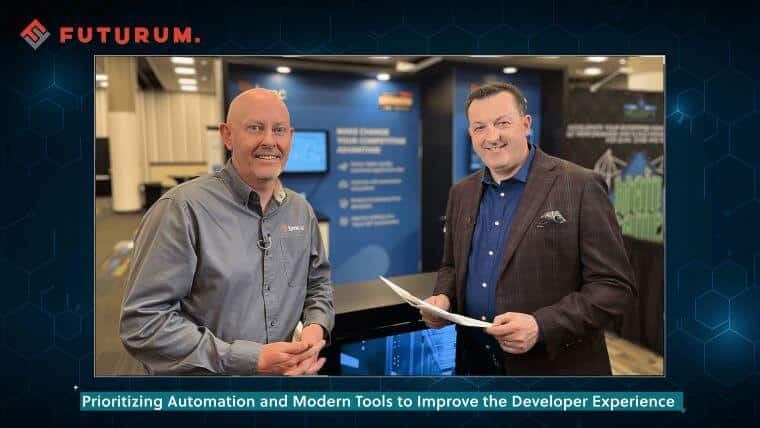
On this episode of Futurum Tech Webcast Interview Series, I talked with BMC Software’s VP of Research and Development, David Jeffries, during the SHARE Conference in Atlanta. Our conversation covered BMC’s efforts with their own development team to prioritize automation and modern tools to improve the developer experience.
It’s a great conversation you don’t want to miss.
Learn more at BMC Software.
You can view the video of our conversation here:
Or grab the audio on your streaming platform of choice here:
If you’ve not yet subscribed to the Futurum Tech Webcast, hit the ‘subscribe’ button while you’re there and you won’t miss an episode.





Disclaimer: The Futurum Tech Webcast is for information and entertainment purposes only. Over the course of this webcast, we may talk about companies that are publicly traded and we may even reference that fact and their equity share price, but please do not take anything that we say as a recommendation about what you should do with your investment dollars. We are not investment advisors and we do not ask that you treat us as such.
Transcript:
Steven Dickens: Hello and welcome to the Futurum Tech Webcast, brought you in collaboration with BMC. I’m joined today by Dave Jeffries, welcome to the show.
David Jeffries: Thank you Steve, nice to be here, again.
Steven Dickens: I know. So Dave, lot going on with BMC right now, lot of transition. Tell me a little bit about your role first off, before we dive in.
David Jeffries: So I’ve been in the role about four months or so, so I’m really leading the whole z/OS product or the IzoT organization as we look at it. Really all the research and development activity that we do, trying to ensure that our products, which we have a lot of products, over 200 plus products, actually have the right development cadence, the right response cadence and ultimately deliver the right client experience to our wonderful clients out there.
Steven Dickens: So lots there to go back to, but I know from tracking BMC, there’s a lot going on with how you are pivoting to how you are handling what you call DevX, this developer experience. I know that you are taking your organization on a journey through what that means. So maybe just unpack some of that for me.
David Jeffries: We’re all on a journey. We’re always on a journey.
Steven Dickens: All right.
David Jeffries: So I think software development, and when I first came into the role, I mean I clearly looked at BMC and thought what is this? It’s a big organization. There’s probably lots going on here, but in reality it’s software development and it’s ultimately how can we as a development organization deliver at the right cadence to our clients at the right time. So there are a lot of things for me to look at and I have looked at and traditionally if you look at the BMC development environment, there’s a multitude of organizations that shall we say have come together.
And so I put myself in the boat of really being customer zero and trying to ensure that what we do as an organization, we have the first experience of how we bring integrated development together prior to our clients. So we should be building technology in a way that we know our clients are going to use our technology. All right, so client zero, customer zero, et cetera is important for me to get across to the team, that’s who we are. And if the experience isn’t right for us, then we change and we move and we transform.
Steven Dickens: So the classic eating your own dog food.
David Jeffries: Absolutely. Eating your own or drinking your own champagne, right?
Steven Dickens: That’s probably a better phrase.
David Jeffries: Yours was good enough. Nothing wrong with that one.
Steven Dickens: That’s better. That’s better. So is that really trying to get your development team, and you’ve got a team of, what is it over 700, something like that now to live the experience that your clients are living? Is that basically what you’re trying to say there with that message?
David Jeffries: Yeah, absolutely. Absolutely. Because I think not only do I look at this client zero, customer zero staff, but I look at the fact that we are probably experiencing what a lot of clients have experienced in their own transitions and transformations. You think of companies going through mergers and acquisitions where many different methodologies come together, many different development tools come together and really it’s the challenge of the new organization to try and pick the right tools for the right role and harness those together for the power of the development team. Because ultimately, as I say, this is a journey. This is us putting ourselves in the shoes of the client and going through the experiences, whether it’s cultural experiences, whether it’s transformation, overall experiences, putting us in that position first so that we can solve those problems our clients are looking to solve.
Steven Dickens: Keywords you kept mentioning there was experience. I know there’s a lot of focus within BMC on this developer experience. What does that mean for you and what do you think it means for your clients?
David Jeffries: I think-
Steven Dickens: Because it’s a phrase that you could think is a marketing term, but from the briefings I’ve had and the information that the team has shared with me, it’s more than that. So I think that’s worth unpacking.
David Jeffries: I think as any development lead and a ex developer, et cetera, or tester and certainly, I grew up as a tester and did some development and then went through the various different ranks, I think fundamentally it’s about you want your development team to be focused on the problem and focused on the solution and not to have to worry about all the pieces and the infrastructure necessary to make that happen. You almost want, let’s say, a platform-agnostic development experience where you can provide the best tools at the right time to allow the engineers to build the right technology in the right way the first time, because we know all the trials and tribulations of things like technical debt and all those sorts of things.
We want to build it right first time because that’s better for us as a software delivery organization, that’s better for the client because out of the box it works the way they expect it to work. So I really want to unleash my development team to build it right the first time with the right tools in hand so that actually we can improve our velocity, we can get quicker, we can therefore deliver even more capability. We can exceed the expectation of the clients that we have.
Steven Dickens: I think that’s an interesting point, you mentioned velocity there. I mean, around these particular tools, there’s lots within the portfolio. We could be talking about the widgets and the different screens and some of the ways you can debug code, but I think for me it all comes down to that velocity point, getting code out faster because what that ultimately means is the business is innovating faster. Is that really what’s the guiding principle?
David Jeffries: Lots of things have to come together here. You can’t just have a fantastic set of tools. That is a large portion of this. You have to have a process behind it, you have to have an agile process behind it. And I know there are a lot of clients out there who probably struggle with levels of agile and whether they’re really agile or I know internally we’ve looked at whether we are totally agile in every aspect that we do and we know we can get better on that. So if you can harness… Previous life, I was very focused around things like design thinking. All right. And I think actually that comes through as well. Really before you pick up a keyboard, you should know exactly what it is you’re going to build. You should know that client experience that you’re expecting to achieve and you should validate it with a set of your clients.
So harnessing things like design thinking, harnessing an agile process and a common agile process that is flexible because I think one of the worst things we can potentially do is develop an agile process and make it so rigid and structured that actually it restricts the power of the organization to be flexible. And then you bring the best of breed development tools together. That’s the perfect mix. Those are the ingredients that allow velocity to happen.
Steven Dickens: And we’re not talking feature function down in the tools. We’ve been talking a few minutes now. You are not telling me about this latest widget. It’s really around how do you craft that overall developer experience.
David Jeffries: Absolutely. And it’s getting into the mindset of the developers and that culture that you can unleash them and they don’t need to be worried about the process because the process takes care of itself. Yes, you need to build an integrated DevOps pipeline and a set of tools and a set of processes, et cetera. Yes, you need to test in the right way. You need to ensure you know what unit test is on functional tests and regression tests and scalability testing and all those aspects and work out ways to do that. But if you can focus them on giving them the tools to build their capability of the product or the function that they’re designing and then ensure there’s a process to take that platform-agnostic development and apply it to the platform you’re going to deploy onto, that’s the magic as this all comes together.
Steven Dickens: You went there with the final comments there around platform-agnostic. You haven’t been talking about mainframe developers specifically. You are talking about developers as a cohort and how they do their job and then it may deploy onto an ultimate platform that’s a mainframe.
David Jeffries: Because you want to unleash their talent as developers versus just being platform specific. And I think as our clients look to build applications, whether they’re retail banking applications, warehousing applications, whatever it may be, they want to focus on the functionality of what they’re trying to deliver to their own client versus, “Well, I need to build it this way because it’s going onto the cloud” or “I need to build it this way because it’s going onto the mainframe.” Focus on that, let the system then handle the deployment.
Steven Dickens: So Dave, BMC does a great job every year with a big survey. I’m just looking to hear some of the metrics. 79% of developers say their mainframe development tools need a significant improvements to be effective. What are you seeing that’s behind that? What’s behind that data point?
David Jeffries: Fundamentally as I would interpret that, I think there are still a lot of very bespoke tools out. There are a lot of very platform specific tools or if you’re coming from this journey, the 32, 70 or wherever, then they’re customized to where you’re coming from. I think we are starting to see an emergence now of what I would class as the platform-agnostic tool set and I think we are starting to see that there are platforms, whether it’s the cloud platforms, whether it’s AWS or whether it’s Azure or those sorts of platforms where there are a standard set of toolkits that people expect.
I think you see clearly people coming out of schools and universities that have a certain expectation of the capability they’ve got when they’re being tasked to being a developer, an application developer or a product developer. And historically those tools have not been immediately consumable because there are training… Skills. Skills on our platform as we know, unless you’ve been living under a rock for the last 20 years, skills is a challenge, and we want to ensure that people come in out of schools and colleges and coming out of other roles on other platforms, working in the cloud organization, whatever, can actually come to our community, our ecosystem and be productive from day one because they can pick up the tools that can leverage the skills that they’ve got and they can start building technology from day one.
Steven Dickens: So Dave, that’s been a really fantastic summary. I think from what I’m hearing from BMC that focus on the developer experience is going to be crucial. If you were to summarize that for the listeners and the viewers here, what would be the way to net that down? What’s the focus from a developer experience perspective?
David Jeffries: I think it’s ensuring that we can raise the level of capability that we’ve got in the product sets, et cetera, that we use and certainly from a BMC development perspective, raising the capability to focus on the business problem and have the system take care of the rest. Have the system take care of the automation, have the system take care of the testing, have the system take care of the overall deployment. One thing that is very key these days, and we are clearly very aware of it from would be December 21, the whole Log4j thing. So one thing that’s very key for us now is the whole DevSecOps journey and that’s certainly something that we are very, very keen on ensuring we’ve got wired into our development processes. Vulnerabilities are there. People love to challenge our platform and ensuring that we are not only have a process, but we have a secure development platform, that’s absolutely key.
Steven Dickens: Fantastic. I think that’s a great way to summarize. You’ve been listening to the Futurum Tech Webcast brought you in collaboration with BMC. Please click and subscribe and we’ll see you next time.
Author Information

Steven engages with the world’s largest technology brands to explore new operating models and how they drive innovation and competitive edge.