
The News: Oracle announced availability of MySQL Autopilot, a new component of MySQL HeatWave service, the in-memory query acceleration engine for MySQL Database Service in Oracle Cloud Infrastructure (OCI). MySQL Autopilot uses advanced machine learning techniques to automate HeatWave which makes it easier to use and further improve performance and scalability, leading to as much as a 35X price/performance advantage over Snowflake. Autopilot is available at no additional charge for MySQL HeatWave customers. The Oracle press release is available here.
Oracle MySQL HeatWave Melts Snowflake with Unparalleled Price and Performance Advantages
Analyst Take: Oracle MySQL HeatWave melts Snowflake? Bold headline, right? I believe an overview of Oracle’s MySQL Database Service with Heatwave proposition is warranted to fully understand why I make this assertion and why I believe the solution delivers such clear-cut price and performance advantages over Snowflake. For starters the MySQL HeatWave solution is designed from its inception for the cloud with many innovations around new distributed algorithms for query processing.
It has been optimized specifically for Oracle Cloud Infrastructure (OCI), enabling the attainment of breakthrough capabilities such as scale-out processing and the ability to use commodity cloud services that offer the least expensive compute, storage, and networking without sacrificing performance. In addition, the solution makes pervasive use of machine learning (ML) to assure such price/performance outcomes.
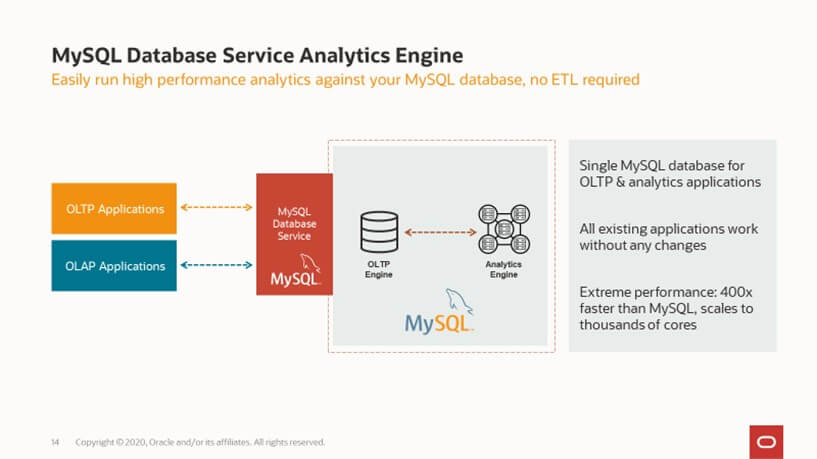
Specifically, Oracle’s MySQL HeatWave offering is an in-memory query accelerator for MySQL Database Service that enables customers to use a single, high-performance MySQL database for both transactional and analytical workloads. The new MySQL HeatWave offering ushers in a distinguished array of innovations that raise the competitive stakes across the entire MySQL market landscape. These innovations, exclusively available on OCI, include:
- Machine learning (ML)-driven automation and system intelligence. Oracle ML models enable MySQL HeatWave to make predictions which are data and query driven and adapt to changing workloads without the need to reprogram the rules. In addition to making a prediction, the system can quantify the benefit of the recommended change as well as exercise the ability to provide an explanation for the recommended change.
- MySQL Autopilot Architecture. The MySQL Autopilot architecture, available exclusively on OCI, introduced innovations that collect new kinds of statistics about data and queries and nove machine learning models to ensure MySQL HeatWave performance breakthroughs.
- Scale out Data Management. MySQL HeatWave’s Scale-Out Data Management supports the reloading of any amount of data in constant time at network bandwidth speed from OCI’s object store.
- Cloud-first design. The MySQL HeatWave solution is based on a cloud-first design that assures cloud-specific capabilities, such as scale-out processing and OCI optimization, are built-in from inception. Now customers can take advantage cloud commodity pricing in areas like storage, virtual machines (VMs), and networking/switching to economically meet their high-performance, scaling, automation, and cost management objectives.
Taken together, the innovations integral to MySQL HeatWave enables Oracle to demonstrate the most compelling price/performance advantages against its main MySQL rival Snowflake. Through a cloud-first development strategy, I believe the MySQL Heatwave solution delivers the extensive automation, unparalleled performance, impressive scalability, lower costs, extensive automation, blended workloads, and security that MySQL customers are prioritizing.
What About Snowflake? Here’s Why Oracle MySQL HeatWave Delivers Unparalleled Price and Performance Advantages over Snowflake
So what about Snowflake? Great question. I believe that MySQL HeatWave stack ups most favorably against Snowflake (based on the 10TB TPC-H third party independent benchmark using 25 nodes of HeatWave, X-Large Cluster for Snowflake). I observe that the price/performance gap increases significantly to an overall 35x differential. This includes HeatWave’s 6.8x faster performance edge, requiring only 346 seconds in relation to Snowflake’s 2350 seconds, and a 5.2x cost edge shown by HeatWave’s $80,536 annual cost compared to Snowflake’s $420,480 annual cost.
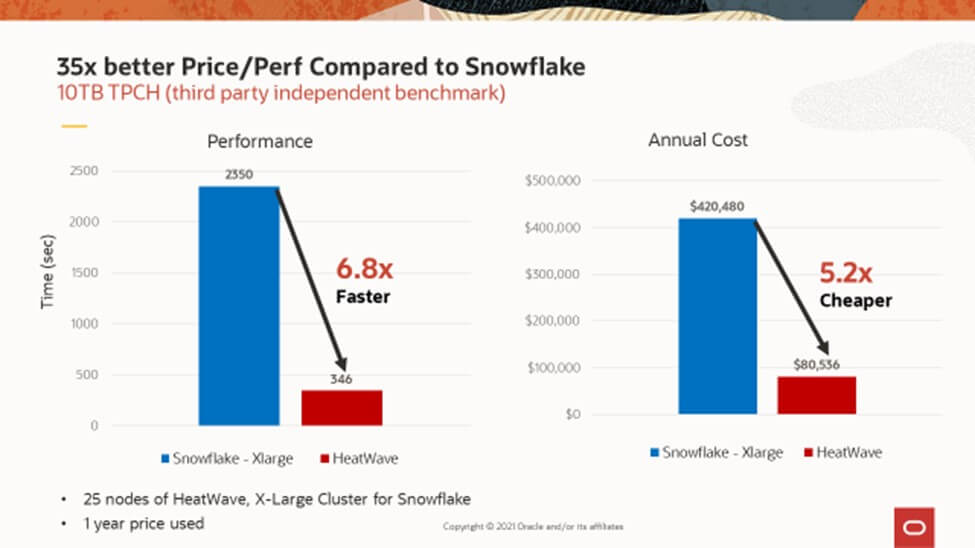
I view Snowflake costs as extremely high as the company forces users to select “T-shirt/shoe sizes,” in increments of 16, 32, or 128 nodes. So, for example, if a customer needs 18 nodes, they are forced to buy 32 nodes. This notable lack of granularity makes as much sense as going into Foot Locker and having to walk out with a size 22 shoe when you have size 10 feet because that’s the next size available.

Moreover, the core capabilities of MySQL HeatWave on OCI allow Oracle to demonstrate the most compelling price and performance advantages against Snowflake on AWS. For example, against Snowflake on AWS — based on benchmark queries that are derived from the industry standard TPCH benchmark — the MySQL Heatwave offering, based on 30TB TPCH, delivers a 11.4 second GeoMean of query time in comparison to Snowflake’s 78.17 seconds.
In addition, HeatWave’s annual costs are $251,073, which is dramatically less than Snowflake’s calculated pay-as-you-go $1,681,920 annual cost (these Snowflake numbers are derived from a GigaOm October 2020 report, the prior numbers are from an independent benchmarking test). These numbers result in MySQL HeatWave delivering a cost per query of only 9.3 cents ($0.093) in comparison to Snowflake’s staggering $4.169 per query — a 44x price and performance advantage over Snowflake.
MySQL Database Service with HeatWave: Definitive OLTP and OLAP Workloads Edge
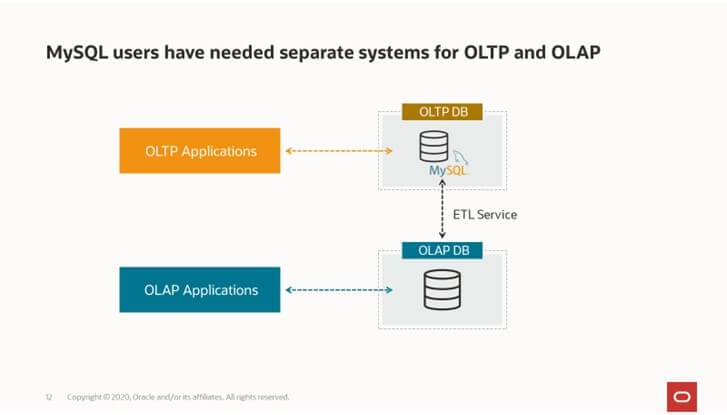
Through cloud-first auto scheduling innovation, MySQL HeatWave offers the topmost performance in the MySQL segment, including in comparison to Snowflake for both OLTP and OLAP. In addition, Snowflake doesn’t support OLT, further crystallizing the advantages of the MySQL HeatWave proposition. Data needs to be imported from OLTP databases into Snowflake, so analytics is not on real-time data — it’s on stale data by the time you get it there. IT must support Snowflake as an additional OLAP database on top of the OLTP database, increasing costs, security procedures, risks and more.
In contrast, MySQL HeatWave supports both OLTP and OLAP natively, and any changes made to the MySQL database are propagated to HeatWave memory and scale-out storage functions, enabling complete transparency without any need for human intervention. This means that queries are always conducted across the latest data.
Moreover, I believe using the CH-benCHmark framework as providing the benchmark readings needed to fully understand mixed OLTP/OLAP workload outcomes. This mixed workload benchmark blends industry standard Transaction Processing Performance Council (TPCC) and Transaction Process Council Ad-hoc/decision support (TPCH) benchmarks, which are essential to simulating real-world applications which have a mix of both OLTP transactions and OLAP queries. Through the benchmark process, the TPC-C schema and statements are kept as is, while TPCH queries and schema are modified. In conducting the benchmark, the net workload consists of the 5 TPCC transactions and 22 queries adapted from TPCH, allowing the benchmark to measure throughput and latency for OLTP and OLAP.
As such, I believe it is important to note that for mixed workloads, MySQL Heatwave registers substantially faster than Amazon Aurora OLAP across four concurrent OLAP sessions (CH-benCHmark, 100G), consisting of 18x lower latency with Heatwave only taking 35 seconds while Aurora (db.r5.8xlarge) takes all the way up to 632 seconds; 110x higher throughput for HeatWave delivering .06 Trnx/minute but Aurora taking 6.6 Trnx/minute; and 2.4x cheaper as HeatWave’s calculated annual costs are only $9,292 while Aurora is an expensive $22,162.
For OLTP only workloads, MySQL HeatWave delivers the same performance as Aurora for OLTP at half the cost (based on the CH-benCHmark, 100G, TPCC, 128 concurrent sessions, 30K OLTP transactions/min). With both HeatWave and Aurora running at the same latency of .02 seconds and throughput (Trnx/minute) of 30K. HeatWave’s annual costs are only $9,292 while Aurora is more than double the cost at $22,162.
Upon combining the OLTP and OLAP differentials, MySQL HeatWave comes in at an astonishing 20x-500x faster and 50x-1200x better price/performance ratio than Aurora. With such astonishing advantages in HeatWave’s favor, I see AWS’ ability to close the gap in a meaningful way as an exceedingly difficult task in the foreseeable future.
Key Takeaways on MySQL HeatWave Prices and Performance Advantages Over Snowflake
I believe TPCH, TPCDS, and the new fully transparent CH-benCHmark benchmarks demonstrate HeatWave’s performance, price, and scale advantages over Snowflake. They are clear, repeatable tests that provide the definitive technical facts which support Oracle’s claims. Of topmost consideration, MySQL HeatWave is faster than Snowflake for blended OLTP and OLAP workloads, delivering an innovation breakthrough that liberates customers from traditional OLTP/OLAP workload limitations and trade-offs.
From my perspective, this is a remarkable repeat performance that follows on the Oracle Autonomous Data Warehouse (ADW) attaining clear differentiation and advantage in the five key areas that organizations assign top priority – cost governance, real-time DW workloads, data integrity, ML integration, and deployment flexibility – in comparison to the Snowflake Cloud Data Platform.
Overall, the MySQL HeatWave solution delivers the unparalleled performance, scalability, lower costs, and blended OLTP/OLAP workload optimization that Snowflake is unable to match. As a result, I see Oracle securing an immediate and enduring competitive advantage over Snowflake across the MySQL market segment, and one that can motivate customers and prospects to avoid a snow job in selecting their cloud database service.
Disclosure: Futurum Research is a research and advisory firm that engages or has engaged in research, analysis, and advisory services with many technology companies, including those mentioned in this article. The author does not hold any equity positions with any company mentioned in this article.
Other insights from Futurum Research:
Oracle Autonomous Data Warehouse Rains on Snowflake’s Cloud Data Platform Parade
Oracle Cloud Infrastructure Exercises the Right to Bear Arm
Oracle Support Rewards Entices Customer Acceleration of Cloud Journey
Image Credit: VentureBeat
Author Information

Ron is an experienced, customer-focused research expert and analyst, with over 20 years of experience in the digital and IT transformation markets, working with businesses to drive consistent revenue and sales growth.
Ron holds a Master of Arts in Public Policy from University of Nevada — Las Vegas and a Bachelor of Arts in political science/government from William and Mary.