Analyst(s): Mitch Ashley
Publication Date: May 13, 2026
MuleSoft’s Omni Gateway extends API governance across LLMs, MCP tools, and autonomous agents from a single control plane. Futurum analyzes what this means for the agent control plane competition and where the release’s boundaries still lie.
What is Covered in This Article:
- MuleSoft, a Salesforce company, has introduced Omni Gateway (formerly Flex Gateway) as a unified governance layer for APIs, MCP tools, LLM calls, and agent traffic across MuleSoft, Kong, Apigee, AWS, and Azure gateway estates.
- Capabilities include federated policy enforcement, OpenAPI-to-MCP conversion, centralized token management with LLM routing, correlation-ID traceability, and identity propagation across agent-to-agent and agent-to-application interactions.
- Federation is the strategically decisive capability. Enterprises do not migrate gateway portfolios, and consistent policy across multi-vendor gateways is what platform teams need.
- Omni Gateway governs the Constraints and Outcomes layers of the agent control plane. Intent and Reasoning layer governance remains the open competitive front.
- The competitive calculus tilts across three vendor categories. Standalone AI gateways, incumbent API platforms, and hyperscaler agent control planes each face different pressures from a federated gateway shipped with the installed API platform.
The News: MuleSoft, a Salesforce company, has introduced Omni Gateway (formerly Flex Gateway), positioned as a solution for the agent control plane that provides unified governance across API, MCP, LLM, and agent traffic. The announcement targets the governance gaps that surface as autonomous agents move from pilot into production on infrastructure originally built for application consumers.
Capabilities include federated policy enforcement across MuleSoft, Kong, Apigee, AWS, and Azure gateways from a single managed catalog; conversion of OpenAPI endpoints into MCP-compliant tools with authentication inherited from the source API; centralized token management with real-time consumption tracking, rate limits, and safety guardrails; end-to-end traceability through correlation IDs across API calls, tool invocations, and agent delegations; and identity propagation across agent-to-agent and agent-to-application interactions. MuleSoft also signaled forthcoming headless management of Omni Gateway through Claude, Slack, and Microsoft Teams.
MuleSoft Omni Gateway: As Close to an Agent Control Plane as It Gets
Analyst Take — Governance Catches Up to the Pace of Agent Deployment: Agent deployment has outpaced the controls enterprises have to govern it. Omni Gateway is MuleSoft’s bet that the API governance discipline already deployed across the Global 2000 is the right substrate, and that bet is defensible. Token sprawl, identity drift, untracked tool invocations, and inconsistent policy enforcement are recognizable variants of the API governance problems enterprise platform teams have spent a decade solving. Gateway vendors have stopped competing on protocol coverage. They are competing on what governance looks like when agents are first-class consumers.
Federation Is the Strategically Decisive Move
Federation is the most consequential element of this release. Enterprises run multiple gateways, and migration to a single vendor for governance is unrealistic. Consistent policy across MuleSoft, Kong, Apigee, AWS, and Azure gateways through a federated catalog is what platform engineering teams actually need. The execution risk is whether MuleSoft can deliver policy semantics that translate cleanly across gateways with different runtime models, identity systems, and policy primitives. If that holds at enterprise scale, gateway diversity stops being a defensive moat for competitors.
MCP Conversion Removes the Largest Operational Bottleneck
OpenAPI-to-MCP conversion is operationally the most valuable capability. Hand-built MCP servers per API have been the largest barrier to making enterprise systems agent-usable. Omni Gateway converts existing REST APIs into governed MCP tools, inheriting authentication policies from the source, collapsing weeks of integration into minutes, and applying governance from the moment the tool is exposed to an agent or registry. For platform teams with mature API portfolios, prior investment becomes agentic readiness without a parallel build effort.
Mapping Omni Gateway to the Agent Control Plane
The Agent Control Plane Framework organizes agentic governance across four layers: Intent, what an agent is authorized to do; Reasoning, how it decides; Constraints, the rules enforced at runtime; and Outcomes, the evidence of what happened. Omni Gateway decisively covers the lower two layers. Token limits, identity propagation, prompt guardrails, PII detection, schema validation, and rate limiting enforce Constraints at the moment an agent acts. Correlation IDs, audit trails, and consumption telemetry produce the Outcomes layer operations and FinOps teams need.
Figure 1: Agent Control Plane Framework
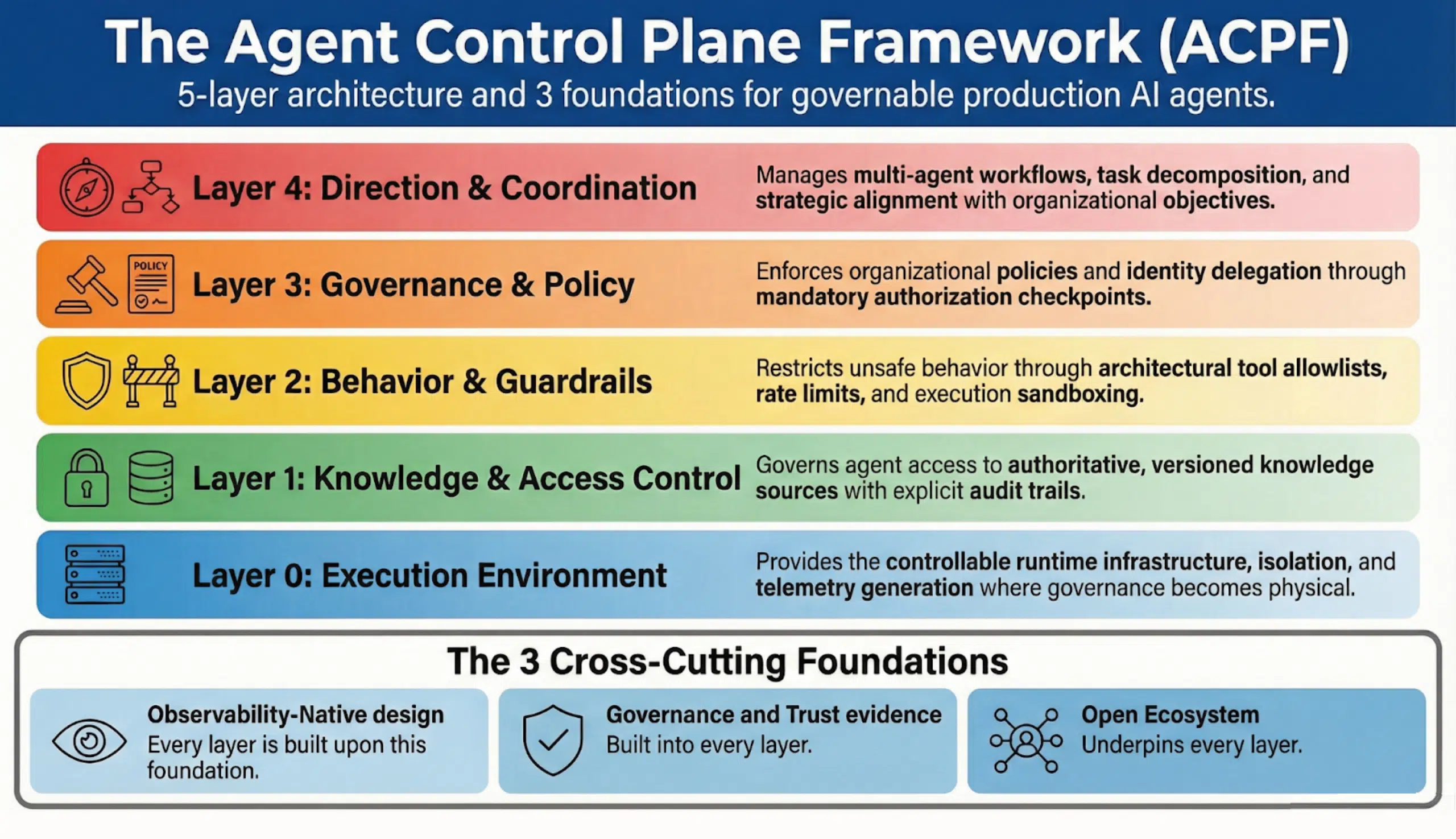
The Intent and Reasoning layers sit upstream of the gateway, in agent definitions, identity systems, and orchestration platforms. MuleSoft addresses part of this surface through Agent Fabric, but who decides what an agent is permitted to attempt, and how it reasons toward action, remains the open competitive front across the industry. Gateways are necessary infrastructure for the agent control plane, not sufficient. Omni Gateway should be evaluated for the layers it actually governs.
Competitive Positioning
Omni Gateway changes the competitive calculus in three directions at once. Against standalone AI gateways, including Kong AI Gateway and Cloudflare AI Gateway, MuleSoft’s installed base advantage is decisive. Existing customers on Platinum, Titanium, Unlimited, or Integration Advanced tiers receive AI Gateway capabilities at no additional cost. Standalone vendors must justify a parallel governance stack in the face of the consolidation path. Kong is the most pointed counter-positioning: its April 14 Agent Gateway release claims to be the only gateway supporting advanced LLM, MCP, and A2A use cases, a claim that predates the MuleSoft announcement by nearly a month and complicates any first-mover framing. Against incumbent API gateway competitors, including Apigee, AWS API Gateway, and Azure API Management, MuleSoft is not asking buyers to migrate. The federated catalog treats those gateways as managed assets under a single policy layer, neutralizing the gateway diversity that previously protected incumbents.
Security-focused vendors, including Cequence and Salt Security, occupy adjacent rather than competitive territory, and Palo Alto Networks joined the category on April 30 through its intent to acquire Portkey, which will become the AI Gateway for Prisma AIRS. That deal moves Portkey out of the standalone segment and into security-led territory, where MuleSoft and security specialists coexist in multi-vendor purchasing rather than collide. The harder front is hyperscaler agent control planes, including AWS Bedrock AgentCore, Google Vertex AI Agent Builder, and Azure AI Foundry. Buyers face the cloud-neutrality-versus-cloud-native trade-off directly, and MuleSoft’s federation across AWS and Azure gateways is the differentiating bet. Enterprises consolidating around fewer control plane vendors weigh integration depth against cloud-platform lock-in.
What to Watch:
- How Kong, Apigee, Azure API Management, and AWS gateway teams respond to the federation play. Cross-vendor policy consistency at scale will require either cooperation or compatibility workarounds, neither of which either side has yet publicly committed to. Watch for counter-positioning that frames federated governance as proprietary lock-in by another name.
- Whether MuleSoft extends governance into the Intent and Reasoning layers, where current capabilities stop. Agent authority modeling, scope-of-action constraints, and decision provenance are the next expansion vector.
- The conversion rate of existing OpenAPI inventories into MCP tools among MuleSoft Platinum-tier customers. If conversion accelerates over the next two quarters, the enterprise MCP supply problem will be solved without a separate build cycle, and Omni Gateway’s strategic position will strengthen substantially.
- Continued consolidation of standalone AI gateways following Palo Alto Networks’ April 30 intent to acquire Portkey. With the standalone segment now compressing, watch Kong AI Gateway and Cloudflare AI Gateway for similar M&A activity, deeper specialization, or alignment with hyperscaler or security ecosystems.
Read the full MuleSoft Omni Gateway announcement on the Salesforce MuleSoft website.
Disclosure: Futurum is a research and advisory firm that engages or has engaged in research, analysis, and advisory services with many technology companies, including those mentioned in this article. The author does not hold any equity positions with any company mentioned in this article.
Analysis and opinions expressed herein are specific to the analyst individually and data and other information that might have been provided for validation, not those of Futurum as a whole.
Other Insights From Futurum:
Atlassian Teamwork Graph: The Secret Weapon That’s No Longer a Secret
Can IREN Build a Full-Stack AI Cloud? The Mirantis Acquisition Makes the Case
AWS Pushes the Agent Stack: Quick, Connect Verticals, OpenAI on Amazon Bedrock
Salesforce Agent API Signals the Next Control Plane Battleground for AI Agents
Author Information

Mitch Ashley is VP and Practice Lead of Software Lifecycle Engineering for The Futurum Group. Mitch has over 30+ years of experience as an entrepreneur, industry analyst, product development, and IT leader, with expertise in software engineering, cybersecurity, DevOps, DevSecOps, cloud, and AI. As an entrepreneur, CTO, CIO, and head of engineering, Mitch led the creation of award-winning cybersecurity products utilized in the private and public sectors, including the U.S. Department of Defense and all military branches. Mitch also led managed PKI services for broadband, Wi-Fi, IoT, energy management and 5G industries, product certification test labs, an online SaaS (93m transactions annually), and the development of video-on-demand and Internet cable services, and a national broadband network.
Mitch shares his experiences as an analyst, keynote and conference speaker, panelist, host, moderator, and expert interviewer discussing CIO/CTO leadership, product and software development, DevOps, DevSecOps, containerization, container orchestration, AI/ML/GenAI, platform engineering, SRE, and cybersecurity. He publishes his research on futurumgroup.com and TechstrongResearch.com/resources. He hosts multiple award-winning video and podcast series, including DevOps Unbound, CISO Talk, and Techstrong Gang.