Analyst(s): Mitch Ashley
Publication Date: May 8, 2026
Atlassian opens Teamwork Graph through a new CLI and Rovo MCP Server tools, turning 20 years of work context into a layer any AI agent can call. Futurum analyzes what changes are in store for governance, competition, and developer practices.
What Is Covered in This Article:
- Atlassian announced general availability of Teamwork Graph Connectors via Forge, an open beta of the Teamwork Graph CLI with 300+ commands, two new Rovo MCP Server tools, and a TeamworkGraph.com site, all introduced at Team ’26.
- The CLI and MCP tools support read and write operations across Atlassian apps and 75+ third-party integrations with a single authentication, and provide a standardized response envelope for agentic clients.
- Atlassian stakes its AI position on context as the durable asset, betting 20 years of accumulated work relationships outweigh any model-layer differentiation.
- Enterprise context becomes a programmable layer that any agent client can call, which converts agent selection from a lock-in decision to a fit-for-purpose one.
- The graph inherits Atlassian’s existing identity, access, and audit boundaries, reducing the procurement and security costs for every new agent that connects.
The News: At its Team ’26 event, Atlassian announced the expansion of Teamwork Graph from an internal product feature to a programmable developer platform. The release includes general availability of Teamwork Graph Connectors via Forge, open beta of the Teamwork Graph CLI with more than 300 commands, two new Rovo MCP Server tools that expose graph context to external AI agents, and a TeamworkGraph.com destination site for visualizing and managing graph data.
The Teamwork Graph CLI is optimized for agentic use across AI clients, including Claude Code, Cursor, Codex, and Cowork. It supports read and write operations, uses a standardized machine-readable response envelope, and offers single authentication across Atlassian apps and connected third-party tools, including GitHub, Google Docs, and Figma. Two new MCP tools, getTeamworkGraphContext and getTeamworkGraphObject, work as a discover-then-fetch pair and operate with any MCP-compatible AI client.
Atlassian states the Teamwork Graph contains more than 150 billion objects and relationships across Jira, Confluence, Bitbucket, Loom, JSM, and 75-plus third-party tools. The company reports that grounding agent responses in Teamwork Graph data delivered 44% more accurate results while using 48% fewer tokens in its internal benchmarks, and that more than 90% of its enterprise cloud customers are using Rovo, with 14 million Rovo-assisted actions in the past month. Mercedes-Benz reports a 10x increase in software delivery speed, 90% improvement in defect intake quality, and 85% faster duplicate detection after building custom Forge connectors against the graph. Both the CLI and MCP Server tools are free today, with future pricing tied to Rovo credits and 90 days’ advance notice before billing starts.
Atlassian Teamwork Graph: The Secret Weapon That’s No Longer a Secret
Analyst Take — Context as a Programmable Surface for AI Agents: Vendors have kept the work context embedded within their own AI products, building the graphs and exposing the results only through their agents. Atlassian is doing the opposite. The Teamwork Graph CLI and Rovo MCP Server tools open that context layer to Claude Code, Cursor, Codex, Cowork, and any other MCP-compatible client. Context stops being an internal feature of someone else’s product and becomes addressable infrastructure.
For developers, the build-against target shifts. Custom agents stop traversing APIs to reassemble work relationships and instead query a graph that already encodes them. The integration tax, which has historically eaten up weeks of agent project time, is paid once by Atlassian on behalf of every client.
For end users, agent choice becomes consequential. The same Teamwork Graph context flows into Claude, Cursor, Codex, ChatGPT, or whatever client emerges next quarter. Agent selection becomes a fit-for-purpose decision; switching clients no longer means re-platforming the context.
For enterprises, every agent the organization deploys is grounded in the same authoritative source. A marketer asking Rovo, a developer asking Claude Code, and a Jira incident agent examining the codebase all read from one graph. Answers remain consistent across teams and tools, and the audit trail collapses into a single boundary.
Teamwork Graph as the Defensible Layer
Atlassian stakes its AI position on the durability of context. As foundation models commoditize, the structured data that connects work, decisions, code, and customers becomes the layer that vendors compete to own. The CLI and MCP Server tools move that thesis from positioning to product, exposing 20 years of accumulated work relationships to any agent that calls them. The strategic intent is clear: Atlassian wants to sit at the layer enterprises consult before any agent acts.
Competing for the Context Layer
Atlassian’s leadership has declined the control tower framing that ServiceNow and others embrace, positioning Teamwork Graph instead as a critical node in a multi-graph enterprise. The premise is that customers will run three to five context sources, and the graph closest to where workflows already live stays the most current. The competitive question is whether Atlassian can convert that incumbency into a developer ecosystem before hyperscalers and workflow vendors close the structural gap.
The structural advantage runs deeper than product surface area. The graph codifies work on enterprise identity, access control, compliance, and security that customers have spent years operationalizing. A document retrieved through Teamwork Graph retains the same permissions, audit boundary, and policy enforcement as when a human opens it. Agents inherit governance rather than routing around it.
That inheritance changes the procurement math. A context source that triggers a fresh security review every time a new agent connects scales poorly. A context source pre-wired to the enterprise identity and access infrastructure starts every conversation with the hardest problem already solved. Hyperscalers and workflow vendors building competing graphs face the same gravity, and they start later.
The Agent Control Plane Lens
Mapped against Futurum’s Agent Control Plane Framework, the announcement strengthens governance and evidence generation. Admin controls over agent creation, tool access, and graph permissions add structure to what agents are permitted to do. Audit logs that record agent actions, tool calls, and traversed connections feed into a tamper-resistant trail that makes decisions defensible under audit.
Mapped to Futurum’s Observability-Native Cycle (Figure 1), the announcement provides organizations with greater visibility into the Constraints and Outcomes phases. Admin controls bound what agents may do; audit logs record what they have done. Visibility into the Intent and Reasoning phases, where agents form goals and select actions, remains the next major observability challenge.
Figure 1 – The Observability-Native Cycle
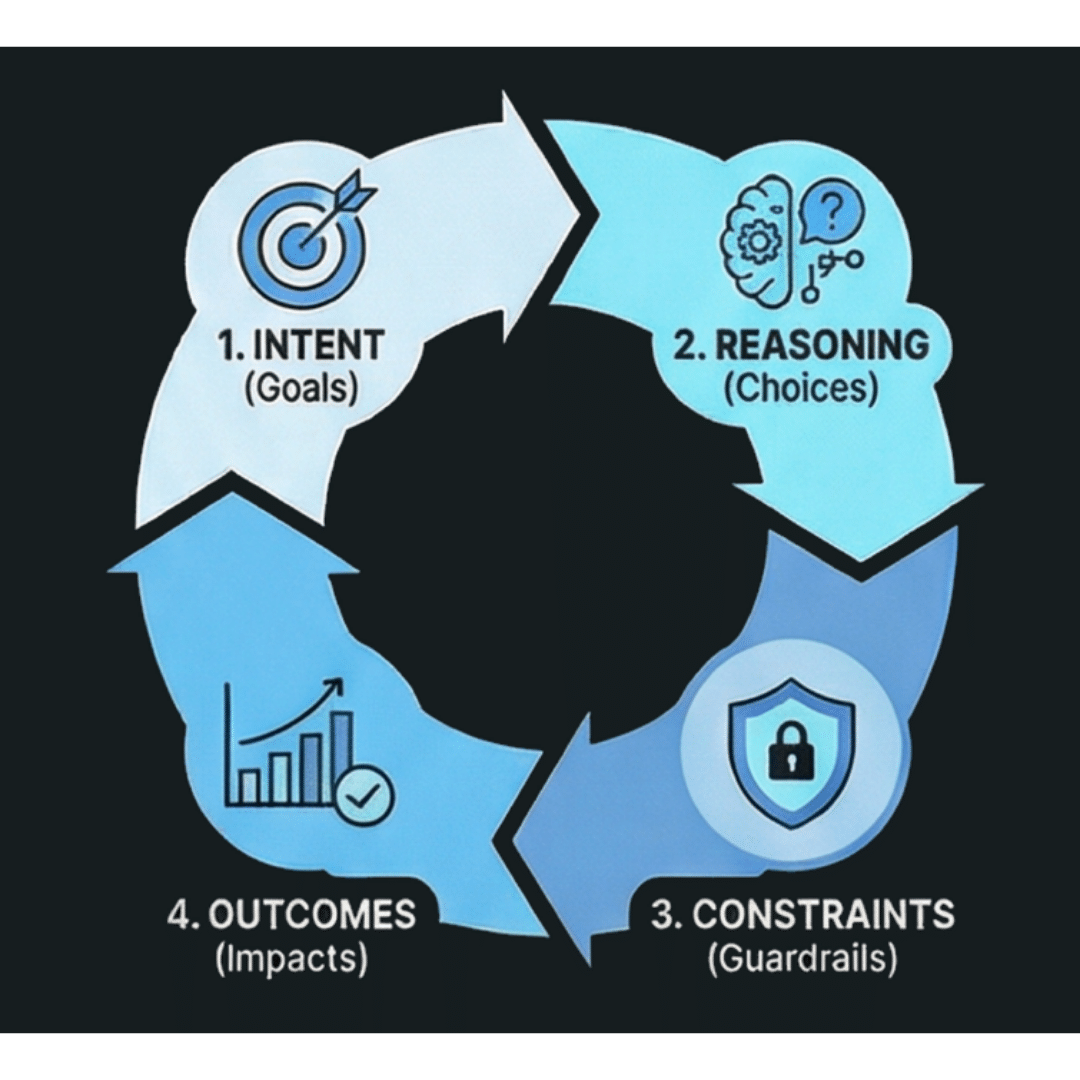
Direction stays with the calling client; the agent forms goals and chooses actions inside Claude Code, Cursor, or whichever client the user picks. Enforcement stays within Atlassian’s existing permission model, which gates write operations at the same boundary it has always used. The next round of competitive pressure will land where governance authorization and execution enforcement need to operate inside a single observable loop rather than across two boundaries.
What to Watch:
- Developer adoption velocity inside the IDE. The CLI and MCP tools land where developers already work. Pull-through to Cursor, Claude Code, Codex, and Cowork projects within 60-90 days will indicate whether the integration friction is as low as Atlassian claims.
- Counter-positioning from Microsoft, Google, ServiceNow, and Salesforce. Each operates an adjacent or competing context layer for AI agents. Expect responses on governance depth, write-back guardrails, and ecosystem reach as Atlassian forces the comparison.
- Governance enforcement inside the agent execution loop. Admin controls and audit logs are evidence-generation surfaces. Authorization that gates what agents are permitted to write at machine speed is the next obligation, and the vendor that ships it first sets the bar.
- Pricing signal when Rovo credits start metering CLI and MCP usage. Both are free today. The 90-day notice before billing begins will tell how Atlassian values context-as-a-service relative to its core seat license.
- Customer evidence beyond Mercedes-Benz. A single 10x reference is positioning, not validation. Three to five named enterprise outcomes across regulated sectors will tell whether the graph holds up where governance bites hardest.
For full announcement details, see Atlassian’s Team ’26 announcement about the Teamwork Graph platform on the company website.
Disclosure: Futurum is a research and advisory firm that engages or has engaged in research, analysis, and advisory services with many technology companies, including those mentioned in this article. The author does not hold any equity positions with any company mentioned in this article.
Analysis and opinions expressed herein are specific to the analyst individually and data and other information that might have been provided for validation, not those of Futurum as a whole.
Other Insights From Futurum:
Atlassian and Google Cloud Expand Agentic AI Partnership
AWS Pushes the Agent Stack: Quick, Connect Verticals, OpenAI on Amazon Bedrock
Futurum Agent Control Plane Framework: A Reference Model for Production AI Agents
The Seven Principles of Observability-Native
Author Information

Mitch Ashley is VP and Practice Lead for the CIO & Technology Buyers and Software Lifecycle Engineering practices at The Futurum Group. A multi-time CIO and CTO with 30+ years leading technical organizations, Mitch built and operated production systems spanning cybersecurity for the U.S. Department of Defense, PKI services for the broadband and 5G industries, SaaS platforms, large-scale telecom and banking systems, and a national broadband network. His work with AI began early, developing expert systems that diagnosed and repaired complex mainframe environments. That operator foundation grounds his analysis in operational consequence, covering the technology buyer's world of software engineering, cybersecurity, DevOps, cloud, and AI.