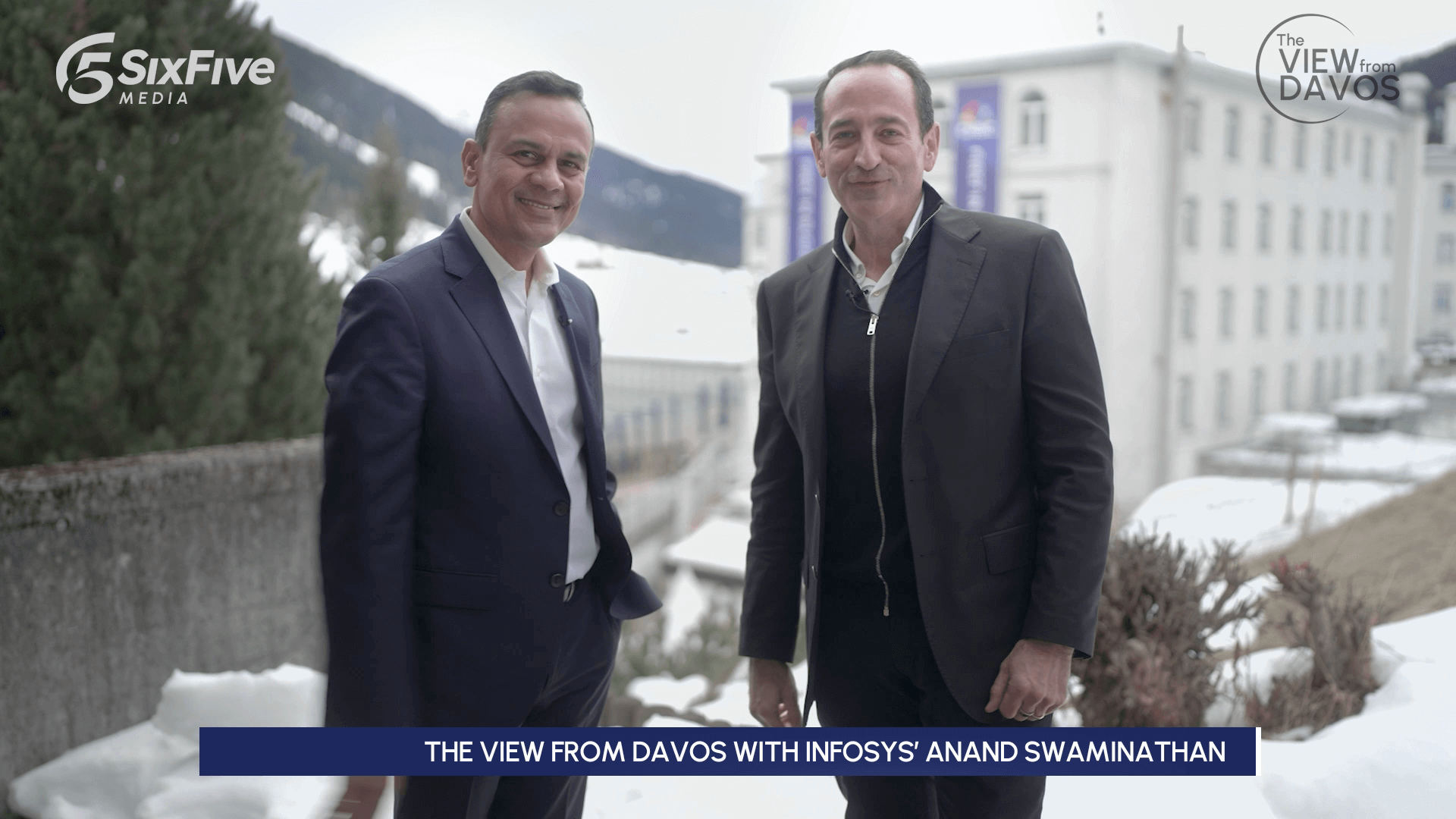
2024 was a great year for AI awareness building. Infosys EVP Anand Swaminathan, Infosys EVP, believes 2025 will be a pivotal year for organizations to unlock the true potential of AI to drive meaningful impact. Host Patrick Moorhead gets his thoughts on this and more on The View From Davos. Tune in as they discuss ⤵️
- AI driving product reimagination and process simplification across industries
- Infosys’s approach to innovation and how it’s shaping the future of business
- Small Language Models (SLMs) are gaining traction for business-specific purposes
- Creating a culture of innovation and embracing AI within large organizations
- Utilizing AI to drive tangible revenue growth
Learn more at Infosys.
Watch the video below, and be sure to subscribe to our YouTube channel, so you never miss an episode.
Or listen to the audio here:





Disclaimer: The View From Davos is for information and entertainment purposes only. Over the course of this webcast, we may talk about companies that are publicly traded and we may even reference that fact and their equity share price, but please do not take anything that we say as a recommendation about what you should do with your investment dollars. We are not investment advisors, and we ask that you do not treat us as such.
Transcript:
Patrick Moorhead: The Six Five is On the Road with a View from Davos. Been having some incredible conversations here. At WEF, it’s really a unique combination of finance, government, technology, everything wrapped into one, and I like to say the density of meeting with senior executives and government officials is truly amazing. A lot of the conversations about AI and how governments and enterprises need help to get ROI from their investments, and I can’t imagine a better person to have a discussion with about that than Anand with Infosys. Welcome to the show.
Anand Swaminathan: Thank you, Pat. Thanks for having me. Appreciate it.
Patrick Moorhead: Absolutely, super… Maybe a great place to start now. This is my first time here. Shockingly, it seems like all I do is attend events, but I’m curious, you’ve been coming here for a few years now. Why do you come here? And we’re halfway into the event, what are you hearing out there?
Anand Swaminathan: First, this is my 8th year, and I’m happy to meet you for the first time here in World Economic Forum, and thanks for having me on the show. For me, first is its efficiency. Most of my clients are here, partners are here. So within two or three days, you’re able to connect with most of these people together in one place. The second is it creates a level of energy when you have so many people across the world coming together to discuss both business as well as the social impact items. So, that gives me a certain sense of direction as we go into the next year.
Patrick Moorhead: It’s incredible. And this concentration part has, I think every CEO, senior executive I’ve talked to, they’ve said the same thing. So I don’t know why it took me this long to get here, but I’m here and I’m happy to be here. Usually, I ask a guest what they do first, but I wanted to get that first part out of the way. You have a very extensive practice at Infosys, technology, telecom, and media. Can you tell me what you do for clients?
Anand Swaminathan: So, I have three roles at Infosys. So I run the telecom, media and the technology business. I also manage all of our alliances and partnerships, which is a big part of our growth and a channel into the market. The third thing is I also oversee all strategic large deals, which is deals $50 million and above across the company. I am responsible for putting in place the right support systems and the right partnerships and pricing mechanisms to go after these large transactions. Now, as far as my telecom media and the tech responsibility, in the tech space, it’s basically all the hyperscalers, the semiconductor companies, contract manufacturing, tech distribution, as well as the OEMs and cyber security and other software companies. In the telecom space, it’s pretty much every telecom and media is media as generally the world defines it.
Patrick Moorhead: You’re a busy guy. That sounds like a lot. I think I interact with a lot of the same people you do. Really interesting thematic themes coming out of the show. Are you getting a sense at this year’s World Economic Forum, a sense of optimism, dread? I mean, with optimism sometimes, like AI for instance, it offers an incredible opportunity economically and societal, but there’s also the, “Oh my gosh, this is spooky and there are things…” But what’s the general sense that you’re getting from the show?
Anand Swaminathan: So, I think in relation to last year when AI or GenAI was just making its inroads into the boards and the C-suite conversations, it was more awareness building at that point in time. But I think in the last 12 months, a lot has been tried, particularly in the enterprise space, applying GenAI and now agentic AI in terms of how we could crack more complex, sophisticated problems. I think it’s ready to take off on the enterprise scale. Enough proof of concepts exist out there, and a few clients have actually also embarked on it. So, the conversations now is how do I apply AI into the core of my business, enhance my products, improve customer experience, bring cost efficiency, and it’s happening at a much more core level. So, that’s one big change.
Second is the general sense of optimism this year seems much higher. For a variety of reasons, people feel that the business climate is going to be much better than what it was last year, to what degree we have to wait and see in what sectors is something to be wait and watched. So, those are two very palpable things. The third one I would say is the continuous uplifting discussions we have had on the social agenda. I think clearly that’s always been on the rise and today and this year it’s gone to another level in terms of how companies that exist for profits should also have a societal thinking towards the impact we make. So, all three are the broad observations I see right now.
Patrick Moorhead: It feels like 2025 is going to be better than 2024, and maybe we always say that, I don’t know, but I think we really mean it this time. Let’s talk a little bit about AI. I think you expressed a really good status of where governments and enterprises are. They did their experiments, they’ve done POCs, and at least our research suggests that 2025, the expectation is they’re going to see some real ROI. I’m curious, what are types of the services that you can bring to the table to help enterprises and governments increase the ROI on AI?
Anand Swaminathan: So, I think the first is clearly unlocking value. So if you, for instance, look at the number of M&A happening in the world, clearly there is an opportunity to deploy AI at scale, to drive synergies much sooner to unlock the value and drive efficiency of the payouts that companies are expecting, and massive scale AI really offers that. Then there are specific areas in which we are driving far more advanced discussions. As a company, our strength is our industry understanding and our vertical understanding. So we are also focused in creating small language models for healthcare, for manufacturing, for telecom, and within those verticals specific processes. So we tie in nicely to the large language models, big platforms, but we also are fine-tuning specific models that are creating much more ROI for our clients. So there is a sense of urgency this year to drive value, and therefore increasing amount of focus in terms of how do we make this mainstream? And I’m excited about that sense of urgency because the moment you agree to a finish line, then the pace and the energy is totally different.
Patrick Moorhead: I’m glad to hear you talk about the investments you’re making as small language models. I know the hype was all around LLM, and we are using that for world types of answers and queries. But when it comes to an ERP or an SCM system or CRM system, HRM, all the Ms, getting value out of those requires a more tailored and less expensive model system to run. One of the things I’m also hearing from… CIOs are executives, CIOs is, “Hey, I’m getting the right output on what I’ve put in place, but I can’t get my people to use it.” Essentially, and we saw this when ERP systems first came out, we saw this when CRM systems first came out, getting people to change the way they work. Any thoughts about this human interaction with AI systems to get companies over the hump and actually people accepting technology that works?
Anand Swaminathan: I think that’s a great question because most of us think when you move towards natural language of interaction with the machines, it must be much easier. But sometimes if you’re conditioned do something in a certain way, it’s really hard to change and think that things could be so easier. So, a lot of investment around training and development and also coaching employees about the sensitivity and the responsibility they have when they use the AI platforms and systems. So, it’s a very holistic thinking about how do we drive context-sensitive skills and education training, and coming from emphasis where we think we are a learning company, we are extending our own learning platform with AI modules tailored to our clients to actually help them on this journey.
Patrick Moorhead: That’s very insightful. There’s also a recognition that maybe we need to do some business process, BPO type stuff to re-architect it. Something that may have taken 20 steps in serial fashion can become two or three, just getting employees up-skilling, re-skilling, to get them to do that. So great conversation so far.
One thing I wanted to ask you though is let’s say next year, Davos 2026, we’re having the same conversation. What is it that you would’ve wanted to achieve in 2025 for you to be satisfied?
Anand Swaminathan: I think I would say the first thing, which will give me gratification, is if we have enabled at least a few of our large enterprise clients to reimagine the products using AI. I think that’s where the value unlock and the revenue optic is clearly possible. So, we are working with many of them today to help them with it. I think we clearly see the possibilities now it’s about execution and getting it done. So, that’s one thing I would love to see. The second is how do we simplify the complex set of tools and processes out there? So we make the enterprise world far more simpler, at least in one or two processes that we have chosen to work with our clients. It could be on the customer support supply chain, it could be on anything, but how distinctly it can be different with AI compared to what it is in the current world.
Patrick Moorhead: Oh, that’s great. Love the insights. It sounds like you’re on a solid track, a lot of work that needs to be done. But listen, you’re in the business of simplification. When your clients don’t want to do it themselves or need help doing it, this is where you come in to play, and every time I think that AI can make things easier, but getting there is a lot of complexity.
Anand Swaminathan: I agree. I agree. Once when things are simplified, it looks magical, that it could be simplified, effort may not be understood. But then I think as you rightly said, to solve the enterprise problem, you have to go through a lot of grind. Whatever is the simplified output can be effective as well.
Patrick Moorhead: That’s great. Hey, thanks for coming on the show.
Anand Swaminathan: No, thank you, Pat. Thanks for having me. Really appreciate it. Thank you.
Patrick Moorhead: Absolutely. So, this is Six Five On the Road with A View from Davos. We are having great conversations about economic opportunity, social issues, regulation, but a lot of talk about AI. Tune into all of the content that we have here in Davos. Thanks again. Hit that subscribe button. Take care.
Author Information

Daniel is the CEO of The Futurum Group. Living his life at the intersection of people and technology, Daniel works with the world’s largest technology brands exploring Digital Transformation and how it is influencing the enterprise.
From the leading edge of AI to global technology policy, Daniel makes the connections between business, people and tech that are required for companies to benefit most from their technology investments. Daniel is a top 5 globally ranked industry analyst and his ideas are regularly cited or shared in television appearances by CNBC, Bloomberg, Wall Street Journal and hundreds of other sites around the world.
A 7x Best-Selling Author including his most recent book “Human/Machine.” Daniel is also a Forbes and MarketWatch (Dow Jones) contributor.
An MBA and Former Graduate Adjunct Faculty, Daniel is an Austin Texas transplant after 40 years in Chicago. His speaking takes him around the world each year as he shares his vision of the role technology will play in our future.