Analyst(s): Mitch Ashley
Publication Date: March 3, 2026
Google announced the expansion of its ADK integrations ecosystem on February 27, 2026, reframing the Agent Development Kit as an agent execution framework rather than a developer toolkit. Direct connections to GitHub, Jira, MongoDB, and five observability platforms, including OpenTelemetry-native telemetry through MLflow signal, that Google is competing for the layer where agent behavior is governed, not just where agents are built.
What is Covered in This Article:
- Google expanded the ADK integrations ecosystem, which connects agents to developer workflows, project management, databases, memory, and observability platforms.
- ADK integrations move Google further toward delivering observability-native capabilities across the agent execution lifecycle.
- Five of the observability integrations launched at release, including MLflow with OpenTelemetry ingestion support, a design decision that signals more than monitoring capability.
- The integration catalog spans GitHub, GitLab, Jira, Confluence, MongoDB, Pinecone, and more. Which toolchains are covered determines ADK’s adoption trajectory.
- DevOps and platform engineering teams face a specific execution obligation before any ADK agent touches production workflows.
The News: Google announced the ADK Tools and Integrations Ecosystem on February 27, 2026, expanding its open-source Agent Development Kit with a curated set of third-party integrations. The announcement connects ADK agents to developer workflows, project management platforms, data and memory systems, and observability infrastructure.
The integration set spans four categories. Code and development tools include Daytona, GitHub, GitLab, Postman, and Restate. Project and work management integrations cover Asana, Atlassian (Jira and Confluence), Linear, and Notion. Data and memory integrations include Chroma, MongoDB, Pinecone, GoodMem, and Qdrant. The observability category, including AgentOps, Arize AX, Freeplay, MLflow, and Monocle platforms, covers session replay, production debugging, prompt management, evaluation, and open-source tracing.
The MLflow integration supports OpenTelemetry ingestion. ADK emits OTel spans for agent runs, tool calls, and model requests, which route to an MLflow Tracking Server for analysis and debugging. MLflow version 3.6.0 or newer is required for OTLP ingestion support.
Google ADK Is Not a Toolkit – It Is an Agent Execution Framework
Analyst Take — ADK Is a Framework, Not a Kit: Google launched ADK as a development kit. The ‘Agent Development Kit’ framing implies tooling for builders, but the integration ecosystem tells a different story. A framework that connects agents to GitHub, Jira, MongoDB, and five of the observability platforms at release is not only about developers assembling agents. It is establishing the architecture layer where agents execute, observe, and govern themselves across engineering workflows. Agents acquire these capabilities natively, during development.
Microsoft’s AutoGen, LangChain, and CrewAI, all widely used agent orchestration frameworks, compete in the agent orchestration space. While frameworks such as AutoGen, LangChain, and CrewAI focus on agent orchestration in application code, platform‑level offerings like Amazon Bedrock AgentCore and GitHub’s Agent HQ provide managed control planes to coordinate multiple agents, enforce governance, and integrate with existing developer workflows.
ADK’s depth of integration with real engineering toolchains, specifically code management, ticketing, vector databases, and observability, distinguishes it from orchestration frameworks that leave integration to the developer.
Net‑net, ADK shifts the question from which framework should I build agents with to which framework owns the execution layer inside my engineering stack and turns agent prototypes into production systems the fastest.
Observability Integrations Signal Structural Durability
Google’s observability depth aligns precisely with where enterprise procurement pressure is building. Futurum Research’s January 2026 Software Lifecycle Engineering Decision-Maker Study found that 37.4% of organizations prioritize AI observability and 30.9% prioritize AI agent observability in platform procurement decisions, ranking ahead of established capabilities, including distributed tracing (23.7%) and AIOps (28.1%).
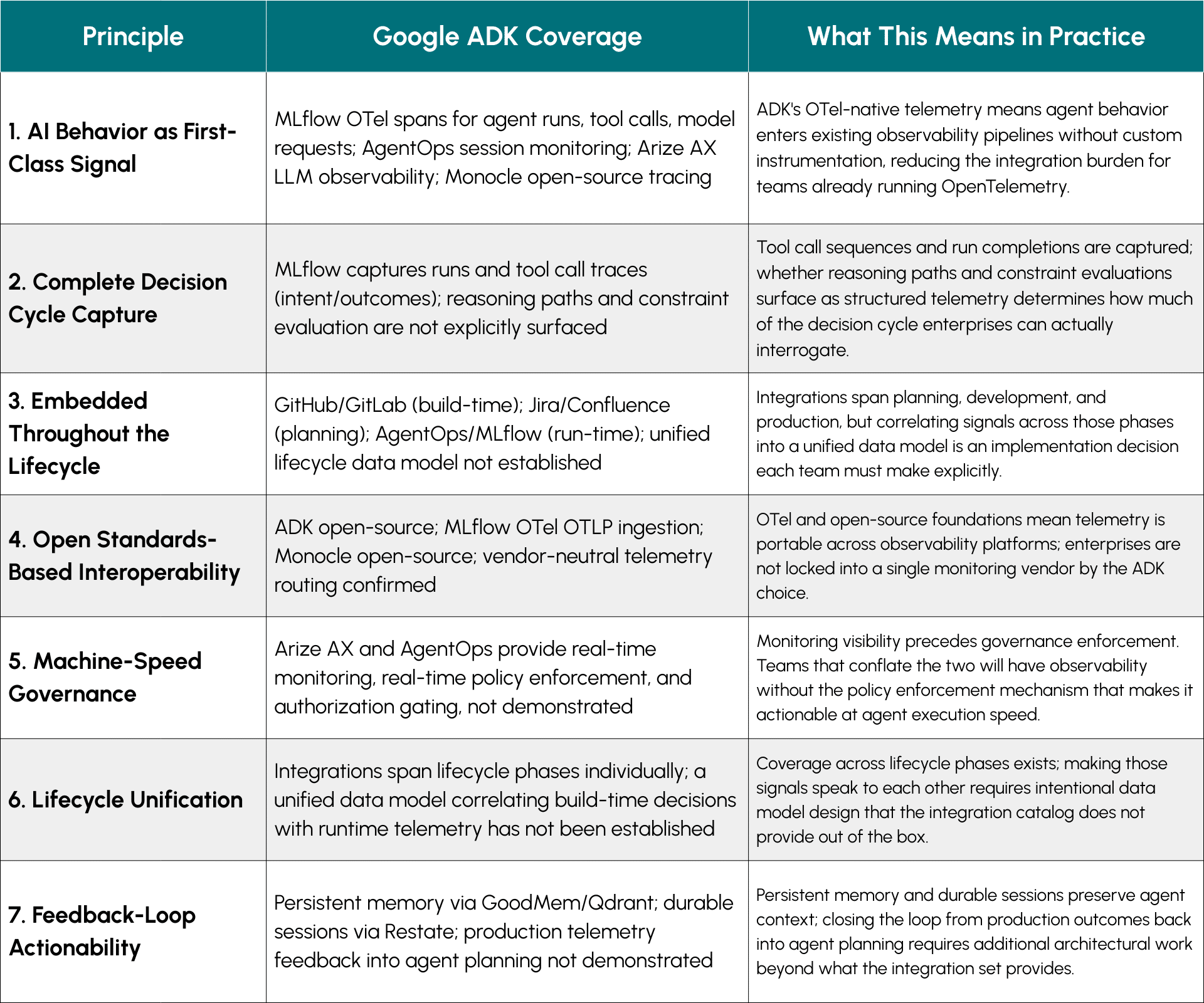
The MLflow and OpenTelemetry connection is the load-bearing decision here. ADK emits OTel spans for agent runs, tool calls, and model requests natively. That is not an integration. That is a design choice. It establishes ADK as an OpenTelemetry-native execution environment, which means telemetry flows from the agent runtime into existing observability infrastructure without custom instrumentation.
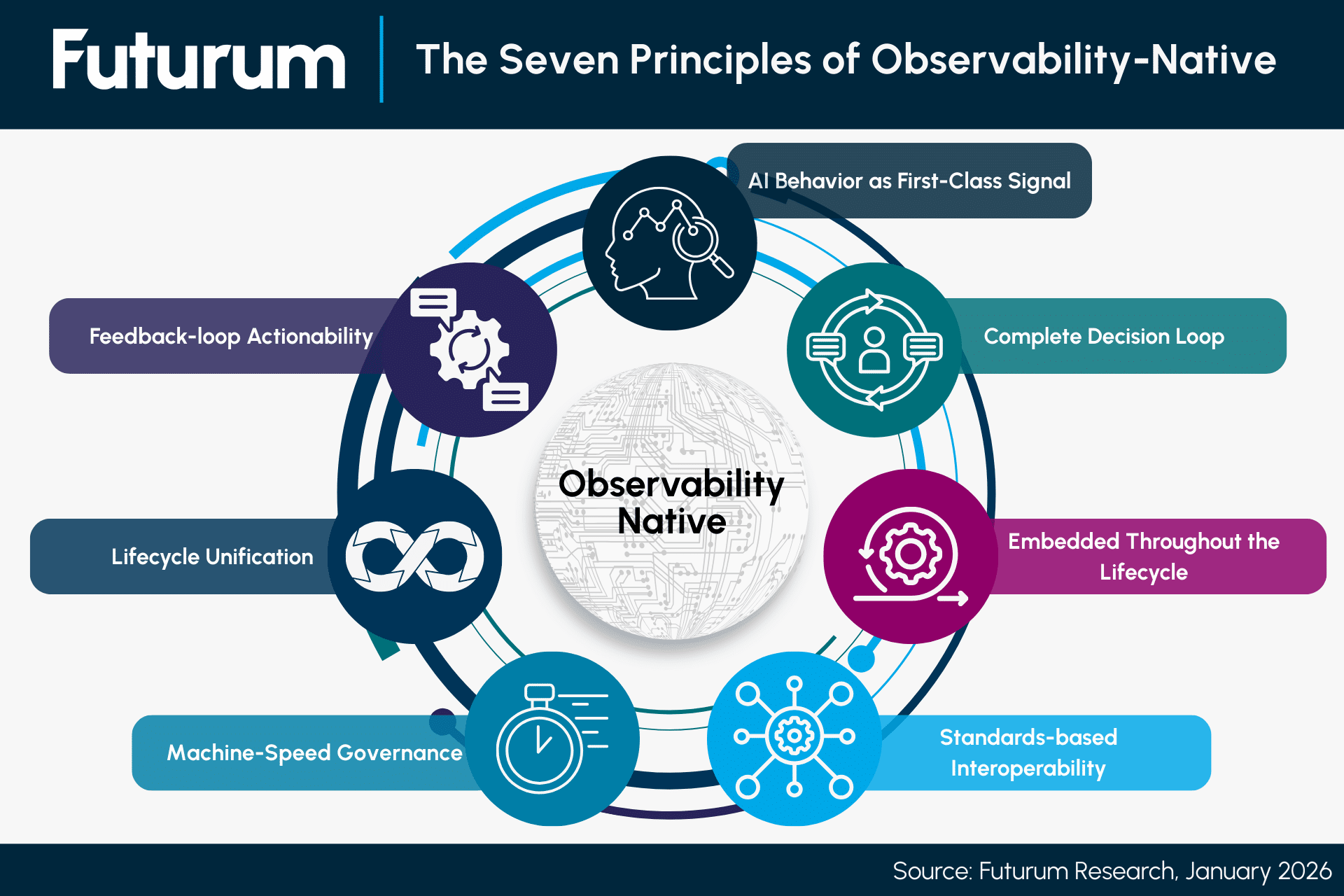
Agent behavior becomes a first-class signal in the same pipelines that capture infrastructure metrics and application traces. The seven principles of observability-native, as Futurum has defined them, require that AI behavior be treated as primary telemetry rather than inferred from infrastructure side effects. ADK’s OTel support is a direct step toward that architecture.
Figure 1: Seven Principles of Observability-Native
The remaining four observability integrations, AgentOps, Arize AX, Freeplay, and Monocle, provide session replay, production debugging, prompt management, and open-source tracing, respectively. They address observability across the agent lifecycle: evaluation during development, monitoring in production, and compliance-ready tracing for governance.
This coverage is not accidental. It reflects Google’s positioning of ADK for the full decision cycle, from intent to outcome, which enterprise governance will require as agents move to autonomous execution at scale.
Table 1: Observability-Native Coverage Summary
The DevOps Execution Obligation
For DevOps and platform engineering teams, the ADK ecosystem announcement creates a specific execution obligation: stack alignment assessment before any agent deployment.
The integrations cover the most common developer toolchains, GitHub for code, Jira for work management, and MongoDB for data, and the observability coverage addresses the governance gap that blocks most production deployments.
The deeper obligation is establishing observability requirements before agents touch engineering workflows. Teams that map their toolchain against ADK’s integration catalog before building agent workflows will avoid the mid-deployment realization that agents require custom or out-of-band instrumentation.
Agent behavior is non-deterministic. The same prompt with the same context produces different decisions across runs. You cannot govern what you cannot see. ADK’s observability integrations provide the foundation, but enterprises need to define what they require from that foundation: which decision-cycle elements need to be captured, which evidence properties are required for audit, and how telemetry flows into existing governance workflows.
Teams that treat observability as a deployment step rather than a design requirement will discover those gaps under the worst possible conditions.
What to Watch:
- Watch whether Google expands the integration catalog faster than enterprises encounter gaps, which will determine whether ADK is building a durable execution ecosystem or curating a launch showcase.
- AgentOps, Arize AX, Freeplay, MLflow, and Monocle observability vendors now compete for preferred monitoring status in ADK deployments; differentiation will shift toward governance integration and completeness of the decision cycle, not session replay and metrics.
- ADK emitting OTel spans natively positions Google in the OpenTelemetry for AI agents standards conversation; watch for active contribution to semantic convention definitions that would entrench that advantage.
- Microsoft has structural advantages through GitHub, Azure DevOps, and Copilot; watch for competitive announcements on observability depth and engineering workflow integration as ADK’s positioning sharpens.
- As production agent incidents accumulate, enterprise RFPs will specify evidence properties, decision-cycle completeness, and audit-trail integrity that the current ADK integration set may not fully address.
See the complete Google blog post Supercharge your AI agents: The New ADK Integrations Ecosystem for more information.
Disclosure: Futurum is a research and advisory firm that engages or has engaged in research, analysis, and advisory services with many technology companies, including those mentioned in this article. The author does not hold any equity positions with any company mentioned in this article.
Analysis and opinions expressed herein are specific to the analyst individually and data and other information that might have been provided for validation, not those of Futurum as a whole.
Other Insights from Futurum:
The Seven Principles of Observability-Native
Enterprises Prioritize Agent Observability Before They’ve Deployed Agents
AWS’s Deploy-to-AWS Plugin: Frictionless Deployment or Developer Honeypot?
Agent-Driven Development – Two Paths, One Future
Image Credit: Google
Author Information

Mitch Ashley is VP and Practice Lead for the CIO & Technology Buyers and Software Lifecycle Engineering practices at The Futurum Group. A multi-time CIO and CTO with 30+ years leading technical organizations, Mitch built and operated production systems spanning cybersecurity for the U.S. Department of Defense, PKI services for the broadband and 5G industries, SaaS platforms, large-scale telecom and banking systems, and a national broadband network. His work with AI began early, developing expert systems that diagnosed and repaired complex mainframe environments. That operator foundation grounds his analysis in operational consequence, covering the technology buyer's world of software engineering, cybersecurity, DevOps, cloud, and AI.