
Austin, Texas, USA, February 26, 2026
New Futurum Research data shows AI agent observability ranks in four of the top 10 enterprise observability procurement priorities before agent deployment is mature or widespread.
Enterprises are prioritizing visibility into AI agent behavior before most have deployed agents at production scale, according to comprehensive new research from Futurum Research. The January 2026 Software Lifecycle Engineering Decision-Maker Study finds that AI, AI agent observability, and AIOps rank in the top 10 among their top procurement priorities for observability platforms.
Mitch Ashley, VP Practice Lead, Analyst at Futurum, said, “Enterprises are not waiting for agents to create problems before they invest in understanding agent behavior. The data tells us something different is happening: organizations recognize that granting AI agents execution authority requires visibility infrastructure in place before that authority is exercised, not after.”
Figure 1: Organizations Prioritize AI and Agent Observability in Platform Selection (n=139)
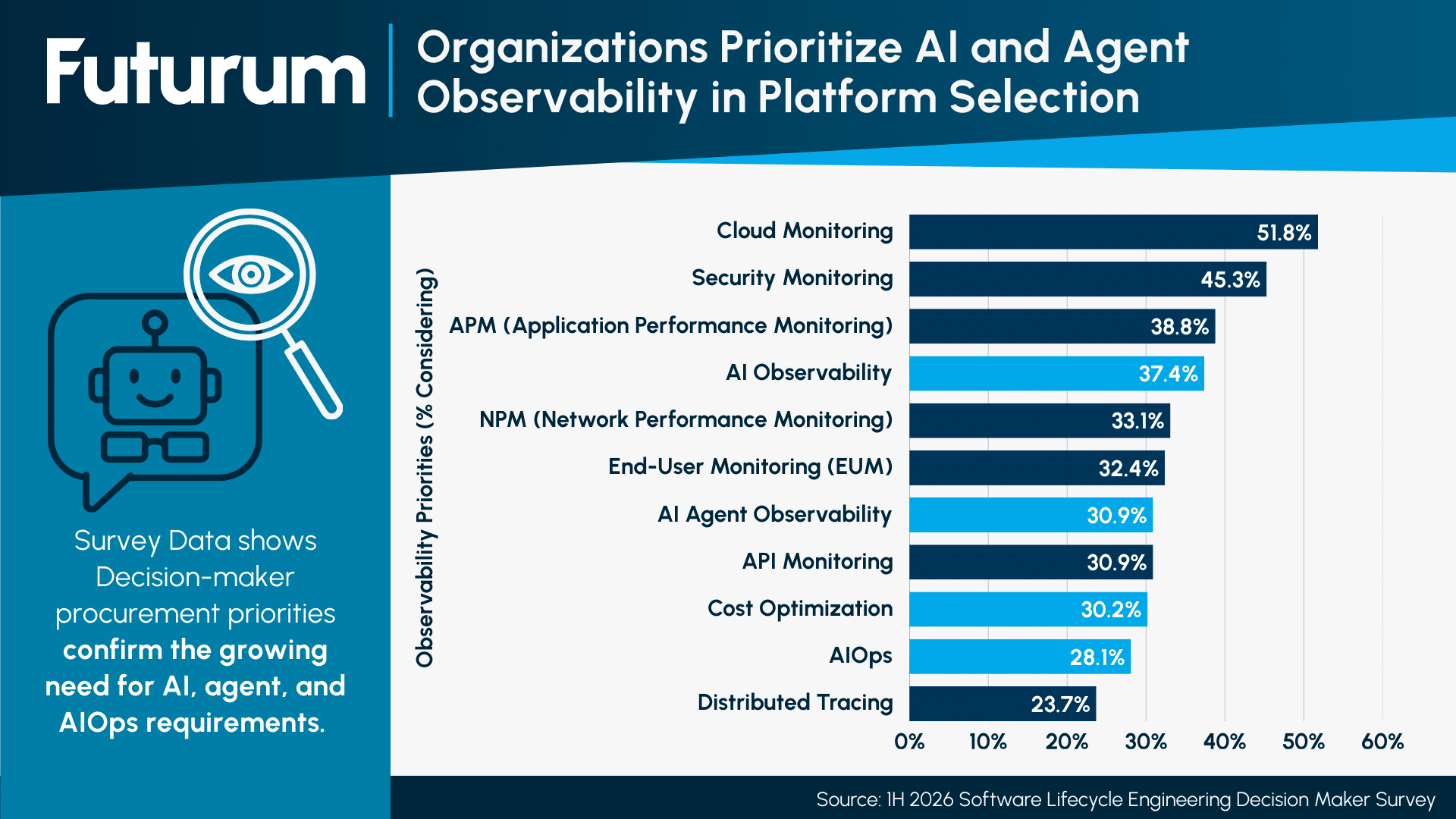
The research reveals several key developments shaping the AI agent observability market:
- AI observability ranks fourth among enterprise observability procurement priorities at 37.4%, ahead of distributed tracing (23.7%), Kubernetes Observability (20.1%), and Infrastructure monitoring (20.1%), indicating demand for AI-specific visibility is already displacing investment in established tooling categories.
- AI agent observability ranks sixth at 30.9%, a notable position given that production agent deployments at enterprise scale remain early-stage across most organizations.
- Cost optimization ranks fifth at 30.2%, placing it in the mix with three AI observability categories, reflecting simultaneous pressure on operational efficiency and investment in emerging governance capabilities.
“Organizations have AI running inside their development workflows today,” noted Ashley. :”The infrastructure required to understand what those AI systems are deciding, what constraints shaped those decisions, and what evidence exists to defend those decisions under audit, is what this procurement data is tracking.
This is part of a greater trend toward observability native: embedding observability across SDLC phases, workflows, pipelines, not only when software reaches production.”
The data pattern reflects a consistent principle from prior technology transitions: observability and governance architecture built in advance of scale is materially less expensive, and more effective, than governance retrofitted after incidents expose its absence. Organizations that act on the procurement signal their peers are sending will enter the autonomous execution phase of AI development with the visibility infrastructure required to operate it safely and defensibly.
Read more in the reports “1H 2026 Software Lifecycle Engineering Decision Maker Survey Report” and “State of the Market Report: Software Lifecycle Engineering, Q1 2026” on the Futurum Intelligence Platform.
About Futurum Intelligence for Market Leaders
Futurum Intelligence’s Software Lifecycle Engineering IQ service provides actionable insight from analysts, reports, and interactive visualization datasets, helping leaders drive their organizations through transformation and business growth. Subscribers can log into the platform at https://app.futurumgroup.com/, and non-subscribers can find additional information at Futurum Intelligence.
Follow news and updates from Futurum on X and LinkedIn using #Futurum. Visit the Futurum Newsroom for more information and insights.
Other Insights from Futurum:
Futurum’s 2026 Key Issues & Predictions Report
Transparency Through Observability is Essential to AI Success
AWS’s Deploy-to-AWS Plugin: Frictionless Deployment or Developer Honeypot?
Truth or Dare: What Can Claude Agent Teams And Developers Create Today?
Author Information

Mitch Ashley is VP and Practice Lead for the CIO & Technology Buyers and Software Lifecycle Engineering practices at The Futurum Group. A multi-time CIO and CTO with 30+ years leading technical organizations, Mitch built and operated production systems spanning cybersecurity for the U.S. Department of Defense, PKI services for the broadband and 5G industries, SaaS platforms, large-scale telecom and banking systems, and a national broadband network. His work with AI began early, developing expert systems that diagnosed and repaired complex mainframe environments. That operator foundation grounds his analysis in operational consequence, covering the technology buyer's world of software engineering, cybersecurity, DevOps, cloud, and AI.

