Analyst(s): Keith Kirkpatrick
Publication Date: September 8, 2026
Genesys launched a four-layer agentic orchestration stack at its Xperience event on September 2, 2026, positioning Genesys Cloud as the enterprise system of record for end-to-end customer experience automation. CEO Tony Bates framed the moment as “the most consequential shift we’ve ever seen in customer experience in a generation,” arguing that consumer AI has reset baseline expectations and that enterprises face a widening context gap that only governed orchestration can close.
The launch arrives as 73.1% of enterprise software decision-makers (n=833) rank Agentic AI as a high-priority technology, and 34.2% identify customer engagement as a top projected deployment area for Agentic AI[1]. Bates cited customer results including 90% containment rates, 35% agent productivity gains, and up to 900% return on investment on the Genesys Cloud platform, framing the architectural thesis with commercial proof points that map to where enterprise budgets are heading.
What Is Covered in This Article:
- Enterprise agentic AI demand and market growth trajectory
- CEO Tony Bates’s agentic operating model thesis and orchestra analogy
- Genesys Cloud Navigator, Orchestrator, Contextual Intelligence, and AI Control Plane architecture
- Customer proof points and platform-level ROI metrics
- Ecosystem expansion: ServiceNow, Sierra, ElevenLabs, Deepgram partnerships
- Availability timeline and competitive positioning
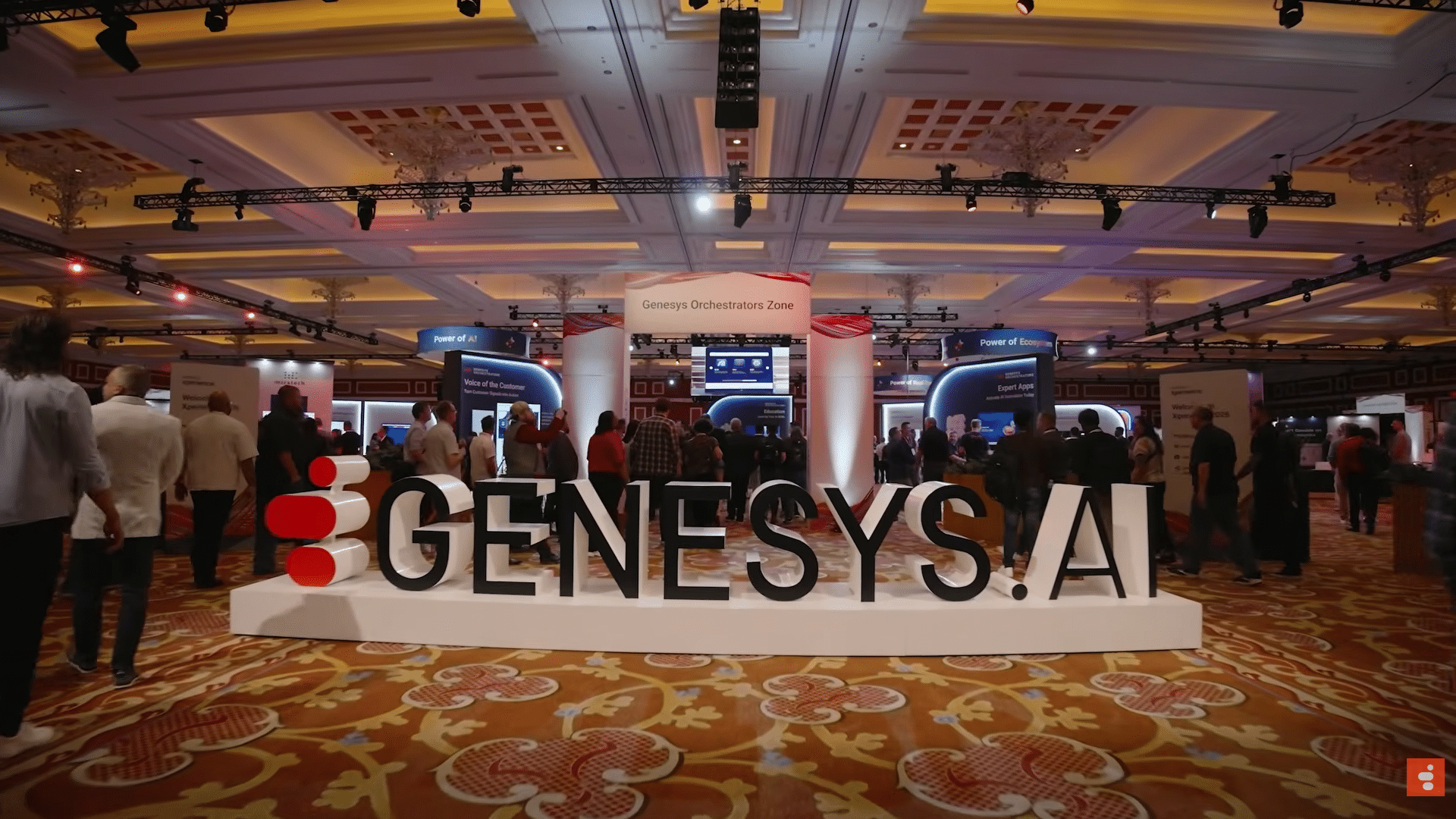
The Event—Major Themes & Vendor Moves: At its Xperience event in Las Vegas on September 2, 2026, Genesys introduced four integrated capabilities advancing Genesys Cloud as an agentic orchestration platform for customer experience. CEO Tony Bates opened the keynote before nearly 4,000 in-person attendees and 16,000 online registrants, framing the announcement as the culmination of Genesys’s Levels of Experience maturity model reaching Level 4: agentic orchestration.
Genesys Cloud Navigator uses conversational understanding, history, and enterprise context to route customers to the right AI agent, workflow, or human. Genesys Cloud Orchestrator maintains journey state and coordinates work across AI, humans, and systems as conditions evolve. Contextual Intelligence builds persistent enterprise memory by connecting real-time signals with customer identity and history, while the AI Control Plane provides centralized governance, policy, and observability.
Contextual Intelligence and the AI Control Plane are available today; Navigator reaches general availability in Q4 FY2026 and Orchestrator in Q1 FY2027. Bates also announced new partnerships with Sierra, ElevenLabs, and Deepgram alongside deeper integrations with AWS, Adobe, and Meta, and highlighted a joint keynote appearance by ServiceNow CEO Bill McDermott, affirming the companies’ agent-to-agent interoperability roadmap. The platform already serves more than 7,500 organizations orchestrating more than 33 billion conversations annually across voice, digital, and AI channels.
Genesys Bets on Agentic Orchestration to Own Enterprise CX
Analyst Take: Genesys is making a deliberate architectural bet that enterprises will consolidate agentic CX orchestration onto a single governed platform rather than assemble point solutions. CEO Tony Bates put the strategic logic in plain terms during the keynote: “Most companies don’t have an AI problem, they have an operating model problem” because “you can’t unlock AI by bolting it onto a model that was designed only for human execution.”
His symphony analogy mapped directly to the product architecture. Genesys Cloud Navigator reads intent like a conductor reading the score. Genesys Cloud Orchestrator determines sequence and approach. Actors (humans, AI agents, workflows) are the instruments. Contextual Intelligence and the AI Control Plane provide the score and governance layer beneath. The market context supports the timing: 73.1% of enterprise software decision makers (n=833) rank Agentic AI as a high technology priority, and the enterprise software market reached $592.4B in 2025, projected to grow at a 10.9% CAGR to $1,103.2B by 2031 under Futurum’s base case scenario[2].
Bates Frames the Operating Model Shift
The strongest strategic signal from the keynote was Bates’s explicit pivot from a technology narrative to an operating model narrative. He outlined five pillars that enterprises must rethink to unlock agentic value: customer experience (connected, proactive, fully contextual, and multi-modal), workforce (a hybrid model where humans and AI agents are managed as one talent system with shared outcomes), economics (shifting KPIs from operational proxies like AHT to business outcomes like customer acquisition cost and revenue retention), control (governance as “the license to scale autonomy, not the brake”), and continuous transformation (transformation as an ongoing operating capability rather than a one-time migration project).
That framing positions Genesys Cloud as an enterprise operating system for experience, a higher-value and stickier sale than a contact center upgrade. Bates reinforced the point by noting that consumer AI has reset baseline expectations: “Once consumers experience [personal AI that remembers context and understands intent], they’re not going to expect anything less from a brand.”
Fragmented enterprise data, spread across CRM, billing, surveys, and transaction systems, is becoming what Bates called a “competitive liability” unless orchestrated into real-time action. That diagnosis aligns with the 47.9% of enterprise decision makers (n=833) who cite better integration capabilities as a key budget confidence driver.
Market Demand Validates the CX-Agentic Intersection
In Futurum Group’s 2H 2026 Enterprise Software Decision Maker Survey (n=833), 34.2% of respondents identified customer engagement (personalized and automated experiences) as a top projected deployment area for agentic AI[1], while a further 37.7% cited sales, marketing and service[1], giving Genesys a combined addressable demand signal across its core market. Separately, 47.9% of decision makers cite better integration capabilities as a key budget confidence driver[1], reinforcing the value of a unified AI Control Plane that spans Navigator, Orchestrator, and Contextual Intelligence rather than requiring customers to stitch together disparate tools.
Genesys currently holds an 8.07% share of the Communication Services segment with $2.28B in CY2025 revenue[2], giving it meaningful scale to cross-sell the new stack into an existing enterprise base while pursuing net-new logos attracted by the agentic differentiation. Bates quantified the platform’s data advantage: Genesys Cloud processes over 33 billion conversations annually and handles more than 1 trillion API invocations per year, giving the orchestration layer a real-time signal density that point solutions cannot match.
Architecture: Four Layers, One Governed Journey
The platform’s design targets a persistent enterprise problem: AI deployments that handle individual interactions but lose context across sessions, channels, and handoffs. Bates described the architecture through his conductor analogy: “The navigator understands why the customer came to you and what the enterprise already knows about them. The orchestrator determines the best approach, just like the conductor, and how to get it done. Then you have the actors: your people, the AI agents, the workflows, the tools, the enterprise systems. And below all of that, a foundation that maintains context, enforces governance, and continuously learns.”
Genesys Cloud Navigator resolves the entry-point problem by replacing static menus with conversational intent understanding that carries context forward. Genesys Cloud Orchestrator tackles mid-journey complexity, maintaining state and reasoning over policies and guardrails so interactions can pause, resume, and adapt without requiring customers to restart. Contextual Intelligence provides the memory layer. Bates characterized it as turning each interaction into a persistent signal that informs future decisions, creating “a score written for an audience of one, in real time.”
The AI Control Plane closes the governance gap that has slowed enterprise agentic adoption. Bates was emphatic: “Autonomy without trust just isn’t enterprise AI. Governance isn’t the brake on autonomy, it’s the license to scale it.” The layered approach lets enterprises adopt components incrementally, with Contextual Intelligence and the AI Control Plane available today.
Customer Proof Points Anchor the ROI Narrative
Three customer outcomes were put forth to validate the commercial thesis before the full stack reaches general availability. Virgin Atlantic unified siloed engagement systems on Genesys Cloud and realized $28 million in three-year value while achieving a 25-point year-over-year increase in customer satisfaction. Meanwhile, Charles Sturt University increased first-contact resolution by 29% and drove chatbot escalations down from nearly 58% to under 20%. Finally, Trademark Global improved SLA achievement by 30% during seasonal peaks while cutting the total cost of ownership by 65%.
Bates extended the ROI narrative with platform-wide metrics from the broader customer base: 90% containment rates, 35% agent productivity gains, 16% reduction in employee attrition, 25% improvement in sales conversion, and 85% improvement in customer retention, with some customers reporting up to 900% return on investment.
These results carry weight because 47.9% of enterprise decision makers (n=833) cite faster time to value realization as a budget confidence driver[1]. Bates’s call to action, “think big, start small, scale fast, pick one use case, pick one outcome, and drive that,” is designed to lower the adoption barrier while the staggered GA timeline plays out.
Ecosystem Expansion Broadens the Orchestration Surface
Bates used the keynote to signal that Genesys’s orchestration ambitions extend beyond its own platform boundaries. ServiceNow CEO Bill McDermott appeared via video to affirm the companies’ joint roadmap, describing a model where “AI agents don’t simply answer questions, they collaborate across applications, data, and workflows to take action” and citing joint use cases in healthcare (Siemens Healthineers) and financial services (Visa).
Bates also announced new partnerships with Sierra (conversational AI), ElevenLabs (voice AI), and Deepgram (speech recognition), alongside deeper integrations with AWS, Adobe, and Meta. The ecosystem strategy serves the orchestration thesis directly: more actors, more data signals, and a broader surface for the Genesys Cloud Orchestrator to coordinate across. Bates framed this as a front-to-back-office ambition: “Think about the beginnings of an orchestration system that goes from the front office to the mid to the back office.” The 1 trillion annual API invocations across the platform confirm that this is already an integration-intensive architecture, not a roadmap aspiration.
Competitive Positioning and Execution Risk
Genesys enters this cycle with structural advantages: an installed base of more than 7,500 organizations, a purpose-built CX data model, a governance layer designed for enterprise compliance requirements, and a partner ecosystem that now includes enterprise platform players (Salesforce, ServiceNow) and AI-native specialists (Sierra, ElevenLabs, Deepgram).
The integrated stack reduces the integration burden that 47.9% of decision makers flag as a budget confidence factor[1]. The primary execution risk is the staggered availability timeline. Genesys Cloud Navigator reaches general availability in Q4 FY2026 (November 2026 through January 2027) and Genesys Cloud Orchestrator in Q1 FY2027 (February through April 2027). Competitors, including Salesforce (which Genesys counts as both partner and competitor) and NICE, have a window to close architectural gaps or lock in deals before the full Genesys stack is deployable. Bates acknowledged the pace challenge indirectly, noting that “transformation needs to become an operating capability” because “this world is moving fast.” Genesys will need to convert the pipeline momentum built at Xperience, and the executive-level framing Bates established, into signed commitments before that window narrows.
What to Watch:
- Navigator GA conversion: whether pipeline built at Xperience translates into signed enterprise deals before the Q4 FY2026 general availability window opens in November 2026
- Genesys Cloud Orchestrator adoption rate: how quickly enterprises move to full-stack deployment once Genesys Cloud Orchestrator reaches general availability in Q1 FY2027
- Operating model adoption: whether Bates’s five-pillar agentic operating model thesis (CX, workforce, economics, control, continuous transformation) gains traction with CIOs and boards as a strategic framework beyond contact center modernization
- Ecosystem execution: whether the newly announced Sierra, ElevenLabs, and Deepgram partnerships deliver production-grade integrations that expand the orchestration surface, and whether the ServiceNow agent-to-agent interoperability roadmap reaches GA
- Competitive response: how Salesforce, ServiceNow, and NICE reprice or repackage agentic CX offerings over the next two quarters in response to Genesys’s integrated stack
- Platform ROI benchmarking: whether the headline metrics Bates cited (90% containment, 35% productivity gains, 900% ROI) hold up as a repeatable pattern across new deployments or remain outlier results
- Share expansion signal: whether the agentic platform drives Genesys’s Communication Services segment share meaningfully above its current 8.07% position through Q1 and Q2 FY2027
You can read the blog post highlighting Tony Bates’ keynote from Xperience 2026 here.
Sources
- Enterprise Software Decision Maker – 2H 2026
- Enterprise Applications Market Sizing & Five-Year Forecast – 2H 2026
Disclosure: Futurum is a research and advisory firm that engages or has engaged in research, analysis, and advisory services with many technology companies, including those mentioned in this article. The author does not hold any equity positions with any company mentioned in this article.
Analysis and opinions expressed herein are specific to the analyst individually and data and other information that might have been provided for validation, not those of Futurum as a whole.
Featured Image: Genesys
Author Information

Keith Kirkpatrick is VP & Research Director, Enterprise Software & Digital Workflows for The Futurum Group. Keith has over 25 years of experience in research, marketing, and consulting-based fields.
He has authored in-depth reports and market forecast studies covering artificial intelligence, biometrics, data analytics, robotics, high performance computing, and quantum computing, with a specific focus on the use of these technologies within large enterprise organizations and SMBs. He has also established strong working relationships with the international technology vendor community and is a frequent speaker at industry conferences and events.
In his career as a financial and technology journalist he has written for national and trade publications, including BusinessWeek, CNBC.com, Investment Dealers’ Digest, The Red Herring, The Communications of the ACM, and Mobile Computing & Communications, among others.
He is a member of the Association of Independent Information Professionals (AIIP).
Keith holds dual Bachelor of Arts degrees in Magazine Journalism and Sociology from Syracuse University.