
Evaluating the Futurum ERP Platform “Signal” – Where My Coverage Aligns and Diverges on Vendor Performance
Analyst(s): Keith Kirkpatrick
Publication Date: August 26, 2026
Document #: AIOKK202608-FSR
What Is Covered in This Report
- How the new Futurum ERP Platform “Signal” report scores and zones 10 ERP vendors, and how that stacks up against what I’ve been writing about these same vendors all year
- Where the Signal’s read on SAP, Epicor, and IFS lines up cleanly with my own reporting
- Where I think the Signal sounds more certain than the evidence supports – specifically on Microsoft, Oracle, NetSuite, and Infor
- Where I simply don’t have enough of my own published work on Sage Group and Intuit to referee the Signal’s calls
What You Need to Know: Overall Assessment
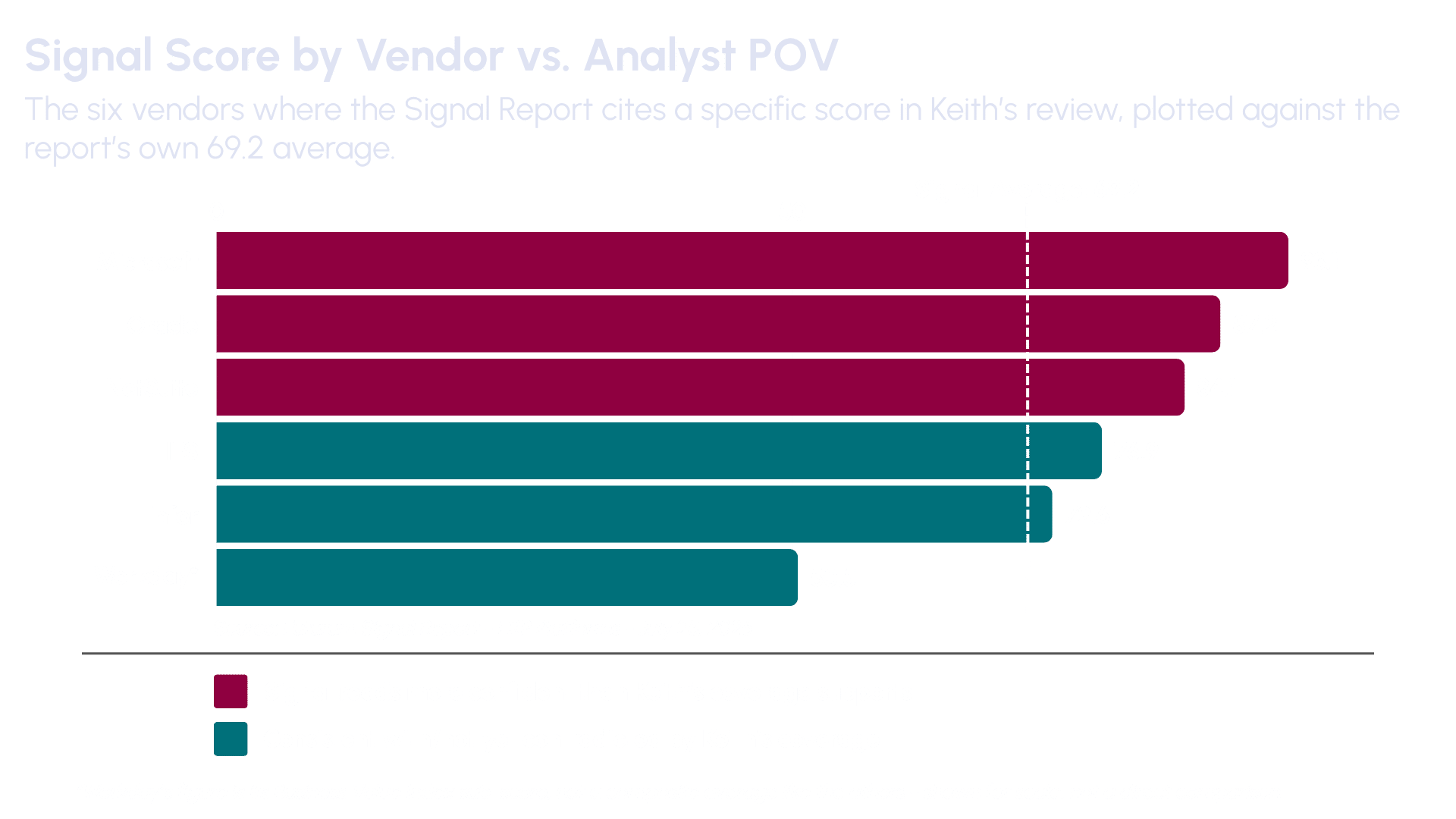
On balance, I think the Signal gets more right than wrong. The Signal’s read on SAP and Epicor is close to a word-for-word match with what I’ve already argued in my own coverage: the same strengths, the same specific risks, and, in some cases, the same phrasing of the tension. Where it drifts from me is less about the facts than about how sure of itself it sounds. I’ve spent a good part of this year pushing back on vendors’ “unique,” “only vendor,” and “gold standard” language, because claims wars like that don’t move buyers – they need proof of outcomes. For a few of the vendors in this report, the Signal’s own prose reaches for exactly that register, in places where I’ve been more careful.
SAP and Epicor: The Signal and I Are Reading From the Same Page
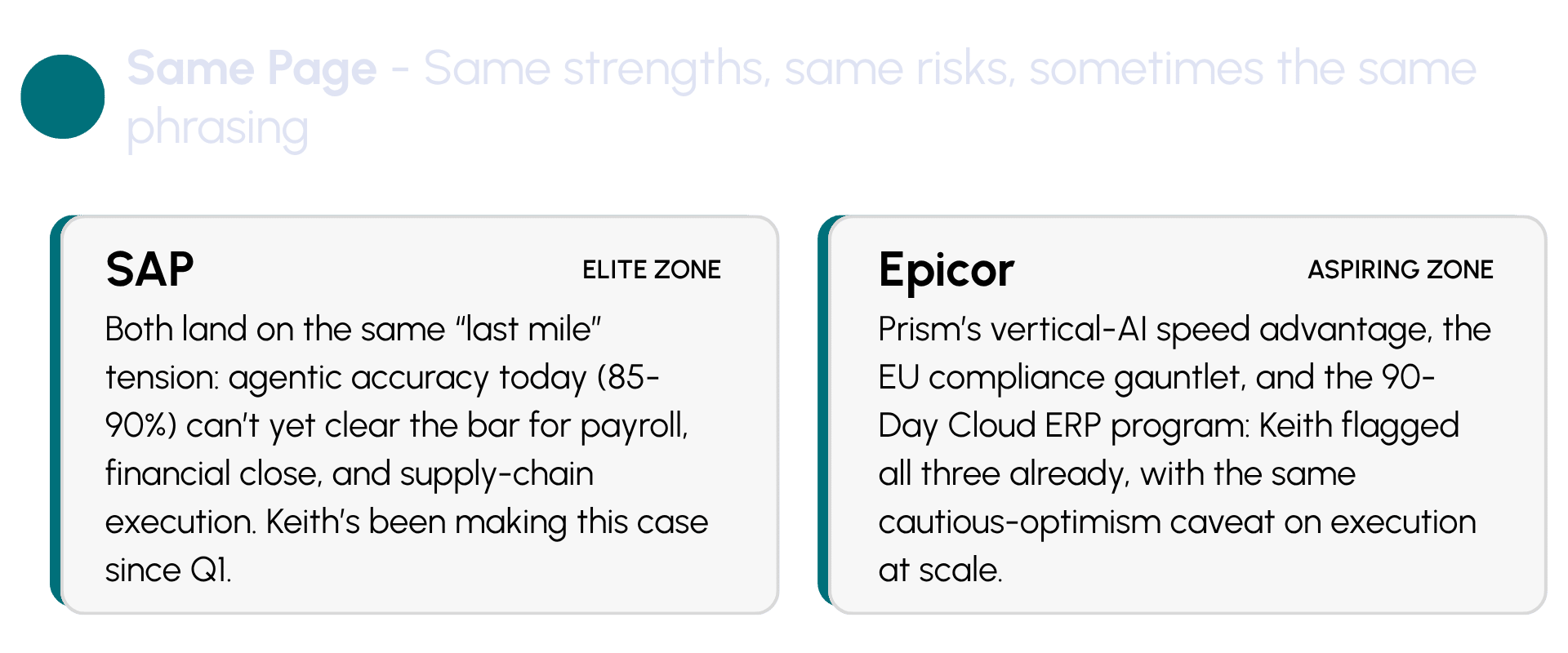
Start with where I have the least to add. On SAP, I’ve been writing since Q1 that the company’s Business AI ambitions run into a “last mile” problem: payroll, financial close, and supply chain execution can’t tolerate the 85–90% accuracy that today’s agentic use cases deliver, and the whole clean-core, RISE-with-SAP push has to prove it can lift that accuracy without disrupting operations customers already trust. That is exactly the tension the Signal lands on when it makes SAP’s ability to “integrate AI capabilities to deliver measurable ROI without disrupting standard ERP operations” the hinge of its Elite-zone case. I’ve also flagged migration resistance and a 12–18-month gap between SAP’s AI-native vision and where the market’s maturity actually sits, and the Signal’s own hedge about “historical migration resistance” tracks with that.
Epicor is the same story. I’ve argued that embedded, verticalized AI such as Epicor Prism “is positioned to deliver faster and more predictable ROI” than horizontal alternatives, but that European rollout brings a real “compliance and localization gauntlet” under the EU AI Act and GDPR, and that agents which “cannot keep pace with evolving workflows” risk pushing manufacturers back to manual workarounds. The Signal’s Epicor write-up, which includes Prism, the shift to headless architecture, and the 90-Day Cloud ERP program, sits on the same foundation.
On the 90-Day program specifically, I was cautiously optimistic rather than dismissive: buyers genuinely rank time-to-value as a top purchase criterion, but “the real test is whether Epicor can maintain delivery certainty as customer needs scale.” The Signal’s Aspiring-zone placement, with the same caveat about execution, matches where I already was.
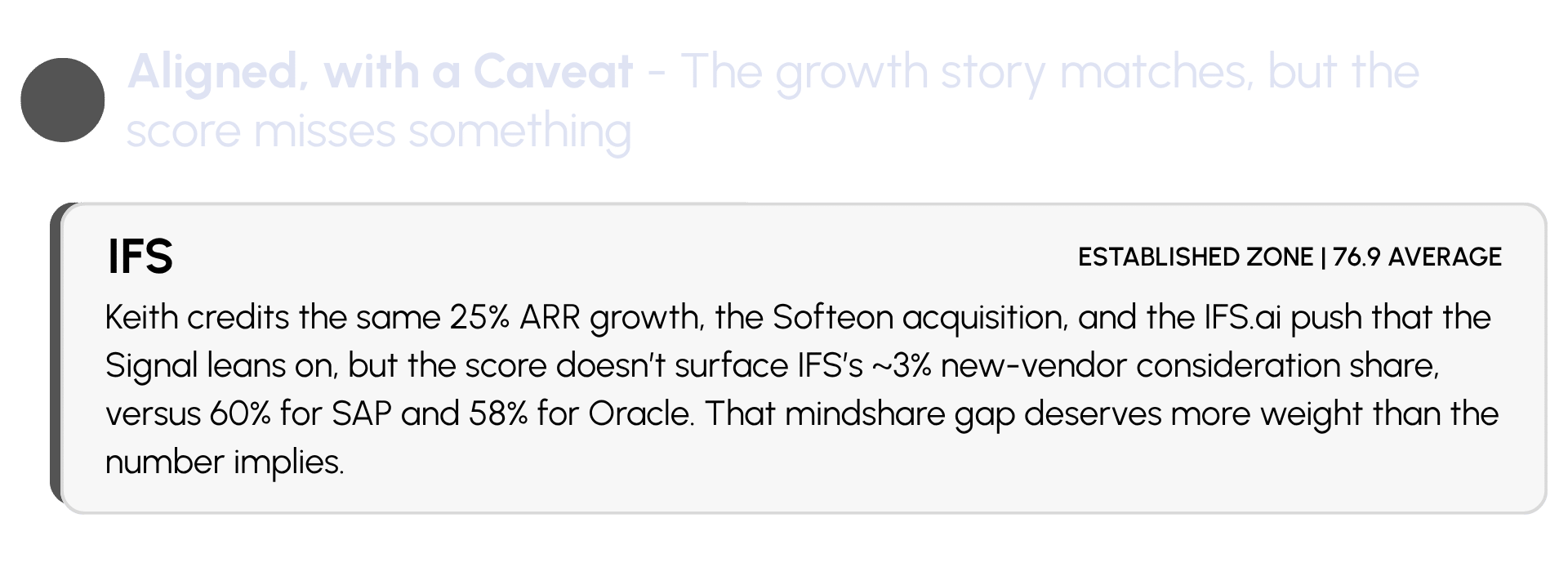
IFS is close to this camp too, with one gap I’d flag. I’ve credited the same growth story the Signal leans on, focusing on 25% ARR growth, the Softeon acquisition, and the IFS.ai/Digital Workers push. I’ve called the combined IFS-Softeon platform well-positioned to “set the new standard for next-generation, autonomous warehouse operations.” But I’ve also put a hard number on IFS’s visibility problem that the Signal’s 76.9 average (second-highest of the 10 vendors) doesn’t really surface: IFS shows up in new-vendor consideration at roughly 3%, “well behind SAP (60%), Oracle (58%), and Microsoft (47%).” That’s a mindshare gap worth more weight than the score implies, even if the Signal’s own lowest IFS sub-score – Ecosystem Alignment – is at least pointed in the right direction.
Where I’d Push Back: Microsoft, Oracle, and NetSuite Are Scored With More Certainty Than I’d Give Them
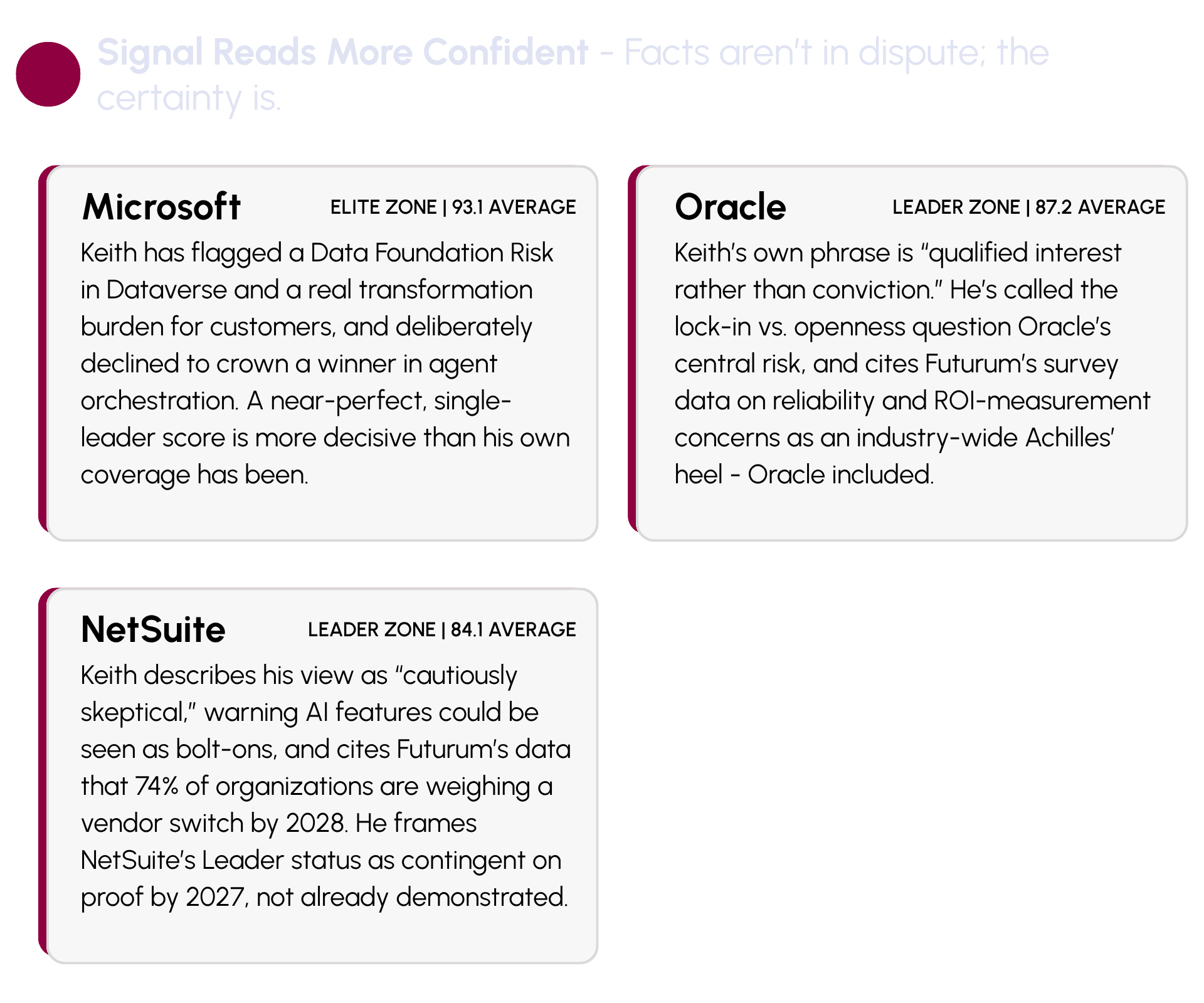
Microsoft is where the gap is widest. The Signal scores Microsoft highest of all 10 vendors, with a 93.1 average and a near-perfect 99.7 on Strategic Vision, and positions the company as the unambiguous Elite-zone leader. That’s not how I’ve covered Dynamics 365. I’ve flagged a real “Data Foundation Risk” if Dataverse “cannot overcome existing data silos,” a “Business Transformation Burden” that forces customers to rethink workflows before they see value, and a gap between benchmark results and sustained real-world performance. And when I looked specifically at who wins the agent-orchestration layer, I deliberately didn’t crown a winner among Microsoft, SAP, Salesforce, ServiceNow, and Google, because each has “its own logic” and “limitations,” and 51% of the buyers I surveyed prefer a hybrid of vendor and in-house orchestration over betting on one platform. A near-perfect, single-leader score for Microsoft is more decisive than I’ve been willing to be.
Oracle gets a similar treatment. The Signal puts it in the Leader zone at 87.2 with confident, forward-leaning language about Fusion Cloud and sovereign cloud. My own phrase for where I actually land on Oracle is “qualified interest rather than conviction.” I’ve called the lock-in-versus-openness question the central risk to its strategy, noting “if it cannot demonstrate openness and interoperability, it risks being sidelined,” and I’ve cited my own survey data that 55% of organizations rank agent reliability and hallucination management as their top adoption barrier, with 43% citing ROI-measurement uncertainty as a close second. I called that combination an “Achilles’ heel” for every vendor chasing agentic ERP, Oracle included. The Signal does note Oracle’s implementation complexity and premium pricing as headwinds, so we’re not in direct conflict, but its overall register is more assured than “qualified interest.”
NetSuite is the clearest case of the Signal getting ahead of me. It lands NetSuite in the Leader zone at 84.1, with Leader status framed as something the vendor “achieves.” I’ve called my own view of NetSuite’s agentic strategy “cautiously skeptical”: if its AI features are “perceived as bolt-ons rather than core workflow enablers, the platform’s moat could erode,” and I’ve pointed to my own data showing 74% of organizations considering a vendor switch between 2025 and 2028 as evidence of just how contestable this Leader-zone standing really is. I framed NetSuite’s success as contingent on proof by 2027, not something already demonstrated. That’s a meaningfully more conditional read than the Signal gives it.
Infor and Workday: Right Instinct, Thin Evidence
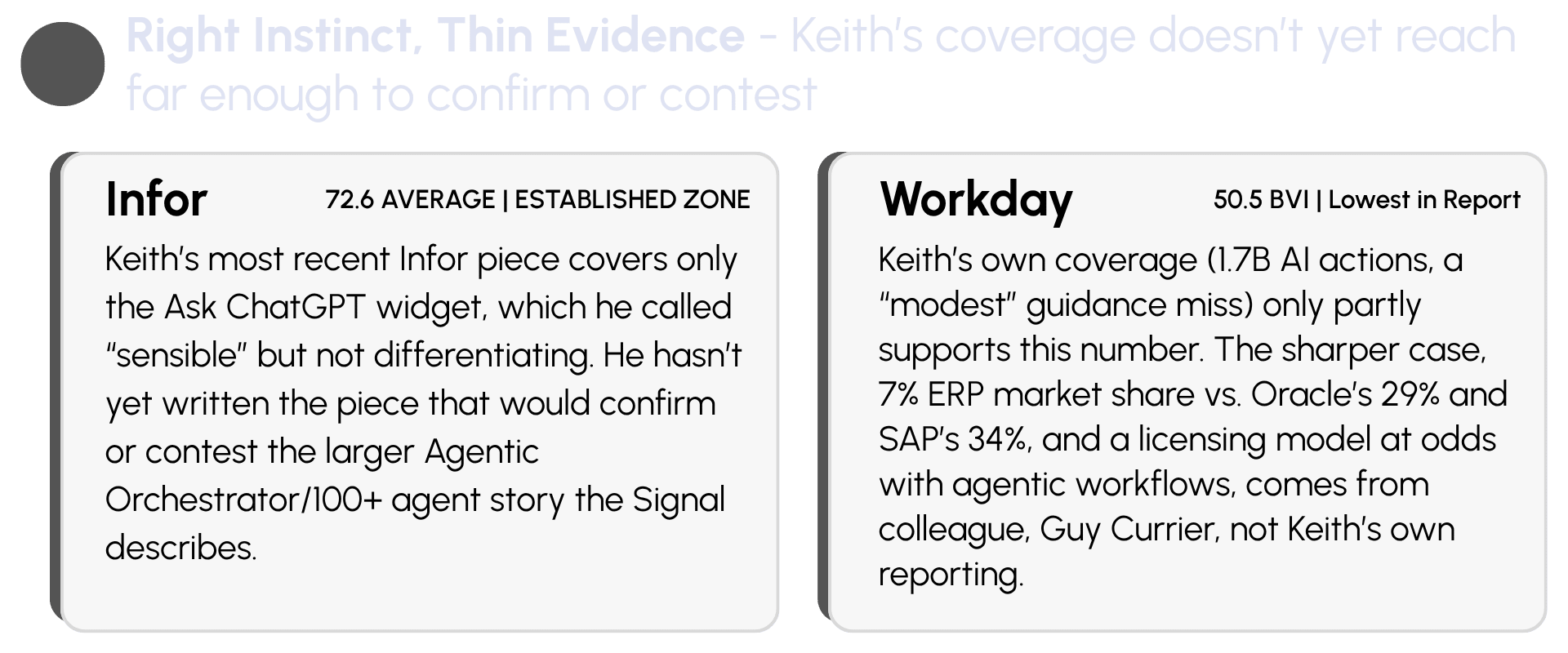
On Infor, the Signal describes a sweeping transformation including “Enterprise Resource Execution,” an Agentic Orchestrator, and more than 100 AI agents, and lands it in the Established zone at 72.6. The most recent Infor piece I can point to is my take on its Ask ChatGPT widget, and I called that move “a sensible, focused implementation rather than a competitive differentiator or revolutionary move,” noting that ordinary LLM hallucination limits still applied and declining to compare Infor against the bigger vendors at all. I haven’t yet written the piece that would confirm or contest the newer Orchestrator/ERX story at the scale the Signal describes, but that’s a gap in my coverage, not a contradiction, and I’d want to close it before I’d sign off on the Established-zone framing as fully earned.
Workday’s Business Value Index (50.5), which is the lowest score anywhere in this report and well under the 69.2 average, is the most striking number in the whole heat map, and I only partly have the receipts for it. My own Q4 FY 2026 earnings piece credited 1.7 billion “AI actions” in FY 2026 as real operational embedding and called the guidance miss “modest,” while still flagging “unproven ROI translation” and slower government/healthcare deal cycles. The sharper case for that low score actually comes from my colleague Guy Currier, who’s written that Workday holds just 7% ERP market share against Oracle’s 29% and SAP’s 34%, and that agentic AI’s workflow-completion model cuts directly against Workday’s seat-based licensing. That’s a fair argument, but I just want to be clear that it’s Guy’s case, sharpening the Signal’s number here more than my own.
The Bigger Disagreement: Breadth Isn’t Automatically Better
The disagreement I care most about isn’t vendor-specific but rather structural. In my own Market Insight Report on generic versus specialized ERP software, I deliberately declined to declare a winner between horizontal platforms and vertical specialists. “Selecting the right type of ERP solution is critical” to fit, not because one category is categorically better, as both approaches have merit, depending on the organization. The Signal’s zone structure runs counter to that: it puts the two most horizontal, platform-broad vendors – Microsoft and SAP – alone in the Elite zone, and pushes the most specialized vertical players – IFS, Infor, Epicor – down into Established and Aspiring. Read plainly, that’s a breadth-equals-superiority hierarchy, and it’s the one part of this report I’d want reworked before I’d put my name fully behind it.
Sage and Intuit: I Can’t Referee This One
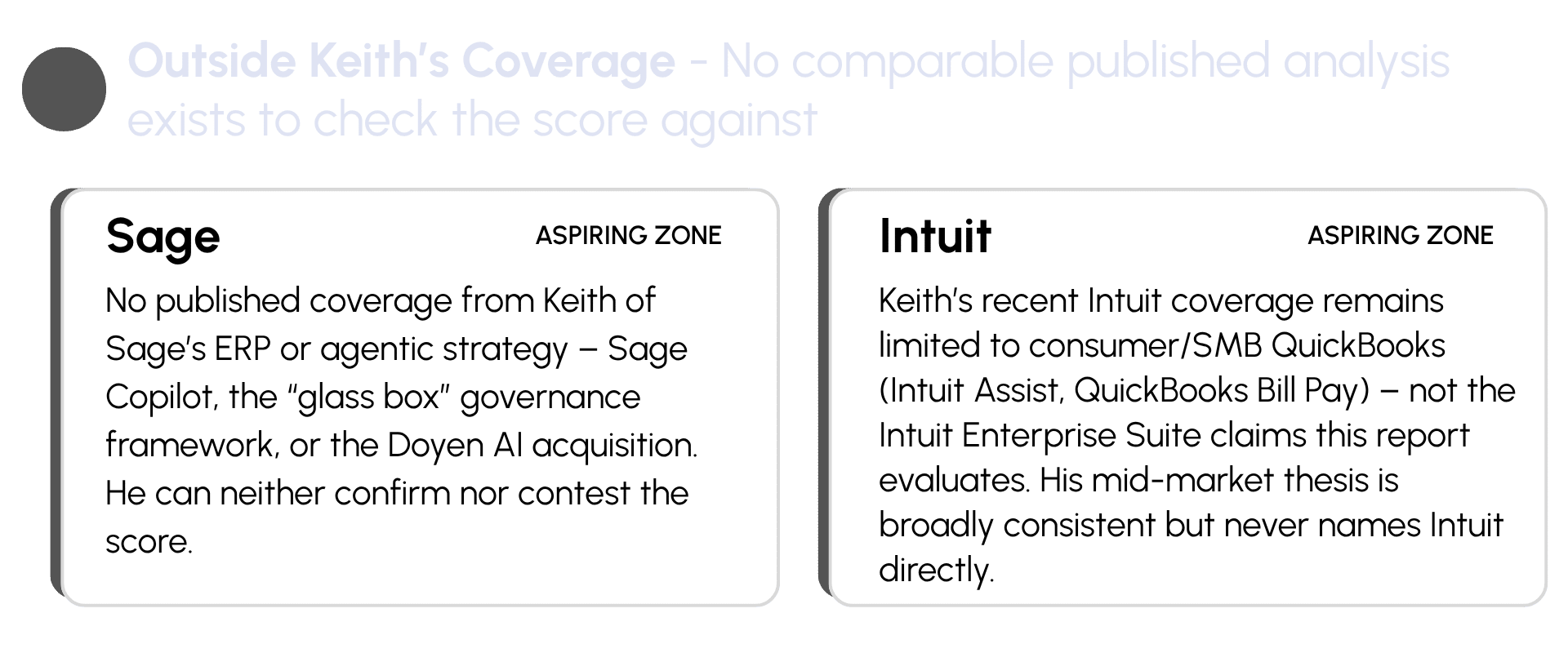
I’ll say plainly where I don’t have standing to grade the Signal’s work. I haven’t published a piece specifically assessing Sage’s ERP or agentic strategy, including Sage Copilot, the “glass box” governance framework, and the Doyen AI acquisition, so I can neither confirm nor contest its Aspiring-zone score. My recent Intuit coverage has stayed on the consumer and SMB side of QuickBooks, including Intuit Assist and QuickBooks Bill Pay, rather than the Intuit Enterprise Suite that this report evaluates. The closest thing I have is my own vendor-agnostic thesis on the mid-market, where I’ve argued buyers in the $500M–$1B band “want enterprise-grade outcomes without enterprise complexity” and reward modular pricing and fast time-to-value. That’s broadly consistent with the upmarket story the Signal tells for both vendors, but I never named either one in that piece, so it’s supportive context at best, not a confirmation of the specific scores.
What to Watch
- Whether Microsoft’s Dataverse and governance story catches up to the Elite-zone score it’s just been given, or whether the “real-world performance gap” I’ve flagged shows up in the next earnings cycle.
- Whether Oracle and NetSuite convert “platform-first” positioning into audited, third-party-verifiable ROI on the timeline I’ve set – 2027 for NetSuite specifically – or whether this Leader-zone standing turns out to be provisional.
- Whether Infor’s Agentic Orchestrator and 100-plus-agent library earn the same scrutiny I gave its earlier Ask ChatGPT widget, once I’ve had a chance to dig into it directly.
- Whether I end up writing dedicated coverage of Sage’s and Intuit’s ERP ambitions so the next version of this Signal has my own published record to check against, the way SAP and Epicor already do.
You can find more information on the Signal Report on ERP Platforms on the Futurum website.
Disclosure: This report reflects Keith Kirkpatrick’s own analysis and opinions, checked against prior published coverage on futurumgroup.com. It does not speak for the Futurum Research or the Futurum Intelligence teams that produced the underlying Signal report, and it is subject to revision as the vendors covered here report new results.
Disclosure: Futurum is a research and advisory firm that engages or has engaged in research, analysis, and advisory services with many technology companies, including those mentioned in this article. The author does not hold any equity positions with any company mentioned in this article.
Analysis and opinions expressed herein are specific to the analyst individually and data and other information that might have been provided for validation, not those of Futurum as a whole.
Sources & Other Insights from Futurum
Referenced in this note, in order of appearance:
- Futurum Signal | ERP Platforms (July 25, 2026)
- Can NetSuite’s Agentic ERP Model Survive the SaaS Apocalypse and Win the Next AI Platform War?
- Oracle’s Fusion Agentic Apps: Can Platform-First AI Finally Deliver Enterprise ROI?
- Oracle Bets on Outcome-Driven AI Agents, But Will Enterprises Buy the Vision?
- Microsoft Introduces New Agents and Benchmarks for Dynamics 365
- SAP Q1 FY 2026 Earnings Show Cloud ERP Suite Acceleration
- Can SAP’s AI-Native North Star Architecture Redefine the Autonomous Enterprise?
- Epicor Prism’s Cognitive ERP Push: Can Embedded AI Agents Redefine Manufacturing Outcomes?
- Can Epicor’s 90-Day Cloud ERP Promise Reset Buyer Expectations for Speed and Value?
- IFS’s 25% Growth: A Sign of Industrial AI’s Rising Strength?
- Will IFS’ Acquisition of Softeon Help Attract New Supply Chain Customers?
- Infor Announces Ask ChatGPT Widget Using OpenAI APIs
- Workday Q4 FY 2026 Earnings Mark AI Agent Push Amid Slight Outlook Miss
- Agentic AI: Workday’s Enterprise Opportunity—and Challenge (Guy Currier)
- Who Will Win the Agent Orchestration Layer Battle?
- Will Vendors Enable More Complex Agentic Workflows in 2026?
- Was 2025 Really the Year of Agentic AI, or Just More Agentic Hype?
- Market Insight Report: Breaking Down Generic versus Specialized ERP Software
- Is the Mid-Market the Sweet Spot for Enterprise Software Companies?
Author Information

Keith Kirkpatrick is VP & Research Director, Enterprise Software & Digital Workflows for The Futurum Group. Keith has over 25 years of experience in research, marketing, and consulting-based fields.
He has authored in-depth reports and market forecast studies covering artificial intelligence, biometrics, data analytics, robotics, high performance computing, and quantum computing, with a specific focus on the use of these technologies within large enterprise organizations and SMBs. He has also established strong working relationships with the international technology vendor community and is a frequent speaker at industry conferences and events.
In his career as a financial and technology journalist he has written for national and trade publications, including BusinessWeek, CNBC.com, Investment Dealers’ Digest, The Red Herring, The Communications of the ACM, and Mobile Computing & Communications, among others.
He is a member of the Association of Independent Information Professionals (AIIP).
Keith holds dual Bachelor of Arts degrees in Magazine Journalism and Sociology from Syracuse University.