Analyst(s): Brendan Burke
Publication Date: August 14, 2026
Coherent Q4 FY 2026 earnings show how AI datacenter demand is shifting the company’s center of gravity toward optical connectivity, integrated optics, and photonics manufacturing capacity. The quarter also shows that industrial softness remains a drag, even as datacenter and communications demand support a stronger FY 2027 setup.
What Is Covered in This Article:
- Coherent’s Q4 FY 2026 financial results
- AI datacenter optics demand acceleration
- Indium phosphide capacity expansion progress
- Integrated optics and OCS ramp
- US manufacturing footprint and industrial optionality
- Guidance and Final Thoughts
The News: Coherent Corp. (NYSE: COHR) reported Q4 FY 2026 revenue of $2.05 billion, up 34% year over year (YoY), above Wall Street consensus of $1.99 billion. Datacenter and Communications revenue was $1.62 billion, up 58.6% YoY, while Industrial revenue was $430.5 million, down 15.8% YoY. Non-GAAP operating income was $445.8 million, up 62.1% YoY, and non-GAAP operating margin was 21.8%, up 381 basis points YoY. Non-GAAP net earnings attributable to Coherent were $351.2 million, up 82.7% YoY. Non-GAAP diluted earnings per share was $1.74, compared with $1.00 in Q4 FY 2025. For FY 2026, revenue was $7.12 billion, up 22.5% YoY, and non-GAAP diluted earnings per share was $5.61, up from $3.53 in FY 2025.
On a pro forma basis, which excludes the aerospace and defense business and the Munich, Germany product division divested during the year, Q4 revenue rose 14% sequentially, and 42% YoY, and FY 2026 revenue rose 28%. On the earnings call, management said the quarter produced another record bookings result, with fiscal 2027 effectively booked out, customer orders now extending into calendar 2028, and long-term agreements (LTAs) running through the end of the decade. CEO Jim Anderson said Coherent expects to reach its first quarter with more than $3 billion of revenue by the end of fiscal 2027, following its first $2 billion quarter in Q4 FY 2026.
“AI runs on compute, but it scales on optical connectivity,” said Jim Anderson, CEO of Coherent. “Coherent is at the center of an extraordinary expansion in optical networking infrastructure driven by the rapid growth of AI, the transition from copper to optical connectivity, and the increasing need for bandwidth and energy efficiency across increasingly large and complex data center architectures.”
Coherent Q4 FY 2026 Earnings: 1.6T Transceivers Ramp, CPO Revenue Approaches
Analyst Take: Coherent’s Q4 FY 2026 results show a company increasingly shaped by AI datacenter buildouts and the move away from copper connectivity. The main story is not only the revenue beat, but the depth of demand visibility tied to optical transceivers, optical circuit switching, co-packaged optics, near-packaged optics, and multi-rail systems. Industrial softness remains a constraint on the consolidated profile, but the Datacenter and Communications segment now carries enough weight to define the company’s strategic direction. The next phase depends on how quickly Coherent can turn demand into supply through indium phosphide capacity, 1.6T ramps, and new integrated optics platforms.
AI Datacenter Optics Becomes the Core Growth Engine
Datacenter and Communications accounted for 79% of Q4 FY 2026 revenue, making it the company’s main growth engine rather than one segment among several. Within the datacenter, revenue rose 24% sequentially and 66% YoY, the third consecutive quarter of double-digit sequential growth, with 800G still growing and 1.6T adoption moving faster across customers. Anderson said the 1.6T ramp has pulled in relative to the company’s view three months ago. Communications revenue rose 11% sequentially and 56% YoY, supported by data center interconnect (DCI), ZR and ZR Plus transceivers, pump lasers, and optical subsystems.
The customer order profile now extends into calendar 2028, while LTAs run through the end of the decade and typically carry rising annual volumes, minimum take-or-pay commitments, and agreed pricing for the life of the agreement. That structure gives Coherent visibility on price as well as volume, which matters in a market where laser pricing is a live debate. Management said it sees no signs of attenuation in customer demand. The visibility reduces near-term demand uncertainty, but it raises the bar for manufacturing execution. Coherent’s competitive position in FY 2027 will be determined more by output capacity than by market access.
Six-Inch Indium Phosphide Capacity Sets the Supply Ceiling
Indium phosphide remains the main internal supply constraint, particularly for 800G and 1.6T transceivers. Anderson was explicit that assembly and test capacity is not the bottleneck, which places the ceiling on datacenter revenue squarely on laser output. Coherent produced about 80% more indium phosphide lasers in the June quarter year-over-year, and because those lasers convert into transceiver shipments in the following quarter, management pointed to that figure as a floor for expected datacenter growth in Q1 FY 2027.
The company remains on track to double internal indium phosphide output by the end of the current quarter, one quarter ahead of its original plan, and plans to more than double output again by the end of calendar 2027, with substrates and other inputs already secured. Additional capacity beyond 2027 is being planned. Six-inch production in Texas and Sweden is producing electro-absorption modulated lasers (EMLs), continuous-wave (CW) lasers, and photodiodes with yields above the legacy three-inch lines, and a third six-inch site in Zurich is scheduled to come online in the first half of calendar 2027.
The cost math is the bigger point: CFO Sherri Luther noted that a six-inch wafer yields roughly four times the output of a three-inch wafer at about half the cost, so the transition is both a revenue unlock and a structural gross margin lever. Texas has also begun ramping the ultra-high-power CW laser used in co-packaged optics solutions, including those tied to Coherent’s NVIDIA partnership, with production wafers already started for December quarter shipments.
Integrated Optics and OCS Expand the Content Opportunity
Coherent is widening its addressable opportunity beyond pluggable transceivers through optical circuit switching (OCS), co-packaged optics (CPO), near-packaged optics (NPO), and related integrated optics platforms. OCS revenue increased sequentially in Q4 FY 2026, and Coherent now sees more than $4 billion of addressable opportunity across DCI, scale-out, and scale-up networks, a figure doubled at OFC earlier this year and one management suggested may still prove conservative.
Demand is broadening from scale-out into scale-across and scale-up, with production expanding across two manufacturing locations and the 320×320 platform anchoring the lineup. CPO, NPO, and other integrated optics formats represent more than $15 billion of incremental addressable market opportunity over the coming years, with initial CPO revenue expected in the December quarter and CPO for scale-up applications expected to begin contributing in the second half of calendar 2027. Anderson said engagement intensity across CPO and NPO has risen sharply over the past three to six months, that essentially every large strategic customer has a CPO or NPO program underway, and that content per socket is comparable across both form factors because Coherent supplies the laser, external laser module, isolators, polarization-maintaining fiber, fiber-attach assembly, and silicon photonics PICs rather than a single component.
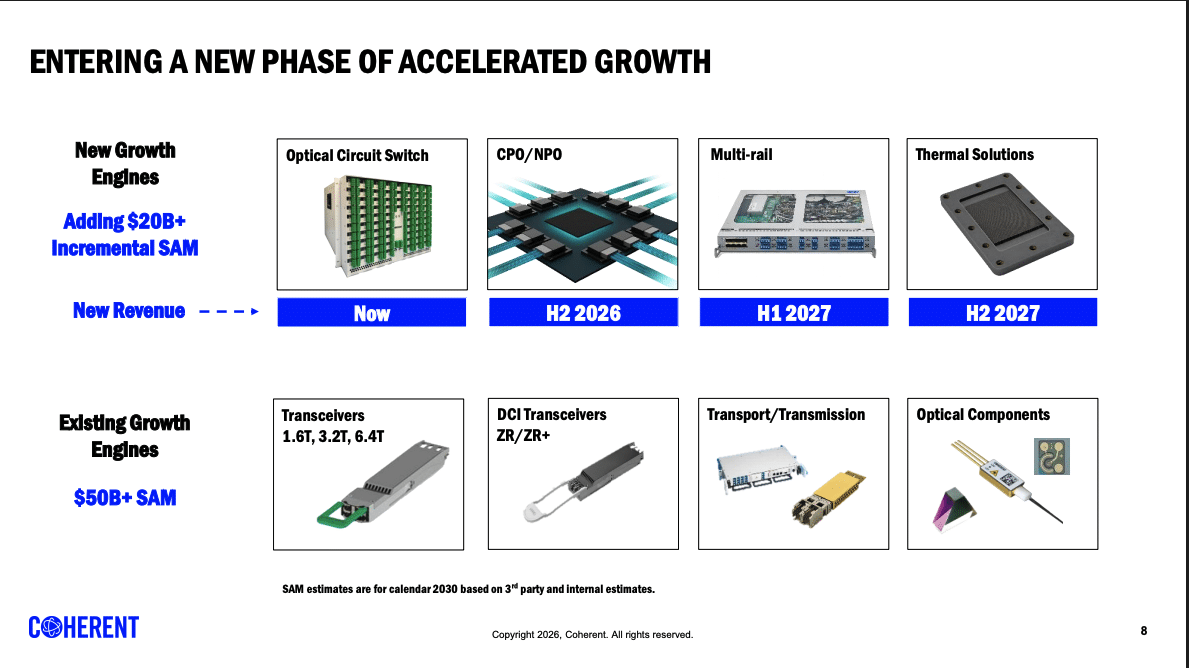
The company’s 200G VCSEL is positioned for NPO-style integrated optics applications as well. PhotonLink, the company’s integrated optics platform, covers light generation, beam shaping, transmission, detection, and electrical conversion around the XPU or switch chip, and will be unveiled at ECOC with a launch event on September 21, with initial PhotonLink-related revenue expected in the December quarter. Coherent also sees multi-rail systems as a more than $2 billion addressable market by calendar 2030, with samples already delivered to multiple customers and initial revenue expected in the first half of calendar 2027. The strategic value is content expansion inside AI network architectures, not just faster transceiver refresh cycles.
US Manufacturing Footprint Becomes a Commercial Catalyst
Industrial revenue was roughly flat on a pro forma basis for both Q4 and FY 2026, with semiconductor and display capital equipment growing sequentially and YoY against continued weakness in broader industrial markets. Management expects growth to resume over the coming quarters, led by semiconductor capital equipment, where bookings are strengthening. The more interesting industrial development is adjacent to the datacenter story: Coherent has delivered samples of its proprietary Thermadite thermal material for XPU cooling and expects revenue to begin ramping in the second half of calendar 2027, which pulls the segment into the same AI infrastructure demand cycle driving the rest of the business.
Separately, reported deliberations over US import restrictions on optical transceivers have already changed customer conversations. Anderson described the reports as speculative but confirmed that multiple customers have reached out to discuss manufacturing options, and said Coherent would be open to expanding US transceiver production if needed. With more than 20 US production facilities, including the Sherman, Texas site making critical components for transceivers, CPO, and NPO, as well as domestic fiber optic cable and garnet production for isolators, Coherent enters that discussion from a stronger position than most competitors. Supply chain geography is becoming a commercial variable in optics, not just a resilience consideration.
Guidance and Final Thoughts
Coherent guided Q1 FY 2027 revenue of $2.2 billion to $2.4 billion, above Wall Street consensus of $2.15 billion. The company expects Q1 FY 2027 non-GAAP gross margin of 39.5% to 41.5%, non-GAAP operating expenses of $400 million to $420 million, a non-GAAP tax rate of 18% to 20%, and non-GAAP earnings per share of $1.85 to $2.05. Management expects growth to accelerate in FY 2027 and to deliver a quarter above $3 billion in revenue by the end of the fiscal year, with EPS again growing faster than revenue. Luther reiterated the target of gross margin above 42%, noting that gross margin has expanded in eight of the past nine quarters for a cumulative gain of more than 660 basis points, and that the bulk of the six-inch indium phosphide ramp and the new product ramps in 1.6T, OCS, CPO, multi-rail, and thermal management are still ahead.
Operating expenses at the midpoint of the Q1 guide are already below the company’s 18% target model, leaving flow-through leverage on top of gross margin expansion. Capital intensity is the tradeoff: capex was $556 million in Q4, up from $290 million in Q3 and $131 million a year ago, and is expected to increase sequentially again in Q1, though Coherent cites roughly an 18-month payback on datacenter investments and exited FY 2026 with debt leverage at 0.7x, down from 2x. Industrial demand remains the primary offset to the stronger Datacenter and Communications trajectory. If Coherent can execute its capacity ramp while maintaining yields and capturing higher optical content per AI system, then FY 2027 should reinforce the company’s position as a key supplier to next-generation AI connectivity architectures.
See the full press release on Coherent’s Q4 FY 2026 financial results on the company website.
Declaration of generative AI and AI-assisted technologies in the writing process: This content has been generated with the support of artificial intelligence technologies. Due to the fast pace of content creation and the continuous evolution of data and information, The Futurum Group and its analysts strive to ensure the accuracy and factual integrity of the information presented. However, the opinions and interpretations expressed in this content reflect those of the individual author/analyst. The Futurum Group makes no guarantees regarding the completeness, accuracy, or reliability of any information contained herein. Readers are encouraged to verify facts independently and consult relevant sources for further clarification.
Disclosure: Futurum is a research and advisory firm that engages or has engaged in research, analysis, and advisory services with many technology companies, including those mentioned in this article. The author does not hold any equity positions with any company mentioned in this article.
Analysis and opinions expressed herein are specific to the analyst individually and data and other information that might have been provided for validation, not those of Futurum as a whole.
Read the full Futurum Group Disclosure.
Other Insights From Futurum:
Coherent Q3 FY 2026: AI Data Center Demand Accelerates Optical Growth
Coherent’s $23 Billion Growth Opportunity Lifted by NVIDIA’s Optical Ambitions
Is Intel’s $20 Billion Stock Offering Enough to Tool a 14A Fab?
Featured Image: Coherent
Author Information

Brendan is Research Director, Semiconductors, Supply Chain, and Emerging Tech. He advises clients on strategic initiatives and leads the Futurum Semiconductors Practice. He is an experienced tech industry analyst who has guided tech leaders in identifying market opportunities spanning edge processors, generative AI applications, and hyperscale data centers.
Before joining Futurum, Brendan consulted with global AI leaders and served as a Senior Analyst in Emerging Technology Research at PitchBook. At PitchBook, he developed market intelligence tools for AI, highlighted by one of the industry’s most comprehensive AI semiconductor market landscapes encompassing both public and private companies. He has advised Fortune 100 tech giants, growth-stage innovators, global investors, and leading market research firms. Before PitchBook, he led research teams in tech investment banking and market research.
Brendan is based in Seattle, Washington. He has a Bachelor of Arts Degree from Amherst College.