Analyst(s): Fernando Montenegro
Publication Date: June 16, 2025
What Is Covered in This Article:
- Summary of main announcements from Cisco Live
- Cisco’s strategic positioning for the agentic AI era
- Integration of security capabilities into network infrastructure architecture
- Corporate reorganization and unified platform strategy execution
- Market positioning and future business transformation opportunities
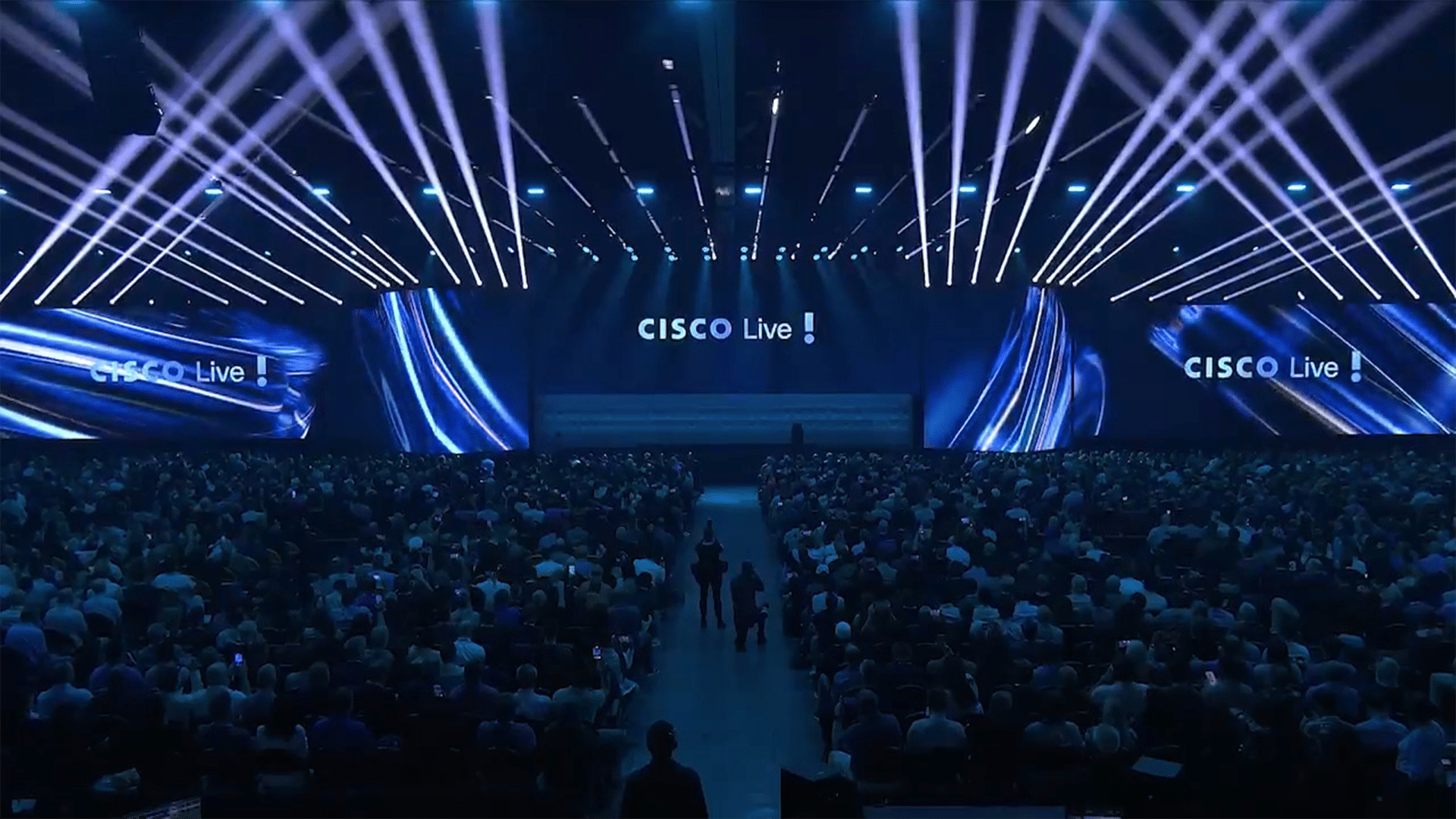
The Event—Major Themes & Vendor Moves: Last week, Cisco held its headline customer event, Cisco Live US, in San Diego, bringing together over 20,000 practitioners, company executives, partners, and more. The event became the showcase for the company to demonstrate progress on its recent reorganization, during which it consolidated several product groups under the leadership of Jeetu Patel, now President and Chief Product Officer, working very closely with Chuck Robbins, CEO and Chairman.
Patel and his team announced many innovations centered on the massive tailwind the company sees in modernizing AI, notably the transition to the “Agentic AI” era. This comes from the reality that the move to AI, particularly autonomous agents, increases the importance of the network and the security stack, and that there are benefits to having security integrated into the network fabric.
Dozens of announcements spanned the company’s operational practices and portfolio, from silicon to software, and were framed around helping customers build data centers and workplaces for the new demands of agentic AI, not to mention maintaining digital resilience. The company sees the AI momentum as it highlighted its partnership with NVIDIA and announced it had surpassed its $1 billion AI infrastructure order target from hyperscalers.
Cisco is referring to the new strategy as AgenticOps, which underpins an AI-driven approach to simplify IT overall. A key example of this was the demonstration of the Cisco AI Canvas, a generative user interface for troubleshooting with AI, widely used to bring together different Cisco products to accelerate the workflow for network engineers. Cisco also touted its Deep Network Model, a domain-specific LLM trained on Cisco’s proprietary data. This focus on simplification was also reflected in announcements such as the unification of management for Catalyst and Meraki, and the merging of Nexus OS and ACI fabrics, or the release of Security Cloud Control for easier management of firewall policies, including third-party firewalls.
On the security front, Cisco highlighted the Cisco Hybrid Mesh Firewall, a distributed firewall architecture that works with its Hypershield technology for deeper, distributed segmentation. It also announced new Secure Firewall 6100 and 200 series appliances. This is complemented by Universal Zero Trust Network Access (ZTNA), which extends identity-based policy to users, devices, and AI agents. The company also highlighted how its AI Defense product strategy covers different use cases of AI usage. As it positions the benefits of its broader platform strategy, Cisco also announced practical considerations such as no-cost Splunk log ingestion for Cisco Firewall logs.
Cisco Builds Its Platform on the Tailwinds of Agentic AI and Secure Networking
Analyst Take: The event turned out to be a strong showcase for Cisco’s organizational transformation and the broader secure networking message, particularly in this age of AI. For each of the main themes we’ve observed — AI and security — Cisco has presented a position that plays to its strengths.
The rise of AI, particularly agentic workflows, is a key tailwind. Cisco’s proposed world view is that agentic workflows fundamentally change how computing and networking must adapt to the underlying technologies. Of particular interest are the demands for high-capacity networking inside AI clusters, or the need for modern AI inference workloads that require much more throughput than traditional machine learning methods.
The company has also offered its own experience with agentic, a broad project aimed at using agentic capabilities to improve the customer experience for its customer base, which opens nearly 1.6 million support cases annually.
The shift to agentic AI is both realistic and imminent. Still, its success also hinges on more than just robust infrastructure, with enterprises needing to develop systems for governance and security, particularly agent verification and control. This plays to the other key pillar of Cisco’s strategy: deeper integration of security capabilities into the network itself.
The event emphasized a multi-layered security approach, always with a view towards a broader platform and improving efficiencies. The foundation is fusing security into the network fabric via the Hypershield and Hybrid Mesh Firewall capabilities, notably using security deep inside the new “Smart Switches” that can enforce policy at the port. The second layer is AI Defense, which tackles use cases such as secure usage of AI services and the security of the AI models and pipelines. The third layer is a broader view of security services at the edge, particularly with Universal ZTNA and others aiming to apply consistent, least-privilege access policies to humans, devices, and the new autonomous agents.
Cisco’s revamp of its overall security portfolio, coupled with the enhancements with Duo for identity and access management, Thousand Eyes and Splunk for observability, and Talos for threat research, offers a balanced set of capabilities that can appeal to practitioners and executives looking for deeper integration between security and networking.
What to Watch:
- Part and parcel of the evolution of AI usage is business transformation. In that context, how well will Cisco be able to position itself as the strategic partner of choice for services organizations delivering on these transformation projects?
- How impactful will the evolution of AI usage within Cisco—CX agents, AI Canvas, DeepNet model, and other technologies be on business and delivery metrics?
- How will the company navigate go-to-market strategies that need to balance a deeper commitment to the platform vision with the existing commercial opportunities for refresh and new initiatives, particularly in the current economic and geopolitical uncertainties?
- The Splunk acquisition provided Cisco with a massive opportunity to deploy deeper security capabilities inside enterprises, and the ongoing evolution of Splunk’s security portfolio will be key to watch.
The main Cisco press release related to Cisco Live is available at the press release section of its news site.
Declaration of generative AI and AI-assisted technologies in the writing process: This content has been generated with the support of artificial intelligence technologies. Due to the fast pace of content creation and the continuous evolution of data and information, The Futurum Group and its analysts strive to ensure the accuracy and factual integrity of the information presented. However, the opinions and interpretations expressed in this content reflect those of the individual author/analyst. The Futurum Group makes no guarantees regarding the completeness, accuracy, or reliability of any information contained herein. Readers are encouraged to verify facts independently and consult relevant sources for further clarification.
Disclosure: Futurum is a research and advisory firm that engages or has engaged in research, analysis, and advisory services with many technology companies, including those mentioned in this article. The author does not hold any equity positions with any company mentioned in this article.
Analysis and opinions expressed herein are specific to the analyst individually and data and other information that might have been provided for validation, not those of Futurum as a whole.
Read the full Futurum Group Disclosure.
Other Insights From Futurum:
Cisco Q3 FY 2025 Sees 20% Order Growth, AI Demand Hits Key Milestone
RSAC 2025: Cisco Raises the AI Security Stakes
Cisco AI Defense: Checking the Reckless Charge Toward AI
Image Credit: Cisco
Author Information

Fernando Montenegro serves as the Vice President & Practice Lead for Cybersecurity & Resilience at The Futurum Group. In this role, he leads the development and execution of the Cybersecurity research agenda, working closely with the team to drive the practice's growth. His research focuses on addressing critical topics in modern cybersecurity. These include the multifaceted role of AI in cybersecurity, strategies for managing an ever-expanding attack surface, and the evolution of cybersecurity architectures toward more platform-oriented solutions.
Before joining The Futurum Group, Fernando held senior industry analyst roles at Omdia, S&P Global, and 451 Research. His career also includes diverse roles in customer support, security, IT operations, professional services, and sales engineering. He has worked with pioneering Internet Service Providers, established security vendors, and startups across North and South America.
Fernando holds a Bachelor’s degree in Computer Science from Universidade Federal do Rio Grande do Sul in Brazil and various industry certifications. Although he is originally from Brazil, he has been based in Toronto, Canada, for many years.