Analyst(s): Brad Shimmin
Publication Date: May 8, 2026
What is Covered in This Article:
- The technical evolution of RaptorDB Pro into a Hybrid Operational and Analytical Processing (HOAP) engine.
- How the new Context Engine serves as a semantic mapping layer to provide autonomous AI with institutional logic.
- The role of the Workflow Data Fabric is to unify disparate enterprise data sources without traditional data movement.
- The strategic significance of the Model Context Protocol (MCP) Registry for governed agentic execution.
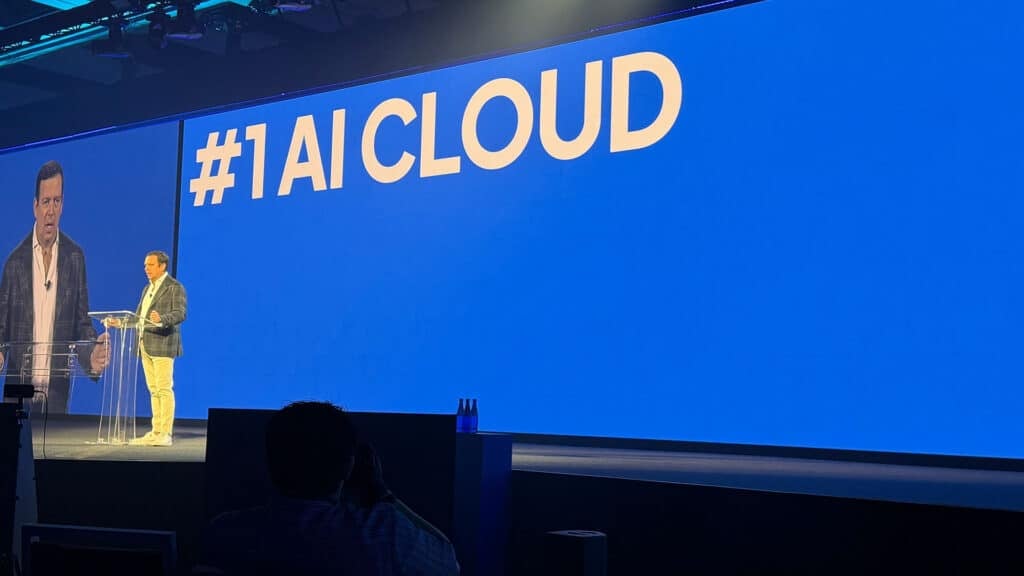
The Event — Major Themes & Vendor Moves: At Knowledge 2026, ServiceNow unveiled a comprehensive overhaul of its underlying data architecture, signaling a transition from a workflow-centric system of record to a high-velocity execution environment for autonomous agents. The announcement centers on the ServiceNow autonomous AI foundation, a suite of technologies designed to eliminate the latency between data insight and business action. By integrating its Context Engine and an upgraded RaptorDB Pro, ServiceNow is attempting to solve the data fragmentation that has historically limited AI to simple recommendations rather than autonomous execution.
The event highlighted several key architectural shifts, most notably the move toward a live data environment that connects internal service records with external systems through a new Workflow Data Fabric. ServiceNow also introduced a standardized Model Context Protocol (MCP) Registry to ensure connections to external services and data sources remain secure and governed. This move is punctuated by the new Workflow Data Network Partner Passport program, starting with IBM and Boomi, aimed at simplifying how enterprises integrate these capabilities into their existing environments. The underlying message is straightforward: the era of moving data to a centralized warehouse for analysis is being challenged by a platform that can analyze and act on data exactly where it lives.
Can ServiceNow’s Autonomous AI Foundation Finally End the Enterprise ETL Tax?
Analyst Take: The most significant technical hurdle for enterprise AI has always been the structural separation of operational databases and analytical warehouses. For decades, organizations have paid a heavy ETL tax, spending vast resources moving data from the systems where work happens to the systems where it is studied. ServiceNow is taking a direct swipe at this inefficiency with its ServiceNow autonomous AI foundation. By rearchitecting RaptorDB Pro as a Hybrid Operational and Analytical Processing (HOAP) engine, the company is looking to collapse these two worlds into a singular, high-performance execution layer.
The Live Perform capability represents a sophisticated technical achievement. It allows the platform to handle both operational and analytical workloads simultaneously on a single database, delivering real-time insights with no performance trade-offs. This eliminates the need to wait for nightly batch processing or complex data pipelines to finish before an AI can understand the current state of the business. In an environment where an autonomous agent needs to make a sub-second decision about a security threat or a service disruption, this lack of latency is a prerequisite for success. RaptorDB Pro essentially provides the high-velocity heartbeat that autonomous agents require to move from observation to action.
Mapping Institutional Logic
While the database provides the performance, the company’s newly introduced Context Engine provides the intelligence. Most autonomous agents fail in the enterprise because they lack a mental map of how the organization actually functions. They might see a server is down, but they do not necessarily understand who owns that server, which business processes rely on it, or what the governing compliance policies are for taking it offline. The Context Engine solves this by functioning as a live, evolving map of enterprise relationships.
This engine acts as a sophisticated semantic layer, mapping the defintion of and connections between assets, people, roles, services, and policies in real time. By incorporating advanced querying technology from the Pyramid Analytics acquisition, ServiceNow is enabling autonomous data analytics, where any person or agent can query the entire enterprise data estate in plain language. This allows an AI agent to operate with the same institutional logic as a seasoned employee. According to the Futurum Group’s 1H 2026 Data Intelligence, Analytics, and Infrastructure Market Sizing & Five-Year Forecast Report, enterprises that successfully implement a unified semantic layer see significantly higher rates of AI project success compared to those relying on fragmented data silos. By embedding this layer directly into the workflow engine, ServiceNow is giving its agents a degree of situational awareness that external, disconnected LLMs simply cannot replicate.
Challenging the Data Gravity of Warehouses
ServiceNow is making a bold play to increase its own data gravity at the expense of traditional cloud data warehouses. For years, the industry narrative has insisted that all data must eventually flow into a central repository to be useful. This ServiceNow autonomous AI foundation suggests a different path. If the platform where the work is already happening—IT, HR, Customer Service—can also handle the analytical heavy lifting through capabilities like Live Connect and Live Archive, the need to move that data elsewhere begins to diminish.
This is a disruptive move that puts ServiceNow on a collision course with specialized data intelligence platforms. However, ServiceNow has the home-field advantage of being already embedded in the mission-critical workflows of the world’s largest companies. This strategy focuses on execution-ready data rather than storage-ready data. This distinction will likely resonate with CIOs tired of high egress fees and the brittle complexity of maintaining massive, centralized data lakes that often serve as graveyards for actionable intelligence.
Governing with MCP
The introduction of the Model Context Protocol (MCP) Registry might be the least flashy part of the announcement, but it is perhaps the most vital for long-term enterprise adoption. Autonomous agents are essentially useless if they cannot talk to external data and tools, yet every new connection represents a potential security vulnerability. By creating a private, governed catalog of approved MCP servers, ServiceNow is creating a standardized handshake for the agentic era.
This registry ensures that when an agent connects to a repository or a third-party service, it does so within the strict boundaries of enterprise security policies. This pragmatic approach to governance is what separates an experimental tool from a serious enterprise platform. It addresses the shadow AI problem before it starts, giving IT departments the control they need without stifling the autonomy that makes these new AI models so promising. It is a necessary safeguard that allows the “playful” side of AI innovation to coexist with the “serious” side of enterprise risk management.
The CMDB Bottleneck
Despite the technical prowess of these new tools, a significant risk remains, namely the data debt inherent in legacy enterprise environments. The ServiceNow autonomous AI foundation and its Context Engine are only as effective as the underlying data they are mapping. Most organizations still struggle with stale Configuration Management Databases (CMDBs) and fragmented service maps.
If the initial mapping is flawed, the autonomous agents will not solve problems. They will simply automate errors at a much higher velocity. This is a pragmatic reality check that every executive must face. The ServiceNow foundation provides the plumbing and the logic, but the enterprise must still provide the truth. Organizations must be honest about their current data health before turning these autonomous systems loose. The promise of executive AI is real, but the path to achieving it requires a disciplined approach to data hygiene that no software can entirely automate – at least for now.
What to Watch:
- Watch for the speed at which MCP is adopted by other SaaS vendors. If the standard gains traction outside of traditional agentic data acquisition, ServiceNow’s registry could become the de facto control point for all enterprise agents.
- Monitor how traditional data warehouse providers respond to the rise of HOAP-capable platforms that reduce the need for external data movement for operational AI.
- Observe whether enterprises prioritize cleaning up their legacy CMDB data to take full advantage of the Context Engine, or if they attempt to let the AI brute-force its way through messy data environments.
- Track the expansion of the Workflow Data Network Partner Passport program to see if more integration specialists join IBM and Boomi in building pre-packaged connectors.
You can read the full press release at ServiceNow’s newsroom.
Disclosure: Futurum is a research and advisory firm that engages or has engaged in research, analysis, and advisory services with many technology companies, including those mentioned in this article. The author does not hold any equity positions with any company mentioned in this article.
Analysis and opinions expressed herein are specific to the analyst individually and data and other information that might have been provided for validation, not those of Futurum as a whole.
Other Insights From Futurum:
Can Databricks Out-Iceberg the Competition?
Author Information

Brad Shimmin is Vice President and Practice Lead, Data Intelligence, Analytics, & Infrastructure at Futurum. He provides strategic direction and market analysis to help organizations maximize their investments in data and analytics. Currently, Brad is focused on helping companies establish an AI-first data strategy.
With over 30 years of experience in enterprise IT and emerging technologies, Brad is a distinguished thought leader specializing in data, analytics, artificial intelligence, and enterprise software development. Consulting with Fortune 100 vendors, Brad specializes in industry thought leadership, worldwide market analysis, client development, and strategic advisory services.
Brad earned his Bachelor of Arts from Utah State University, where he graduated Magna Cum Laude. Brad lives in Longmeadow, MA, with his beautiful wife and far too many LEGO sets.