Analyst(s): Nick Patience
Publication Date: September 9, 2026
What Is Covered in This Article:
- Equinix’s first Horizon customer event and its two flagship launches, Fabric One and Inference Exchange
- How NVIDIA and Together AI fit into the Inference Exchange partnership, and who actually owns the GPUs
- Why Equinix’s stock has swung from a laggard to one of the AI infrastructure sector’s strongest performers over the past year
- What “neutral by design” means as a strategy, and where it runs into limits
- How Equinix is pitching sustainability and community investment as part of the same AI buildout story
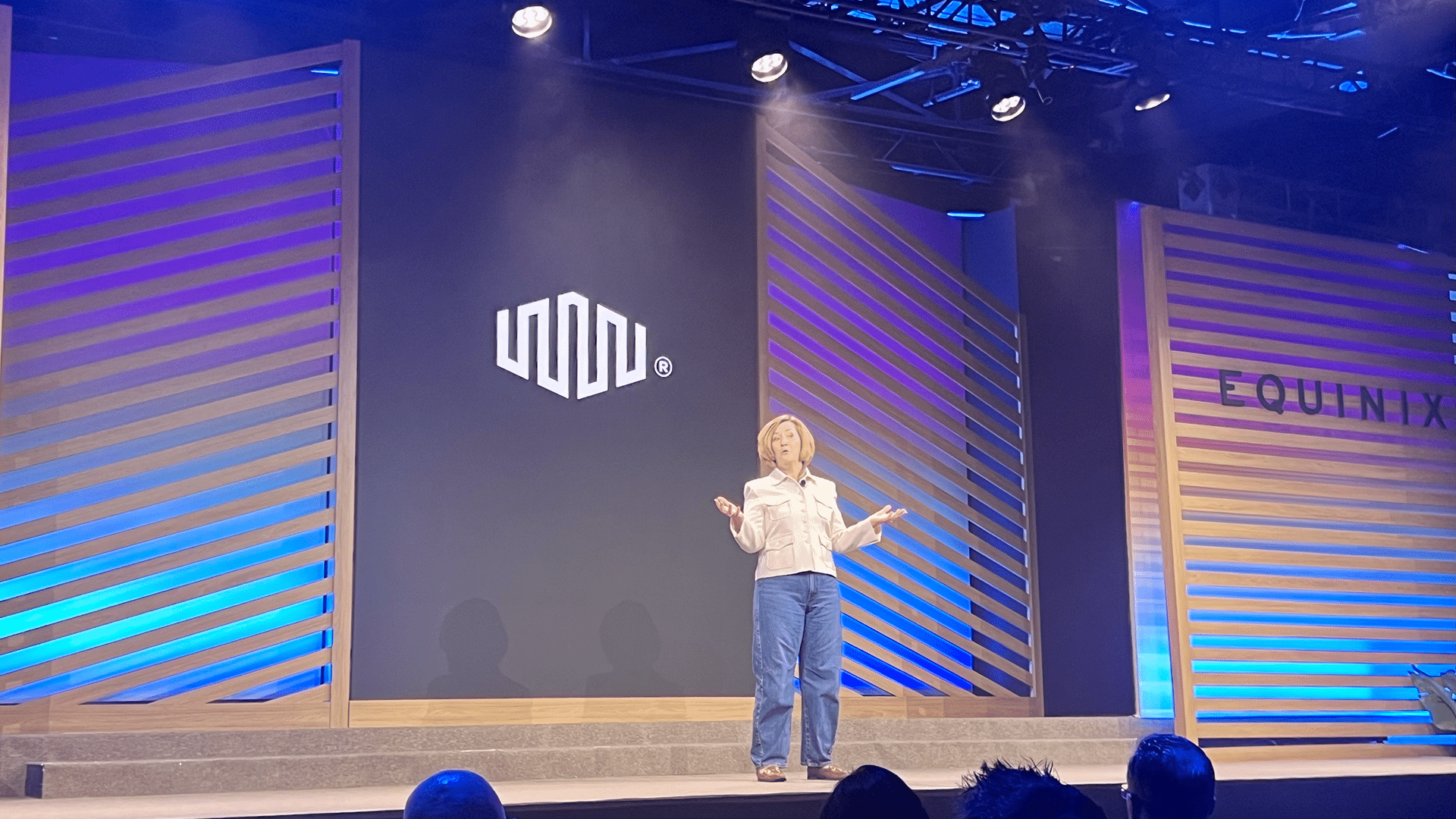
The Event—Major Themes & Vendor Moves: Equinix held its first Horizon customer event on September 2 in San Francisco, following an analyst summit the day before, built around two product launches and a keynote pairing CEO Adaire Fox-Martin with NVIDIA CEO Jensen Huang.
Fox-Martin traced a lineage of neutral exchanges, from Mesopotamian trade clearing houses through the Athens agora, Amsterdam’s stock exchange, and Wall Street, positioning Equinix as their AI-era equivalent. She cited four forces reshaping enterprise infrastructure: compute fragmenting across an estimated 50 to 70 distinct providers by 2030, network traffic shifting from human-initiated to machine-to-machine, AI token costs becoming a board-level concern, and data sovereignty becoming a design requirement rather than an afterthought. Equinix says it already connects more than 60% of the Fortune 2000, across 282 data centers in 77 metros and 36 countries, with more than 522,000 interconnections between customers.
Other Equinix executives put the same shift in economic terms: a typical enterprise already reaches roughly 20 clouds across six categories; within four years, that grows to around 50 clouds across 15, as neoclouds, model clouds, GPU-as-a-service providers, sovereign clouds, and agent-orchestration platforms multiply. Connecting to each individually, invoking Metcalfe’s Law, means costs that grow geometrically with the number of endpoints, an “AI cloud tax,” Equinix’s connect-once model is built to avoid.
Equinix launched two products at the event. Equinix Fabric One is an intent-based connectivity service, built, Equinix says, in five months: customers describe a desired outcome rather than specifying routers, ports, and bandwidth manually, and the network configures itself. Executives stressed it’s additive, not a replacement: existing Fabric ports, virtual connections, and cloud routers are unchanged underneath it. AWS and Google Cloud are lead integration partners, with Geo Zones handling data-sovereignty enforcement. Fabric One previews with design customers in the fourth quarter of 2026 and reaches general availability in the first quarter of 2027; a further phase, an Agent Factory and managed MCP server for AI agents to provision connectivity directly, is still in development, though Fabric One is already manageable today through MCP-compatible coding tools.
Equinix Inference Exchange pairs Equinix’s data centers with NVIDIA’s enterprise reference architectures and Together AI’s inference platform, aiming to deploy distributed AI inference in days rather than months, also reaching general availability in the first quarter of 2027. Together AI’s chief revenue officer, Kai Mak, said Together AI buys the GPUs from NVIDIA and deploys them inside Equinix facilities, with all three companies going to market together; Equinix said this is meant to be the first of several inference-platform partners on its Fabric Marketplace, not an exclusive arrangement.
Huang, joining live by video from the G20 meeting in North Carolina, compared onboarding an AI system to onboarding a new employee; both need access controls, working memory, and a secure sandbox before an organization can trust them with real tasks. NVIDIA’s Raj Mirpuri added that the industry has largely moved past proof-of-concept AI deployments, and that power and land, not GPU supply, are now the binding constraint on deployment speed; a data center build still takes about 36 months in the US.
On the infrastructure side Equinix outlined three priorities: digitizing colocation so it can be ordered and expanded through APIs, with a new orchestration service promising network-ready cabinets within 30 days; building the physical foundation for AI, including liquid cooling and a power-first site strategy that secures electricity before land; and expanding Managed Solutions, including a new Managed AI Factory with NVIDIA and Dell, alongside the existing Cisco-built Secure AI Factory and AI Solutions Lab. Executives said customer deployments have grown from five-to-ten-megawatt tranches to much larger commitments and cited an example from Silicon Valley utility PG&E, whose president said each added gigawatt of steady data center demand has cut electricity tariffs for neighboring ratepayers by roughly 1%.
Equinix also detailed sustainability commitments, including more than 1,400 megawatts of contracted wind and solar power, over 100 megawatts of on-site fuel cells, agreements for more than a gigawatt of next-generation nuclear capacity, and a doubled Equinix Foundation commitment, now $100 million.
Beyond Raw Compute: Equinix’s Strategic Bet on AI Infrastructure
Analyst Take: Equinix Fabric One and Inference Exchange both bet that enterprises want a neutral place to plug in AI infrastructure, rather than commit to a single cloud or model provider’s stack. That bet has already paid off in the market: Equinix shares have climbed roughly 40% over the past 12 months, from a 52-week low near $720 to a high above $1,120 in August, even as the stock lagged the AI infrastructure story for most of 2025.
A key consideration is whether Fabric One and Inference Exchange address immediate enterprise requirements or anticipated future developments. The evidence presented highlights multiple perspectives. Fox-Martin pointed to enterprise usage of five or more models growing by 29% year over year, demonstrating active multi-provider adoption. Meanwhile, regarding the ultimate scale of the Inference Exchange partnership, Together AI’s Kai Mak noted that capacity expansion will align with ongoing enterprise adoption. While this reflects the early stage of the recently announced partnership, it underscores how the value proposition for Fabric One’s flexible connectivity is designed to support evolving, long-term network strategies as enterprise demand matures.
The cloud-fragmentation argument, supported by references to Metcalfe’s Law, highlights how connectivity requirements evolve as organizations expand across multiple cloud environments. From an architecture perspective, a neutral hub approach offers a centralized connectivity strategy to streamline network topologies compared to multiple point-to-point integrations. Equinix’s presentation raises an important strategic consideration for enterprise architects: balancing highly distributed AI workloads, driven by regional data sovereignty, power availability, and latency requirements, with a unified operational layer. The value proposition centers on consolidating management and interconnection at the networking layer, even as physical compute infrastructure remains inherently distributed across global locations.
The go-to-market structure of Inference Exchange reflects broader industry dynamics in multi-cloud AI ecosystem development. Together AI’s similar partnership with IBM Cloud underscores a strategy where platform providers partner with multiple infrastructure and cloud vendors on reference architectures. In this model, Together AI secures GPU capacity directly from NVIDIA to deploy within Equinix facilities. This non-exclusive arrangement aligns with Equinix’s positioning as an open, neutral marketplace, where key differentiation relies on global interconnection density and network reach rather than exclusive vendor lock-in. Equinix has signaled that Inference Exchange represents the initial footprint of a broader multi-partner inference ecosystem on Fabric Marketplace.
Across its portfolio, Equinix offers several targeted solutions for enterprise deployment path selection, including the AI Solutions Lab, the Cisco-anchored Secure AI Factory, and the Managed AI Factory with NVIDIA and Dell. These programs provide distinct entry points for managed AI infrastructure alongside Fabric One and Inference Exchange. In terms of automation roadmaps, Equinix is developing agentic connectivity features, such as an Agent Factory and a managed MCP server to support direct programmatic provisioning by AI agents, while currently supporting API integration and configuration through MCP-compatible developer tools like Cursor and Claude Code.
Addressing public concerns over data center growth, Equinix sustainability executives directly acknowledged issues surrounding power consumption, water usage, and land demands. The company has expanded its long-standing community initiatives – originally established through the Equinix Foundation to support digital inclusion, school connectivity, workforce training, and technical education – by doubling its Foundation commitment to $100 million. Alongside a new “community-first operating model” integrating energy, water, and employment pledges, Equinix presented specific data claims, including that adding one gigawatt of steady demand reduces local residential electricity tariffs by approximately 1%. While these measurable metrics demonstrate a substantive strategy to align business expansion with community interests, it remains an open question whether such initiatives will fully appease regions with significant opposition to data center development. Executives we spoke to acknowledged that the data center industry has a major PR problem right now and is only in the very early stages of addressing it.
As AI infrastructure requirements increasingly pivot from component availability to power capacity and real estate acquisition, long-term data center operators with established utility relationships and site holdings are positioned to address these physical constraints. Enterprise adoption of these flexible interconnection options will be a key performance indicator as products launched at Horizon move toward general availability in 2027.
What to Watch:
- Whether enterprises are already running multi-provider inference in production, or whether “neutral by design” remains insurance most haven’t yet needed to use.
- How Fabric One’s fourth-quarter design-customer preview performs ahead of its first Q1 2027 general availability, and whether the five-month build cycle holds up under real customer load.
- Whether NVIDIA extends Equinix the kind of direct capital relationship it has given CoreWeave, Nebius, and Together AI, rather than a purely architectural one.
- Whether Together AI adds infrastructure partners beyond Equinix and IBM Cloud, which would confirm this is a genuinely multi-partner strategy rather than a two-horse race.
You can read the full press release on Equinix’s newsroom.
Disclosure: Futurum is a research and advisory firm that engages or has engaged in research, analysis, and advisory services with many technology companies, including those mentioned in this article. The author does not hold any equity positions with any company mentioned in this article.
Analysis and opinions expressed herein are specific to the analyst individually and data and other information that might have been provided for validation, not those of Futurum as a whole.
Other Insights From Futurum:
Equinix Q2 FY 2026: Enterprise AI Fuels the Next Phase of Data Center Growth
Equinix’s Strategic Partnership: A Blueprint for Future Infrastructure Investments
Equinix’s Upcoming Investor Conferences: A Strategic Opportunity for Growth
Author Information

Nick Patience is VP and Practice Lead for AI Platforms at The Futurum Group. Nick is a thought leader on AI development, deployment, and adoption - an area he has researched for 25 years. Before Futurum, Nick was a Managing Analyst with S&P Global Market Intelligence, responsible for 451 Research’s coverage of Data, AI, Analytics, Information Security, and Risk. Nick became part of S&P Global through its 2019 acquisition of 451 Research, a pioneering analyst firm that Nick co-founded in 1999. He is a sought-after speaker and advisor, known for his expertise in the drivers of AI adoption, industry use cases, and the infrastructure behind its development and deployment. Nick also spent three years as a product marketing lead at Recommind (now part of OpenText), a machine learning-driven eDiscovery software company. Nick is based in London.