More demanding AI chip tests lifted sales of Analog Devices’ measurement components, while data center networks drove demand for its optical controls. Packaging and assembly now limit how quickly the company can fill some orders.
What is Covered in this Article
- Q4 FY 2026 revenue and profitability
- Optics outgrow data center power
- Chip complexity drives test demand
- Packaging limits near-term chip supply
- Guidance and Final Thoughts
The News: Analog Devices (NASDAQ: ADI) reported Q4 FY 2026 revenue of $4.37 billion, up 42% year over year (YoY), above Wall Street consensus of $4.32 billion and the $4.30 billion midpoint of its prior $4.20 billion to $4.40 billion outlook. Industrial revenue rose 55% YoY to $2.19 billion, and automotive revenue increased 21% YoY to $1.04 billion. Communications revenue grew 81% YoY to $706.76 million, and consumer revenue rose 7% YoY to $429.35 million. Adjusted operating income increased 71% YoY to $2.29 billion, and adjusted operating margin widened 880 basis points to 52.3%. Adjusted net income rose 77% YoY to $1.97 billion, and adjusted diluted earnings per share (EPS) increased 80% YoY to $4.06.
“While AI infrastructure investments are driving tremendous growth across our data center and ATE businesses, more than two-thirds of our growth in fiscal 2026 came from non-AI-centric market opportunities,” said Vincent Roche, chair and chief executive officer of Analog Devices. “These growth dynamics reinforce our confidence that ADI is structured to thrive across a wide range of technology and investment cycles.”
Analog Devices Q4 FY 2026: Optical Demand Drives Data Center Growth
Analyst Take: AI infrastructure accounted for more of ADI’s business than its data center sales alone would indicate. Semiconductor manufacturers also bought test equipment that uses ADI components to characterize increasingly complex chips, and ADI counts those sales as industrial. Elsewhere, automotive revenue reached a second consecutive annual record despite lower vehicle production, as ADI won a larger role in driver assistance and infotainment systems. Across its end markets, the pipeline of customer designs grew 40% in FY 2026, increasing the value of securing capacity before customers enter production.
Optical Controls Gain Ground in Data Centers
Data center sales more than doubled YoY for the second consecutive quarter, reaching 83% of communications revenue and 13% of total sales. Optical products grew slightly faster than power products in FY 2026 after the two businesses had grown at similar rates. ADI’s optical controls keep pluggable transceivers and optical circuit switches tuned as they move data between systems. The Empower Semiconductor acquisition expands ADI’s ability to deliver power directly to processors, while liquid-cooled racks create demand for sensors that monitor coolant flow and detect leaks. Data center orders exceeded billings in Q4 FY 2026, and the business earned a gross margin above the company average. ADI’s decision to report data center sales separately beginning in Q1 FY 2027 will let customers and investors track demand for rack components independently of the wireless equipment cycle.
Chip Complexity Drives Test Demand
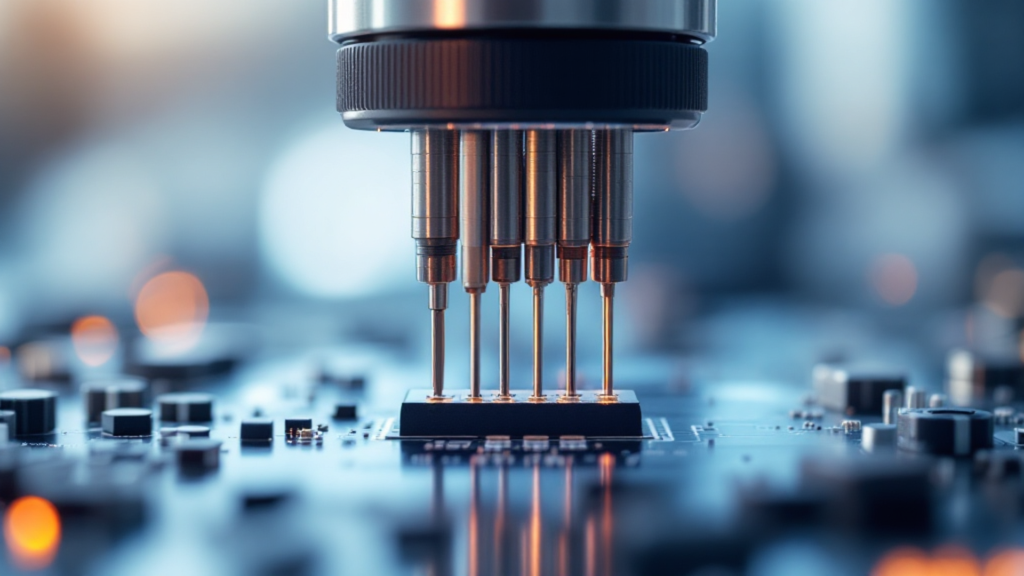
Testing AI processors, memory and networking chips requires more precise measurements at higher speeds. ADI supplies the signal-processing components that let test equipment makers meet those requirements while shortening the time needed to test a device. Both automated test equipment and electronic test and measurement generated record annual revenue and record customer designs in FY 2026. Automated test equipment, aerospace and defense, and data centers together accounted for about 30% of ADI’s revenue and drove shipments above their long-term trend. Across the rest of the portfolio, ADI estimated that shipments were at or below current consumption, with little evidence of material customer restocking. For industrial suppliers planning production, separate order trends for chip testers and factory equipment offer a better demand signal than ADI’s aggregate industrial growth rate.
Packaging Limits Near-Term Chip Supply
Packaging and assembly were ADI’s main supply constraint over the past six months. The company added capacity weekly as equipment ordered up to nine months earlier came online. ADI also raised inventory by $152 million sequentially in Q4 FY 2026, building reserves of unpackaged chips and finished products. Distributors ended the quarter with six to seven weeks of inventory, back within ADI’s target range. ADI can draw on its chip reserves when orders rise, but each chip still needs assembly and testing before it can ship. For buyers scheduling a production run, the availability of the specific finished part is a better guide to delivery than ADI’s total inventory.
Guidance and Final Thoughts
Analog Devices (ADI) expects Q1 FY 2027 revenue of $4.25 billion to $4.55 billion, with the $4.40 billion midpoint approximately 0.9% above Wall Street consensus of $4.36 billion and 0.7% higher sequentially, compared with a typical mid-single-digit seasonal decline. Management projects an adjusted operating margin of 49.5% to 51.5% and adjusted diluted EPS of $3.62 to $4.02. Holiday factory shutdowns are expected to bring adjusted gross margin to approximately 74%, while a full quarter of Alif-related expenses will contribute to a mid-single-digit sequential increase in operating expenses. ADI plans FY 2027 capital expenditures of $1.6 billion to $1.9 billion, approximately 2.4 times FY 2026 spending at the midpoint, to expand cleanrooms at existing US and European facilities and increase testing and assembly capacity. Initial stages of the expansion could become operational as early as Q1 FY 2028, leaving near-term shipment growth dependent on incremental capacity additions. For FY 2027, management targets operating expense growth at roughly half the rate of revenue growth.
ADI’s exposure to AI infrastructure extends beyond data center power management into optical connectivity, semiconductor testing, and thermal monitoring, increasing its potential component content across increasingly complex systems. Data center sales more than doubled YoY for two consecutive quarters, alongside above-company-average gross margins in that business, suggesting that continued growth could support a more favorable revenue mix. However, more than two-thirds of FY 2026 growth came from non-AI-centric opportunities, providing a broader demand base and reducing dependence on AI infrastructure spending alone. The 40% expansion in the customer design pipeline supports the rationale for higher capital investment, although packaging and assembly constraints could delay the conversion of those designs into revenue. Separate data center reporting beginning in Q1 FY 2027 will improve visibility into the contribution of AI infrastructure demand. The durability of ADI’s margin expansion will depend on converting design wins into production shipments, easing supply bottlenecks, and maintaining capacity utilization as its manufacturing footprint expands.
See the full press release on Analog Devices’ Q4 FY 2026 financial results on the Company website.
Declaration of generative AI and AI-assisted technologies in the writing process: This content has been generated with the support of artificial intelligence technologies. Due to the fast pace of content creation and the continuous evolution of data and information, The Futurum Group and its analysts strive to ensure the accuracy and factual integrity of the information presented. However, the opinions and interpretations expressed in this content reflect those of the individual author/analyst. The Futurum Group makes no guarantees regarding the completeness, accuracy, or reliability of any information contained herein. Readers are encouraged to verify facts independently and consult relevant sources for further clarification.
Disclosure: Futurum is a research and advisory firm that engages or has engaged in research, analysis, and advisory services with many technology companies, including those mentioned in this article. The author does not hold any equity positions with any company mentioned in this article.
Analysis and opinions expressed herein are specific to the analyst individually and data and other information that might have been provided for validation, not those of Futurum as a whole.
Read the full Futurum Group Disclosure.
Other Insights from Futurum:
Analog Devices Q3 FY 2026 Earnings Hit First $4 Billion Quarter on AI Demand
Will Analog Devices’ Empower Deal Reshape Power Delivery for AI Data Centers?
Author Information

Brendan is Research Director, Semiconductors, Supply Chain, and Emerging Tech. He advises clients on strategic initiatives and leads the Futurum Semiconductors Practice. He is an experienced tech industry analyst who has guided tech leaders in identifying market opportunities spanning edge processors, generative AI applications, and hyperscale data centers.
Before joining Futurum, Brendan consulted with global AI leaders and served as a Senior Analyst in Emerging Technology Research at PitchBook. At PitchBook, he developed market intelligence tools for AI, highlighted by one of the industry’s most comprehensive AI semiconductor market landscapes encompassing both public and private companies. He has advised Fortune 100 tech giants, growth-stage innovators, global investors, and leading market research firms. Before PitchBook, he led research teams in tech investment banking and market research.
Brendan is based in Seattle, Washington. He has a Bachelor of Arts Degree from Amherst College.