Why the Agentic AI Foundation Cementing MCP as a Shared Open Standard at AGNTCon + MCPCon Is the CIO’s New Leverage
Analyst(s): Mitch Ashley
Publication Date: November 4, 2026
Document #: CIOMA202610
What You Need to Know
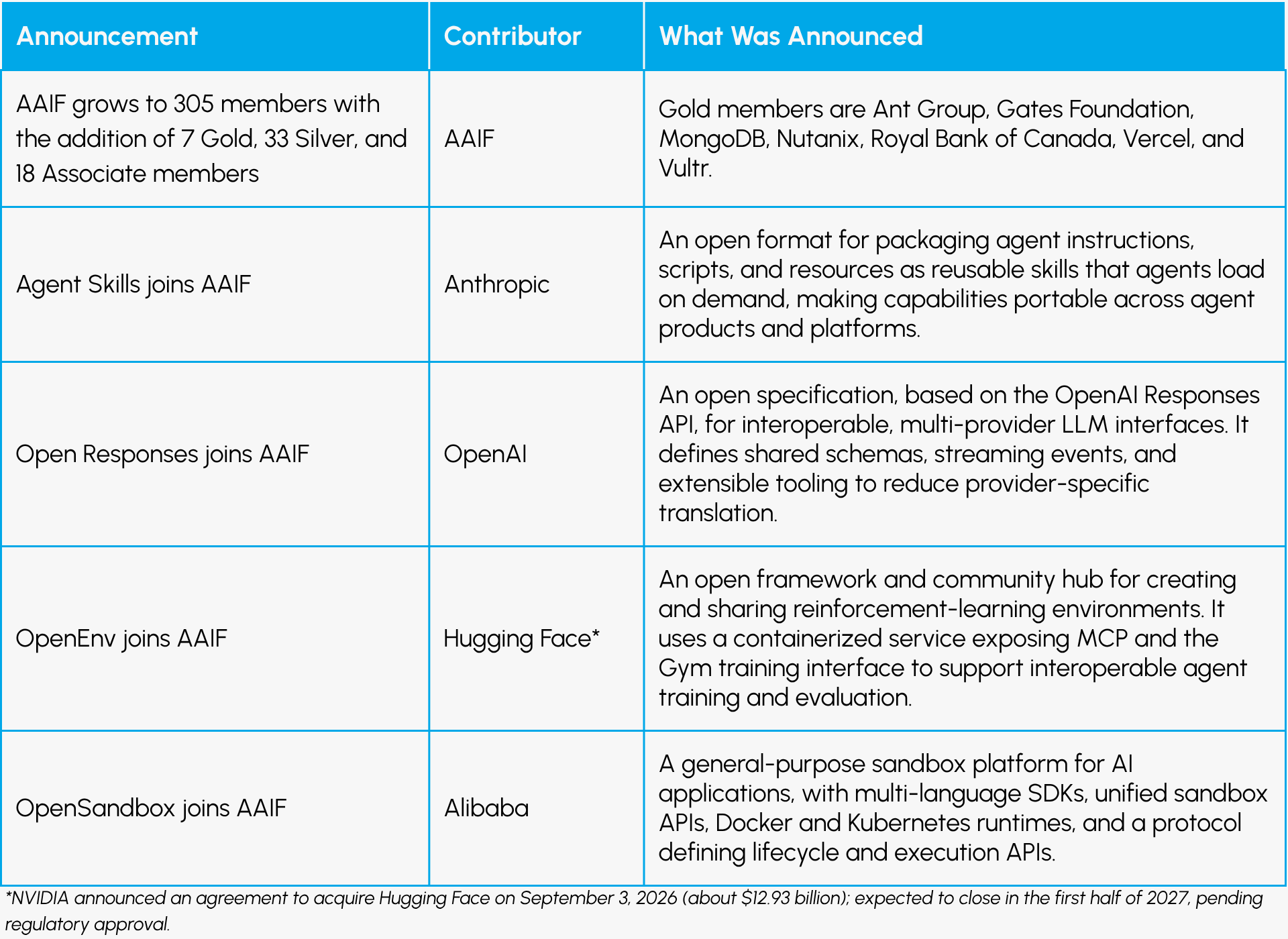
- AGNTCon + MCPCon Cemented an Open Agent Standard: At the Agentic AI Foundation’s (AAIF) October 22, 2026, event in San Jose, the foundation accepted four contributed projects – Agent Skills from Anthropic, Open Responses from OpenAI, OpenEnv from Hugging Face, and OpenSandbox from Alibaba – bringing it to 10 hosted projects alongside MCP, and reported 305 member organizations within 10 months of launch.
- MCP Gained Enterprise-Grade Capabilities: Maintainers detailed long-running MCP tasks, server-initiated events, elicitation that guarantees a human confirms an action, and skills served over MCP and bound to a user’s identity and authorization. Block demonstrated signed agent identity, an attestation that an agent belongs to a named person, with scoped access.
- The Standard Is Reported in Production: The AAIF reported that 89% of surveyed members run MCP in production and 81% have deployed agentic AI. Anthropic reported MCP tool calls in Claude crossing 2 billion. These are foundation-reported figures.
The Futurum View
In this report, we examine the AAIF’s October 22, 2026, announcements, MCP, and the agent-identity work shown at the event. The focus was not the typical frontier model announcement du jour, nor the pace of frontier model capabilities and sophistication; instead, our focus is on the actors that operate atop models, data, and systems, and the buyer intent behind them.
The CIO’s new leverage is cross-vendor open standards consistency. A shared standard that behaves consistently across vendors makes agents and agentic work surfaces viable across the enterprise, and AGNTCon + MCPCon North America cemented that standard.
Four telling moves did it: competitors contributed four projects into the Agentic AI Foundation, the membership behind it passed 305 with new committees and working groups, MCP added the capabilities enterprise work requires, and members reported the standard already running in production.
An enterprise cannot secure, govern, or operate at scale a hundred bespoke agent integrations. It can govern one consistent standard that every vendor builds to in the same way. Buying leverage now sits upon the standardized connector layer, and then governs what agents reach and can do through that layer.
Figure 1: AI/ML Leads Enterprise Spending Intent: Top Seven Sectors by Net Score
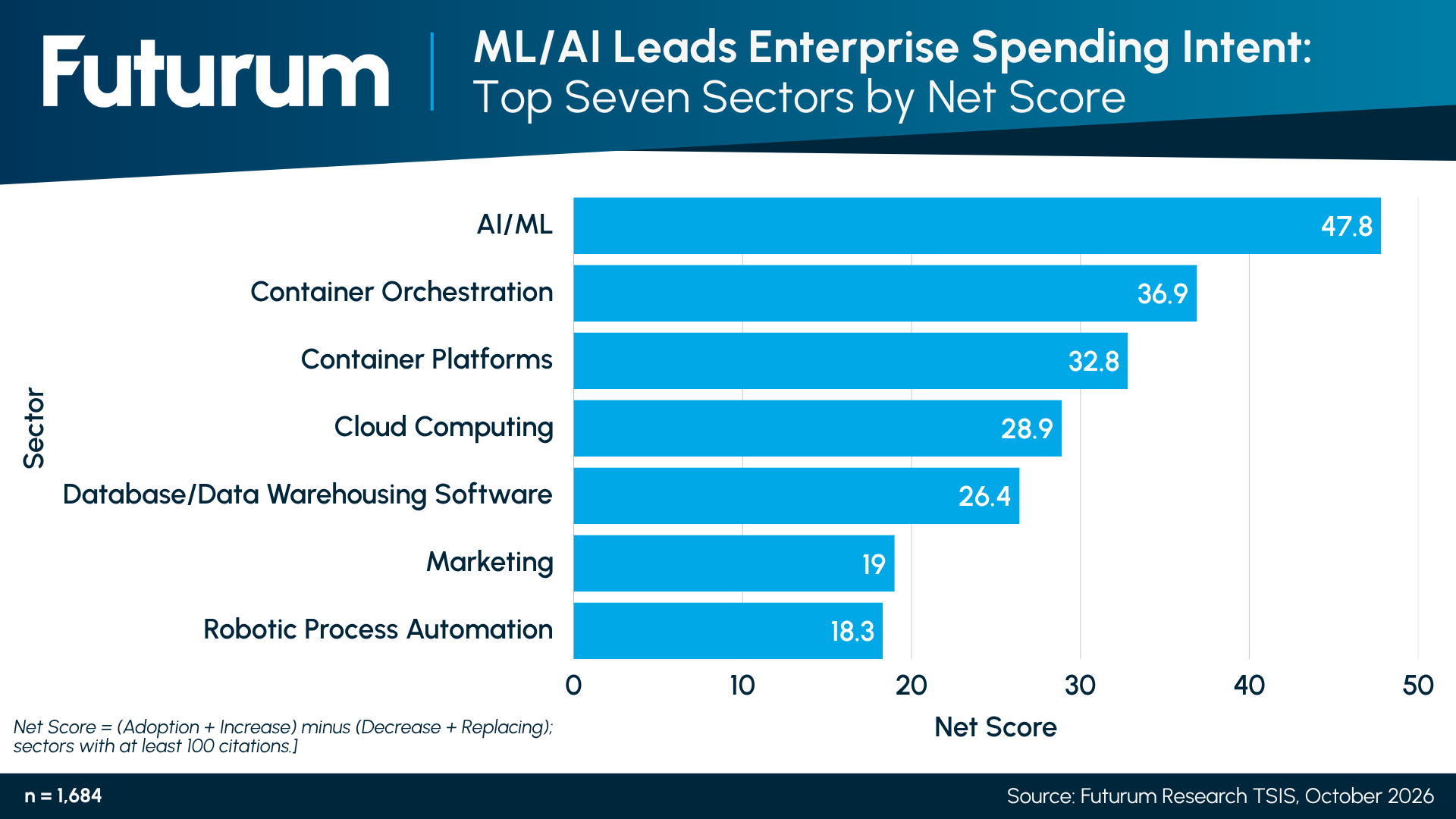
Adoption research backs what’s happening. Futurum’s own decision-maker panel shows ML and AI lead every tracked sector on spending intent, with a Net Score of 47.8, underpinned by deployment across 66% of respondents, nearly three times the broad-market reading (Futurum Research, Technology Spending Intentions Study, October 2026, N = 1,684). This lends independent weight when AAIF says 89% of its members run MCP in production and 81% have deployed agentic AI. Anthropic’s reported MCP tool calls in Claude exceeding 2 billion is a sizable leading indicator. Those are foundation and member figures, and they describe an open standard already in production rather than one in committee, or languishing on vendor roadmaps.
Futurum Research’s own decision-maker data validates the importance of the timing of this announcement. Enterprises have settled the adoption question; it’s not if but when and how quickly agents will proliferate across the organization. Currently, spending intent is focused on the platform and orchestration layers, and the barrier to scale is standardized, interoperable integration coupled with verification.
An Open Standard That Makes Agentic Work a Reality
The real news coming out of AGNTCon + MCPCon is not any single project or capability. It is the cross-vendor, cross-competitor open contributions. When Anthropic, OpenAI, Hugging Face, and Alibaba all contribute building blocks of agent infrastructure to a neutral foundation, every vendor starts building to the same kind of door that agents use in the enterprise. And CIO and CISO buyers sit up and take notice when it happens. This is something that bespoke integrations and untested vendor integrations never deliver.
Table 1: Key Announcements at AGNTCon + MCPCon North America 2026
For the buyer, the market has stopped debating whether to run agents. In Futurum’s 2H 2026 CIO and Technology Buyers survey, only 4.1% of enterprises report using no AI at all, down from 7.1% nine months earlier (Futurum Research, September 2026, N=1,636). The open question is what to govern once agents are everywhere, and a consistent standard is an essential step that makes governing possible.
Consistency Turns Governance Into the CIO’s New Leverage
Because a shared standard applies the same way across vendors, one set of controls can be applied everywhere. That is the difference between governing interfaces based upon one open standard and governing a hundred integrations. The MCP work shown at the event is what makes those controls real. Skills served over MCP bind to a user’s login and permissions, moving agent skills from the latest AI sprawl problem to a managed and maintainable capability. Elicitation forces a human to confirm a destructive action or a payment. The agent-identity work demonstrated onstage attaches a signed attestation that an agent belongs to a named person, scoped so it reads shared channels and not private messages.
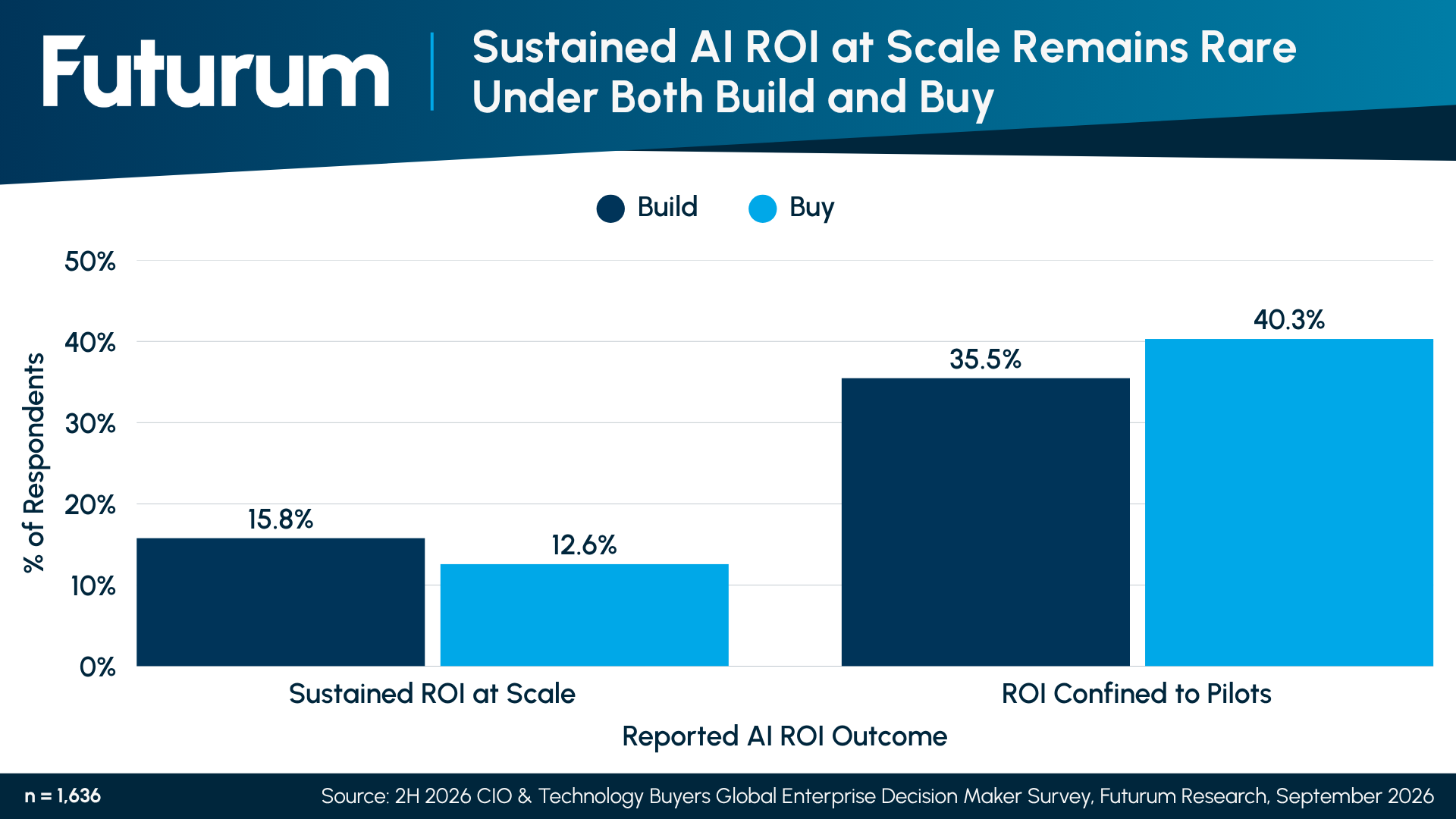
The scarce work sits exactly here. Futurum’s 2H 2026 survey finds only 15.8% of enterprises reporting sustained ROI at scale from building AI in-house and 12.6% from buying it, while roughly 4 in 10 remain in pilots under either route (Futurum Research, September 2026, N=1,636). The barrier between a working pilot and a scaled result is an integration and verification problem, and the organizations crossing it do so with more direct control over integration.
That is the leverage. A CIO who governs at the connector layer can grant an agent what it needs, require a human where it counts, and revoke access in one move, across every vendor at once. The controls that used to live in a hundred places now live in one, and the one is governable.
Figure 2: Sustained AI ROI at Scale Remains Rare Under Both Build and Buy
Neutral Governance Keeps the Open Standard Safe in a Developing AI Market
A shared standard is only leverage if one vendor cannot close it later. That was the point the foundation’s leaders pressed hardest, and it is the one that matters most to a buyer betting an enterprise on the layer. Open under one company’s control can be revoked one release at a time. Open under neutral governance cannot.
Anthropic donating Agent Skills to the foundation, with MCP already hosted there, is the condition that lets a CIO treat the connector layer as a foundation rather than a dependency. The foundation reported 305 members in 10 months and eight working groups now publishing early standards, which is competitors agreeing on the plumbing in public.
For procurement, governance provenance becomes a real question: who can change the rules on the stack you are standardizing on. A vendor whose integration story is a proprietary, per-system connector is asking the enterprise to accept a layer it cannot govern and a dependency it cannot replace.
The Counterargument: Buying Authority Is Leaving the CIO
The fair objection is that this reads leverage into a loss. Buying authority is already leaving the CIO. Futurum’s own decision-maker data puts 62% of AI buying authority outside the CTO and CIO offices (Futurum Research, 1H 2026 AI Platforms Decision Maker Survey, n=838). Moreover, among enterprises running AI over budget, 23.1% now fund the overrun from a business-unit budget outside IT. The drift toward the line-of-business buyer I traced in Enterprise AI Overruns Hit 46.9%. A connector standard written by frontier labs and a foundation can look like one more thing happening to IT rather than for it. It is the opposite.
The connector layer is the one control that survives the dispersion. A veto only stops things, and a veto the CIO can no longer enforce across distributed buyers is not authority. Governing what agents reach and do is control the CIO can still operate when the purchase and the build happen elsewhere, because the shared standard is the one part of the agent stack that behaves the same everywhere. The measurable edge is the first-call position, and the connector layer is where the CIO holds it.
What to Watch:
- A Break in the Standard: A forked or competing connector standard, or a major harness going proprietary, is the clearest threat, because it breaks the consistency the whole case rests on. Agent-driven commerce is the highest-stakes test, since the purchase-decision layer could fall to a single vendor without neutral governance.
- Governance Tooling Ships or It Does Not: The controls described at the event, identity-bound skills, elicitation, and signed attestations are early. Broad enterprise adoption would confirm the position. A year of protocol aspiration without enterprise tooling would weaken it.
- Cost Control Attaches to the Layer: Watch whether AI spend visibility and outcome-based pricing land at the connector and gateway layer. With 46.9% of enterprises already running AI over plan, the connector layer is the natural place to govern cost as well as access.
Disclosure: Futurum is a research and advisory firm that engages or has engaged in research, analysis, and advisory services with many technology companies, including those mentioned in this article. The author does not hold any equity positions with any company mentioned in this article.
Analysis and opinions expressed herein are specific to the analyst individually and data and other information that might have been provided for validation, not those of Futurum as a whole.
Other Insights From Futurum:
With Kong Volcano, Kong Hosts the Agents It Governs
NVIDIA Wants Agent Safety Enforced in Silicon
OpenAI Moves Up the Stack and Competes With the Platforms It Powers
Harness Shows Why LLM Security Scanning Needs a Repeatable Verdict
Author Information

Mitch Ashley is VP and Practice Lead for the CIO & Technology Buyers and Software Lifecycle Engineering practices at The Futurum Group. A multi-time CIO and CTO with 30+ years leading technical organizations, Mitch built and operated production systems spanning cybersecurity for the U.S. Department of Defense, PKI services for the broadband and 5G industries, SaaS platforms, large-scale telecom and banking systems, and a national broadband network. His work with AI began early, developing expert systems that diagnosed and repaired complex mainframe environments. That operator foundation grounds his analysis in operational consequence, covering the technology buyer's world of software engineering, cybersecurity, DevOps, cloud, and AI.