
Lattice’s Q3 FY 2026 results show organic FPGA demand, not the AMI acquisition, driving growth. Futurum believes Lattice is becoming the control plane supplier of record for AI racks, with neutrality, not demand, now the main risk.
What is Covered in this Article
- Lattice’s Q3 FY 2026 financial results
- AI servers expand programmable control content
- AMI extends security and management capabilities
- Industrial recovery tests new product adoption
- Guidance and Final Thoughts
The News: Lattice Semiconductor (NASDAQ: LSCC) reported Q3 FY 2026 revenue of $291.04 million, up 118.3% year over year (YoY), compared with Wall Street consensus of $255.9 million. Compute and Communications revenue reached $171.9 million, up approximately 132% YoY. Industrial and Embedded revenue totaled $80 million, up approximately 35% YoY. AMI contributed $39.1 million following the acquisition’s July 27, 2026 closing. Adjusted operating income rose 208.7% YoY to $119.58 million, with adjusted operating margin increasing to 41.1% from 29% in the prior period. Adjusted net income increased 171.7% YoY to $103.66 million, while adjusted diluted earnings per share (EPS) rose 157% YoY to $0.72. Compute and Communications represented 59% of Q3 revenue, Industrial and Embedded 28%, and AMI 13%. Compute and Communications grew 36% quarter over quarter (QoQ) and Industrial and Embedded grew 7% QoQ. FPGA revenue grew approximately 90% YoY, while adjusted gross margin reached 70.9% and adjusted EBITDA margin reached 45%.
“The addition of AMI meaningfully expands our opportunity in security, control and management solutions. Early commercial momentum across security retrofit, rack boot, plug and play, and power and cooling demonstrates the value of our combined portfolio, positioning Lattice to capture greater content per platform, deepen strategic customer relationships and drive sustainable long-term growth,” said Ford Tamer, Chief Executive Officer of Lattice Semiconductor.
Lattice Q3 FY 2026: Organic FPGA Demand Drives 118% Revenue Growth
Analyst Take: Q3 confirms Futurum’s view that Lattice has moved beyond a cyclical recovery into an AI infrastructure content expansion cycle. FPGA revenue of approximately $252 million rose about 25% from Q2, a quarter with no AMI contribution, and sits roughly 31% above the prior cycle peak of $192.2 million. AMI beat its $33 million to $37 million outlook, and gross margin cleared the 69.5% guide by 140 basis points. The debate is no longer about demand. Supply, conversion of AMI pilots into production, and the durability of AMI’s silicon neutrality will set the pace into FY 2027.
AI Servers Expand Programmable Control Content
Lattice’s data center growth depends on control functions per platform more than server units. FPGA attachment has progressed toward as many as four devices per platform, spanning GPU card power and throttling, network card offload, BMC companion and root-of-trust functions in the server, and attestation, telemetry, coolant distribution, and leak response at the rack. The rack-level functions matter most, because liquid-cooled AI racks create control requirements that air-cooled fleets never had.
Futurum views Lattice as becoming the control standard for open server designs. It authored the LTPI protocol into the OCP DC-SCM specification, ships the FPGAs that implement it, and now owns the firmware on top, with the Arm AGI CPU collaboration as the first proof point. Mach-N2 is the only small FPGA family Futurum has identified with full CNSA 2.0 compliance ahead of the January 1, 2027 federal procurement gate, turning post-quantum security into a buying requirement.
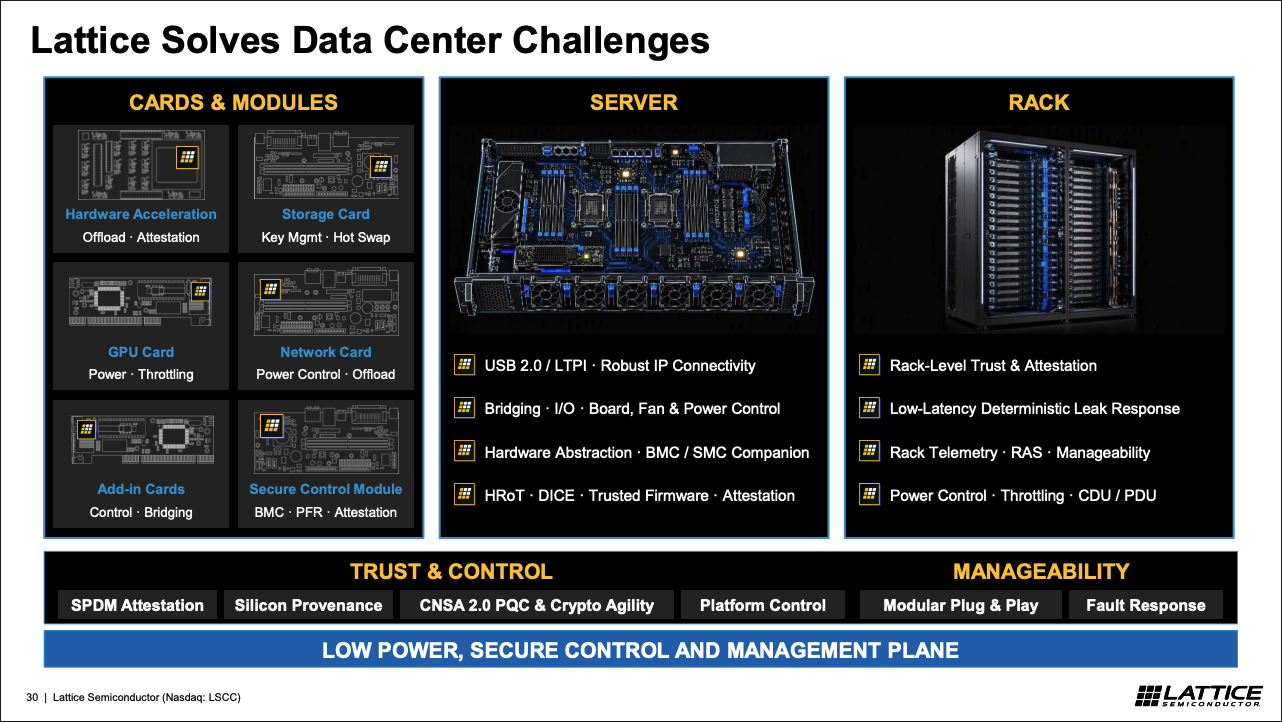
The larger threat is integration rather than direct competition. Google Titan, Microsoft Cerberus, and OCP Caliptra show hyperscalers pulling roots of trust into their own silicon, while Axiado targets a single device that merges BMC, root of trust, and control logic. Futurum expects layered coexistence. Lattice will own reference designs and merchant OEM volume, while the largest hyperscalers blend in-house security with Lattice control parts.
AMI Extends Security and Management Capabilities
AMI’s $39.1 million in roughly two months implies an annualized run rate near $235 million, ahead of the company’s target of more than $200 million exiting FY 2026. Its Aptio and MegaRAC firmware already reach AWS, Azure, Google, CoreWeave, Lambda, Crusoe, Quanta, Wiwynn, Inventec, Dell, and Supermicro. Tens of customers are in proof-of-concept engagements across four joint offerings, led by security retrofit, the right lead product because it monetizes installed fleets without waiting for a new server generation. Sentry 5.0 is the first product proof that AMI turns Lattice into a platform security stack vendor.
The most strategic move is SCaMPi, the OCP rack control workstream launched with AMD, Arm, Aspeed, Intel, Jabil, Microsoft, and NXP. It positions Lattice interfaces and AMI firmware as the reference implementation, the same playbook that made LTPI a standard.
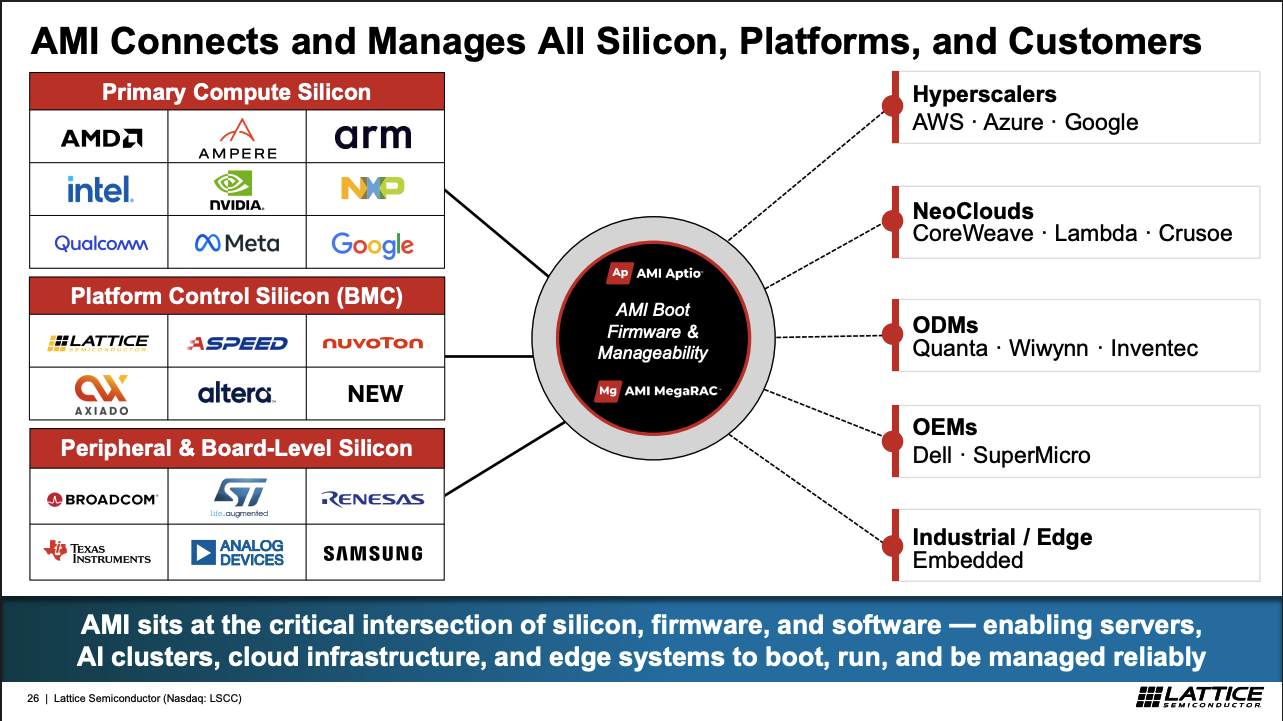
That breadth creates the deal’s central tension. AMI also supports control silicon from FPGA rival Altera and integrated challenger Axiado, while the acquisition logic depends on pulling firmware toward Lattice devices. Futurum’s test is whether future Tektagon releases ship post-quantum features on non-Lattice roots of trust at parity. If they do not, server vendors will qualify Microchip-based and Caliptra-based alternatives. The validating milestone is a hyperscaler deployment publicly naming the combined Lattice and AMI stack.
Industrial Recovery Tests New Product Adoption
Industrial is a steady recovery, not a second growth engine. Industrial and Embedded revenue grew 7% sequentially versus 36% for Compute and Communications, and fell to 28% of revenue from about 37% in Q2. Lattice is matching shipments to end demand after normalizing channel inventory, the right discipline after the FY 2024 trough.
The company’s advantages are durable, including the largest FPGA unit volume in the industry and average product longevity above 20 years. New product revenue grew more than 70% YoY, and Lattice Prompt’s company-reported tenfold productivity gains address the real constraint at mid-sized OEMs, the shortage of FPGA engineers. Physical AI, spanning robotics, autonomous machines, and humanoids, remains a FY 2028 revenue story rather than a FY 2027 one.
Guidance and Final Thoughts
For Q4 FY 2026, Lattice expects revenue of $325 million to $345 million, above consensus of $293.4 million, with the $335 million midpoint implying approximately 130% YoY growth. Adjusted gross margin is projected at 71% to 73% and adjusted EPS at $0.82 to $0.86. The outlook implies approximately $1 billion in FY 2026 revenue, and preliminary FY 2027 expectations call for at least 60% growth, with backlog extending into FY 2028.
That target says more about FPGA demand than about AMI. A full year of AMI ownership is included in the comparison, since Q3 included only about two months, but the roughly 25% FY 2027 growth the company has indicated for AMI sits well below the 60% target. FPGA demand must therefore carry most of the increase on a base that nearly doubled this year, leaving supply availability, not demand, as the gating factor.
Futurum believes Q3 FY 2026 marks Lattice’s shift from FPGA supplier to control plane platform for AI infrastructure. Organic FPGA growth is driving the step-up; AMI has beaten its first outlook; and SCaMPi, Sentry 5.0, and the Arm design win give Lattice a credible path to set the reference control plane for open AI racks. Futurum expects Lattice to become the default control plane supplier for merchant and OEM AI servers, while the largest hyperscalers continue to blend in-house security silicon with Lattice parts.
See the full press release on Lattice’s Q3 FY 2026 financial results on the Lattice Semiconductor website.
Sources
1. LATTICE SEMICONDUCTOR REPORTS RECORD 3Q26 REVENUE, UP 118% YOY, Latticesemi
2. Lattice Semiconductor Corporate Overview, November 2026, Latticesemi
Disclosure: Futurum is a research and advisory firm that engages or has engaged in research, analysis, and advisory services with many technology companies, including those mentioned in this article. The author does not hold any equity positions with any company mentioned in this article.
Read the full Futurum Group Disclosure.
Other Insights from Futurum:
Lattice Sentry 5.0 Turns Post-Quantum Silicon Into a Full Platform…
Lattice Brings FPGAs and AMI Firmware to Arm’s $15 Billion AGI CPU…
Lattice Mach-N2 Turns the Post-Quantum Procurement Gate Into an FPGA…
Author Information

Futurum Research
Futurum Research delivers forward-thinking insights on technology, business, and innovation. Content published under the Futurum Research byline incorporates both human and AI-generated information, always with editorial oversight and review from the expert Futurum Research team to ensure quality, accuracy, and relevance. All content, analysis, and opinion are based on sources and information deemed to be reliable at the time of publication.
The Futurum Group is not liable for any errors, omissions, biases, or inadequacies in the information contained herein or for any interpretations thereof. The reader is solely responsible for any decisions made or actions taken based on the information presented in this publication.