Analyst(s): Olivier Blanchard
Publication Date: October 27, 2026
The News: On October 13, 2026, a federal jury in Wilmington, Delaware, found that Arm breached its Architecture License Agreement (ALA) with Qualcomm and intentionally interfered with Qualcomm’s business with Meta. Jurors awarded $1 on each of those two claims and sided with Arm on the four remaining claims, all tied to pricing under the separate Technology License Agreement (TLA).
The $2 headline understates the stakes. Qualcomm’s lawyers asked for nominal damages on purpose: the liability finding is the key that could unlock a five-year royalty suspension under the ALA, a remedy that U.S. District Judge Maryellen Noreika, not the jury, will decide. That remedy could amount to ~$300 million a year, or about $1.5 billion in total.
How Did We Get Here?
This is the second Delaware trial between the two companies. The legal dispute originated in early 2021 when Qualcomm acquired Nuvia, a silicon startup created by experienced chip architects with an Arm architecture license for server processors. Qualcomm integrated Nuvia’s team and technical designs into its development plans to create its custom Oryon CPU architecture. By March 2022, Arm revoked Nuvia’s license and instructed Qualcomm to eliminate all design files based on Nuvia’s technology, claiming that licensing terms prohibited transferring custom architecture between distinct companies without prior approval and renegotiated agreements. Rejecting Arm’s demands, Qualcomm argued that its broad, existing agreement granted full rights to build and sell the Oryon CPU cores.
In response, Arm filed a lawsuit in federal court in Delaware in August 2022, alleging trademark infringement and breach of contract while seeking to block Qualcomm from manufacturing chips using Nuvia-based technology.
That initial legal battle concluded mostly in Qualcomm’s favor, with a Delaware jury ruling in December 2024 that the custom CPUs were validly covered under Qualcomm’s original architecture license, and that Nuvia’s contract had not been breached. The presiding judge additionally upheld these findings on September 30, 2025, dismissing Arm’s remaining claims as a matter of law. Arm subsequently appealed the ruling to the U.S. Court of Appeals for the Third Circuit, where the dispute is currently pending.
Qualcomm launched its own legal counteroffensive in April 2024, accusing Arm of violating its licensing contracts by withholding technical support, refusing to offer fair licensing terms, and unlawfully disrupting Qualcomm’s client relationships.
The confrontation intensified in October 2024 when Arm threatened to cancel Qualcomm’s primary architecture license, an action that risked shutting down worldwide manufacturing of Snapdragon chips. Perhaps in part because Arm issued a mandatory 60-day notice of cancellation for the overarching ALA (which allows Qualcomm to design custom processor cores such as the Oryon CPU based on Arm’s standards) in the middle of Qualcomm’s annual Snapdragon Tech Summit, just as Qualcomm was showcasing its next-generation mobile and automotive silicon, Qualcomm added the threat to its allegations of bad-faith conduct. Arm withdrew the cancellation notice in January 2025, but both parties ultimately met in court for Round 2 of their litigation in Wilmington, Delaware, this October.
Qualcomm’s Core Complaints and Arguments
Qualcomm argued that Arm stopped acting as a neutral licensor once it began building competing chips and used its control over the instruction set to slow Qualcomm’s custom Oryon CPU program.
Qualcomm’s core arguments are summarized:
- Breach of the Architectural License Agreement (ALA): Qualcomm claimed that Arm breached its long-standing ALA by failing to honor its commitments to provide technical resources like essential software patches, Arm Compliance Kit (ACK) verification materials, out-of-band test lists, and technical tools required to validate Qualcomm’s custom chip designs (such as its Oryon CPUs).
- Business Interference with Key Customers (Meta): Qualcomm accused Arm of intentionally and negligently interfering with its business relationships by issuing threats to terminate licenses and leaking dispute details to the media (notably to Bloomberg News in October 2024, during Qualcomm’s Snapdragon Tech Summit). Qualcomm alleged that it was on the cusp of finalizing a major deal with Meta in 2024, but Arm’s public threat and leaks artificially delayed and disrupted the negotiations.
- Bad-Faith Negotiations and Unfair Competition: Qualcomm complained that Arm breached the implied covenant of good faith and fair dealing by attempting to impose unfavorable terms and refusing to negotiate in good faith regarding access to next-generation versions of the Arm architecture. Qualcomm also alleged that after SoftBank acquired Arm, Arm shifted from being an architecture licensing partner to competing directly by selling its own chip designs, engaging in unfair practices to stymie Qualcomm’s custom silicon.
- Technology License Agreement (TLA) Breaches: Qualcomm also brought additional breach-of-contract claims under its separate Technology License Agreements (TLAs) for standard off-the-shelf processor IP (e.g., Cortex cores), asserting Arm failed to offer commercially reasonable licensing terms. Qualcomm also argued that Arm’s move into its own silicon gives it a motive to favor its own designs. Qualcomm has pressed this theory with the FTC, the European Commission, and Korea’s Fair Trade Commission, and it isn’t entirely out of the realm of possibilities that this point could be revisited at some point in the future, independently of this trial.
- Arm’s v10 pricing is punitive: Qualcomm also pointed out that Arm’s proposed ARMv10 royalty is 1,800% above ARMv9 rates.
Arm’s counter was (summarized) that Qualcomm was not harmed, that Meta’s reduced deal reflected Meta’s own shift from VR headsets to AI glasses, and that the Section 8.3 clause is an unenforceable penalty.
What Qualcomm asked for:
- A five-year royalty suspension. Under ALA Section 8.3, Qualcomm says royalties on qualifying products drop to zero for five years if Arm commits a material breach and fails to cure it within 30 days. Qualcomm says it sent breach notices in November and December 2022.
- Damages for the Meta deal. Qualcomm said the value of its Meta chip deal fell by $170 million because Arm leaked its October 2024 license-termination notice to Bloomberg while the deal was close to signing.
- Most-favored-nation (MFN) pricing. Qualcomm said Arm violated a TLA clause that keeps Qualcomm’s price within 10% of the lowest price Arm charges any licensee for comparable cores.
- A good-faith finding on ARMv10 (bench trial). Qualcomm asked the judge to find that Arm did not negotiate the next architecture license in good faith. Qualcomm says it elected to extend its license to v10 back in May 2020.
Critical Wins for Qualcomm’s Lawyers During Testimony
Qualcomm’s team won where it mattered most: on the two claims that determine whether Arm committed a material ALA breach. Public reporting on the five-day trial is thin on witness-by-witness detail, but several moments stand out for their relevance to Qualcomm’s claims and the ultimate outcome of the case:
- The tools-withholding story held up. Qualcomm managed to convince jurors that Arm’s withholding of OOB packages and ACK patches violated Section 5 of the ALA. The jury would interpret this as evidence of a breach of the architecture license itself, the contract that carries the royalty-suspension remedy.
- The Meta leak was tied to Arm. Qualcomm also persuaded jurors that the 2024 Bloomberg leak was deliberate. The jury found Arm’s interference both intentional and negligent, and rejected Arm’s argument that Meta’s shift to AI glasses explained the delay.
- A concrete harm number. Qualcomm put evidence of a $170 million drop in the Meta deal’s value in front of the jury from opening statements onward. This figure gave the interference claim weight even though the jury did not award it.
- Amon’s 1,800% chart. During the bench portion of the trial, Qualcomm showed a chart of Arm’s proposed ARMv9-to-ARMv10 royalty jump. When Arm’s counsel argued that a 2013 cap of $1.88 per chip (five or more cores) meant Qualcomm was “getting 283 [cores] for free” on 288-core server chips, CEO Cristiano Amon argued that he didn’t see it that way.
- A nominal-damages strategy that worked. In closing, Qualcomm’s attorney walked jurors through the verdict form and told them they could award $1 per claim. That lowered the bar for a liability finding, which is all Qualcomm needs to argue Section 8.3 before the judge. To be clear, Qualcomm wasn’t after monetary damages here. Their objective was to win their Section 8.3 claim, which they did.
What the Jury Decided
Deliberations began on October 9 and ran about four hours without a verdict. Jurors returned on October 13. The jury split the six claims 2–4, but Qualcomm won the two that carry the most leverage. Here is the breakdown:
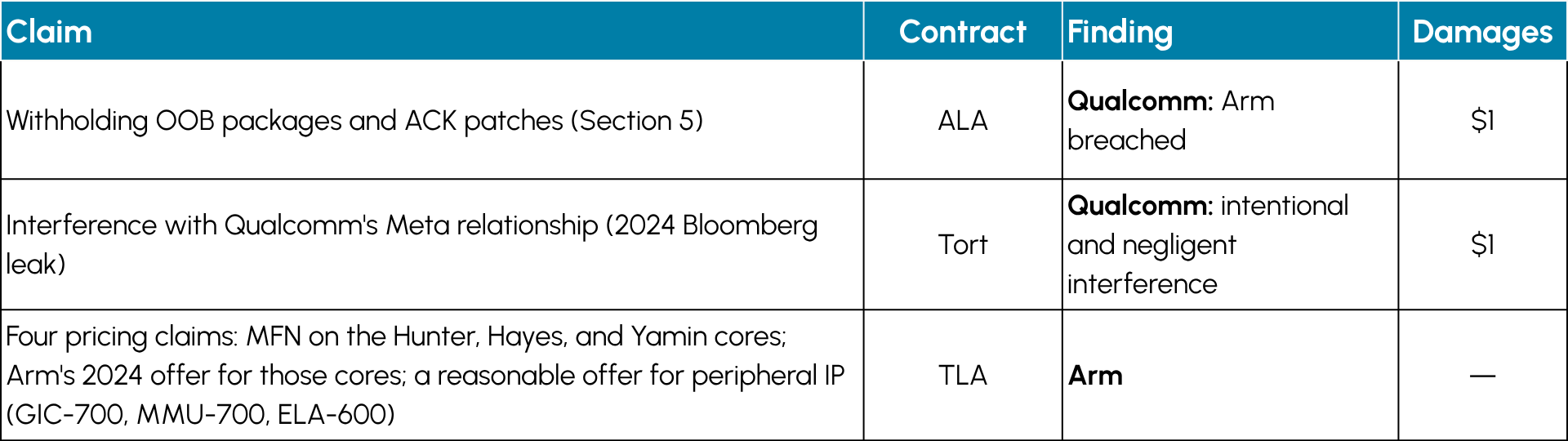
Not surprisingly, both sides declared victory. Qualcomm stated that the jury found Arm “failed to honor its commitments, and intentionally acted to disrupt Qualcomm’s businesses,” while Arm stated that the verdict “confirms that Arm operated in good faith under its technology license agreement” and that the $2 award “confirms the merit of Arm’s arguments.”
Where the Case Stands Today
The jury phase is over; the financially decisive questions now sit with Judge Noreika, who has not ruled as of October 26. Closing arguments are scheduled for October 20, with no timeline set for a decision. Here are the questions that remain pending:
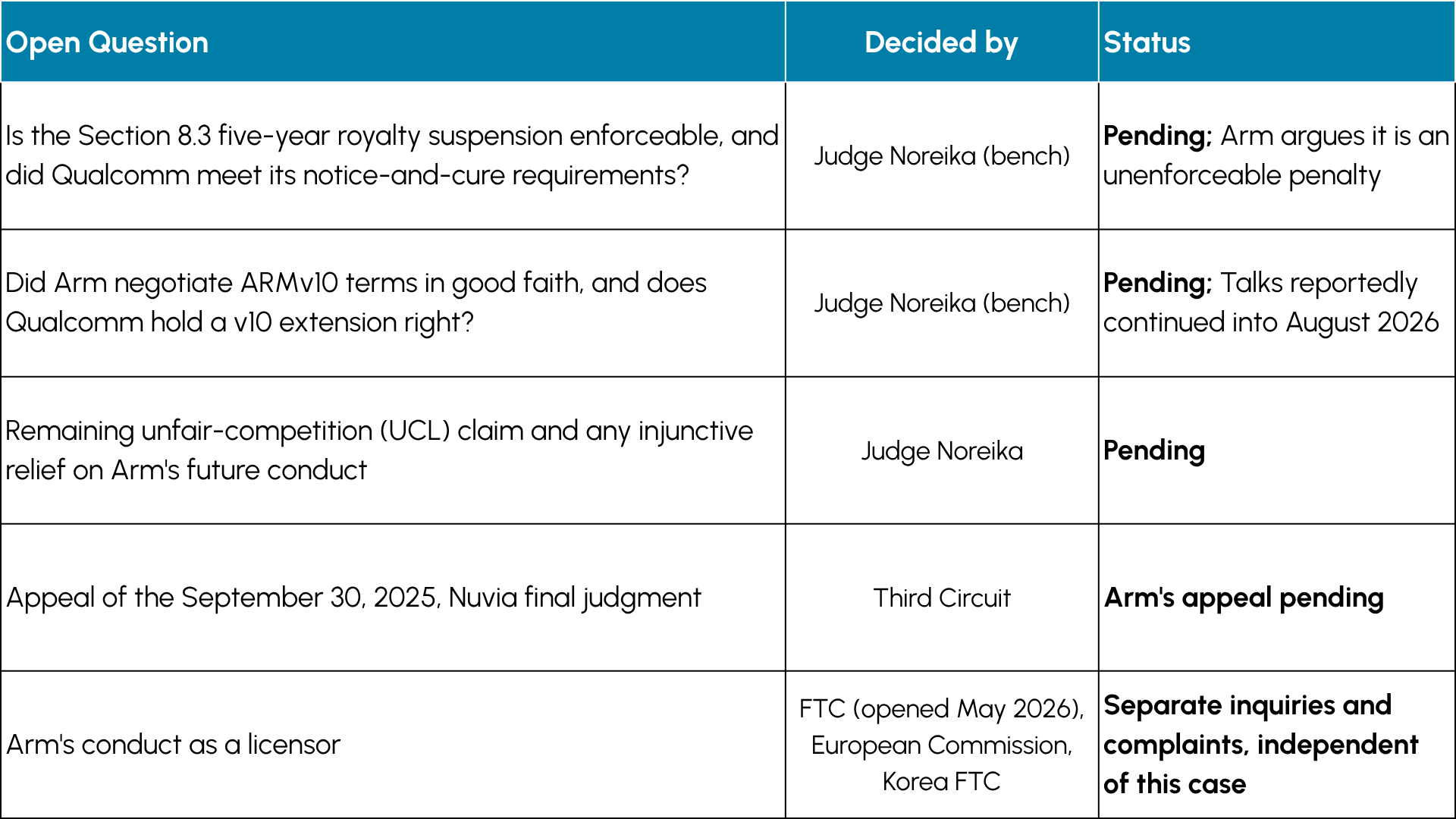
No appeal of the October verdict has been announced, though the losing side on the bench rulings is widely expected to appeal.
Perhaps the most important detail to remember at this juncture is that Qualcomm’s ALA runs through 2033, so the companies remain bound to each other regardless of the outcome.
Futurum’s Take
Qualcomm: Qualcomm won the verdict it needed, even if, from a news headline perspective, the $2 award looks like a win in name only. It is important to remember that Qualcomm’s lawyers deliberately chose nominal damages to secure a clean finding that Arm materially breached the ALA – given the stakes, a far more critical objective. That finding is the prerequisite for Section 8.3, which is where the real money is, both literally and figuratively.
Arm: The stakes for Arm are material: Qualcomm accounted for roughly 9% of Arm’s fiscal 2026 revenue (April 2025–March 2026), about $443 million of $4.92 billion, and close to half of its roughly $900 million operating income, per TechTimes. A five-year suspension would hit Arm’s cash flow just as it ramps its own silicon business. Arm has a couple of things going for it, though: 1) It beat every TLA pricing claim, and 2) courts often hesitate to enforce clauses that look like penalties, so Judge Noreika could decide to throw water on this fire and lean towards a judgment that creates the least amount of friction for Arm.
The broader ecosystem: The interference finding, especially, will matter beyond this case because it gives Qualcomm a jury record that Arm acted against a licensee’s commercial interests. This strengthens its hand in the ARMv10 good-faith question, especially if the argument ever makes its way to the FTC, European Commission, and Korea FTC. More broadly, for OEMs and hyperscalers weighing custom Arm-based silicon, the verdict raises a real question about how Arm will balance its dual roles as both licensor and competitor in the future, now that it is no longer quite as “Switzerland” neutral as it once was. On the one hand, this gives Arm more leverage in the tech industry than ever before, but on the other hand, the argument could be made that guardrails may be needed to avoid the risk of anticompetitive friction moving forward. It could be argued that such guardrails would be as beneficial to Arm as to the ecosystem it serves, but that will have to be a conversation for another day.
What’s next: Judge Noreika’s Section 8.3 ruling will set the commercial terms of the Arm-Qualcomm relationship through 2033, with appeals being filed by whichever party feels unsatisfied by the outcome. The timing of that ruling remains elusive but is expected before the end of the calendar year.
Disclosure: Futurum is a research and advisory firm that engages or has engaged in research, analysis, and advisory services with many technology companies, including those mentioned in this article. The author does not hold any equity positions with any company mentioned in this article.
Analysis and opinions expressed herein are specific to the analyst individually and data and other information that might have been provided for validation, not those of Futurum as a whole.
Other Insights From Futurum:
Arm Q4 FY 2026: Agentic CPU Shift Boosts Demand Outlook
Qualcomm’s Snapdragon 8 Elite Gen 6: A League of its Own?
Author Information

Olivier Blanchard is Research Director, Intelligent Devices. He covers edge semiconductors and intelligent AI-capable devices for Futurum. In addition to having co-authored several books about digital transformation and AI with Futurum Group CEO Daniel Newman, Blanchard brings considerable experience demystifying new and emerging technologies, advising clients on how best to future-proof their organizations, and helping maximize the positive impacts of technology disruption while mitigating their potentially negative effects. Follow his extended analysis on X and LinkedIn.