
Marvell used its October 6 Investor Day to raise its total addressable market 4x to approximately $400 billion by calendar 2030 and set an FY 2031 revenue target of $70 billion to $90 billion. Futurum examines the two engines behind the target, custom silicon built on XPU attach and a scale-up optics franchise moving from near-zero revenue to a planned ramp next year.
What Is Covered in This Article:
- A $400 billion calendar 2030 TAM, 4x the prior figure, inside approximately $3 trillion of data center CapEx
- An FY 2031 revenue target of $70 billion to $90 billion, 10x FY 2026 revenue at the $80 billion midpoint
- Custom silicon raised to more than $12 billion in FY 2029 and approximately $30 billion in FY 2031 on XPU attach momentum
- Scale-up optics moving from near-zero revenue toward a ramp next year with Fast Pipe and Flat Pipe light engines
- The Teralynx T100 monolithic 102.4T switch and scale-in optical I/O chiplets built on microLED and microVCSEL light sources
The News: Marvell Technology (NASDAQ: MRVL) held its 2026 Investor Day in New York on October 6, raising its total addressable market to approximately $400 billion by calendar 2030, 4x the prior figure of less than $100 billion. CEO Matt Murphy set an FY 2031 revenue target of $70 billion to $90 billion, implying 55% to 70% compound annual growth in data center revenue from the $6.1 billion the segment posted in FY 2026. The company also raised its FY 2028 revenue outlook to approximately $20 billion from the $18 billion guided in August and its FY 2029 custom silicon target to more than $12 billion from more than $10 billion. New CFO Dan Durn framed the earnings power as “$30 in ’30,” non-GAAP EPS greater than $30 in FY 2031 on a 56% to 59% gross margin. The presentations are posted on the Marvell investor relations website.
Marvell Investor Day 2026 Targets $80B FY 2031 Revenue with Custom Silicon and Optics
Analyst Take: The Marvell Investor Day repriced the company from a connectivity component supplier into a claim on the two fastest-expanding layers of AI infrastructure, custom compute attach and optical scale-up. An company with $8.2 billion in FY2026 revenue laid out a path to $80 billion at the midpoint in five years. The plan is built bottoms-up by customer, product, and design win, with strategic agreements at 3 of the 5 largest companies by market cap and, per COO Chris Koopmans, more than 35 sockets at the top 4 US hyperscalers delivering the vast majority of the target. Futurum’s view is that the custom trajectory through FY 2029 is the most underwritable piece of the plan, the scale-up optics ramp is the most consequential new disclosure, and the FY 2031 range requires a five-year AI capex boom nobody can contract for today.
A $400 Billion TAM Aligns with Jensen’s $3 Trillion CapEx Assumption
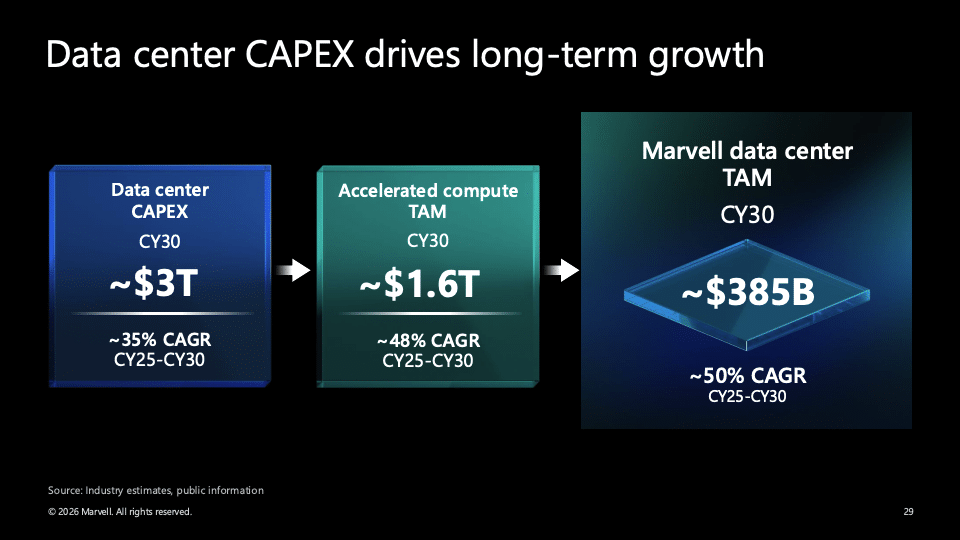
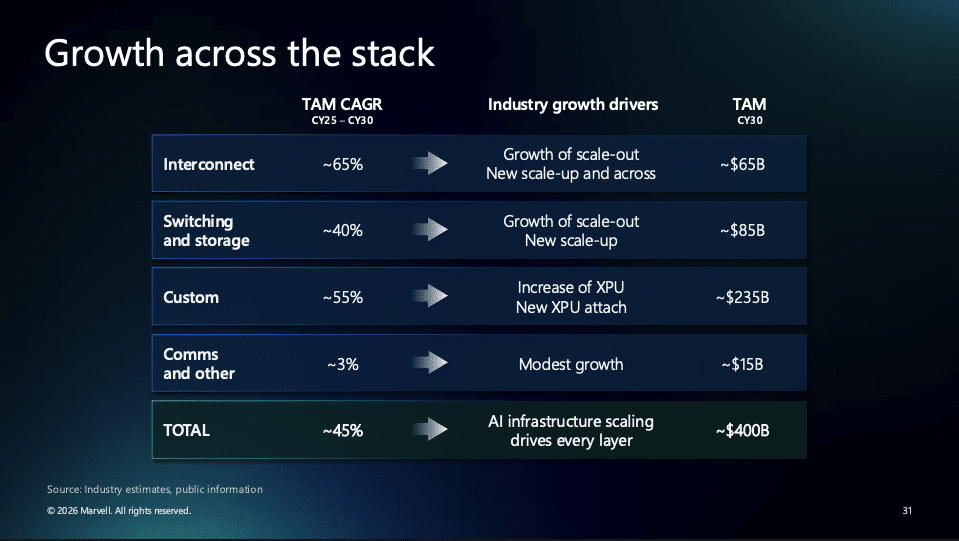
The framework starts with data center capex reaching approximately $3 trillion by calendar 2030, a 35% CAGR that assumes growth decelerates from roughly 70% today toward 20% in the outer years. Accelerated compute represents approximately $1.6 trillion of that spend, and Marvell carves out approximately $385 billion: custom at approximately $235 billion growing 55% annually, switching and storage at $85 billion, and interconnect growing fastest at roughly 65% to $65 billion. The top 10 hyperscalers will account for more than 70% of CapEx by calendar 2030, so demand consolidates at exactly the accounts where Marvell already ships. Futurum forecasts $3.2 trillion in AI data center CapEx in 2030, above the approximately $3 trillion assumption that sizes Marvell’s TAM. NVIDIA CEO Jensen Huang has reaffirmed the same threshold, projecting $3 trillion to $4 trillion in annual AI infrastructure spending by 2030.
XPU Attach Turns Custom Silicon Into a Portfolio Business
Custom silicon head Will Chu raised the FY 2029 custom target to more than $12 billion, more than triple the FY 2028 level, on a path to approximately $30 billion by FY 2031, an approximately 80% revenue CAGR. The composition shifted more than the number: Marvell expects rough balance between XPU and XPU attach by FY 2031, with attach spanning NICs, Structera CXL memory expansion, semi-custom storage controllers, and two new categories, AI infrastructure management processors and inference accelerators. The management processors claim a 1,000x performance increase over traditional BMCs, a vendor figure with programs at multiple hyperscalers behind it. Chu’s unit math is 1 to 2 attach sockets per XPU at ASPs around $1,000, and Murphy said the $30 billion target implies only about 13% share of the $235 billion custom TAM. Futurum’s coverage of the Google warrant agreement argued the $120 billion vesting ceiling was sized to outlast the relationship and Murphy said the FY 2031 plan includes a pragmatic most-probable-outcome portion of that agreement rather than the full warrant value.
Scale-Up Optics Converts the Copper Wall Into an Entry Point
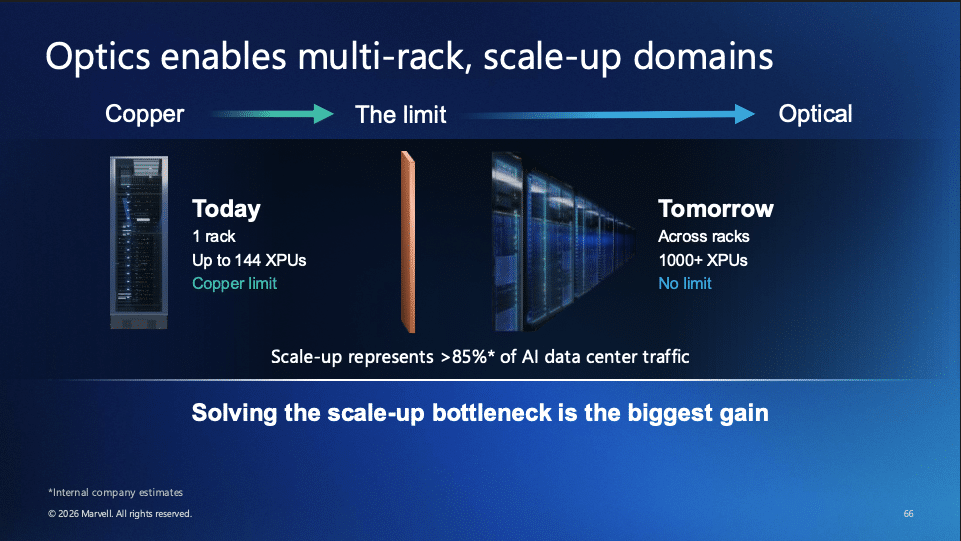
The most consequential new disclosure is the scale-up optics ramp. Scale-up traffic exceeds 85% of data center traffic, 100% of XPU-to-XPU links run on copper today, and at 200 Gbps per lane copper reach is 2.5 meters, forcing scale-up domains inside a single rack just as KV cache growth demands multi-rack domains of 512 to 576 XPUs. Optics is the only way out, and Marvell is fielding TIAs and drivers for module partners, Fast Pipe light engines at 200 to 400 Gbps per lane, and DSP-less Flat Pipe engines built on the Celestial AI Photonic Fabric. Murphy said scale-up optics runs at virtually zero revenue today with multi-hundred-million-dollar revenue starting next year and networking head Dave Lazovsky sized the content at thousands of dollars per XPU on both sides of the link. The Teralynx T100, described as the first monolithic reticle-limited die at 102.4 Tbps, anchors a scale-up switching portfolio spanning ESUN Ethernet, UALink, and NVLink Fusion. Broadcom’s Tomahawk 6 also ships at 102.4T, NVIDIA is driving co-packaged optics into Quantum-X and Spectrum-X, and Astera Labs is building Scorpio fabric switches around attach. The protocol-agnostic posture is the advantage most likely to persist.
Marvell also named its next frontier, scale-in, moving optics inside the package. Optical I/O chiplets built on microLED and microVCSEL light sources extend die-to-die reach from roughly 10 millimeters of electrical I/O to 1.5 meters and beyond. Murphy called scale-in immaterial to the FY 2031 numbers, a funded call option with multiple customer engagements. Scale-in sits today where scale-up optics sat in 2024, a physics argument with engineering staffed against it, and Futurum’s FMS 2026 coverage of Marvell’s AI memory portfolio traced the memory disaggregation thesis it would eventually support.
What to Watch:
- Whether scale-up optics delivers the multi-hundred-million-dollar FY 2028 revenue management described
- Whether custom revenue more than triples in FY 2029 toward the raised $12 billion+ target
- Whether the UALink U115 switch ships at its lead hyperscaler in calendar 2027
- Whether the Teralynx T100 latency and power claims withstand third-party benchmarking against Broadcom’s Tomahawk 6
- Whether Google warrant tranches begin vesting in fiscal Q3 2027 filings as XPU attach programs reach production
See more details about Marvell Investor Day 2026 on the company website.
Sources
- Marvell Investor Day 2026, Marvell
Declaration of generative AI and AI-assisted technologies in the writing process: This content has been generated with the support of artificial intelligence technologies. Due to the fast pace of content creation and the continuous evolution of data and information, The Futurum Group and its analysts strive to ensure the accuracy and factual integrity of the information presented. However, the opinions and interpretations expressed in this content reflect those of the individual author/analyst. The Futurum Group makes no guarantees regarding the completeness, accuracy, or reliability of any information contained herein. Readers are encouraged to verify facts independently and consult relevant sources for further clarification.
Disclosure: Futurum is a research and advisory firm that engages or has engaged in research, analysis, and advisory services with many technology companies, including those mentioned in this article. The author does not hold any equity positions with any company mentioned in this article.
Analysis and opinions expressed herein are specific to the analyst individually and data and other information that might have been provided for validation, not those of Futurum as a whole.
Read the full Futurum Group Disclosure.
Other Insights From Futurum:
Marvell’s 2nm Optics Target AI Scale-Up Beyond the Rack
Marvell Q2 FY 2027: Connectivity and Custom Silicon Fuel AI Growth
Marvell Attaches Across Google’s TPU Stack With a Warrant Vesting Toward $120B
Author Information

Brendan is Research Director, Semiconductors, Supply Chain, and Emerging Tech. He advises clients on strategic initiatives and leads the Futurum Semiconductors Practice. He is an experienced tech industry analyst who has guided tech leaders in identifying market opportunities spanning edge processors, generative AI applications, and hyperscale data centers.
Before joining Futurum, Brendan consulted with global AI leaders and served as a Senior Analyst in Emerging Technology Research at PitchBook. At PitchBook, he developed market intelligence tools for AI, highlighted by one of the industry’s most comprehensive AI semiconductor market landscapes encompassing both public and private companies. He has advised Fortune 100 tech giants, growth-stage innovators, global investors, and leading market research firms. Before PitchBook, he led research teams in tech investment banking and market research.
Brendan is based in Seattle, Washington. He has a Bachelor of Arts Degree from Amherst College.