Astera Labs announced Aries 7, the industry’s first PCIe 7 signal conditioning portfolio spanning copper and optical interconnects, adding Smart Redrivers, Smart Optical Drivers, and Optical TIAs to its flagship retimer line. Futurum examines whether the expansion can convert a maturing retimer franchise into an optical growth driver timed to the 2027 near-package optics ramp.
What Is Covered in This Article:
- Aries 7 launch as the industry’s first PCIe 7 signal conditioning portfolio across copper and optical interconnects
- Astera Labs’ first optical devices, a Smart Optical Driver and Optical TIA designed for low-power, high-density near-package optics and linear pluggable optics
- A new Smart Redriver and OCP Signal Conditioner Standard Footprint support enabling Smart Swap without board redesigns
- Sampling expected to begin in Q4 2026 with select hyperscale, OEM, and NPO customers
- Competitive positioning against Marvell, Broadcom, Credo, and linear optics specialists in PCIe 7 connectivity
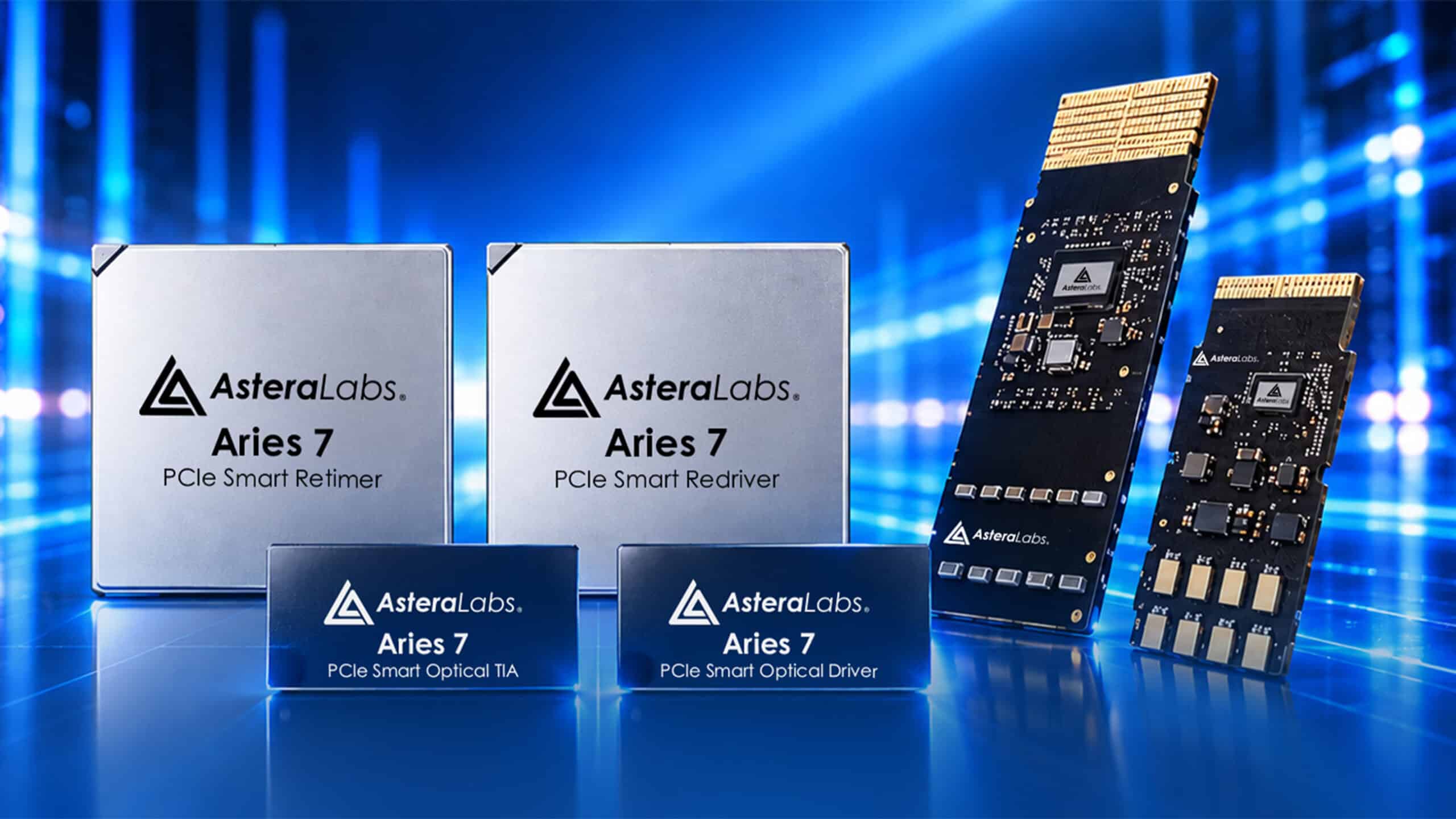
The News: Astera Labs announced Aries 7, which the company describes as the industry’s first PCIe 7 signal conditioning portfolio spanning copper and optical interconnects. The expanded Aries Smart Signal Conditioning family now includes Smart Retimers, Smart Redrivers, Smart Cable Modules, Smart Optical Drivers, and Smart Optical Transimpedance Amplifiers (TIAs), giving hyperscalers, neoclouds, OEMs, and ODMs a connectivity platform that extends reach from centimeters of PCB trace to 50-plus meters over optical cables spanning multiple racks at PCIe 7’s 128 GT/s data rate. The Smart Retimers and Smart Redrivers support the OCP Signal Conditioner Standard Footprint, allowing customers to design once and decide later by swapping signal conditioners without redesigning the board. Fleet management and deep diagnostics across the portfolio are unified under the COSMOS software suite for monitoring, debugging, and dynamic tuning.
“The real question for architects isn’t retimer vs redriver, or copper vs optical: it’s whether they have one comprehensive toolbox with the optionality to pick the right tool for their evolving reach, density and power requirements,” said Adit Narasimha, Senior Vice President, Signal Connectivity Group at Astera Labs. “That is what we built with Aries: the same intelligence and the same software, for the solution the link needs.” AMD and Intel have each validated Aries Smart Retimers in production across their platforms from PCIe 4 through PCIe 6 and both are now collaborating with Astera Labs on the transition to PCIe 7. Zane Ball, Chief Technical Officer of the Open Compute Project, endorsed the footprint extension from Taurus’s Ethernet and UALink applications to the Aries PCIe portfolio. Aries 7 devices are expected to begin sampling in Q4 2026 to select hyperscale, OEM, and NPO customers, with broader availability anticipated as platforms complete qualification, and Astera Labs will demonstrate PCIe 7 copper and optical links at the 2026 OCP Global Summit, October 12-15 in San Jose.
Astera Labs Aries 7 Goes Optical. Can PCIe 7 Outgrow the Retimer Plateau?
Analyst Take: The Astera Labs Aries 7 launch injects new life into the retimer franchise that built the business as its growth matures. Aries set another quarterly revenue record in Q2 2026, yet its share of company revenue has fallen from roughly 90% in 2023 to 53% in Q2 2026 as Scorpio fabric switches and Taurus Ethernet modules scale faster. Scorpio is on pace to overtake Aries as the largest product family in Q3, a quarter earlier than previously guided. The risk embedded in that mix shift is that PCIe retimer demand will flatten as scale-up topologies favor switch silicon over point-to-point conditioning.
Aries 7 is the counter. The portfolio stretches the brand across five device classes, two of them optical, and times the company’s first optical silicon to the near-package optics (NPO) deployments it expects to ramp in 2027. As a result, Aries is no longer a single product line riding PCIe generational transitions. It is now the connectivity layer through which Astera Labs sells optionality with reach from centimeters of board trace to 50 meters of fiber with one software suite.
Aries 7 Converts a Maturing Retimer Franchise Into an Optical On-Ramp
The physics of PCIe 7 explains why the category needed reinvention. Moving from Gen 6 to Gen 7 doubles the data rate to 128 GT/s while the insertion loss budget rises only from 32 dB to 36 dB, cutting usable PCB trace from roughly 14 inches to 10 inches before a signal conditioner becomes mandatory. Shorter reach raises attach rates for conditioning silicon, which supports retimer ASPs through the Gen 7 transition.
That declining reach made an optical transition necessary. The Smart Optical Driver and Optical TIA are the first optical devices Astera Labs has launched, designed for low-power, high-density NPO and linear pluggable optics (LPO) across multi-rack AI fabrics, with linearity and dynamic tuning designed for links that omit a DSP. Astera Labs said the first joint copper and optical deployments will arrive in late 2026 and early 2027. We hear that NPO will enter volume deployment with tier 1 customers in 2027 with CPO architectures following in 2028.
Removing the DSP from a linear optical module leaves high-linearity analog devices tuned through software as the conditioning layer, well suited to optical drivers and TIAs, and the new analog redriver applies the same smart-analog pattern on copper. DSP removal also raises the analog content in each optical port, with a driver on every transmit lane and a TIA on every receive lane, so NPO adoption could become the next major growth leg beyond 2027 as multi-rack scale-up fabrics adopt linear optics. That timing aligns the first Aries optical revenue with the industry’s first high-volume PCIe optical sockets. Aries 7 gives the oldest product line a credible claim on growth within that mix rather than a managed decline.
Smart Swap and COSMOS Convert Portfolio Breadth Into Switching Costs
Swappable modules give this product suite staying power in the copper-to-optical transition. PCIe 7 platform teams face mid-design changes in reach, power, and density requirements, including the copper-versus-optical decision, and a rigid component choice can force a board respin that consumes months of validation. Aries 7 Smart Retimers and Smart Redrivers share the OCP Signal Conditioner Standard Footprint, so a customer can pick a different signal conditioner as requirements change without redesigning the board. The cable modules apply the same logic at the cabling layer, with active copper cables built on the redriver reaching 3 meters and active electrical cables built on the retimer reaching 6 meters at Gen 7 rates, each swappable with optical modules in the same form factor. COSMOS unifies fleet management, monitoring, debugging, and dynamic tuning across all five device classes, and in optical links without a DSP the software compensates for temperature drift, voltage drift, and laser aging that a DSP would otherwise absorb.
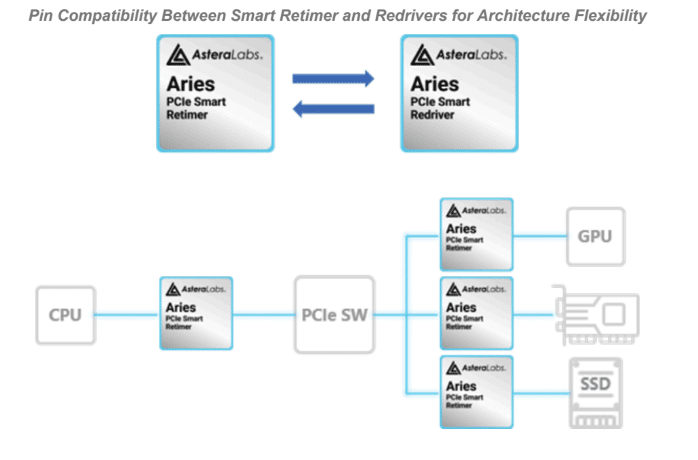
The Smart Redriver itself is a new product class for the Aries line, a mixed-signal device with adaptive equalization through an integrated ADC and built-in eye monitoring, aimed at power-optimized architectures where a full DSP retimer is unnecessary. The bull case is that footprint compatibility plus unified software raises switching costs across an entire cluster design cycle, since every link, copper or optical, reports into the same management layer. The bear case is that the swap is a board-level convenience rather than a qualification shortcut. Hyperscalers qualify silicon, not footprints, so a customer who swaps a retimer for a redriver, or a copper module for an optical one, still faces a fresh qualification cycle on a different product. Four generations of field data back the retimer. The redriver, optical driver, and TIA are new device classes without that operating history, and the reliability record that makes Aries the default choice in copper does not extend automatically to parts that have never run in a production fleet. The OCP standard footprint sharpens the same risk from the other side, since Zane Ball’s endorsement explicitly celebrates multi-vendor sourcing, which invites a qualified second source into every socket Astera Labs designs.
Aries 7 Arrives a Generation Ahead of Announced Merchant Alternatives
Astera Labs enters PCIe 7 with the first signal conditioning portfolio for the generation. The Smart Optical Driver and TIA make it the only vendor to announce PCIe 7 silicon spanning copper and optical. The individual sockets are already contested, and every rival moved in 2026. Marvell announced its acquisition of XConn Technologies in January 2026 and launched the Structera S 60260, a 260-lane PCIe 6.0 switch, at OFC 2026, pairing it with Alaska P retimers so cable partners can stretch PCIe 6.0 AEC reach to 7 meters and active optical cable reach beyond that, with customer sampling expected in Q3 2026. Broadcom showcased PCIe Gen 6 switches and retimers at OFC 2026 alongside 3.2T VCSEL-based NPO and the Tomahawk 6 Davisson CPO switch, placing the incumbent PCIe switch franchise and an Ethernet-side NPO portfolio one protocol away from the sockets Aries 7 targets. Credo’s Toucan PCIe 6 retimer achieved PCI-SIG compliance in February 2026, and its announced Magpie PCIe 7 retimer makes Credo the nearest challenger in the Gen 7 retimer socket itself. The lead is real yet may be fleeting. AMD and Intel Gen 7 collaboration is announced rather than qualified, and Q4 2026 sampling means qualification data will arrive through 2027. Performance and interoperability claims at 128 GT/s require production validation before they reshape procurement, above all for the optical devices, which enter a market where Astera Labs has no deployment history.
What to Watch:
- Whether AMD and Intel’s PCIe 7 collaboration converts into production platform validations, and whether hyperscalers commit publicly to Aries 7
- Whether Smart Optical Driver and TIA design wins align with the 2027 NPO production ramp at a tier 1 AI system designer
- Whether retimer revenue flattens in 2027 as scale-up topologies shift value to fabric switches
- Whether redriver adoption dilutes Aries ASPs or expands total attach per cluster
- Whether Marvell and Broadcom answer with PCIe 7 retimer and optical conditioning roadmaps of their own
- Whether PCIe 7 ecosystem readiness beyond custom XPUs slips toward 2028, stretching the Gen 6 revenue tail
Read the complete press release about Aries 7 on Astera Labs’ website.
Sources
Declaration of generative AI and AI-assisted technologies in the writing process: This content has been generated with the support of artificial intelligence technologies. Due to the fast pace of content creation and the continuous evolution of data and information, The Futurum Group and its analysts strive to ensure the accuracy and factual integrity of the information presented. However, the opinions and interpretations expressed in this content reflect those of the individual author/analyst. The Futurum Group makes no guarantees regarding the completeness, accuracy, or reliability of any information contained herein. Readers are encouraged to verify facts independently and consult relevant sources for further clarification.
Disclosure: Futurum is a research and advisory firm that engages or has engaged in research, analysis, and advisory services with many technology companies, including those mentioned in this article. The author does not hold any equity positions with any company mentioned in this article.
Analysis and opinions expressed herein are specific to the analyst individually and data and other information that might have been provided for validation, not those of Futurum as a whole.
Read the full Futurum Group Disclosure.
Other Insights From Futurum:
SAP’s Autonomous Enterprise: Is Joule the ERP Endgame?
CoreWeave Fully Connected 2026: Forge Brings RL to AI Teams
OPSWAT Firmware 4.3.0 Deepens OT/IT Data-Sharing for Industrial Diodes
Author Information

Brendan is Research Director, Semiconductors, Supply Chain, and Emerging Tech. He advises clients on strategic initiatives and leads the Futurum Semiconductors Practice. He is an experienced tech industry analyst who has guided tech leaders in identifying market opportunities spanning edge processors, generative AI applications, and hyperscale data centers.
Before joining Futurum, Brendan consulted with global AI leaders and served as a Senior Analyst in Emerging Technology Research at PitchBook. At PitchBook, he developed market intelligence tools for AI, highlighted by one of the industry’s most comprehensive AI semiconductor market landscapes encompassing both public and private companies. He has advised Fortune 100 tech giants, growth-stage innovators, global investors, and leading market research firms. Before PitchBook, he led research teams in tech investment banking and market research.
Brendan is based in Seattle, Washington. He has a Bachelor of Arts Degree from Amherst College.