Analyst(s): Brad Shimmin
Publication Date: August 18, 2026
Document #: AINBS202608
What You Need to Know
- Amazon Web Services (AWS) introduced AWS Context (announced in preview this June) alongside the more recently introduced Context Ontology Accelerator, an independent, governed intelligence layer that together can help bridge the gap between raw enterprise data stores and autonomous, agentic reasoning.
- Born from the battle-tested architecture powering Amazon Quick (SemStore and Personal Knowledge Graph), the service leverages an internally proven foundation that supports massive numbers of graph nodes while delivering significant gains in token efficiency and retrieval accuracy.
- AWS Context sidesteps traditional Retrieval-Augmented Generation (RAG) limitations by automatically inferring entities, relationships, join paths, and business rules across structured and unstructured data estates.
- To ensure customer ownership and avoid proprietary metadata lock-in, the system exports contextual data to open table formats such as Apache Iceberg on Amazon S3.
Agents interface with this intelligence layer through a unified, identity-aware agentic search API that uses the open Model Context Protocol (MCP), enabling runtimes such as Bedrock AgentCore, Claude, and OpenAI to safely navigate the enterprise data estate.
Recommendations
- Mandate Open Semantic Portability: When evaluating new agentic reasoning layers, context graphs, or knowledge graphs, strictly demand open-format compatibility. Do not allow your enterprise’s core intellectual property – its painstakingly defined business rules, ontologies, and entity relationships – to become permanently locked inside a proprietary platform configuration. Treat AWS’s architectural decision to use Apache Iceberg for context export as a mandatory baseline procurement requirement for all future vendor evaluations.
- Audit Your Foundational Agent Tooling for Identity Awareness: Ensure that any contextual layer you deploy inherently understands identity and robust usage controls. Autonomous software must face the exact same governance, auditing, and restrictions as human workers. Recognize that a context engine that cannot bind an agent’s specific identity to existing cell- or row-level access controls poses a catastrophic compliance risk.
- Elevate the Role of the Data Steward: The introduction of automated, inferred knowledge graphs accelerates deployment but does not eliminate the need for human oversight. Actively reallocate manual data engineering budgets toward strategic data stewardship, inserting human-in-the-loop curation via tools such as the Context Ontology Accelerator to disambiguate conflicting business rules before an autonomous agent hallucinates a costly operational mistake.
Analysis
The transition from experimental generative AI to production-grade autonomous agents has exposed a severe architectural deficiency within modern data infrastructure. For the past two years, developers have attempted to grant large language models (LLMs) access to enterprise knowledge by wiring them into standalone vector databases, pulling data in using semantic search algorithms. This approach, widely known as naive Retrieval-Augmented Generation (RAG), works adequately for simple document summarization. However, when deployed as the cognitive foundation for autonomous software tasked with executing complex, multi-step business operations, naive RAG breaks down every time.
Organizations attempting to scale these basic retrieval systems repeatedly run into a formidable “context wall.” Without a governed, semantically rich understanding of how different datasets interrelate, agents routinely hallucinate relationships among datasets, invent join paths that do not exist, and return wildly inconsistent answers across business units. The problem is entirely structural and pervasive among current enterprise practitioners. According to the Futurum 1H 2026 Data Intelligence, Analytics, and Infrastructure Decision Maker Survey Report, 59.4% of enterprise RAG architectures remain limited to basic or hybrid search implementations. Unsurprisingly, this architectural immaturity breeds extreme operational hesitation, with 24.9% of enterprise decision-makers citing accuracy and model hallucinations as their primary reservation regarding GenAI replacing traditional BI.
AWS Context, alongside its companion Context Ontology Accelerator, represents a direct, aggressive remedy to this kind of architectural failure. By positioning a governed, automated knowledge graph between raw data storage and agentic reasoning frameworks, AWS intends to provide autonomous systems with the mathematical, deterministic truth they need in order to function safely in production.
Figure 1: Semantic Grounding and Cost Optimization Priorities
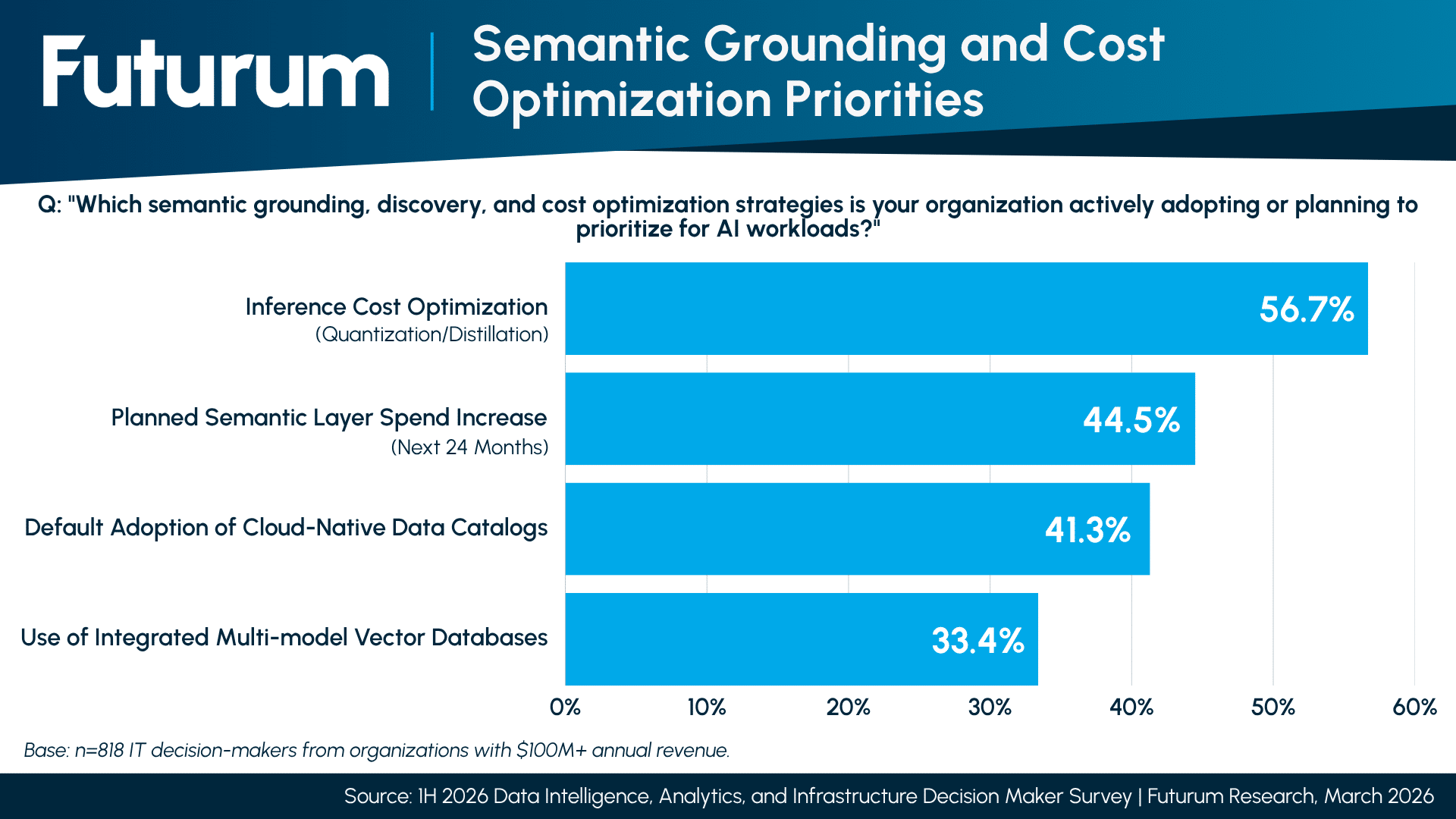
Enterprises recognize that naive RAG architectures are highly prone to hallucination and operational inefficiency, prompting nearly half of all enterprises to increase their semantic layer investments. By actively grounding agents in governed, deterministic business definitions, organizations are fundamentally transitioning their architecture to prioritize mathematical truth over probabilistic guesswork.
Moving from Pipeline Duct Tape to a Governed Knowledge Graph
As this is an architectural problem to solve, the technical pedigree of AWS Context warrants a close examination. Rather than serving as a conceptual whiteboard exercise driven by a fleeting industry trend, this service commercializes the internal infrastructure that powers the Amazon Quick AI assistant. Behind the scenes, Amazon has already scaled this exact approach, utilizing a SemStore (an automatically inferred knowledge graph over structured assets) and a Personal Knowledge Graph (mapping unstructured signals such as people, projects, and messages). With Quick, Amazon reports operating at a 10-million-node scale and serving millions of queries daily. This architecture purportedly yielded a 29-point increase in retrieval accuracy and a tenfold improvement in token efficiency for internal teams. Note that these numbers have not been independently verified by Futurum.
By generalizing this capability across the entire AWS data estate, AWS Context attacks the fragmented “split-stack sprawl” that currently plagues many data engineering teams. Instead of forcing developers to manually duct-tape vector stores, relational databases, and caching layers together through fragile synchronization pipelines, this service automatically infers entities, relationships, and business rules. In this way, it actively maps the relationships among a customer record in an Amazon Aurora database, a transactional log in DynamoDB, and a contract PDF in Amazon S3.
Yet there is no easy button here. AWS itself acknowledges that automated inference will inevitably clash with the messy, undocumented reality of most corporate data lakes. Algorithms alone cannot resolve human business disputes, such as the fact that “Net Revenue” has entirely different definitions for the sales department and the accounting department. This is where the Context Ontology Accelerator can prove its strategic value. The service explicitly applies AI-assisted inference combined with mandatory human curation. It surfaces ambiguities and contradictions, allowing domain experts – acting in a modernized “AI Shepherd” capacity – to step in, disambiguate definitions, and attach formal ontologies before promoting the relationships to production. This can create a self-improving flywheel that ensures that as agents succeed or fail, interaction traces feed back into the graph, continuously enriching the semantic foundation.
The MCP Trojan Horse: Schema-First Navigation
A massive, accurately mapped knowledge graph offers little value if autonomous agents cannot query it reliably. Historically, developers exposed databases to language models via Text-to-SQL pipelines. This, of course, is an inherently dangerous methodology. Exposing a model to raw database schemas and asking it to blindly guess the correct SQL syntax frequently results in poorly optimized queries that crash production servers or, worse, produce confidently incorrect mathematical outputs due to a misunderstanding of the underlying data model.
AWS is engineering a far more elegant consumption model for AWS Context by natively integrating an identity-aware agentic search API powered by the Model Context Protocol (MCP). This acts as a universal, secure gateway, standardizing exactly how models communicate with disparate data sources. Instead of forcing an LLM to guess at SQL code, MCP allows an agent to systematically browse pre-governed business entities and toolsets before putting pen to paper, as it were.
This pragmatic architectural choice aligns perfectly with leading-edge enterprise adoption. According to the Futurum 1H 2026 Data Intelligence, Analytics, and Infrastructure Decision Maker Survey Report, 20% of respondents interested in agentic AI are already running the MCP in production. By embracing this open standard, AWS effectively decouples AWS Context from any specific foundational model. Whether a development team builds an agent on Bedrock AgentCore, Anthropic’s Claude, or an OpenAI model, that agent can plug directly into the AWS Context graph and navigate the enterprise data estate safely, predictably, and strictly within the bounds of its defined identity and access management permissions.
The Near-Death of the Vendor-Locked Ontology
A strategically significant aspect of the AWS Context announcement is its deployment architecture. The enterprise technology market features numerous business intelligence vendors and data platforms offering powerful semantic modeling, only to trap the resulting business logic inside a proprietary metadata repository. Enterprise buyers view this approach with deep cynicism, recognizing that a walled-garden ontology can operate as a hostage situation, making it nearly impossible to migrate workloads to competing engines down the line.
AWS explicitly neutralizes this objection by exporting the resulting contextual data in open table formats, specifically Apache Iceberg on Amazon S3. By physically decoupling the intelligence layer from the compute layer, customers retain full ownership of the resulting knowledge graph. If an enterprise wishes to query its governed context using a compatible third-party query engine, the Iceberg format makes that entirely possible.
This level of semantic portability can help to restore a high degree of sovereignty to the enterprise. The painstaking work of defining business logic, mapping organizational relationships, and governing entity definitions persists as open, executable code. By establishing AWS Context as an open, highly interoperable intelligence substrate, AWS is strategically positioning itself to own the critical governance plane of the agentic AI era rather than the metadata itself, seamlessly collapsing the historical divide between passive data storage and autonomous operational execution.
What to Watch
- Monitor the progression of AWS Context from its current preview state to General Availability, targeted for late 2026. While the foundational architecture shows immense promise, the ultimate enterprise success of this service relies heavily on a rapid rollout of integrations far beyond the initial AWS Glue Data Catalog and Managed Knowledge Base connections. To serve as a universal intelligence layer, AWS Context must demonstrate frictionless, out-of-the-box connectivity with major third-party SaaS ecosystems and external data platforms.
- Keep a close eye on the competitive responses from pure-play vendors Microsoft and Snowflake as these titans of data catalog, governance, and observability respond to this aggressive maneuver. For years, pure-play vendors thrived by providing the connective metadata tissue that cloud hyperscalers historically neglected. As AWS successfully collapses the distance between semantic understanding and active data storage, specialized context vendors will face intense pressure to justify their architectural silos. Expect these competitors to heavily emphasize multi-cloud neutrality and advanced governance workflows as their primary defense against AWS’s native integration advantage.
- As fleets of agents autonomously hit this graph API to resolve complex multi-step workflows, organizations must carefully govern their underlying usage. Humans click dashboards; agents execute thousands of continuous API calls in milliseconds. Watch for the rapid emergence of new “Data FinOps” tooling designed specifically to manage runaway token expenditures, optimize semantic caching, and throttle compute spikes generated by hyper-active autonomous software navigating these massive 10-million-node graphs.
For more information, see the AWS company website.
Disclosure: Futurum is a research and advisory firm that engages or has engaged in research, analysis, and advisory services with many technology companies, including those mentioned in this article. The author does not hold any equity positions with any company mentioned in this article.
Analysis and opinions expressed herein are specific to the analyst individually and data and other information that might have been provided for validation, not those of Futurum as a whole.
Other Insights from Futurum
AWS Looks to Collapse the Search-Analytics Divide: How Its New OpenSearch Engine Fuels Agentic AI
Active Storage Takes Over: AWS DynamoDB Adds Native Vector Search for Agentic AI
From Storage to Action: Why Autonomous AI is Forcing a Database Revolution
Can Legacy Data Security Survive the Velocity of Autonomous AI Agents?
Author Information

Brad Shimmin is Vice President and Practice Lead, Data Intelligence, Analytics, & Infrastructure at Futurum. He provides strategic direction and market analysis to help organizations maximize their investments in data and analytics. Currently, Brad is focused on helping companies establish an AI-first data strategy.
With over 30 years of experience in enterprise IT and emerging technologies, Brad is a distinguished thought leader specializing in data, analytics, artificial intelligence, and enterprise software development. Consulting with Fortune 100 vendors, Brad specializes in industry thought leadership, worldwide market analysis, client development, and strategic advisory services.
Brad earned his Bachelor of Arts from Utah State University, where he graduated Magna Cum Laude. Brad lives in Longmeadow, MA, with his beautiful wife and far too many LEGO sets.