
Analyst(s) Name: Nick Patience
Publication Date: July 22, 2026
Document #: AIONP202607
Key Points
- Three and a half years after ChatGPT’s launch, and with its adoption running faster than that of any comparable technology, the aggregate labor data on both sides of the Atlantic show no economy-wide AI jobs shock. The softening seen in the US and the UK through 2026 is a broad, cyclical hiring slowdown, not automation-driven displacement, and AI is too often a flattering explanation for ordinary cost-cutting.
- The one genuine effect is narrow, concentrated on the entry rung of the most exposed occupations, such as software and customer support, where output is verifiable, and the context an agent needs sits in one place. Entry-level hiring here is measurably down (Stanford finds a 13–16% relative fall for 22- to 25-year-olds; the UK government finds exposed job adverts down 38%), even as intensive AI adopters in the euro area are, on balance, adding staff.
- AI still cannot do most jobs end-to-end: on real, paid freelance work, the best available agent completed just 2.5% of projects to a client-acceptable standard (Scale AI/Center for AI Safety). Adoption is racing, but the measured productivity gain is around 1%, and the binding constraint now is integration and procurement, not raw capability. In many cases, vendors’ products are already more capable than most buyers are ready to deploy.
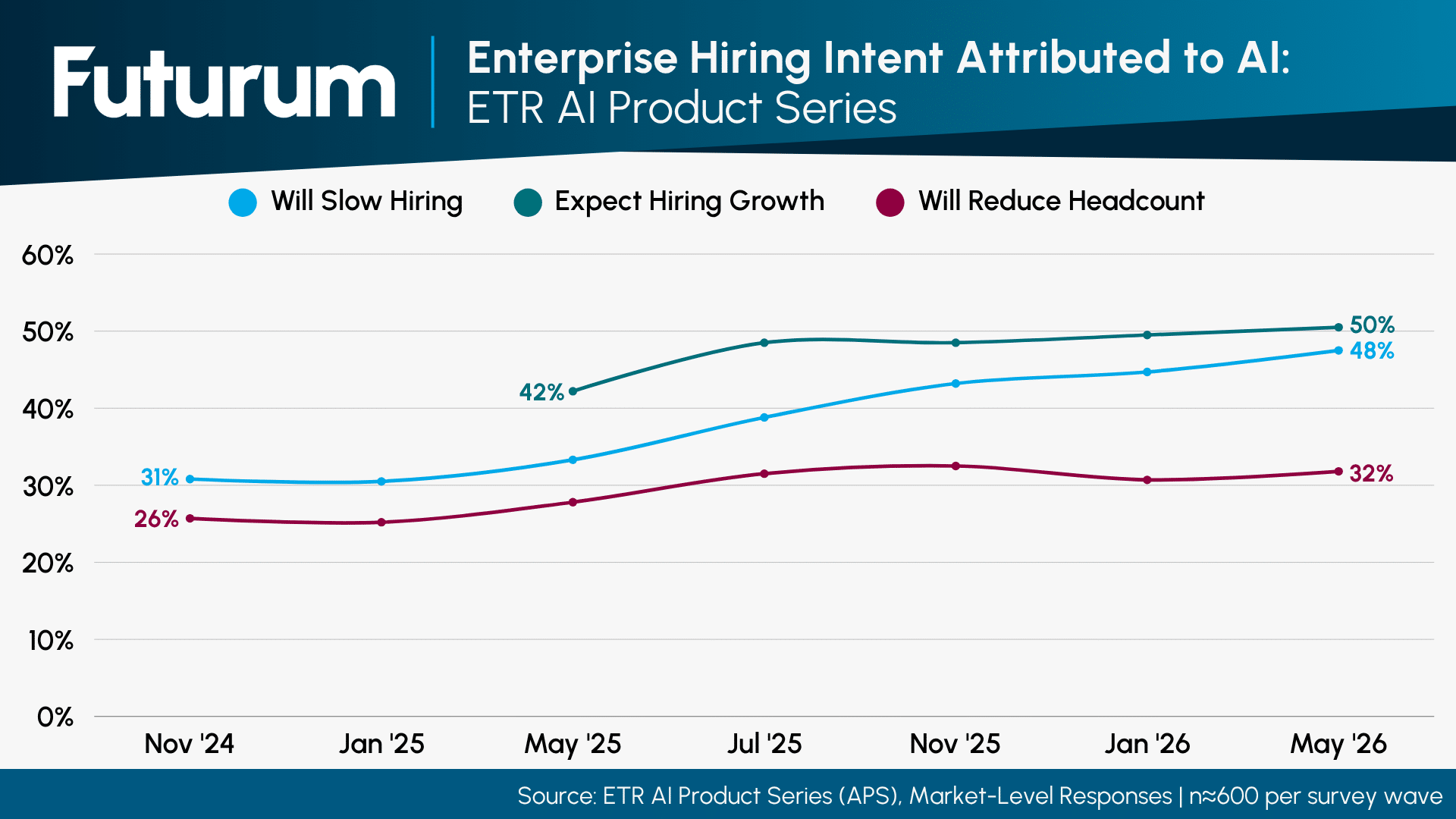
- Enterprises expect AI to slow their hiring in the near term far more than to cut existing headcount: in Futurum’s ETR data, agreement that AI will slow hiring has risen to ~47%, while intent to cut headcount has barely moved (~32%). That looks like a pause while firms work things out, not a permanent reset.
- History’s base rate and the shape of Europe’s hiring data both point to AI expanding the labor market over time rather than shrinking it, with the IMF, WEF, and PwC all leaning in the same direction. The optimistic reading weakens if the entry-rung squeeze climbs the seniority ladder, or if cheaper compute suddenly makes far more work automatable end-to-end.
Recommendations for Vendors
- Sell Growth and Augmentation, Not Headcount Reduction: The firms adopting AI most successfully and hiring are those using it to expand output, not shed staff. Position on new capacity and revenue per employee. The “replace your team” pitch both overpromises, given a 2.5% end-to-end automation rate, and correlates with the weaker-adopting cost-cutters.
- Attack the Integration Bottleneck, Which More Than Model Capability, Is the Real Constraint: Buyers can’t absorb what they already have: scattered context, access controls, and procurement bans. Vendors that solve deployment in terms of enterprise context, governance, and permissioning unlock more value than those chasing another benchmark point.
- Build for the Humans in the Loop and for the New Roles That AI Creates: The durable pattern is augmentation plus emerging functions, such as the internal deployment engineer on the customer side. Design for the people wiring agents into workflows and the juniors whose productivity AI lifts most, and give buyers the measurement to prove modest-but-real gains, since only about one in seven currently see gains above 25%.
Analysis
Hardly anyone serious claims AI has already put huge numbers of knowledge workers out of a job. The real fear is about what’s coming: that the technology gets good enough and cheap enough to do most of what a junior analyst, a support agent, or a coder does today, and that firms will act on that the moment it’s true. That’s a claim about the future, and it can’t be settled by pointing at today’s jobs figures alone.
But today’s data is still the best evidence we have about which way things are heading, and it’s worth taking seriously precisely because it’s the leading edge of the thing people are worried about. Three and a half years after ChatGPT, and with adoption running faster than any previous technology, the aggregate labor market on both sides of the Atlantic shows nothing like the early stages of a wholesale shift. What it does show is a narrow, real effect at the entry level of a handful of exposed occupations, which is arguably where you’d expect the future to show up first, if it’s coming. So the question worth answering isn’t “has AI taken the jobs,” it’s whether that entry-level squeeze is an early tremor or a false alarm. The evidence below leans toward tremor, but a small and contained one so far, not the start of the earthquake.
It is worth a moment to consider how poorly we forecast these moments, in both directions. In 1964, the alarm was serious enough that President Johnson convened a national commission to establish whether automation would outrun job creation; it found nothing of the sort, and the same fear has resurfaced roughly once a generation since. The best cautionary tale cuts both ways: US bank-teller numbers actually grew for decades after the ATM – cheaper branches meant more of them, the standard rebuttal to automation panic – until mobile banking, a far more complete substitute, quietly did what the machines never had. And in 2016, Geoffrey Hinton, one of the “godfathers of AI,” called it “completely obvious” that deep learning would outperform radiologists within five years and advised people to stop training them; nine years on, radiology is short-staffed, and the field is forecast to grow. The lesson is not that automation anxiety is always right or always wrong, but that the timing and completeness of the substitute determine everything, and both doom-mongers and debunkers tend to declare victory too early. A useful humility check on any forecast here is included.
The Aggregate Says Stability Rather Than Collapse
Perhaps the most careful economy-wide read, from the Budget Lab at Yale, finds the US occupational mix shifting no faster than it did when the PC or the internet arrived, and no relationship between an occupation’s AI exposure and its employment or the duration of unemployment1. The softening through 2026 is real but cyclical: hiring has frozen while employers wait out interest rates and uncertainty, and involuntary separations – the US Bureau of Labor Statistics (BLS) layoffs-and-discharges rate – remain close to normal2. A workforce being displaced by machines would show rising layoffs in exposed sectors; instead, the US and the UK show a low-hire, low-fire stall3. Naming AI as the cause of a cut is more often than not a flattering gloss on ordinary cost-cutting, which is why I would weight the self-reported layoff counts far below the payroll data.
Adoption Is Racing; the Dividend Is Modest
There is a clear disconnect here: AI is being adopted at record speeds, yet the actual impact on the economy remains surprisingly small. The St. Louis Fed’s self-reported estimates put the productivity dividend at around a single percentage point4; ETR’s enterprise telemetry echoes it, with roughly nine in ten organizations reporting some engineering-productivity gain from AI coding tools but only about one in seven reporting gains above 25%5. The gains are also conditional on what they are applied to. As a senior Salesforce executive put it to me recently: AI has never fixed a bad process; it makes a good one better, but it never carries an organization from good to great on its own. A general-purpose technology in its early, augmentation-heavy phase does not clear out a workforce; it makes the people who use it somewhat more productive, unevenly, while formal enterprise integration still lags well behind informal use.
Can AI Even Do the Work?
The replacement thesis assumes the technology can already do the jobs end-to-end, and the best evidence says it largely cannot (remember, the timing and completeness of the substitute really matter). The Remote Labor Index from Scale AI and the Center for AI Safety tests agents on real, paid freelance projects, a median of roughly 11.5 hours of professional work each. The best-performing agent completed just 6 of 240 to a standard a client would accept: an automation rate of 2.5%, with failures as mundane as truncated deliverables and corrupt files6. Set that against the 80-to-90% these same models score on isolated benchmarks, and the mismatch is the point: benchmark skill is not the same as doing the job. The more useful question is not whether AI can work, but where it works first. Box CEO Aaron Levie has pointed out that coding is unusually suited to today’s agents because its output is verifiable – the code runs, or it does not – the models are steeped in it, and the context an agent needs sits in one place. Most other knowledge work has none of those properties; its context is scattered across 20+ systems, and access controls get in the way. That is why the earliest, clearest effects show up in software and support, and why broad knowledge-work displacement is further off than the coding results alone would suggest.
What Enterprises Actually Plan: Slow Hiring, Not Layoffs
The most useful forward signal comes from asking buyers directly, which is what Futurum’s ETR does. Across seven waves of ETR’s AI Product Series, agreement that AI will lead firms to slow hiring has climbed from about 31% to roughly 47%, while agreement that AI will drive outright headcount cuts has barely moved, from about 26% to 32% (Figure 1). More than half now expect hiring growth to lag revenue growth due to AI-driven productivity gains. Read together, enterprises are planning to grow output faster than payroll and to hire more slowly, far more than they are planning redundancies. This is stated intent, not realized action, and belongs alongside the payroll data rather than in place of it, but its direction is unambiguous, and it lands hardest on new hiring. It also assumes deployment is even permitted; we hear anecdotally pretty regularly that the default position of many enterprises is a blanket prohibition on AI in delivered products, which is a reminder that much of the constraint on AI at work still sits in procurement, rather than in capability. We are aware that technology vendors have products that are far more capable than people – or the companies they work for, at least – are ready to use.
Figure 1: Enterprise Hiring Intent Attributed to AI – ETR AI Product Series
Where AI Is Genuinely Biting: The Entry Rung
The most compelling contrary evidence doesn’t come from layoff headlines, but from serious research. Stanford’s Digital Economy Lab, using high-frequency payroll data, finds a 13-to-16% relative employment decline for 22- to 25-year-olds in the most AI-exposed US occupations since late 2022, concentrated where AI automates rather than augments, while older workers in the same roles hold steady. The authors specifically argue that interest rates do not explain the disproportionate entry-level fall, and that the result survives excluding remote-friendly work7. The UK shows the same: its Department for Science Innovation & Technology (DSIT) finds high-exposure job adverts down 38% against 21% for low-exposure roles8, and online job site Indeed reports UK postings that mention AI running far above baseline, even as overall postings sit below it9. There is a genuine puzzle here in that the productivity experiments show AI helping novices most, yet it is juniors in exposed roles whose hiring is falling. The likely reconciliation is that AI makes the juniors who remain more productive while shrinking how many a firm needs at the entry rung. And the number of rungs is contracting, not the value of a human on one.
The Transatlantic Split
Drawing on the European Central Bank’s (ECB) survey of some 5,000 firms published in March 2026, economists Laura Lebastard and David Sondermann found no overall employment gap between AI-using and non-using firms. They found that intensive AI users are about 4% more likely to add staff, and the firms deploying AI for R&D and growth are driving that hiring, while the minority using it mainly to cut costs, hire less. Bloomberg summarized the ECB’s conclusion thus: AI has not cost euro-area jobs so far, and the heaviest users are adding people10. The corroborating micro-evidence is a Danish study titled Large Language Models, Small Labor Market Effects11. That sits alongside the ECB’s own reading of the US, where high-substitution-risk occupations grew about 15 percentage points more slowly than low-risk ones between 2019 and 202512. My own reading is that the continent’s issue is less one of adoption than of production: thousands of firms of varying age, size, and maturity, a pattern common to most of the world. The more flexible US labor market simply adjusted earlier.
Zoom out, and the global evidence points the same way. The IMF estimates roughly 40% of jobs worldwide are exposed to AI, rising to about 60% in advanced economies, but with exposure split fairly evenly between roles likely to be complemented and those at genuine risk13. The World Economic Forum’s Future of Jobs 2025 projects net job creation to 203014 and PwC’s 2026 Global AI Jobs Barometer of around a billion job ads finds AI-exposed industries posting faster growth in revenue per employee and faster wage growth; a two-track market that reprices human judgment upward rather than eliminating it15.
Jevons or Engels? Paradox or Pause? – Two Ways the Next Decade Could Run
There are two reasonable economic readings of where this goes, and they point in opposite directions – but that’s the nature of economics. The optimistic one is the Jevons Paradox: as a resource becomes cheaper to use, we use it far more. Box’s Levie is, by his own admission, “Jevons-pilled” and his argument is that when one engineer can do the work of several, firms that always wanted more engineering simply commission far larger projects and hire more, not fewer, people. PwC’s finding that the most AI-exposed firms are adding both headcount and wages, and the ECB’s that intensive adopters hire, both lend it support.
The pessimistic reading is the economic historian Robert Allen’s Engels’ Pause: the long early-industrial stretch in Britain when output per worker climbed while workers’ real wages stagnated, because technical change raised the demand for capital, and capital’s share of income grew at labor’s expense16. The AI parallel is imperfect but instructive, and its clearest present-day sign is where the money is going. The hundreds of billions pouring into GPUs and data centers is, in Allen’s terms, investment flowing to capital rather than to labor, i.e., spent on compute, not on payroll. Ryan Avent, writing in the FT’s Alphaville section, arrives at the same place from the other direction: the sheer scale of that investment makes fast, total automation implausible, while scarce compute is rationed by price (the tokenmaxxing-to-tokenminimizing turn of 2026), with firms throttling employee AI use and Ford rehiring veteran engineers after AI fell short17. On this reading, even without a jobs apocalypse, labor can still lose, through wage pressure and a rising capital share, as the gains accrue to the owners of the compute rather than the people working alongside it. The ECB’s observation that AI’s effect is so far visible in who gets hired, but not yet in wages, is consistent with precisely that.
Conclusion
In conclusion, I lean optimistic: toward Jevons rather than Engels and toward an expanding labor market rather than a stagnant one. Two things put me there. The first is the base rate. The history cited here is largely a history of people underestimating how much demand for a service grows once it gets cheaper and better: bank branches after the ATM, radiology after Hinton, and I suspect knowledge work after generative AI. The second is what the entry-rung squeeze actually looks like up close: firms managing junior headcount down while they work out how to redeploy the capacity that AI is freeing up, reads to me as a transition cost, not a structural verdict on demand. My expectation is that the next few years look more like the original ATM story than the mobile-banking sequel: new roles, more of them, and more ambitious projects commissioned because the marginal engineer, or analyst, or support agent just got a lot cheaper to field. The ETR data on hiring intent is worth watching closely (and will be updated regularly), but I would read it as the leading edge of a slowdown in near-term recruitment rather than evidence that the market itself is shrinking. The experience of Europe, where the firms using AI to grow are the ones hiring, looks to me like the shape the rest of the world eventually takes, once the current caution about headcount works its way through.
What to Watch
- Entry-Level Cohorts, the Monthly Canary: Employment for 22- to 25-year-olds in software and customer support, and graduate postings are the leading indicators to track ahead of the topline payrolls.
- New Role Categories: Watch for the “internal deployment engineer” that Levie and others in the tech industry describe, i.e., people who wire agents into a business function. If AI is creating jobs, this is where the hiring data should show it first.
- Transatlantic Convergence: Whether the euro area’s “AI is hiring” pattern holds as adoption deepens, or drifts toward the US and UK reallocation at the exposed margin.
- The Compute Throttle: If inference stays expensive, workers stay cost-competitive for longer; if capacity build-out cheapens tokens quickly, more use cases become economical, and the calculus shifts.
- Policy Anchoring: Whether governments build retraining and jobs policy on self-reported AI attribution rather than realized payroll data.
Sources:
- The Budget Lab at Yale, “Evaluating the Impact of AI on the Labor Market” (Gimbel, Kinder, Kendall, and Lee), October 2025, with monthly CPS updates
- US Bureau of Labor Statistics, Employment Situation—June 2026 (released July 2, 2026), and the JOLTS layoffs-and-discharges series
- Office for National Statistics, “Labour market overview, UK,” spring 2026
- Bick, Blandin, and Deming, “The State of Generative AI Adoption in 2025,” Federal Reserve Bank of St. Louis, November 13, 2025
- ETR (Enterprise Technology Research, a Futurum Group company), AI Product Series (APS), Q21 Coding Tool Impact, market-level responses, July 2025 and January 2026
- Scale AI and the Center for AI Safety, Remote Labor Index, 2025–26
- Brynjolfsson, Chandar, and Chen, “Canaries in the Coal Mine? Six Facts about the Recent Employment Effects of Artificial Intelligence,” Stanford Digital Economy Lab, August 2025 (revised November 2025), with follow-up note, March 2026
- UK Department for Science, Innovation and Technology, “Assessment of AI Capabilities and the Impact on the UK Labour Market,” January 2026
- Indeed Hiring Lab (UK), March 2026
- Lebastard and Sondermann, “Artificial Intelligence: Friend or Foe for Hiring in Europe Today?,” European Central Bank Blog, March 4, 2026 (ECB Survey on the Access to Finance of Enterprises); coverage in Bloomberg
- Humlum and Vestergaard, “Large Language Models, Small Labor Market Effects,” 2025
- European Central Bank, Economic Bulletin box on AI and US employment, 2026
- IMF (Cazzaniga et al.), “Gen-AI: Artificial Intelligence and the Future of Work,” 2024
- World Economic Forum, Future of Jobs Report 2025
- PwC, 2026 Global AI Jobs Barometer
- R. C. Allen, “Engels’ Pause: Technical Change, Capital Accumulation, and Inequality in the British Industrial Revolution,” Explorations in Economic History 46, no. 4 (2009)
- Ryan Avent, “Artificial intelligence and Engels’ Pause,” FT Alphaville, June 29, 2026
Disclosure: Futurum is a research and advisory firm that engages or has engaged in research, analysis, and advisory services with many technology companies, including those mentioned in this article. The author does not hold any equity positions with any company mentioned in this article.
Analysis and opinions expressed herein are specific to the analyst individually and data and other information that might have been provided for validation, not those of Futurum as a whole.
Other Insights from Futurum
AI Platforms Market Hits $109.9B, More Than Tripling by 2030
Sovereign AI: What Nations Want (And What They’ll Actually Get)
Author Information

Nick Patience is VP and Practice Lead for AI Platforms at The Futurum Group. Nick is a thought leader on AI development, deployment, and adoption - an area he has researched for 25 years. Before Futurum, Nick was a Managing Analyst with S&P Global Market Intelligence, responsible for 451 Research’s coverage of Data, AI, Analytics, Information Security, and Risk. Nick became part of S&P Global through its 2019 acquisition of 451 Research, a pioneering analyst firm that Nick co-founded in 1999. He is a sought-after speaker and advisor, known for his expertise in the drivers of AI adoption, industry use cases, and the infrastructure behind its development and deployment. Nick also spent three years as a product marketing lead at Recommind (now part of OpenText), a machine learning-driven eDiscovery software company. Nick is based in London.