Analyst(s): Brad Shimmin
Publication Date: July 17, 2026
Regatta introduces RegattaDB, a unified OLTP/OLAP database engineered to collapse disparate architectures into a single, linearly scalable core. Capable of ingesting hundreds of millions of events per second, this pure scale-out engine directly targets the infrastructure gaps that often hinder read-write autonomous AI agents. The platform offers a consolidated alternative to the fragmented stacks of operational databases, cloud data warehouses, and vector stores currently dominating the enterprise landscape.
What Is Covered in This Article:
- A Unified Database Engine: Regatta has launched RegattaDB, a combined transactional (OLTP) and analytical (OLAP) database natively designed to bridge the gap between real-time data ingestion and deep analytical reasoning.
- Massive Concurrency and Scale: Built on a pure scale-out, shared-nothing architecture, RegattaDB leverages a unique concurrency control mechanism to process hundreds of millions of events per second while maintaining strict ACID compliance.
- Displacing the Fragmented Stack: The offering aggressively challenges the traditional multi-vendor data stack, aiming to replace operational systems (MySQL, PostgreSQL, MS SQL), analytical warehouses (Snowflake, BigQuery, Redshift), and dedicated vector stores (Chroma, Milvus, Pinecone).
- Enabling Agentic Autonomy: Specifically engineered to support the emerging era of agentic AI, the architecture allows autonomous agents to execute live transactions directly against systems of record without suffering crippling pipeline latency.
- Current Deployment Limitations: At launch, Regatta offers the technology only for on-premises or single-cloud/managed hosted environments, with plans for native hybrid deployment capabilities.
The News: Regatta officially launched RegattaDB, a unique, combined OLTP and OLAP database. Rooted in seven years of dedicated engineering to unify query execution across historically disparate data sources, RegattaDB introduces a pure scale-out architecture capable of ingesting hundreds of millions of events per second. By merging transactional processing, analytical querying, and vector search into a single foundational technology, Regatta positions RegattaDB to systematically displace legacy operational systems such as MS SQL Server, PostgreSQL, MySQL, and MariaDB. The platform also takes direct aim at modern cloud data warehouses, including Snowflake, Redshift, and BigQuery, alongside specialized vector databases such as Pinecone.
RegattaDB Arrives: A Unified Engine Built for the Era of Read-Write AI
Analyst Take: The enterprise AI narrative suffers from severe data pipeline fatigue. Today’s AI environments remain largely trapped in a passive, read-only paradigm. Most generative models rely on Retrieval-Augmented Generation (RAG) pipelines, pulling historical data from isolated vector databases or analytical data warehouses solely to inform a chatbot’s conversational response. While functional for generating text, this setup collapses completely when asked to drive actual business execution.
According to the Futurum Research 2026 Key Issues & Predictions report, AI commerce is definitively transitioning from “Read-Only” conversational interfaces to “Read-Write” autonomous agents capable of executing live transactions. However, this transition creates a deep architectural physics problem. If an AI agent needs to analyze a massive corpus of historical customer behavior (OLAP) and immediately update a live inventory system or process a payment (OLTP), forcing that workflow across disconnected databases and brittle extraction, transformation, and loading (ETL) pipelines introduces unacceptable latency and risk. RegattaDB attacks this specific friction point by collapsing the silos, empowering the analytical reasoning engine and the transactional system of record to operate seamlessly on the exact same data substrate.
This agentic action gap is actually paralyzing infrastructure bottlenecks by blocking data engineering teams from building functional autonomous workflows. Practitioners spent the early part of the year teaching models to understand enterprise data through semantic layers and complex knowledge graphs. But now, organizations are facing a considerably harder challenge: safely permitting software agents to touch and alter that data.
The empirical data surrounding agentic deployments make these friction points glaringly obvious (see Figure 1).
Figure 1: Agentic Workflow Bottlenecks
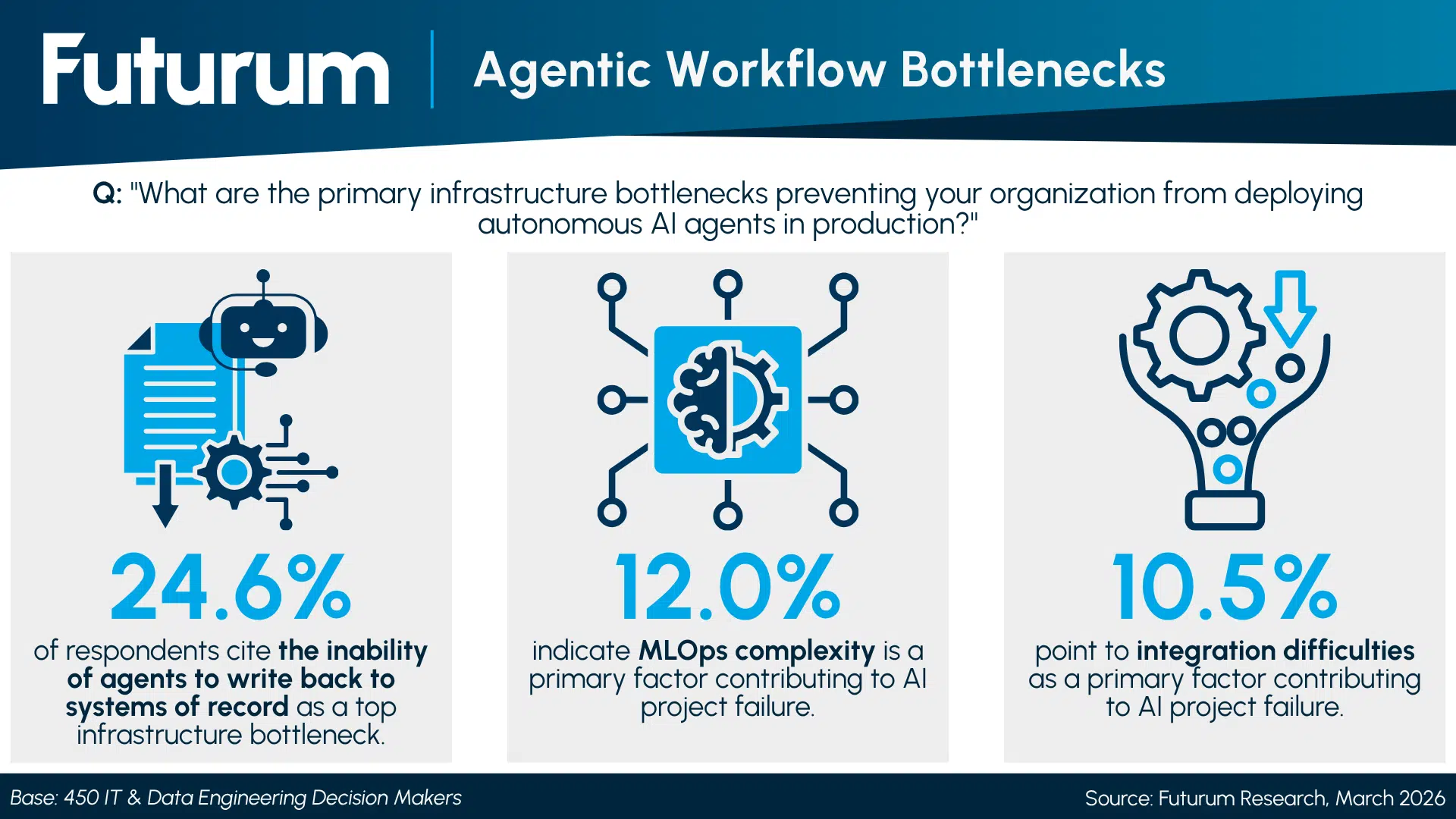
As organizations push beyond basic RAG implementations, the fundamental inability of AI agents to execute transactional writes against operational databases has emerged as a critical roadblock, necessitating a unified OLTP/OLAP data layer.
Under the Hood
Regatta’s pure scale-out architecture is an interesting technical differentiator for RegattaDB. It naturally invites comparisons to Oracle HeatWave and other operational databases with overlaid analytical capabilities. While HeatWave paved the way for unified MySQL analytics, RegattaDB employs a substantially more aggressive, purely distributed approach to concurrency and scale.
The most compelling engineering achievement within RegattaDB, however, involves its patented concurrency control mechanism (CCP). Traditional pessimistic locking cripples performance at massive scale, while purely optimistic concurrency triggers high conflict rates during write-heavy workloads. RegattaDB’s non-blocking, semi-optimistic approach threads this needle, enabling strong ACID compliance across a massive cluster without degrading ingest performance. By generating tens of millions of distributed, consistent snapshots per second, the platform provides a serious advantage for high-velocity AI ingest. An AI agent can read a globally consistent state of the business in real-time, compute a decision, and execute a write transaction without ever locking up the underlying operational systems.
Furthermore, RegattaDB leverages advanced data layouts and logical caching strategies within an effective shared-nothing architecture. Eschewing generic industry approaches that treat all storage media identically, RegattaDB optimizes data layouts per media type (such as Flash), workload, and specific datatype.
The engineering team paired this design with patented cache eviction policies and dynamic optimizers built natively for massive distributed systems. Because it operates on a many-to-many architecture, the platform leverages all resources across all cluster nodes simultaneously. This maintains total elasticity and avoids the single-node bottlenecks that traditionally plague unified databases. Enterprises can start with small, highly efficient configurations and scale linearly into massive heterogeneous cluster environments.
A Collision Course with the Data Status Quo
RegattaDB sets an aggressive collision course with incumbent database vendors. A single logical engine capable of simultaneously processing transactions, running deep analytical queries, and executing high-dimensional vector search directly challenges the traditional multi-vendor stack. Regatta essentially tells enterprises they no longer need to fund or manage the brittle pipelines connecting PostgreSQL for transactions, Snowflake for analytics, and Pinecone for vector embeddings, for example.
This consolidation strategy closely aligns with Futurum’s evolving concept of “data gravity,” as outlined in the State of the Market Report: Data Intelligence, Analytics, and Infrastructure, Q2 2026. Major vendors actively pursue data gravity, pushing AI agents directly to where the data resides to minimize security risks and latency overhead. The question then emerges: why split that data up into irreconcilable data silos? RegattaDB seeks to answer that question and capitalize on this trend by ensuring the transactional system of record and the analytical context window remain the exact same destination.
What to Watch:
- The Hybrid Deployment Hurdle: At launch, RegattaDB remains restricted to on-premises or single-cloud/managed hosted environments. This presents a noticeable friction point. Enterprise IT leaders strongly prioritize open, decoupled architectures that span multiple clouds and edge locations to mitigate vendor lock-in.
- The Pure-Play Retaliation: As Regatta encroaches on the territory of dedicated vector stores and specialized cloud data warehouses, expect aggressive architectural counter-moves. Incumbents in the vector space will likely push deeper into application logic, intelligent caching, and model orchestration to defend their highly specialized value propositions against unified OLTP/OLAP engines.
- Ecosystem Integration Friction: Collapsing the database stack demands profound changes to application development patterns. Transitioning from writing SQL against a traditional relational database to leveraging a unified engine for agentic workflows requires a substantial lift. Watch how quickly the developer community adopts RegattaDB’s unified query interfaces compared to the deeply entrenched, specialized tooling they currently use for PostgreSQL and Snowflake.
See the complete press release on the Regatta website.
Disclosure: Futurum is a research and advisory firm that engages or has engaged in research, analysis, and advisory services with many technology companies, including those mentioned in this article. The author does not hold any equity positions with any company mentioned in this article.
Analysis and opinions expressed herein are specific to the analyst individually and data and other information that might have been provided for validation, not those of Futurum as a whole.
Other Insights From Futurum:
Navigating the Shift to Production AI in 2026
The Semantic Layer Wars: Why BI Must Remain the Center of Gravity for Trusted AI
Snowflake Acquires Observe: Operationalizing the Data Cloud
Author Information

Brad Shimmin is Vice President and Practice Lead, Data Intelligence, Analytics, & Infrastructure at Futurum. He provides strategic direction and market analysis to help organizations maximize their investments in data and analytics. Currently, Brad is focused on helping companies establish an AI-first data strategy.
With over 30 years of experience in enterprise IT and emerging technologies, Brad is a distinguished thought leader specializing in data, analytics, artificial intelligence, and enterprise software development. Consulting with Fortune 100 vendors, Brad specializes in industry thought leadership, worldwide market analysis, client development, and strategic advisory services.
Brad earned his Bachelor of Arts from Utah State University, where he graduated Magna Cum Laude. Brad lives in Longmeadow, MA, with his beautiful wife and far too many LEGO sets.