
Austin, Texas, USA, June 17, 2026
The enterprise build preference is holding firm, but SaaS vendors have more ground to stand on than the headline numbers suggest.
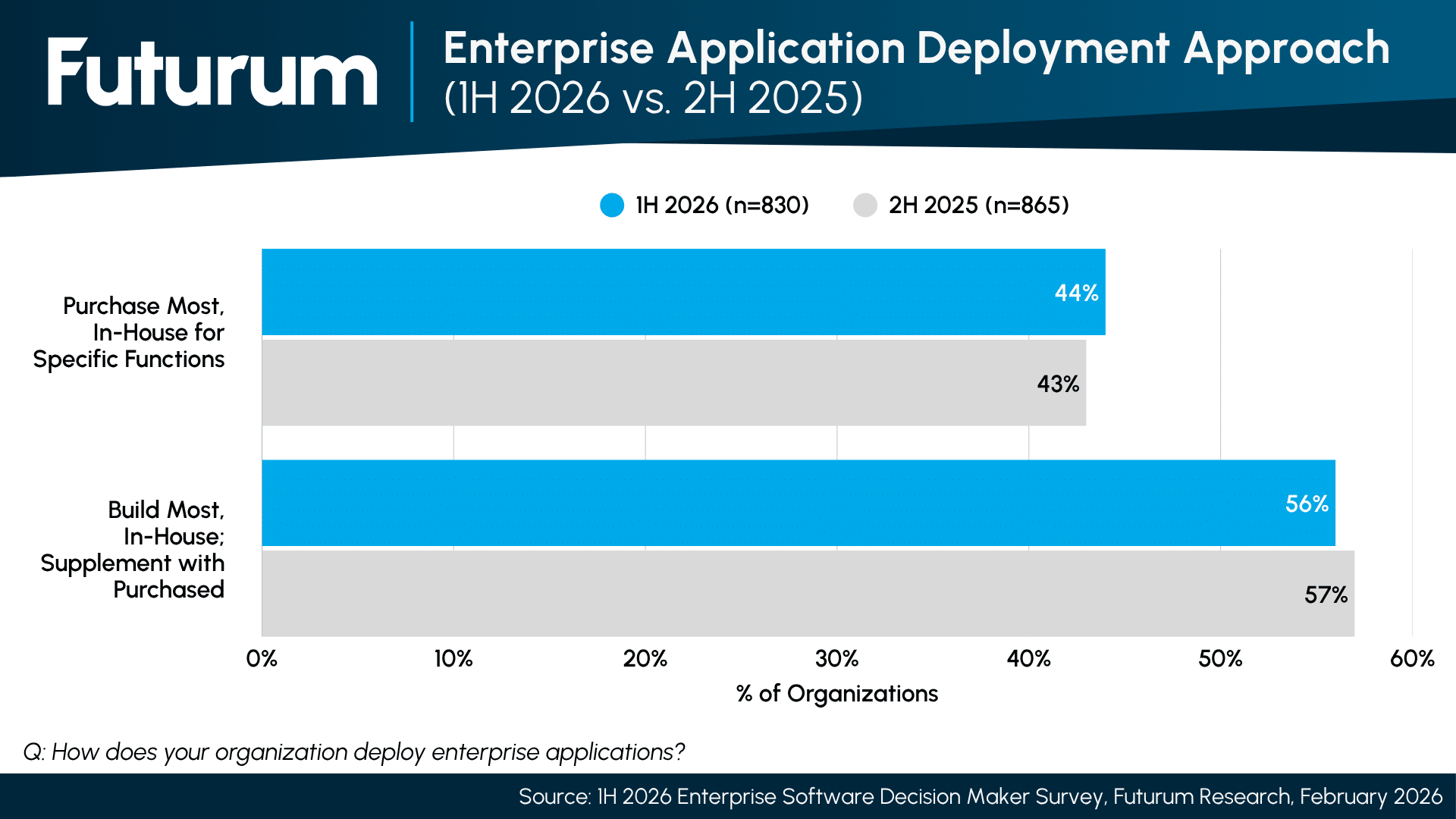
New findings from The Futurum Group’s “1H 2026 Enterprise Software Decision Maker Survey Report,” a study of 830 global IT decision-makers, reveal that 56.0% of enterprise decision-makers still prefer to build most applications in-house, supplementing with purchased solutions only where necessary. The figure is virtually unchanged from 56.6% in 2H 2025, a near-zero movement despite the explosion of AI-powered development tools, no-code and low-code platforms, and increasingly capable SaaS solutions.
The persistence of the build preference presents a genuine competitive challenge for software vendors. At the same time, the data points to a set of structural advantages that commercial vendors hold over internal teams, particularly as AI raises the stakes on cross-enterprise data consistency, security governance, and software reliability.
Figure 1: Enterprise Application Deployment Approach, 1H 2026 vs. 2H 2025
“The build preference is real, and vendors should not underestimate it, particularly as AI tools make internal development faster and more accessible. But the competitive picture is more nuanced than the top-line number suggests. Enterprise software vendors carry decades of accumulated advantage in areas that internal teams consistently struggle to match: cross-enterprise workflow design, the operational burden of ongoing maintenance and upgrades, security and data privacy governance at scale, and the complexity of managing third-party integrations across heterogeneous environments. As AI agents begin operating across these same dimensions, those moats become more valuable, not less.”
— Keith Kirkpatrick, Vice President and Research Director, The Futurum Group
The research reveals several key dynamics shaping the build-versus-buy balance:
- Citizen developers are expanding the build coalition beyond IT: 53.3% of organizations report that 20 to 40% of their non-IT workforce now uses no-code, low-code, or natural-language tools to create or modify applications, and 22.3% report 40 to 60% adoption. Business users are building directly, reducing reliance on both internal IT departments and external vendors.
- SaaS vendors hold defensive moats that internal teams cannot easily replicate: Commercial vendors offer compounding advantages in four areas where in-house teams face persistent gaps: experience designing cross-enterprise workflows that span organizational boundaries; ownership of the software maintenance and upgrade lifecycle; purpose-built security and data privacy controls tested across thousands of enterprise environments; and deep expertise managing third-party application integrations. As agentic AI operates increasingly across these domains, these capabilities represent durable vendor differentiation.
- Speed-to-value remains the most direct conversion lever: Vendors capable of collapsing implementation timelines from months to weeks, through pre-built industry workflows, open APIs, and low-code extensibility, offer build-first enterprises the one advantage internal teams cannot manufacture: accumulated cross-customer insight built into the product from day one.
Subscribers can read more in the “1H 2026 Enterprise Software Decision Maker Survey Report” on the Futurum Intelligence Platform. Non-subscribers—click here for more information.
About Futurum Intelligence for Market Leaders
Futurum Intelligence’s Enterprise Software & Digital Workflows IQ service provides actionable insight from analysts, reports, and interactive visualization datasets, helping leaders drive their organizations through transformation and business growth. Subscribers can log into the platform at https://app.futurumgroup.com/, and non-subscribers can find additional information at Futurum Intelligence.
Follow news and updates from Futurum on X and LinkedIn using #Futurum. Visit the Futurum Newsroom for more information and insights.
Other Insights From Futurum:
The Hidden Moat: Why Operational Depth Defeats the ‘Build It Yourself’ Narrative
Who Will Control the Enterprise Agentic Workforce? – CIOs Face a New Platform War
Are Outcome-Based and Hybrid AI Pricing Models Rewriting the Vendor Playbook?
Author Information

Keith Kirkpatrick is VP & Research Director, Enterprise Software & Digital Workflows for The Futurum Group. Keith has over 25 years of experience in research, marketing, and consulting-based fields.
He has authored in-depth reports and market forecast studies covering artificial intelligence, biometrics, data analytics, robotics, high performance computing, and quantum computing, with a specific focus on the use of these technologies within large enterprise organizations and SMBs. He has also established strong working relationships with the international technology vendor community and is a frequent speaker at industry conferences and events.
In his career as a financial and technology journalist he has written for national and trade publications, including BusinessWeek, CNBC.com, Investment Dealers’ Digest, The Red Herring, The Communications of the ACM, and Mobile Computing & Communications, among others.
He is a member of the Association of Independent Information Professionals (AIIP).
Keith holds dual Bachelor of Arts degrees in Magazine Journalism and Sociology from Syracuse University.

