
Analyst(s): Name Dion Hinchcliffe
Publication Date: June 1, 2026
Document #: AIODH202605
The enterprise AI market is undergoing a major transition from assistive tools toward autonomous operational systems, with the latest generation of Agentic AI platforms focusing on governance, orchestration, and persistent execution of enterprise work. Five major vendors—Microsoft, Salesforce, ServiceNow, AWS, and Google—are battling to establish themselves as the operational control plane for this digital labor, each approaching the market with different architectural strategies. The core competitive battle now centers on interoperability, governance, and operational trust, as CIOs must manage complex, heterogeneous multi-agent environments and develop new operational disciplines around the Agentic AI workforce.
Key Points
- Microsoft, Salesforce, ServiceNow, AWS, and Google are all attempting to become the operational control plane for enterprise digital labor, which has become core to AI transformation, but each is approaching the market from fundamentally different architectural and organizational assumptions.
- The enterprise AI market is rapidly evolving from copilots toward governed systems of autonomous execution, forcing CIOs to deeply rethink workflows, governance, workforce design, and operational architecture simultaneously.
- The next phase of enterprise platform competition will be defined less by model quality and more by orchestration, interoperability, governance, operational trust, and the ability to coordinate heterogeneous multi-agent environments at scale.
Recommendations for Vendors in the Enterprise Agent Space
- Prioritize Operational Governance over AI Novelty: Enterprises increasingly care less about chatbot sophistication and more about whether agentic systems can operate safely, observably, and reliably at scale across complex enterprise environments.
- Reduce Orchestration Complexity and Implementation Friction: Most enterprises are not prepared to engineer multi-agent systems from scratch, meaning vendors that simplify deployment, governance, identity management, and interoperability will gain substantial competitive advantages.
- Build for Heterogeneous Enterprise Environments Rather Than Assuming Platform Exclusivity: CIOs are increasingly rejecting closed AI stacks in favor of interoperable ecosystems capable of orchestrating workflows across multiple clouds, applications, data systems, and models.
What You Need to Know
The enterprise AI market is entering a major transition from assistive AI toward autonomous operational systems capable of executing enterprise work. The latest generation of agentic AI platforms from Microsoft, Salesforce, ServiceNow, AWS, Google, IBM, Oracle, Palantir, SAP, and UiPath increasingly focus on orchestration, governance, workflow automation, and persistent execution rather than isolated conversational interfaces.
Microsoft expanded its Agent 365 and Azure AI Foundry strategy to create a broad enterprise AI control plane deeply integrated with Microsoft Graph, Fabric, Teams, and enterprise identity systems. Salesforce accelerated its API-first “Agentic Enterprise” strategy through Agentforce, Headless 360, Data Cloud, and MuleSoft orchestration initiatives designed to transform CRM into a broader system of action. ServiceNow also doubled down on workflow-native digital labor orchestration through AI Control Tower, tokenized pricing, and governance-centric execution models tightly integrated with enterprise workflows.
AWS and Google continue evolving infrastructure-centric orchestration strategies through Bedrock AgentCore, Gemini Enterprise Agent Platform, Agentic Data Cloud, and interoperability initiatives such as MCP and A2A. Meanwhile, vendors such as Palantir, IBM, SAP, Oracle, and UiPath are pursuing differentiated approaches centered around ontology-driven operations, regulated workflow execution, embedded enterprise systems, or hybrid orchestration architectures.
The larger competitive battle is no longer simply about AI models. It is increasingly about which vendors can establish themselves as the operational layer governing autonomous enterprise execution at scale.
Analysis
The Enterprise AI Market Has Quietly Become a Battle Over Digital Labor
The enterprise AI market is no longer primarily centered on generative AI assistants or conversational interfaces. It is increasingly becoming a competition to control and orchestrate digital labor across the enterprise.
This distinction materially changes how CIOs and enterprise buyers should evaluate the market.
The most important platforms emerging today are not simply AI-enhanced productivity tools layered on top of large language models. They are becoming operational systems designed to coordinate, govern, secure, observe, and optimize large populations of autonomous or semi-autonomous digital workers operating across enterprise workflows, APIs, applications, data systems, and human approval chains.
This represents a major architectural and organizational transition for enterprise IT.
The vendors leading this market increasingly understand that the long-term economic value of AI will not primarily come from content generation or conversational assistance. Instead, value will emerge from autonomous execution: systems capable of carrying out operational work reliably, repeatedly, and safely at enterprise scale.
As a result, the competitive center of gravity is shifting away from model quality alone toward orchestration, governance, interoperability, workflow integration, operational trust, and enterprise execution maturity.
Figure 1: Enterprise AI Platform Priorities Among CIOs, 2026
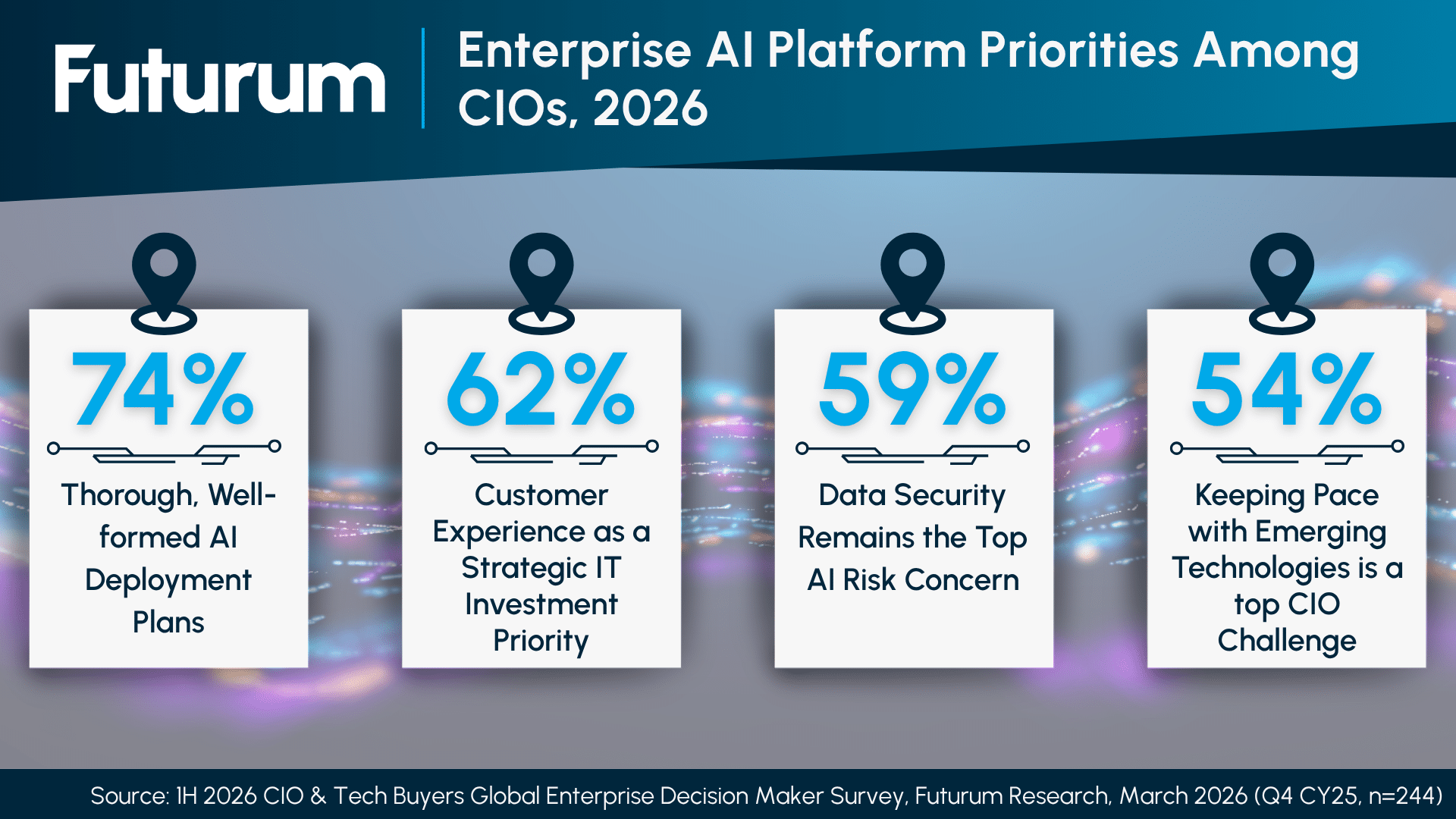
Source: 1H 2026 CIO & Tech Buyers Global Enterprise Decision Maker Survey, Futurum Research, March 2026
Microsoft Is Building the Broadest Enterprise AI Operating System
Microsoft currently possesses the market’s broadest and most integrated enterprise AI strategy. The company is not simply deploying AI assistants across productivity applications; it is attempting to establish a unified operational fabric spanning workflow execution, identity, governance, orchestration, data grounding, observability, and enterprise security.
Agent 365, Azure AI Foundry, Microsoft Graph, Fabric, Entra ID, Purview, and Copilot Studio collectively position Microsoft as one of the strongest contenders to become the operating system layer for enterprise digital labor.
A particularly important strategic decision is Microsoft’s aggressive embrace of interoperability standards such as MCP and A2A. This reflects an understanding that most enterprises will operate heterogeneous AI environments involving multiple models, frameworks, applications, and orchestration systems. Microsoft appears increasingly focused on controlling the orchestration layer above these heterogeneous systems rather than enforcing complete stack exclusivity.
However, Microsoft also faces growing operational complexity risks. Its AI portfolio is expanding rapidly across multiple overlapping orchestration surfaces, governance systems, and product families. CIOs increasingly express concerns regarding implementation complexity, governance sprawl, and the operational burden of stitching together multiple Microsoft AI layers coherently at scale. Long-term success may depend less on capability breadth and more on Microsoft’s ability to simplify deployment and operational management.
Salesforce Wants to Become the API Layer for Enterprise Action
Salesforce is pursuing one of the market’s most aggressive strategic pivots. The company is attempting to evolve beyond CRM into a generalized orchestration platform for autonomous enterprise execution.
Agentforce, Headless 360, MuleSoft, Atlas, and Data Cloud collectively represent an effort to transform Salesforce from a customer engagement platform into an API-first operational system capable of coordinating machine-driven enterprise workflows across heterogeneous environments.
This strategy is notable because Salesforce correctly recognizes that the next phase of enterprise AI will rely increasingly on machine-to-machine interactions rather than human-facing interfaces alone. Autonomous systems will need to coordinate APIs, workflows, approvals, data systems, and operational logic directly across enterprise environments.
Salesforce’s commercial momentum demonstrates strong market demand for this model. However, the company’s success remains closely tied to enterprise operational readiness. Agentic systems amplify underlying organizational and architectural weaknesses. Fragmented customer data, inconsistent workflows, and poor operational hygiene can significantly limit the effectiveness of autonomous execution systems.
As a result, Salesforce’s long-term positioning depends heavily on whether enterprises can mature their own operational architectures quickly enough to support large-scale agentic deployment.
ServiceNow Is Quietly Building the Safest Digital Labor Platform
ServiceNow currently possesses one of the strongest governance and operational trust narratives in the market.
Its workflow-native architecture provides a highly credible foundation for enterprise digital labor orchestration, particularly in operationally sensitive and highly governed environments. AI Control Tower, structured workflow orchestration, observability tooling, compliance mapping, and governance-centric execution models align closely with the priorities many CIOs increasingly view as essential for enterprise AI adoption.
Unlike several competitors emphasizing broad AI platform narratives, ServiceNow remains tightly focused on governed operational execution. This pragmatic positioning resonates strongly with risk-conscious enterprises attempting to balance innovation with operational safety.
The company’s acquisition strategy further reinforces this direction. The Armis acquisition demonstrates recognition that enterprise AI governance increasingly requires deep operational visibility into assets, infrastructure, identity systems, and security posture management.
However, ServiceNow’s architecture remains highly workflow-centric and process-bound. Over time, enterprises may demand more adaptive and semi-structured forms of autonomous reasoning that extend beyond predefined workflows. ServiceNow will need to demonstrate that it can evolve toward more flexible operational intelligence models without sacrificing the governance rigor that currently differentiates the platform.
AWS Is Betting That Open Infrastructure Eventually Wins
AWS continues to approach the market from a fundamentally infrastructure-centric perspective. Rather than positioning itself primarily as the end-user operating environment, AWS is attempting to establish itself as the orchestration substrate underpinning enterprise digital labor systems.
Bedrock AgentCore, orchestration runtimes, governance tooling, memory systems, evaluation frameworks, and open framework support collectively position AWS as a highly flexible orchestration layer for autonomous execution environments.
From a technical perspective, this architecture is extremely capable. AWS’s emphasis on modularity, open frameworks, and heterogeneous model support aligns closely with how many enterprises ultimately expect to deploy AI operationally.
However, AWS continues facing a substantial enterprise translation challenge. Many CIOs struggle to convert AWS orchestration primitives into operational business systems without significant internal engineering effort. AWS often presents itself more as a sophisticated infrastructure toolkit than as a simplified enterprise operating platform.
As enterprise AI adoption accelerates, operational simplification may become increasingly important relative to technical flexibility alone. AWS’s long-term success may therefore depend on its ability to package its orchestration capabilities into more operationally consumable enterprise architectures.
Google Possesses Tremendous Technical Strength but Still Lacks Cohesion
Google remains one of the market’s strongest technical AI competitors. Gemini, Vertex AI, Agentspace, Agentic Data Cloud, TPU infrastructure, and the company’s multimodal AI capabilities collectively create one of the industry’s most advanced technical foundations for enterprise AI orchestration.
The company also deserves credit for aggressively supporting interoperability initiatives and open coordination standards, positioning itself favorably for heterogeneous enterprise AI environments.
However, enterprise platform leadership requires more than technical capability. It also requires organizational cohesion, operational clarity, and enterprise confidence.
Despite recent consolidation efforts around Gemini Enterprise Agent Platform, Google continues struggling with portfolio fragmentation and inconsistent enterprise positioning. CIOs evaluating long-term enterprise AI architectures increasingly prioritize operational trust, governance maturity, deployment confidence, and implementation simplicity over raw model performance.
Google’s technical trajectory remains highly competitive, particularly around multimodal reasoning and data-centric orchestration. However, the company must still demonstrate that it can package these capabilities into a cohesive operational platform that enterprises can confidently govern and scale over long deployment horizons.
CIOs Are Becoming Managers of Blended Human-Digital Workforces
The most important implication of the agentic platform transition may ultimately be organizational rather than technical.
CIOs are increasingly becoming managers of blended human-digital workforces.
Historically, enterprise IT organizations focused primarily on applications, infrastructure, cybersecurity, networking, and enterprise software management. Agentic AI introduces entirely new operational disciplines, including digital labor governance, autonomous workflow management, token economics oversight, orchestration policy management, AI observability, exception handling systems, and human-agent supervisory models.
This represents a significant operating model transition for enterprise organizations.
Many enterprises still frame AI primarily as a tooling or productivity discussion. In reality, agentic AI is increasingly becoming a workforce architecture discussion involving operational redesign, governance frameworks, and organizational transformation.
The vendors competing in this market are beginning to address pieces of this transition through orchestration tooling, governance systems, observability platforms, interoperability standards, and workflow automation frameworks. However, no vendor has yet fully solved the broader organizational challenges associated with operating large-scale blended human-digital workforces.
What to Watch
The next phase of enterprise AI competition will likely be shaped less by model innovation alone and more by operational execution, orchestration maturity, and governance capability. As enterprises move from experimentation toward scaled deployment, several strategic developments warrant close attention.
- First, interoperability is rapidly emerging as one of the market’s most important architectural battlegrounds. Standards such as MCP and A2A are becoming increasingly significant as enterprises seek to coordinate workflows across multiple models, orchestration systems, applications, and cloud environments. Vendors capable of supporting heterogeneous, multi-agent ecosystems without introducing excessive operational complexity will likely gain long-term strategic advantages.
- Second, Microsoft’s trajectory deserves close monitoring as the company continues expanding its AI stack across productivity, governance, orchestration, identity, security, and infrastructure layers. While Microsoft currently benefits from exceptional ecosystem breadth, the company must continue simplifying operational deployment and governance to avoid creating excessive implementation complexity for enterprise customers.
- Third, Salesforce’s API-first “system of action” strategy represents one of the market’s most ambitious attempts to operationalize autonomous enterprise execution. The company’s long-term success will depend heavily on whether enterprises can sufficiently modernize and unify their underlying operational and data architectures to support large-scale autonomous workflows.
- Fourth, ServiceNow’s governance-centric positioning aligns strongly with the growing enterprise focus on operational trust, compliance, and workflow reliability. The company is well-positioned for highly governed operational environments, though it must continue evolving beyond rigid workflow structures toward more adaptive forms of operational intelligence.
- Fifth, AWS and Google both possess exceptionally strong technical AI foundations but continue facing enterprise operationalization challenges. Their future success will likely depend on whether they can simplify orchestration complexity and package their AI capabilities into operationally consumable enterprise architectures.
- Finally, CIOs themselves are entering a new operational era. Over the next 24 months, enterprises will increasingly need to develop formal operational disciplines around digital labor governance, AI observability, token economics management, orchestration policy enforcement, and blended human-agent workforce operations. Organizations that adapt operationally to this transition early are likely to gain substantial competitive advantages.
This is a companion piece to Futurum Group’s newly released Agentic Signal, which analyzes the top agentic platform for the enterprise on a regular basis, and can be found here.
Click here to download this report.
Other Insights from Futurum
Who Will Win the Agent Orchestration Layer Battle
Will Vendors Enable More Complex Agentic Workflows in 2026?
Adobe CX Enterprise Coworker Aims to Disrupt Agentic AI in Customer Experience
Disclosure: Futurum is a research and advisory firm that engages or has engaged in research, analysis, and advisory services with many technology companies, including those mentioned in this article. The author does not hold any equity positions with any company mentioned in this article.
Analysis and opinions expressed herein are specific to the analyst individually and data and other information that might have been provided for validation, not those of Futurum as a whole.
Read the full Futurum Group Disclosure.
Author Information

Dion Hinchcliffe is a distinguished thought leader, IT expert, and enterprise architect, celebrated for his strategic advisory with Fortune 500 and Global 2000 companies. With over 25 years of experience, Dion works with the leadership teams of top enterprises, as well as leading tech companies, in bridging the gap between business and technology, focusing on enterprise AI, IT management, cloud computing, and digital business. He is a sought-after keynote speaker, industry analyst, and author, known for his insightful and in-depth contributions to digital strategy, IT topics, and digital transformation. Dion’s influence is particularly notable in the CIO community, where he engages actively with CIO roundtables and has been ranked numerous times as one of the top global influencers of Chief Information Officers. He also serves as an executive fellow at the SDA Bocconi Center for Digital Strategies.