
Analyst(s): Keith Kirkpatrick
Publication Date: May 12, 2026
Outcome-based pricing is becoming a market standard as Zendesk and Intercom bill only for successful AI resolutions, linking vendor revenue directly to customer value. This shift disrupts traditional SaaS frameworks and raises expectations for all AI-driven automation providers. Flexible pricing is now a critical differentiator; Futurum’s 1H 2026 survey shows 43% of buyers prefer consumption-based models, while 27% favor outcome-based structures. Vendors restricted to seat-only pricing risk immediate disqualification. Hybrid models from leaders such as Adobe, Salesforce, and ServiceNow offer a middle ground by blending consumption, per-seat, and outcome components. This strategy balances buyer flexibility with the revenue predictability required to prove AI ROI.
Key Points:
- Enterprise SaaS vendors are rapidly shifting away from traditional seat- and license-based pricing toward models tied to measurable business outcomes, driven largely by AI and automation technologies that make it easier to connect software usage directly to operational results such as workflows completed, issues resolved, or productivity improvements.
- Vendors such as Zendesk, Intercom, and Decagon are leading the move toward true outcome-based pricing by charging customers based on successful AI-driven resolutions or completed interactions, rather than on user access, thereby tightly aligning pricing with delivered business value.
- A broader group of vendors, including Adobe, Salesforce, ServiceNow, UiPath, Automation Anywhere, and Workhuman, is adopting hybrid models that combine subscriptions, consumption metrics, and outcome-linked pricing components, signaling a broader market evolution toward monetizing business impact rather than software access alone.
Overview:
Enterprise SaaS vendors are increasingly moving away from traditional pricing models based on seats, licenses, or feature access toward pricing structures tied to measurable business outcomes. This shift is being accelerated by AI, automation, and agentic systems, which make it easier to connect software usage directly to results such as issues resolved, workflows completed, or productivity gains. According to Futurum Research’s 1H 2026 Enterprise Software Decision Makers survey, fewer than one in five buyers still prefer classic per-user pricing models.
Several vendors are already embracing true outcome-based pricing. Zendesk now charges for successful AI-driven issue resolutions instead of AI seat licenses, while Intercom applies a similar model for its Fin AI agent. Decagon goes even further by structuring pricing around resolved customer interactions, making it one of the clearest examples of AI monetization directly tied to business value and efficiency gains. In many cases, vendors and customers jointly define what qualifies as a successful outcome through agreed-upon metrics and guardrails.
Figure 1: Vendors Using Outcome-Based or Hybrid Pricing Approaches
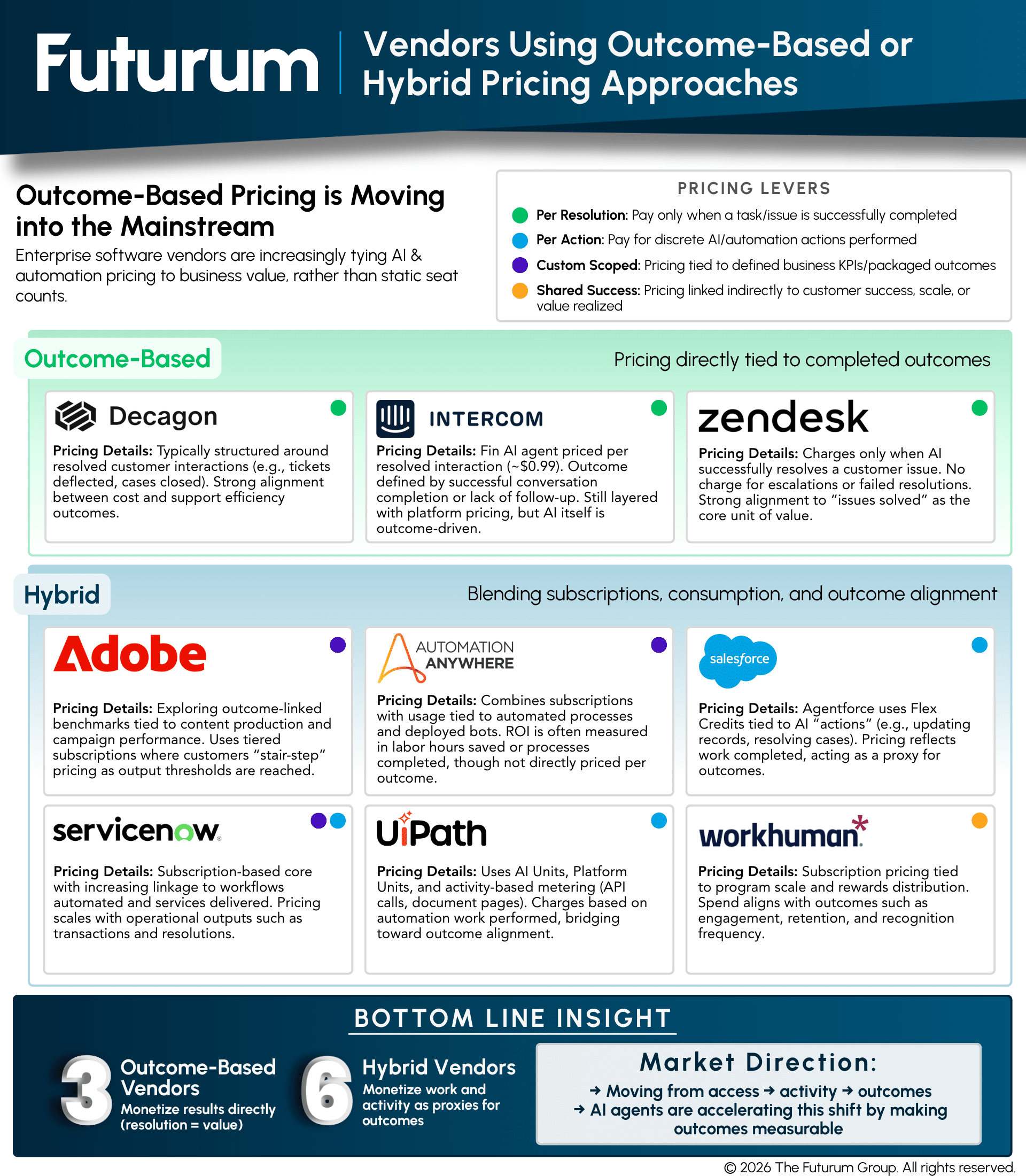
A larger group of enterprise vendors is adopting hybrid pricing approaches that blend subscriptions, consumption metrics, and outcome-linked elements. Adobe is experimenting with pricing tied to performance benchmarks and automated content or campaign thresholds, allowing customers to scale into higher pricing tiers as business impact increases. Automation Anywhere increasingly aligns pricing with the number of automated processes, bots deployed, and labor hours replaced, helping customers justify costs through measurable efficiency gains.
Other vendors are evolving similarly. Salesforce introduced Agentic Work Units (AWUs) within Agentforce to track AI-driven actions such as workflow execution and case resolution through consumption credits. ServiceNow is embedding AI across its platform and increasingly tying pricing to workflows automated and services delivered. UiPath uses AI and platform units tied to operational activity, such as document processing and workflow execution, while Workhuman aligns pricing with employee engagement and recognition outcomes rather than simple platform access. Together, these approaches reflect a broader market transition toward pricing software based on measurable operational and business impact rather than access alone.
The full report, “Are Outcome-Based and Hybrid AI Pricing Models Rewriting the Vendor Playbook?” is available via subscription to Futurum Intelligence’s Enterprise Software & Digital Workflows IQ service—click here for inquiry and access.
Futurum clients can read about it in the Futurum Intelligence Platform, and non-clients can learn more here: Enterprise Software & Digital Workflows Practice.
About the Futurum Enterprise Software & Digital Workflows Practice
The Futurum Enterprise Software & Digital Workflows Practice provides actionable, objective insights for market leaders and their teams so they can respond to emerging opportunities and innovate. Public access to our coverage can be seen here. Follow news and updates from the Futurum Practice on LinkedIn and X. Visit the Futurum Newsroom for more information and insights.
Author Information

Keith Kirkpatrick is VP & Research Director, Enterprise Software & Digital Workflows for The Futurum Group. Keith has over 25 years of experience in research, marketing, and consulting-based fields.
He has authored in-depth reports and market forecast studies covering artificial intelligence, biometrics, data analytics, robotics, high performance computing, and quantum computing, with a specific focus on the use of these technologies within large enterprise organizations and SMBs. He has also established strong working relationships with the international technology vendor community and is a frequent speaker at industry conferences and events.
In his career as a financial and technology journalist he has written for national and trade publications, including BusinessWeek, CNBC.com, Investment Dealers’ Digest, The Red Herring, The Communications of the ACM, and Mobile Computing & Communications, among others.
He is a member of the Association of Independent Information Professionals (AIIP).
Keith holds dual Bachelor of Arts degrees in Magazine Journalism and Sociology from Syracuse University.

