Analyst(s): Brendan Burke
Publication Date: June 9, 2026
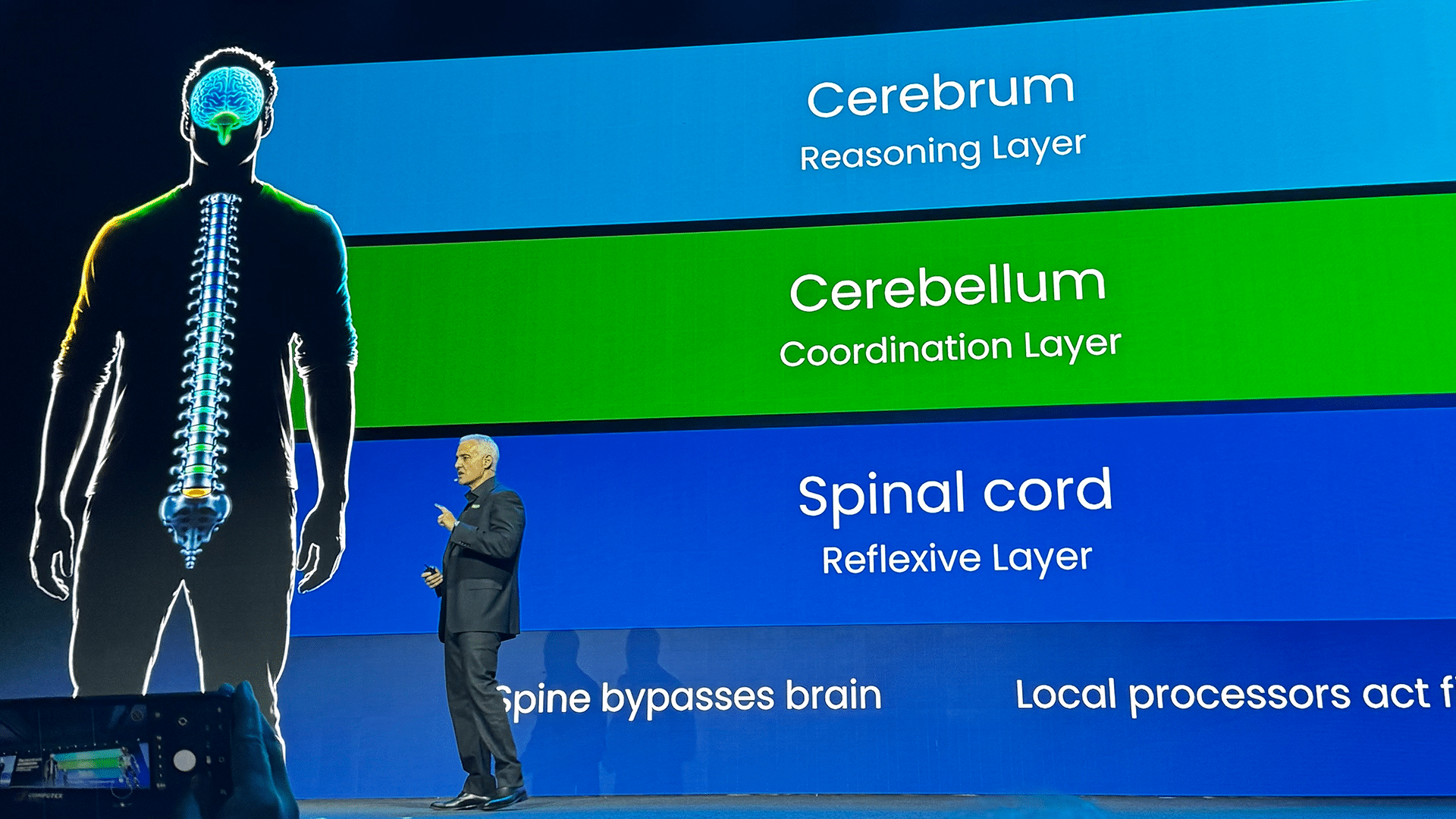
At COMPUTEX 2026, NXP CEO Rafael Sotomayor unveiled the NXP Neural Axis architecture — a three-layer, biologically inspired platform for physical AI spanning reasoning, coordination, and reflexive intelligence. The strategy can position NXP as the NVIDIA of the extreme edge, owning the full stack of silicon, deterministic networking, and software that improve real-world robots not just at reasoning but reacting. The question is whether NXP can build a CUDA-class moat at the edge through reinforcement learning, as NVIDIA has done in the data center.
What is Covered in This Article:
- NXP introduced its Neural Axis architecture at COMPUTEX 2026, organizing physical AI into three interconnected layers — reasoning, coordination, and reflexive intelligence — designed to let machines act in milliseconds without waiting on the cloud.
- Neural Axis is NXP’s bid to win physical AI on a full-stack platform with silicon, deterministic networking, eIQ software, and a trust framework.
- NXP’s Kinara acquisition, automotive networking heritage, and eIQ toolkit are the three legs of an NVIDIA-style platform play.
- The prize is the real-world reinforcement learning flywheel: whoever’s silicon sits in the deployed fleet owns the data loop that refines vision-language-action (VLA) models.
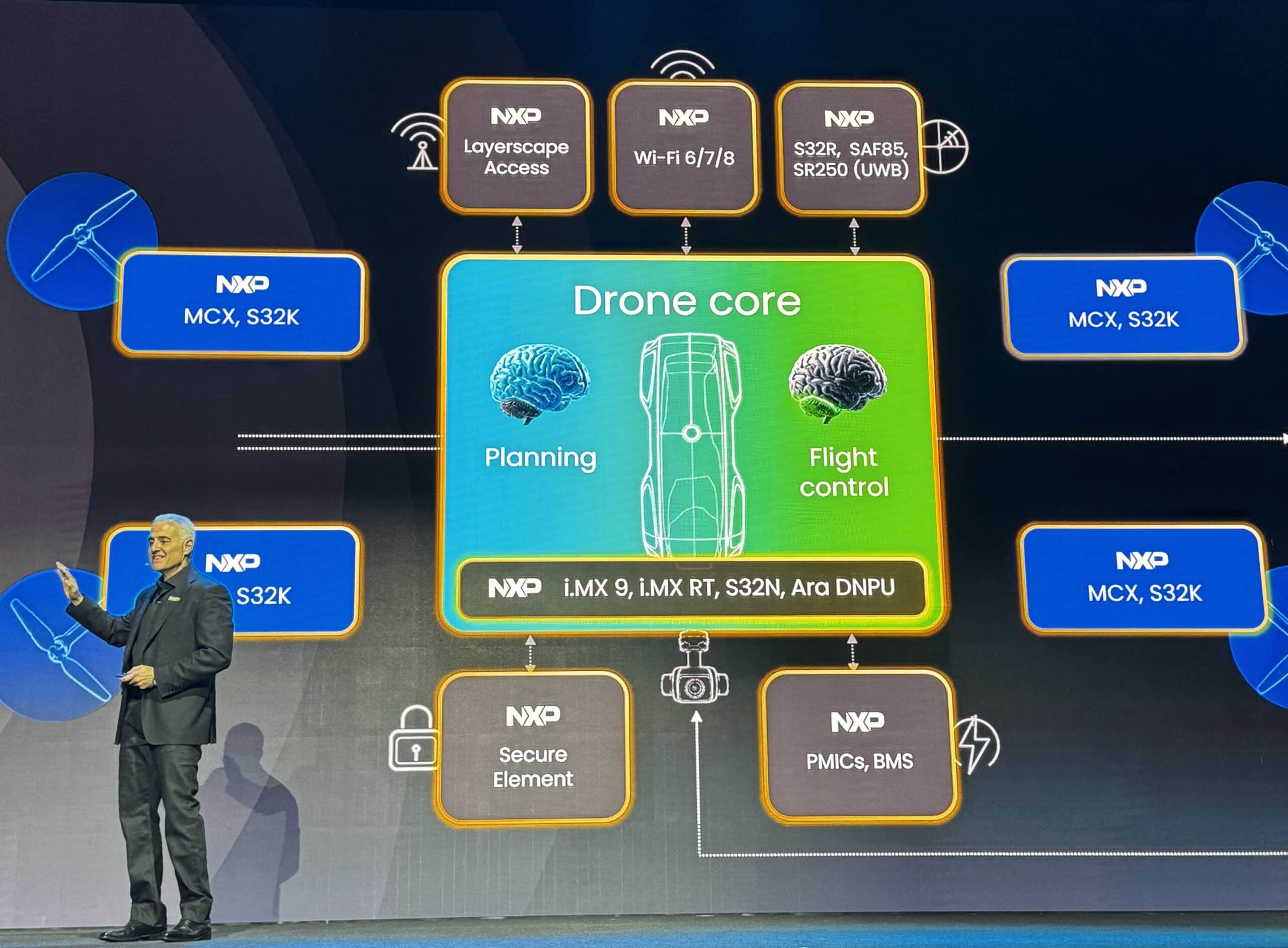
The News: At COMPUTEX 2026, NXP Semiconductors President and CEO Rafael Sotomayor delivered a physical AI keynote introducing the company’s Neural Axis architecture, a framework that distributes intelligence across three interconnected layers — reasoning, coordination, and reflexive intelligence — so autonomous machines can operate safely in dynamic environments. Sotomayor argued that the defining challenge of physical AI is not raw intelligence but the ability to react in milliseconds without round-tripping to the cloud. NXP demonstrated the architecture across drones, software-defined vehicles, and humanoid robots, paired it with a trust framework spanning containment, protection, verification, and adaptation, and tied it to its eIQ toolkit, its $307M acquisition of edge AI NPU maker Kinara, and a foundational partnership with NVIDIA.
NXP’s Neural Axis Architecture: A Blueprint to Own the Robotic Nervous System
Analyst Take: Beyond the biology metaphors, the NXP Neural Axis architecture aligns a holistic edge AI platform with the frontier of Physical AI research. By organizing physical AI into reasoning, coordination, and reflexive layers and wrapping them in silicon, networking, software, and a trust framework, NXP is attempting to define the reference architecture that every drone, software-defined vehicle, and humanoid gets designed around. In other words, NXP can become the NVIDIA of the extreme edge: the company whose stack is the default, whose tools developers standardize on, and whose installed base becomes self-reinforcing. Whether it can pull that off is the most important semiconductor question outside the data center.
How to Replicate NVIDIA’s Leadership at the Extreme Edge
NVIDIA did not win the AI data center on GPUs alone. It won by owning the full stack — compute, then the interconnect, then CUDA, and the software ecosystem that made switching costs prohibitive, then reference architectures that customers simply adopted wholesale. This platform aligned with scaling laws across pre-training, post-training, and reinforcement learning. The ecosystem became a moat as model size scaled. NXP’s Neural Axis ambition could yield an equally sticky full-stack platform for the physical world. The keynote’s emphasis on a single architecture spanning every robot form factor, a unified software toolkit, and an end-to-end trust model positions a stack for robotics researchers to gather real-world data for generational leaps in robotic performance.
NXP now has credible answers on all three legs of an NVIDIA-style platform. On compute, the $307M Kinara acquisition brings a programmable 40-TOPS Ara-2 NPU and a mature model-optimization toolchain into the portfolio, giving NXP a discrete NPU story for the reasoning and coordination layers. On the interconnect, NXP’s automotive and industrial networking heritage is precisely the deterministic, safety-rated fabric the coordination layer needs, and NXP estimates connectivity can be 80–90% of a deployed solution. On software, eIQ is positioned to be the CUDA of the extreme edge: the layer that compresses, optimizes, and deploys models across NXP silicon, turning a chip vendor into a platform. The upcoming i.MX 93W, which fuses an NPU with secure tri-radio wireless and can replace up to 60 discrete components, lowers the barrier to designing NXP in across the very drones and autonomous mobile robots that seed the platform.
The strongest argument for NXP’s ambition is that the edge does not reward the data center playbook. Inside an autonomous machine, the constraints are deterministic latency, <10-watt power budgets, functional safety certification, and 7–8 year automotive design-in cycles. NXP frames the reasoning layer as a sub-1,000-TOPS, roughly 10W-to-under-40W envelope where latency, power, and cost dominate, not peak compute. NXP’s opening is that the physical edge is fragmented and safety-bound in ways that favor a supplier with three decades of automotive and industrial certification scars.
The Real-World RL Flywheel Is the Prize
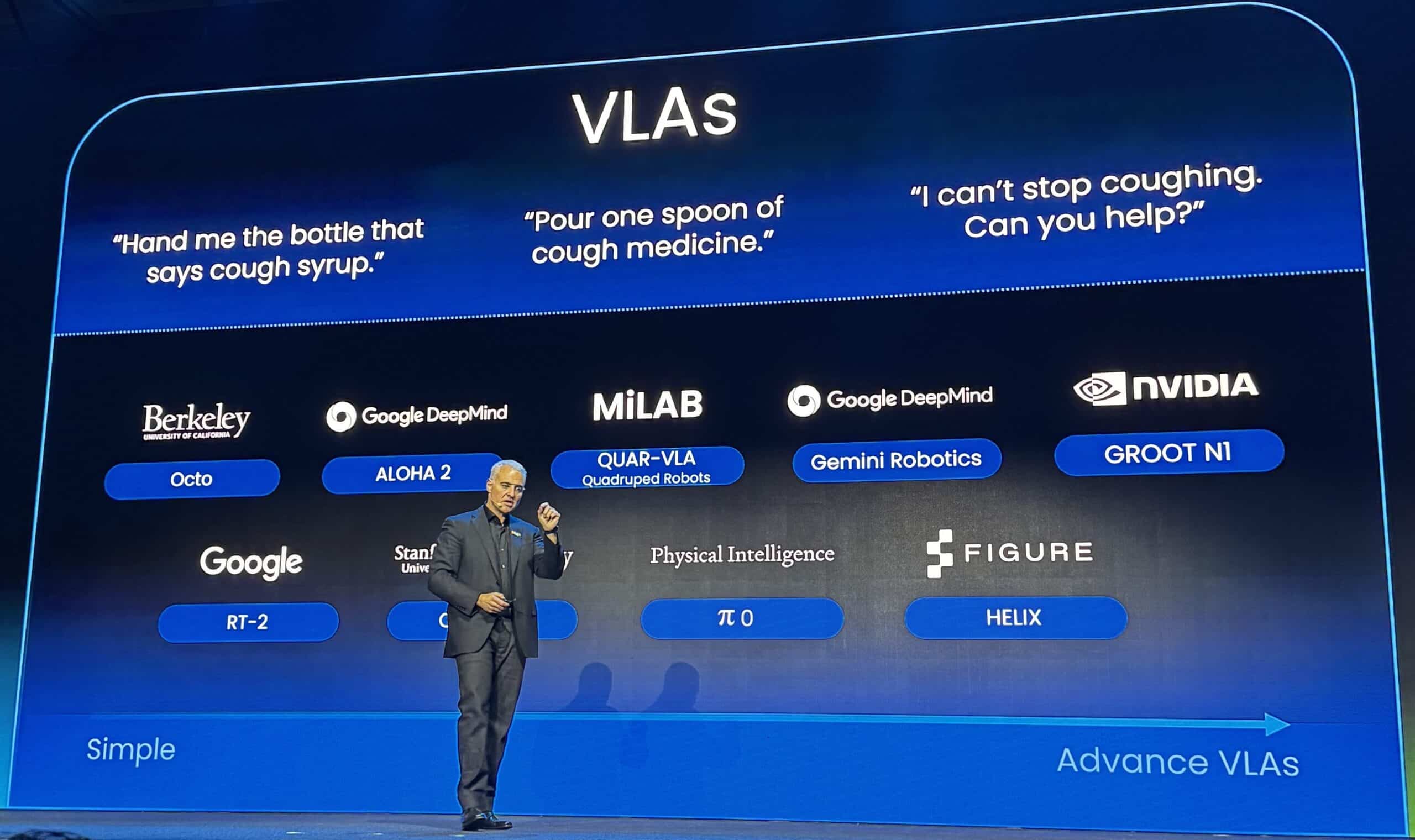
The deepest part of NXP’s pitch is the claim that synthetic data alone does not work for physical AI, much resembling the shift to RL for LLM post-training. When robots encounter genuinely novel situations, a VLA model applies an action, may get it wrong at first, and can learn in context. The refinement that turns a clumsy demo into a deployable product comes from real reinforcement learning across deployed fleets, effectively crowdsourcing experience from the physical edge. In that loop, the deployed device becomes the data-generating engine, and the resulting models become the key IP. This is the edge analog of NVIDIA’s most durable advantage: not the chip, but the installed base and developer gravity that compound over time. If NXP’s silicon is what makes low-latency, trustworthy, always-on real-world learning possible, then the more robots ship on Neural Axis, the better the models get, and the more builders standardize on the platform. NXP’s embrace of frontier robotics research makes close collaboration and lock-in with the developer community possible.
The Numbers Behind the Bet
The ambition lands against a backdrop that is finally cooperating. NXP reported Q1 2026 revenue of $3.18 billion, up 12% year over year, with automotive and industrial leading the recovery. The broader edge AI applications market is forecast to grow at roughly a 30% CAGR to about $40 billion by 2030. Management has described AI-infused industrial products as the fastest-growing part of the portfolio and physical AI as the biggest sales funnel it has seen in a year, with on the order of 50 active engagements tied to humanoid hands alone. For a company trying to become the NVIDIA of the edge, design-win breadth across drones, SDVs, and humanoids is the metric that matters more than any single benchmark.
Execution Hurdles to Clear
The fulfillment of this vision will depend on the maturation of the software layer to make frontier intelligence compatible with edge processors. eIQ is promising but not irreplaceable, and the edge AI tooling world is fragmented across Qualcomm, NXP, STMicroelectronics, Renesas, Texas Instruments, and a long tail of open-source runtimes. NXP partnered with NVIDIA in integrating the Holoscan Sensor Bridge, inviting the question of whether NXP is building a rival platform or a complement that NVIDIA can absorb by pushing Jetson and Holoscan further down toward the reflex layer. The open-source momentum behind VLA and world models could also erode the proprietary value of RL fine-tuning if the best models become free. The most honest framing is that NXP has assembled the pieces of an NVIDIA-of-the-edge platform and articulated the strategy clearly — but the moat still has to be earned in design wins and developer adoption. With robotics searching for its ChatGPT moment, the window for definitive platforms has opened.
What to Watch:
- Developer adoption of eIQ and switching costs test whether NXP becomes a platform or stays a component vendor.
- Whether the NVIDIA relationship aids in robotic research leadership
- A flagship “cerebellum” switching product turning the networking-as-moat thesis into shipping silicon.
- The ~50 humanoid-hand engagements converting to production sockets
- Competitive platform responses from Qualcomm, Texas Instruments, Renesas, Infineon, and STMicroelectronics.
Disclosure: Futurum is a research and advisory firm that engages or has engaged in research, analysis, and advisory services with many technology companies, including those mentioned in this article. The author does not hold any equity positions with any company mentioned in this article.
Analysis and opinions expressed herein are specific to the analyst individually and data and other information that might have been provided for validation, not those of Futurum as a whole.
Other Insights From Futurum:
NXP’s Q1 2026: Can Automotive and Industrial Momentum Outrun Semiconductor Volatility?
NXP Q4 FY 2025: Auto Stabilises, Edge AI Platforms Gain Traction
Intel’s COMPUTEX Keynote Reframes an Iconic Company as a Silicon-to-Systems AI Lab
Author Information

Brendan is Research Director, Semiconductors, Supply Chain, and Emerging Tech. He advises clients on strategic initiatives and leads the Futurum Semiconductors Practice. He is an experienced tech industry analyst who has guided tech leaders in identifying market opportunities spanning edge processors, generative AI applications, and hyperscale data centers.
Before joining Futurum, Brendan consulted with global AI leaders and served as a Senior Analyst in Emerging Technology Research at PitchBook. At PitchBook, he developed market intelligence tools for AI, highlighted by one of the industry’s most comprehensive AI semiconductor market landscapes encompassing both public and private companies. He has advised Fortune 100 tech giants, growth-stage innovators, global investors, and leading market research firms. Before PitchBook, he led research teams in tech investment banking and market research.
Brendan is based in Seattle, Washington. He has a Bachelor of Arts Degree from Amherst College.