The News: Renault Group, one of the world’s largest automakers, is intensifying its digital transformation initiatives with the launch of Renault Group Metaverse, which is based on four dimensions: mass data collection, digital twins of processes, connecting the supply chain ecosystem, and a set of advanced technologies. During Renault Group’s Tech Industry Days at the Refactory in Flins, the company presented 32 use cases for the Renault Group Metaverse. Read the Press Release on the Renault Group website.
Renault Group Metaverse Announced at Tech Industry Days
Analyst Take: During Renault Group’s Tech Industry Days at the Refactory in Flins, the Renault Group announced that it is intensifying its digital transformation initiatives with the launch of Renault Group Metaverse, and presented 32 use cases. According to the company, the Renault Group Metaverse is based on four dimensions: mass data collection, digital twins of processes, connecting the supply chain ecosystem, and a set of advanced technologies. As of today, the Renault Group reported that 100% of production lines are connected (8,500 pieces of equipment), 90% of supply flows are constantly monitored, and 100% of supply chain data is hosted in the Renault Group Metaverse. Renault Group has engaged in Industry 4.0 since 2016, an initiative that has yielded total savings of €780 million. By 2025, the Renault Group anticipates the Renault Group Metaverse will enable €320 million in various savings, to which will be added €260 million in savings on inventories, a 60% reduction in vehicle delivery time, and a 50% reduction in the carbon footprint of its vehicle manufacturing, as well as a significant reduction in innovation cycles and a contribution to the 60% reduction in warranty costs targeted by the Renault Group.
“This industrial Metaverse is unique and enables us to activate previously invisible efficiency and performance levers, to the benefit of people and the environment. The management of data at Group level allows us to monitor, for example, the energy consumption of all our industrial and non-industrial sites in detail, and above all to optimize them in real time when a plant is stopped,” Patrice Haettel, VP, Industrial Strategy and Engineering reports.
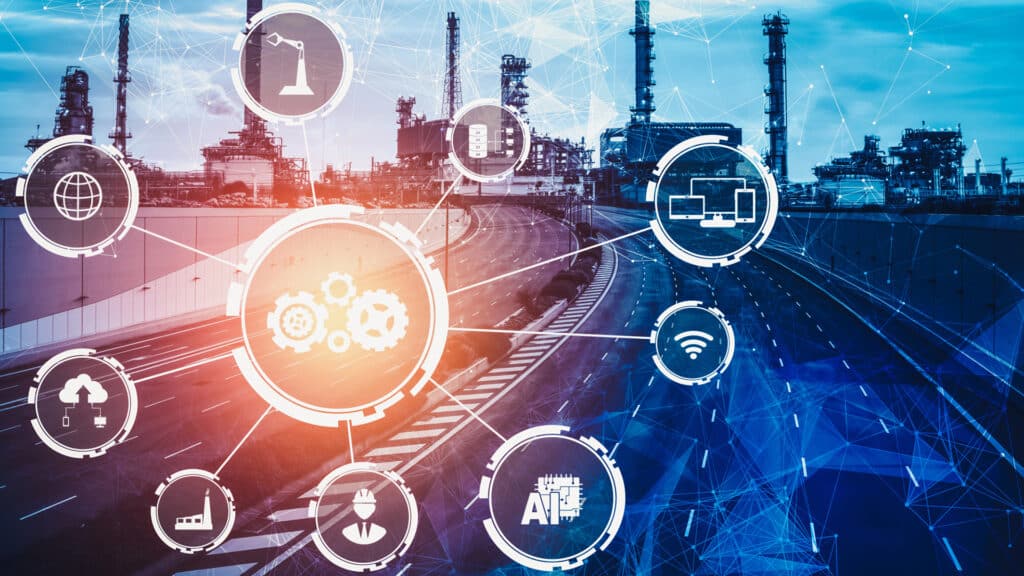
Renault Group Metaverse: Four Dimensions
- Mass Data Collection: The Renault Group has developed a platform to collect massive amounts of industrial data to feed the Renault Group Metaverse, providing the mechanisms to enhance real-time performance in the production process.
- Digital Twins: Each factory has its replica in the virtual world, and just like factories, the supply chain has its own digitized universe, which is an integral part of the industrial Metaverse, and is controlled in real time by a control tower.
- Supply Chain Ecosystem: Digital Twins are enriched with supplier data, sales forecasts, quality information, exogenous information such as weather and traffic data, and AI that allows the development of predictive scenarios.
- Advanced Technologies: Renault Group has developed a unique platform for the convergence of the technologies needed, such as cloud, real-time analytics, 3D rendering, and big data, to run the digital twins and their ecosystems resiliently.
Renault Group Metaverse: Use Case Examples
- The Industrial Data Management Platform (IDM) 4.0: Collects all the industrial data of Renault Group and stores it in the cloud (Google Cloud Platform). The industrial data feeds the Renault Group Metaverse and allows companies to correct or improve the production process in real time.
- The Control Tower of the extended supply chain: Concentrates information flows, alerts in real time to risks or anomalies in all transport operations, and leverages AI to propose crisis management scenarios.
- Industry decarbonization: Recognizes that real-time monitoring of the carbon footprint of equipment and transport capacity will play an important role in decarbonization to reach a 50% renewable energy mix in France by 2026 and 100% by 2030.
Because the Renault Group Metaverse is based on mass data collection, digital twins of processes, connecting the supply chain ecosystem ,and a set of advanced technologies, it accounts for a complete, persistent, and real-time industrial metaverse. The manufacturing industry can leverage the Renault Group Metaverse to enable companies to optimize production, reduce costs, and improve efficiency.
Disclosure: The Futurum Group is a research and advisory firm that engages or has engaged in research, analysis, and advisory services with many technology companies, including those mentioned in this article. The author does not hold any equity positions with any company mentioned in this article.
Analysis and opinions expressed herein are specific to the analyst individually and data and other information that might have been provided for validation, not those of The Futurum Group as a whole.
Other Insights from The Futurum Group:
Metaverse and HR Integration for Human Resources Management
Qualcomm and Renault Group Extend Partnership to Create Software-Defined Vehicles of the Future
The Future of Industrial and Commercial IoT | Futurum Tech Webcast
Author Information

Clint brings over 20 years of market research and consulting experience, focused on emerging technology markets. He was co-founder and CEO of Dash Network, an integrated research and digital media firm focused on the CX market, which was acquired by The Futurum Group in 2022. He previously founded Tractica with a focus on human interaction with technology, including coverage of AI, user interface technologies, advanced computing, and other emerging sectors. Acquired by Informa Group, Clint served as Chief Research Officer for Informa’s research division, Omdia, with management and content strategy responsibility, formed by the combination of Tractica, Ovum, IHS Markit Technology, and Heavy Reading.
Clint was previously the founder and President of Pike Research, a leading market intelligence firm focused on the global clean technology industry, which was acquired by Navigant Consulting where he was Managing Director of the Navigant Research business.
Prior to Pike Research, Clint was Chief Research Officer at ABI Research, a New York-based industry analyst firm concentrating on the impact of emerging technologies on global consumer and business markets.
Clint holds a Master of Business Administration in Telecommunications Management from the University of Dallas and a Bachelor of Arts in History from Washington & Lee University.