This past month I took my first international trip since 2019. Armed with my knowledge of the CX technology stack that many travel and hospitality companies would potentially be using to deliver a good experience, I was fully prepared to come back and write a long diatribe on all the failure points. Since I follow travel and hospitality trends, I felt fully prepared for the long lines, delayed flights, lost luggage, poor service, unhappy workers, and poor operations that have all been making headlines lately.
Perhaps it was my own ability to set expectations and mitigate some of these risks (I am looking at you, tiny carry-on bag). Perhaps it was traveling to a destination that was not technology-laden and/or centered around large hotel chains. What I can report is, my trip was smooth and uneventful. Did I have moments of CX that wowed me? Yes, but they were not wrapped up in a tech stack, they were personal moments of human connection and support as a traveler in a foreign country. And honestly, I was just fine with that.
This may be the crux of some of the issues people are having returning to travel: the disconnect between what consumers expect and what some travel and hospitality companies are capable of delivering due to market and labor shortage constraints. Travel is different now, and it might be for a while. Additionally, while strong CX can be supported by many technologies and solutions, this sector must overlay human touch and empathy. During a period of time where travel and hospitality workers are stretched and need more support themselves, this can often be a challenge.
According to Dash Research’s report, CX in the Travel & Hospitality Industry, the demand for omnichannel interactions and self-service, as well as increased communications, are two main market drivers of CX technologies. Let us start with my physical customer journey, which in reality consisted of planes, trains, taxis, rental cars, and ferries while transiting through or within four different countries. From a CX technology standpoint, my customer journey was a disparate and nonlinear process through digital, voice, and in-person touchpoints. Each touchpoint in that journey was an opportunity to build brand loyalty, trust, and positive emotion.
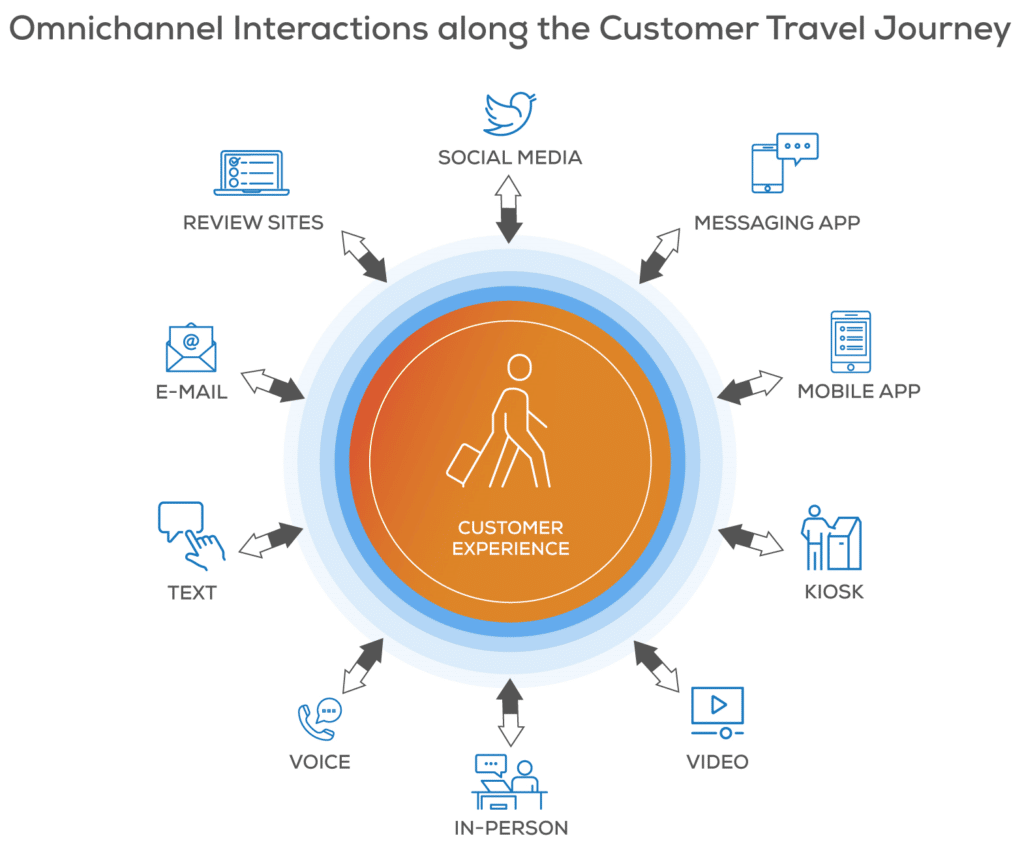
For this trip, with the exception of video, each of the touchpoints in the diagram was leveraged from the moment I started to research destinations via social media and review sites to when I went through the customs check point at my home airport.
Other than being easily granted a late check out and the ability to drink a bottle of water free of charge at a hotel we have loyalty points with, this was not a trip where personalization and insights into our personal travel habits were strongly supported by the CX tech stack to give multiple “Wow!” moments.
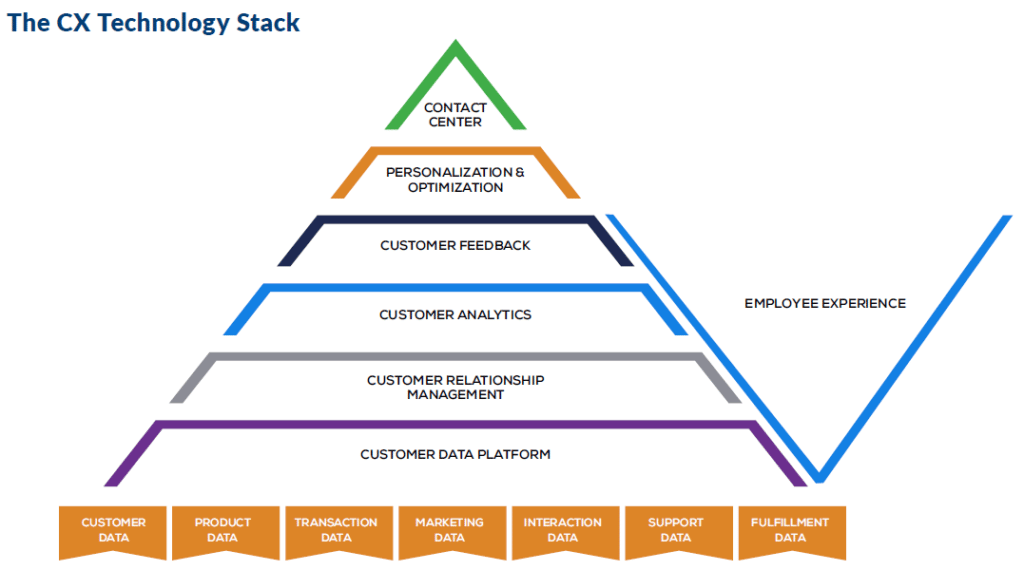
Our tech stack interaction was mainly around contact centers (including omnichannel communications) and customer feedback. This was a trip where communications and the ability to get help where we were, when we needed it, and on multiple channels was the star. More than ever before, travelers need information during their journeys. Travelers need reassurance along the way on flight schedules, check-in times, itinerary changes, and any potential health and safety regulations. The negative feelings erupting in this segment have often stemmed from a lack of communication, particularly in terms of canceled flights. When companies are not on top of sending out important information via the channels travelers want, or do not give appropriate further instruction on next steps, they risk disgruntled customers who can amplify this negativity across social media and review sites. Airlines and hotels are leaning into messaging systems and mobile apps both for outbound communications and inbound requests and questions.
For my travel communication touchpoints, we had positive experiences throughout, with the exception of the eye-rolling and terse ticketing agent on one of our journey legs, which might actually point to poor employee experience (which is of course, closely tied to CX). Our ability to both send and receive communications via a variety of both high tech and low-tech channels was impressive.
Outgoing
- Late night check-in? In person.
- Request for late check out? Phone call that went directly to front desk.
- Request for potential seating upgrade? Website. Updated notifications via mobile app.
Incoming
- Delayed flight? Email and Text. Sent hours ahead of time so day could be planned accordingly.
- Further action on delayed flight? Detailed text that covered any question we could have.
- Ferry schedule change? Email.
- Directions for ferry queuing: Handwritten sign on post.
- Boat tour schedule change? Phone call and in-person knock on hotel room from their sister (not a joke).
- Request for post-flight feedback? Email. Short, with expectations set on number of questions.

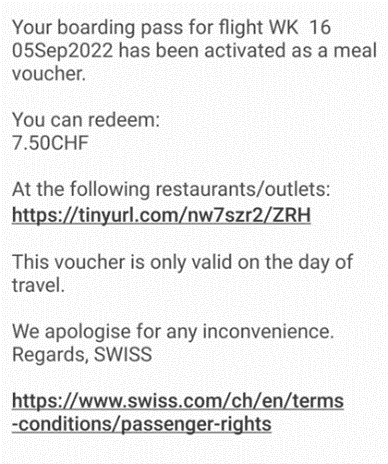
A trip going smoothly should not normally be cause for major celebration or a multi-paragraph article. Travelers should expect that their journeys will go well and be well supported via technology and human interaction. However, travel is still in a state of flux with understaffing, airport operational issues, and sporadic Covid-19 outbreaks. Consumer expectations about customer experience need to be kept in line with the new reality as the travel industry gets back on its feet and travelers need patience for the return of the “Wow!” moments. Until then, smooth and uneventful is not necessarily a bad thing.
Author Information

As a detail-oriented researcher, Sherril is expert at discovering, gathering and compiling industry and market data to create clear, actionable market and competitive intelligence. With deep experience in market analysis and segmentation she is a consummate collaborator with strong communication skills adept at supporting and forming relationships with cross-functional teams in all levels of organizations.
Sherril holds a Master of Business Administration in Marketing from University of Colorado, Boulder and a Bachelor of Arts in Psychology from Rutgers University.