For most retailers, the holiday season is marked by an uptick in the number of items ordered and shipped online. And while many organizations have done an admirable job of focusing on the CX during the marketing and sales phases of a shopper’s journey, the post-purchase gap, or the period between the completion of the transaction and the product being received and accepted by the shopper, is often not under the control of the retailer.
During this post-purchase gap, there are both opportunities to improve CX and pitfalls that can completely wipe out any goodwill earned during the earlier phases of the customer journey. Most of the activities that can be undertaken by organizations revolve around addressing the shortcomings with CX that arise because of third-party shippers or carriers that do not necessarily share the same commitment to ensuring a frictionless delivery experience.
Several issues often contributing to poor post-purchase CX include the following:
- The lack of real-time customer visibility over packages in transit, particularly those that are delayed, can impact the ability of the retailer to provide proactive issue resolution. Packages that are “lost in the system” may still be delivered, but customers are left in the dark until the package arrives.
- Similarly, retailers that use commercial carriers often experience delivery information opacity and are unable to address incoming customer communications about the status of their order, which can negatively impact the customer’s view of the retailer.
- Customers become frustrated with shipments that do not arrive on time, and may attribute that delay to the retailer, rather than the carrier.
- Retailers are reluctant to share bad news, such as fulfillment or shipping delays, for fear of upsetting their customers.
Several steps can be taken by retailers to lessen frustration and improve CX. While some may require investments in technology, most of the techniques simply require more detailed and more frequent communication with the customer.
Overcommunicate
According to Lateshipment.com, a provider of real-time delivery tracking software for retailers, customers track orders between 6 and 8 times before delivery, and are often extremely nervous about their order’s status and expected delivery. Retailers should immediately contact the customer via their channel of choice with the order details, current order status, and expected delivery date. As the status changes, additional communication should automatically be triggered so the customer does not need to check in with the company on their order status.
Research from Navar Corp. found that messages about orders and customer service are the top priority for most customers.
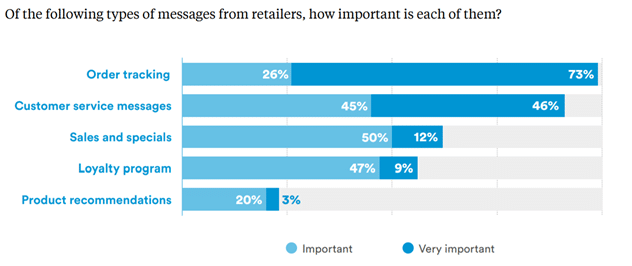
Furthermore, although shipping delays may be somewhat inevitable during busy periods of the year, customers would rather be kept in the loop, even if there is bad news, and 98% of customers say they feel better about a company if they are immediately notified when something goes wrong, according to the Navar survey.

This communication should continue even after the product has been delivered to ensure that all is well with the shipment, and to let them know how to return a product if something is not correct. Further, these types of communication provide the retailer with additional touchpoints to sell additional products and add-on services (e.g., extended warranties), and help capture customer feedback on the entire purchasing process.
Predict Problems and Provide Solutions
By using real-time delivery software, retailers can identify shipments that are predicted to be delayed, and proactively reach out to customers to provide them with updates. If items are lost, damaged, or likely to be severely delayed, additional customer service options should be offered to customers, including discounts, coupons, or the option to stop the shipment if it will not arrive on time. These actions demonstrate empathy for the customer’s situation, and the retailer’s willingness to “make things right” even when the delays or issues are not directly under their control.
Enable CX Teams to Handle Shipping Issues
Even with proactive outreach, some customers still want to speak with an agent to find out when a package will be delivered or to discuss additional options. Given that, on average, more than 30% of the support inquiries are shipping and delivery related, according to LateShipment.com, CX teams should have access to the most recent information on a package’s status and whereabouts, and should be provided with the company’s policies and parameters for handling frustrated customers. Despite the shift to digital ordering, physical goods are still subject to the laws of physics and inefficiencies inherent in transportation networks. Companies can ensure that customers have the best experience possible by providing frequent and honest communication with customers, even when the news is not ideal.
Author Information

Keith Kirkpatrick is VP & Research Director, Enterprise Software & Digital Workflows for The Futurum Group. Keith has over 25 years of experience in research, marketing, and consulting-based fields.
He has authored in-depth reports and market forecast studies covering artificial intelligence, biometrics, data analytics, robotics, high performance computing, and quantum computing, with a specific focus on the use of these technologies within large enterprise organizations and SMBs. He has also established strong working relationships with the international technology vendor community and is a frequent speaker at industry conferences and events.
In his career as a financial and technology journalist he has written for national and trade publications, including BusinessWeek, CNBC.com, Investment Dealers’ Digest, The Red Herring, The Communications of the ACM, and Mobile Computing & Communications, among others.
He is a member of the Association of Independent Information Professionals (AIIP).
Keith holds dual Bachelor of Arts degrees in Magazine Journalism and Sociology from Syracuse University.