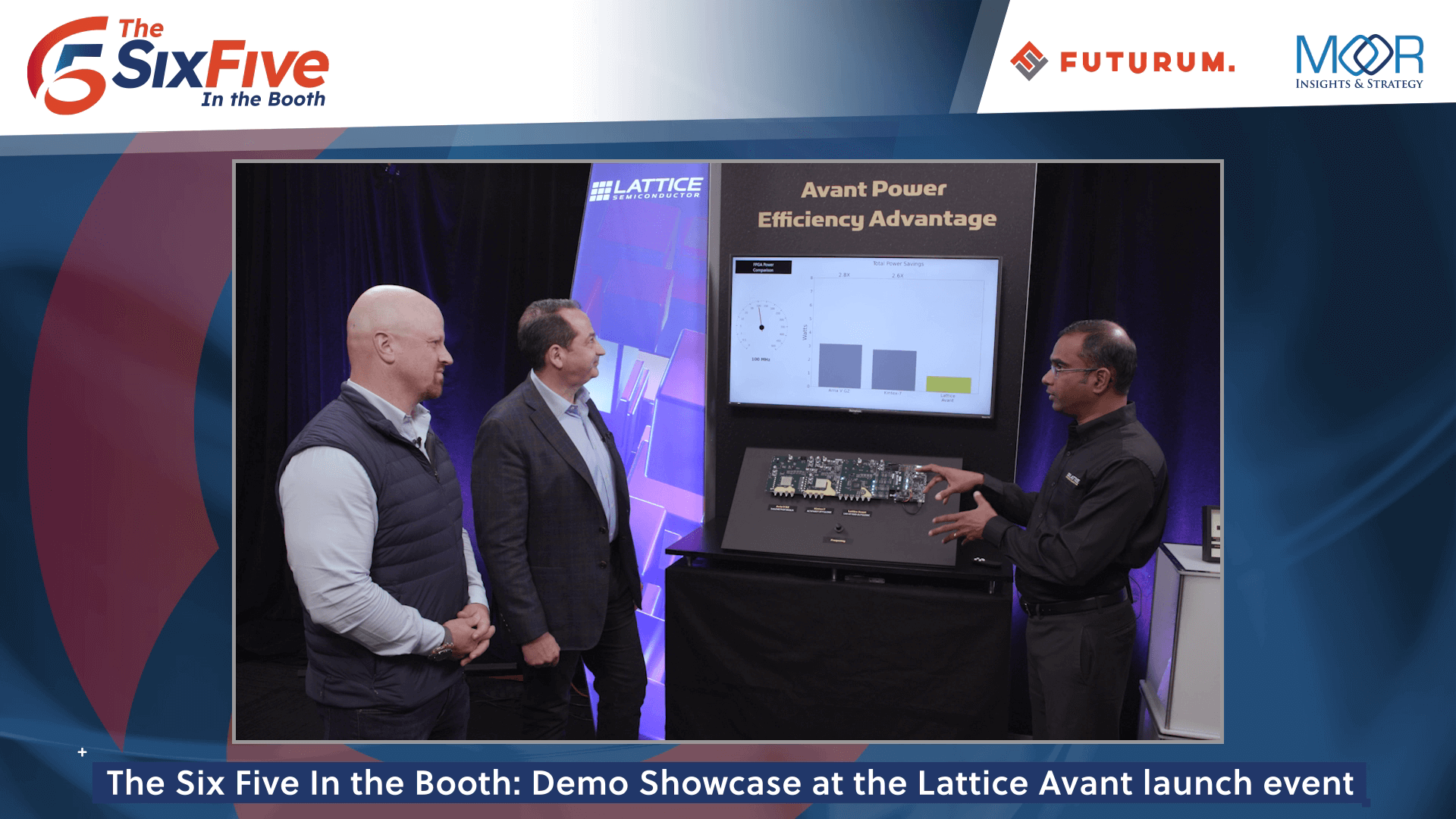
The Six Five In The Booth at the launch of Lattice Semiconductor’s new Lattice Avant mid-range FPGA platform. Patrick Moorhead and Daniel Newman walk through the Avant demos with Deepak Boppana, Senior Director, Segment Marketing at Lattice Semiconductor. Their conversation covers:
- Lattice Avant FPGA platform’s Power Efficiency, Performance, & AI Processing demos with competitive and generational comparisons
- The importance of thermal management and its effect on the overall cost
- Applications that benefit from lower power
- How Lattice Avant improves AI acceleration
Be sure to subscribe to The Six Five Webcast so you never miss an episode.
You can watch the full video here:
You can listen to the conversation here:
Disclaimer: The Six Five On the Road is for information and entertainment purposes only. Over the course of this webcast, we may talk about companies that are publicly traded, and we may even reference that fact and their equity share price, but please do not take anything that we say as a recommendation about what you should do with your investment dollars. We are not investment advisors, and we do not ask that you treat us as such.
Transcript:
Patrick Moorhead: Hi, this is Pat Moorhead, and we are live at Lattice’s Avant launch at the Computer History Museum in Silicon Valley. Things are rocking, huge announcement today. Daniel, this is awesome. You know how much I like product announcements.
Daniel Newman: I love being around the Computer History Museum. It’s so much of what we do. We love Silicon, we love big announcements, and we love hearing about the future of FPGAs. And Lattice has been a really exciting company, so big day today.
Patrick Moorhead: Yeah. What I love, too, and especially I love to geek out on the technology, but what I also appreciate is the doubling of the addressable market of the company. And that’s a big deal. How many announcements could potentially double the size of the company?
Daniel Newman: Well, we’ve watched, over the last eight to 12 quarters, Lattice Semiconductor has been there. And you and I both published numerous articles, Market Watch, Forbes. We’ve put a lot of opinion out there and it’s been a really impressive run. And I think it’s great that we’re going to have the opportunity here to show our audience a little bit of what they did today, some of the announcements of Avant. You’re talking power efficiency, we’re talking better performance, we’re talking AI. We’ve got an expert, Deepak, here that’s ready to show us what’s going on and show you. So why don’t we do that? Deepak, what are we looking at here at the first demo?
Deepak Boppana: Yeah. So in this demo, we’re going to measure the power consumption of the Avant FPGA, relative to similar class of FPGAs from other vendors. So this board that you see here has an REFI FPGA from Intel, Kintex-7 FPGA from AMD Xilinx, and of course Avant FPGA from Lattice. Now many of the applications for this class of FPGAs typically have frequencies in the 100 to 350 megahertz range. So what we’re going to show here is as we modulate the frequency in that range, so starting with a hundred megahertz, we can see the Avant FPGA, we have up to two and a half times lower par consumption. And as we continue to modulate the frequency throughout this range, we can see how Avant continues to have up to two and a half times lower power consumption than other FPGAs. And this really helps simplify thermal management and lowers operating costs.
Patrick Moorhead: Yeah, let’s dive, do a double click on this. First of all, I just want to say I love your demos and your marketing department. I like these so much because it’s hitting on something that a lot of embedded companies don’t do. They don’t do a very good job showing what this might mean. So I appreciate that. I want to do the double click though on thermal management and cost. Why does this equate, this benefit, equate to lower cost for your partners?
Deepak Boppana: Yeah, absolutely right. So in many of these class types of applications, especially if you think about edge computing, there’s so much intelligence moving to the edge. A lot of these devices have to do a lot more computing than before, but they have the same constraints in terms of form factor and power consumption. So they just cannot afford to have things like fans and heat sinks and stuff.
Patrick Moorhead: More to fact, there are some implementations that you can’t put a fan in and also fan, spent a little time at a real product company before, fan equals less reliability in the end.
Deepak Boppana: Absolutely. So that definitely helps from that standpoint as well. And then there are battery operated equipment too, like industrial robots for example. I mean, every milliwatt of power that you can save just helps extend the battery life longer.
Daniel Newman: Right. So Deepak, people always want to be able to correlate a technological advantage, or in this case say power efficiency to the application. So you kind of alluded to it a little bit with the edge, but talk a little bit more about the applications your partners and customers are coming to you looking to solve.
Deepak Boppana: Absolutely. So power consumption, low power consumption is so important across so many different segments. So we see that in the industrial side, for example, with some examples like machine vision cameras that again are getting smarter but still have the form factor and thermal constraints. We have industrial robotics, we have edge servers that are being placed closer to the edge. We have automotive, infotainment, kind of applications. And then of course the traditional communications applications, with 5G, base stations and small cells in the future that are really compact in size and that they can really benefit from the slow power.
Daniel Newman: Deepak, that’s terrific. Hey Pat, we got two more demos. Why don’t we go over and have Deepak show us a little bit about the performance advantages?
Patrick Moorhead: That’s great. Let’s do it. Deepak, thanks so much for showing us the power advantage demo for the new Lattice Avant, but you know, you can hit low power, but the next question is, can you hit the performance that you’re going after?
Deepak Boppana: Absolutely. So that’s what we want to be showing in this demonstration. So we’ll be measuring the performance of Avant FPGA in a high speed data transfer application. So we have the same board as before, the exact same board with the REFI FPGA, Kintex-7 FPGA and Avant FPGA.
Patrick Moorhead: So, Intel, AMD, Lattice?
Deepak Boppana: Lattice, exactly. And the channel from each of these FPGAs is connected to a different board that does the clock and data recovery and monitoring of the data transfer. So the key thing is we are going to go ahead and start the data transfer and you can see how the Avant FPGA completes the data transfer two times faster than the other FPGAs, and basically this delivers increased bandwidth and lower system costs.
Daniel Newman: Okay. So you’re dealing with power, you’re doubling performance, where are customers going to be, what are the applications they’re going to be coming to you and saying, “This is something we explicitly believe Lattice is going to be able to sell for us that these others can’t.”
Deepak Boppana: Yeah, I mean performance and even connectivity performance, which is what we are showing here, is going up in so many applications with especially all the video resolutions going up in the industrial space, the data coming from cameras and emit sensors, as well as going into the displays. So the video related traffic is going up, the speeds are going up, and then obviously on the side we have the usual networking and 5G data rates that are basically going up as well. So this faster connectivity helps in all those applications.
Patrick Moorhead: So, let’s say something in networking, it would be the difference between, it would literally be the line speed of that network connectivity. And then for other applications it could be the difference between either let’s say the number of cameras coming into the system or even the resolution of the video coming into the subsystem itself.
Deepak Boppana: Exactly.
Patrick Moorhead: So automotive, robotics and pretty much anything that connects via network, which is pretty much everything.
Deepak Boppana: Absolutely right. And we touched on this before with the whole intelligence aspect. All these devices are getting smarter and there’s so much connectivity in the automotive space, connectivity within the car, the industrial networking space with ethernet and TSN protocols.
Daniel Newman: Sounds like you’ve got speed, you’ve got power. One of the big applications everyone’s asking about now though is AI.
Patrick Moorhead: That’s right.
Daniel Newman: So, I heard you’ve got something to show there. How about we head over and you give us…
Deepak Boppana: Absolutely.
Patrick Moorhead: Let’s do it.
Daniel Newman: Deepak Artificial intelligence is a really big topic this year. Patrick and I are constantly covering it, talking about it and everyone’s asking in the FPGA space with this Avant launch, AI’s got to be a part of your story. Tell us about that.
Deepak Boppana: Absolutely. So we have a really cool demo here where we’ll be showcasing the Avant FPGA based AI inferencing solution and this performs real time analytics on a video stream and we show vehicles operating under different traffic conditions and we’ll see how the solution performs in terms of detecting and tracking the vehicles. So let’s go ahead and play the first video clip. So here we see a bunch of slow-moving vehicles and AI solution, as you can see, identifies the vehicles with the green box around them and tracks the movement of the vehicles. Now in the second clip, the conditions are much harsher with fog, snow, faster oncoming traffic, but the AI solution is still able to keep pace with all that and continues to track the movement. Now this last clip has extremely fast moving traffic and the AI solution is still able to identify and track the different cars on the road. So this is really an example of how Avant can deliver scalable AI performance for a variety of different edge computing use cases.
Patrick Moorhead: Now, this is great. And I particularly love that last one because it was a good, did you send that video from how you drive Dan in Texas?
Daniel Newman: The third one. Just the last one.
Patrick Moorhead: I got you. Okay. This is good. So AI is definitely more about automotive, but I think it’s something we can all relate to. How about smart factories, smart distribution, other types of applications?
Deepak Boppana: Absolutely right. So AI is being used in so many different industrial applications. You mentioned smart factory, robotics, both the fixed and mobile robots that need to move around and basically do object detection and collision avoidance and stuff like that. You have machine vision cameras that basically do the quality inspection. So that’s a use case for AI and the typical surveillance cameras as well. And this could also be an example of a traffic management system.
Patrick Moorhead: Right. Hey, let’s get another smart city, right?
Deepak Boppana: Yeah. That’s the smart city, yeah.
Patrick Moorhead: So smart retail, smart factory, smart distribution, pretty much intelligence anytime you have a camera that you want to pull into intelligence.
Deepak Boppana: Exactly.
Patrick Moorhead: Okay.
Deepak Boppana: So yeah.
Daniel Newman: So basically, anywhere that inferencing needs to be done at the edge, Avant is there.
Deepak Boppana: Absolutely.
Daniel Newman: Anytime there’s a launch, it’s always about generation to generation. This is the launch of Avant, but Nexus to Avant, talk just a little bit about what are some of the improvements of performance that people can really expect in terms of AI.
Deepak Boppana: Absolutely. So yeah, I think spot on, even with Nexus, we have very good success in traction with AI use cases. In fact, we are building on that with Avant. So the way to think about it is, I mean even if you take this particular example, the Nexus products will probably do a good job of the first slower moving traffic and the second one, but it’s really use cases where you need faster frames per second processing or higher quality resolution. That’s where Avant really adds to what we already have. And the beauty is the FPGAs, both are programmable and as you know, the AI world is still evolving, with all the networks and models still changing. So both of them have the basic value proposition of FPGA programmability.
Patrick Moorhead: Yeah. So Deepak really appreciate you taking us through these demos of the new Avant product. We looked at power, we looked at performance, we also looked at AI performance. So I appreciate you taking us through that.
Deepak Boppana: Oh, my pleasure, thank you.
Patrick Moorhead: So, it was a great launch here. We are live here at the Lattice Avant launch event at the Computer History Museum in Silicon Valley. This is rocking it. Great demos, great presentations. Tune in to check out some of our other videos on the event we are tuning out here. I want to thank you for tuning in. If you like what you heard, hit that subscribe button. Take care.
Author Information

Daniel is the CEO of The Futurum Group. Living his life at the intersection of people and technology, Daniel works with the world’s largest technology brands exploring Digital Transformation and how it is influencing the enterprise.
From the leading edge of AI to global technology policy, Daniel makes the connections between business, people and tech that are required for companies to benefit most from their technology investments. Daniel is a top 5 globally ranked industry analyst and his ideas are regularly cited or shared in television appearances by CNBC, Bloomberg, Wall Street Journal and hundreds of other sites around the world.
A 7x Best-Selling Author including his most recent book “Human/Machine.” Daniel is also a Forbes and MarketWatch (Dow Jones) contributor.
An MBA and Former Graduate Adjunct Faculty, Daniel is an Austin Texas transplant after 40 years in Chicago. His speaking takes him around the world each year as he shares his vision of the role technology will play in our future.