
Austin, Texas, USA, August 28, 2026
Futurum’s 2H 2026 channel survey finds partner growth polarization, splitting the ecosystem as AI reshapes how partners build, buy, and sell.
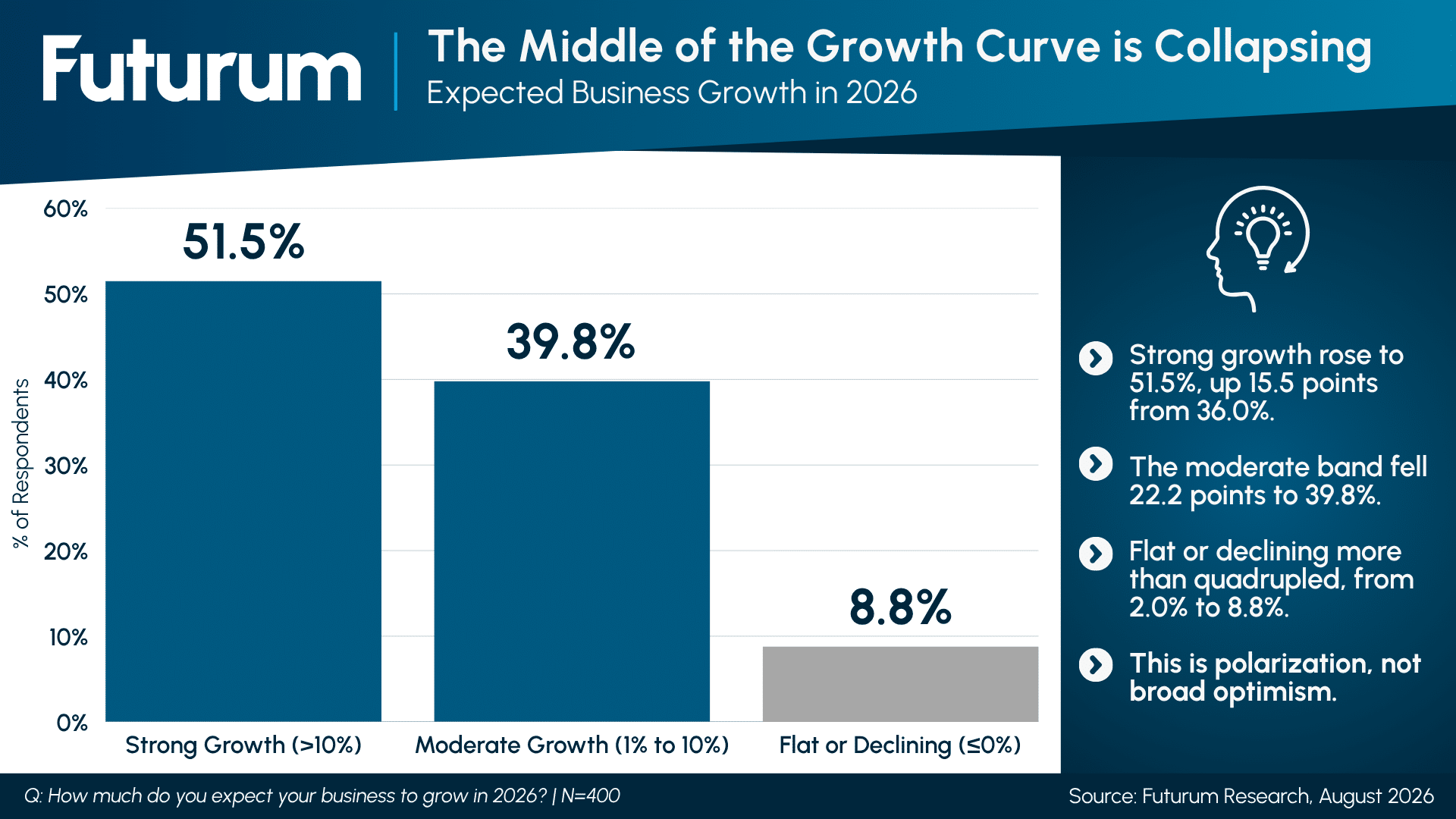
Partner growth polarization is reshaping the technology channel in 2026, according to a new survey from The Futurum Group. Among 400 partner decision makers across North America and Western Europe, the share expecting strong growth above 10% jumped to 51.5% from 36.0% at the start of the year, while the moderate 1% to 10% band fell 22.2 points to 39.8%, and the flat-or-declining group more than quadrupled to 8.8%.
The pattern (see Figure 1) is not broad optimism but partner growth polarization: growth is concentrated in partners positioned for AI-driven demand and thinning everywhere else. AI is the engine of the split, yet partners describe their maturity carefully. Two-thirds of partners confident in an AI-transformed market (66.8%) say they have built their own solutions using large language models, now the single dominant capability claim, while every claim tied to running AI in production for customers receded. Partners are building AI faster than they are deploying it.
Figure 1: Expected Business Growth in 2026
Alex Smith, GM, Futurum Research, and the VP & Practice Lead, Ecosystems, Channels & Marketplaces at The Futurum Group, said, “Partner growth polarization is the story of this channel in 2026. The middle of the growth curve is falling, and a vendor needs to pay close attention to their partner base to identify which ones are primed to capture the growth opportunities.”
The AI-native model providers are not yet a channel force, despite their visible investments to develop their respective partner communities of late. On their first appearance in the study, OpenAI is named strategic by 11.2% of partners and Anthropic by 7.0%, against Microsoft (64.2%), AWS (56.2%), and Google Cloud (47.8%), the hyperscalers’ partners still organize around. Partner line card polarization is also visible in the portfolio, where partners are carrying fewer lines, not different ones: the average partner now sells 4.99 technology categories, down from 5.47, and 4.14 services, down from 4.80, shedding low-margin work such as outsourcing services, down 30.3 points to 11.5%, and hardware peripherals, down 10.5 points to 18.0%.
The research reveals several developments behind this partner growth polarization:
- The middle of the growth curve is collapsing: partners expecting strong growth above 10% rose to 51.5% from 36.0%, while the moderate 1% to 10% band fell 22.2 points to 39.8%, and the flat-or-declining group more than quadrupled to 8.8%.
- Partners are building AI, not yet deploying it: among partners confident in an AI-transformed market, 66.8% have built their own solutions using large language models, while every claim tied to running AI in production for customers has receded.
- OpenAI and Anthropic remain far from mass channel penetration: the AI-native model providers are named strategic by just 11.2% and 7.0% of partners, against Microsoft at 64.2%, AWS at 56.2%, and Google Cloud at 47.8%.
- Portfolios are narrowing toward higher-value lines: the average partner now sells 4.99 technology categories, down from 5.47, with the deepest cuts in low-margin outsourcing services (down 30.3 points to 11.5%) and hardware peripherals (down 10.5 points to 18.0%).
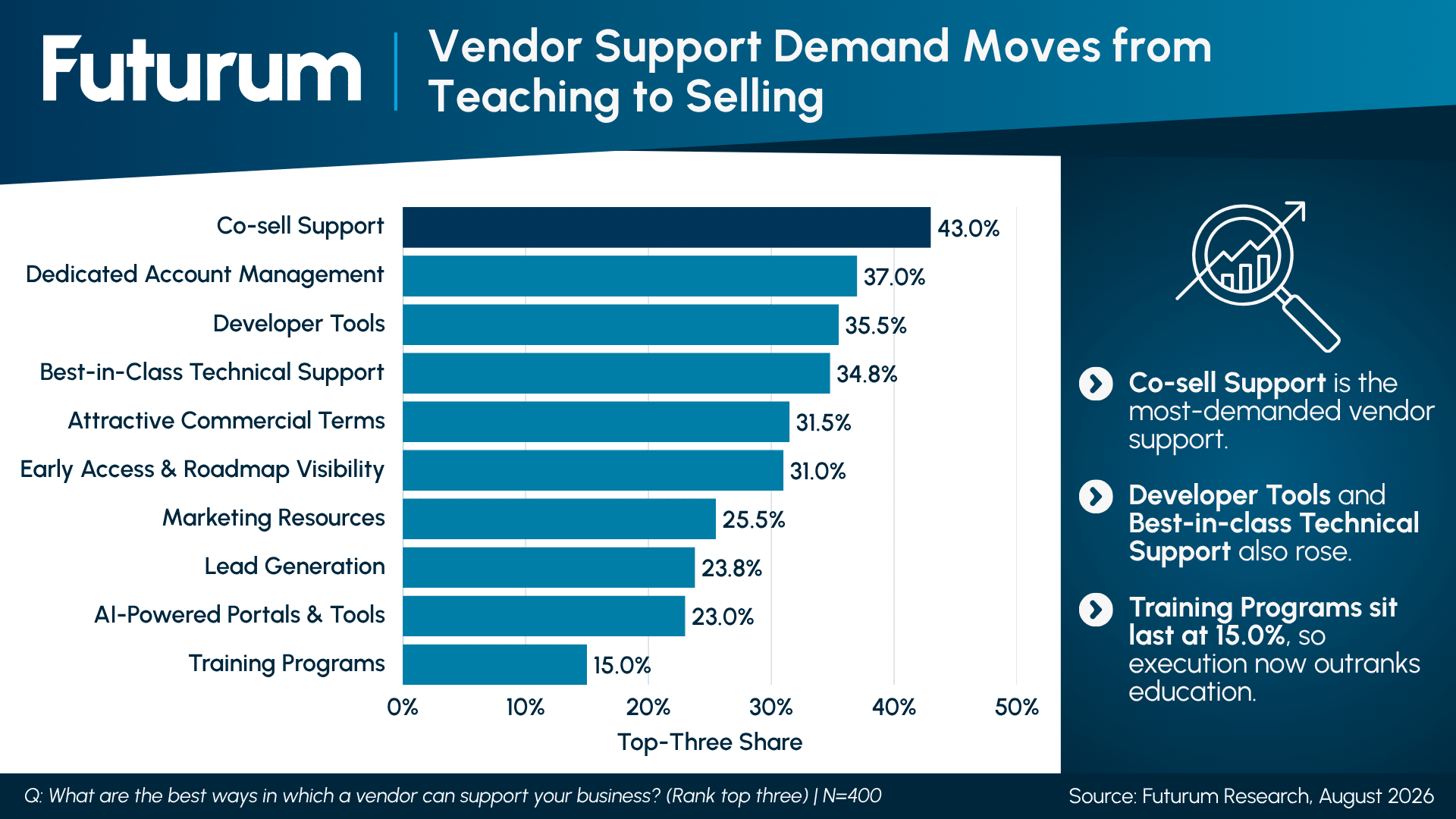
- Vendor support demand is moving from teaching to selling: co-sell support is the most-demanded form of vendor support at 43.0% top-three, while training programs now sit last at 15.0%.
- Enterprise applications posted the sharpest fall of any technology category in growth expectation, dropping 31.1 points to 25.9% of its sellers and last of 14, yet custom application development held as the second-highest-conviction service at 71.0%.
Where partners want vendor help has moved in step. Co-sell support is now the single most-demanded form of vendor support at 43.0% in the top three, with developer tools (35.5%) and best-in-class technical support (34.8%) rising, while marketing resources, early access, and lead generation all fell, and training programs sit last at 15.0% (Figure 2).
Figure 2: Vendor Support Demand Moves from Teaching to Selling
“The vendors that win this cycle will segment partners by growth posture rather than just revenue band, fund execution over education, and meet partners inside the hyperscaler relationships they already hold,” added Smith.
The through-line is bifurcation. Partner growth polarization, the split between partners scaling into AI-driven demand and those under margin pressure, is remaking the channel into two populations that need two motions, and the vendor programs still built for one will meet only half the market.
Read more in the 2H 2026 Ecosystems, Channels & Marketplaces Decision Maker Survey Report on the Futurum Intelligence Platform. Non-subscribers click here for more information.
About Futurum Intelligence for Market Leaders
Futurum Intelligence’s Ecosystems, Channels, and Marketplaces IQ service provides actionable insight from analysts, reports, and interactive visualization datasets, helping leaders drive their organizations through transformation and business growth. Subscribers can log into the platform at https://app.futurumgroup.com/, and non-subscribers can find additional information at Futurum Intelligence.
Follow news and updates from Futurum on X and LinkedIn using #Futurum. Visit the Futurum Newsroom for more information and insights.
Other Insights From Futurum:
How Anthropic and OpenAI Are Building “Everywhere Ecosystems”
Is Micron at the Center of the AI Universe? A Trillion-Dollar Cap Suggests Yes
Dell’s New Partner Program Blueprint for the AI Era
Author Information

Alex is Vice President & Practice Lead, Ecosystems, Channels, & Marketplaces at the Futurum Group. He is responsible for establishing and maintaining the Channels Research program as part of the overall Futurum GTM and Channels Practice. This includes overseeing the channel data rollout in the Futurum Intelligence Platform, primary research activities such as research boards and surveys, delivering thought-leading research reports, and advising clients on their indirect go-to-market strategies. Alex also supports the overall operations of the Futurum Research Business Unit, including P&L segmentation, sales and marketing alignment, and budget planning.
Prior to joining Futurum, Alex was VP of Channels & Enterprise Research at Canalys where he led a multi-million dollar research organization with more than 20 analysts. He played an integral role in helping the Canalys research organization migrate into Omdia after having been acquired in 2023. He is an accomplished research leader, as well as an expert in indirect go-to-market strategies. He has delivered numerous keynotes at partner-facing conferences.
Alex is based in Portland, Oregon, but has lived in numerous places, including California, Canada, Saudi Arabia, Thailand, and the UK. He has a Bachelor in Commerce and Finance Major from Dalhousie University, Halifax Canada.

