Analyst(s): Alex Smith
Publication Date: May 29, 2026
What is Covered in This Article:
- Universal Growth Across Every Vanguard: An analysis of the May 2026 index update showing positive TTM revenue growth across all 25 large-cap Vanguards.
- Memory as the New Center of Tech: Why high-bandwidth memory has become the critical bottleneck for AI acceleration, driving massive growth for Micron and Samsung.
- The Resurgence of the Established Guard: How Cisco, IBM, Oracle, and Apple have captured immense momentum through strategic pivots and AI monetization.
- Consistent Hyperscaler Acceleration: Why AWS, Microsoft Azure, and Google Cloud are growing faster today than they were 12 months ago, defying their massive scale.
- Intel’s Pivotal Turnaround: Marking the semiconductor giant’s return to positive trailing-twelve-month (TTM) growth after years of structural declines.
- Looming Headwinds and Question Marks: A transparent critique of the structural challenges facing HP Inc., SAP, and Qualcomm in the current market.
The News: The Futurum Tech Vanguards Index serves as a critical health check for the world’s 25 largest and most influential public technology companies. In this latest index update, the May 2026 data reveals an extraordinary market dynamic: 100% of the Vanguards are exhibiting positive Trailing Twelve Month (TTM) revenue growth. This universal positive performance is not merely a reflection of robust macroeconomic conditions; it is evidence that the generative AI infrastructure buildout and enterprise digital modernization are permeating every layer of the technology stack. From foundational memory and silicon suppliers to client devices, hybrid infrastructure, and enterprise software, the entire market is expanding.
At the absolute forefront of this wave is Micron Technology, which has registered a blistering 85.6% TTM revenue growth, securing the top growth spot in the entire index. In a stunning display of this momentum, Micron officially crossed the $1 trillion market capitalization milestone for the first time on May 26, 2026, driven by an unprecedented surge in memory demand. While the headline-grabbing semiconductor and hardware players continue to operate at massive growth velocities, there is a profound structural shift underway. The initial “land grab” phase of AI infrastructure is transitioning into a systemic, multi-faceted modernization cycle. For enterprise buyers, technology providers, and investors, this creates an environment of synchronized expansion where the “established guard” is resurging alongside the hyper-growth disruptors.
Is Micron at the Center of the AI Universe? A Trillion-Dollar Cap Suggests Yes
Analyst Take — Memory Emerges as the New Center of Tech: As the industry moves from basic AI model exploration to massive training and inference deployments, a critical realization has gripped the technology landscape: compute is nothing without memory bandwidth. In this environment, memory is no longer a cyclical commodity but the vital bottleneck and strategic centerpiece of modern computing architectures. This paradigm shift is reflected in the extraordinary performance of the index’s leading memory makers, most notably Micron Technology and Samsung.
Figure 1: Futurum Tech Vanguards, May 2026
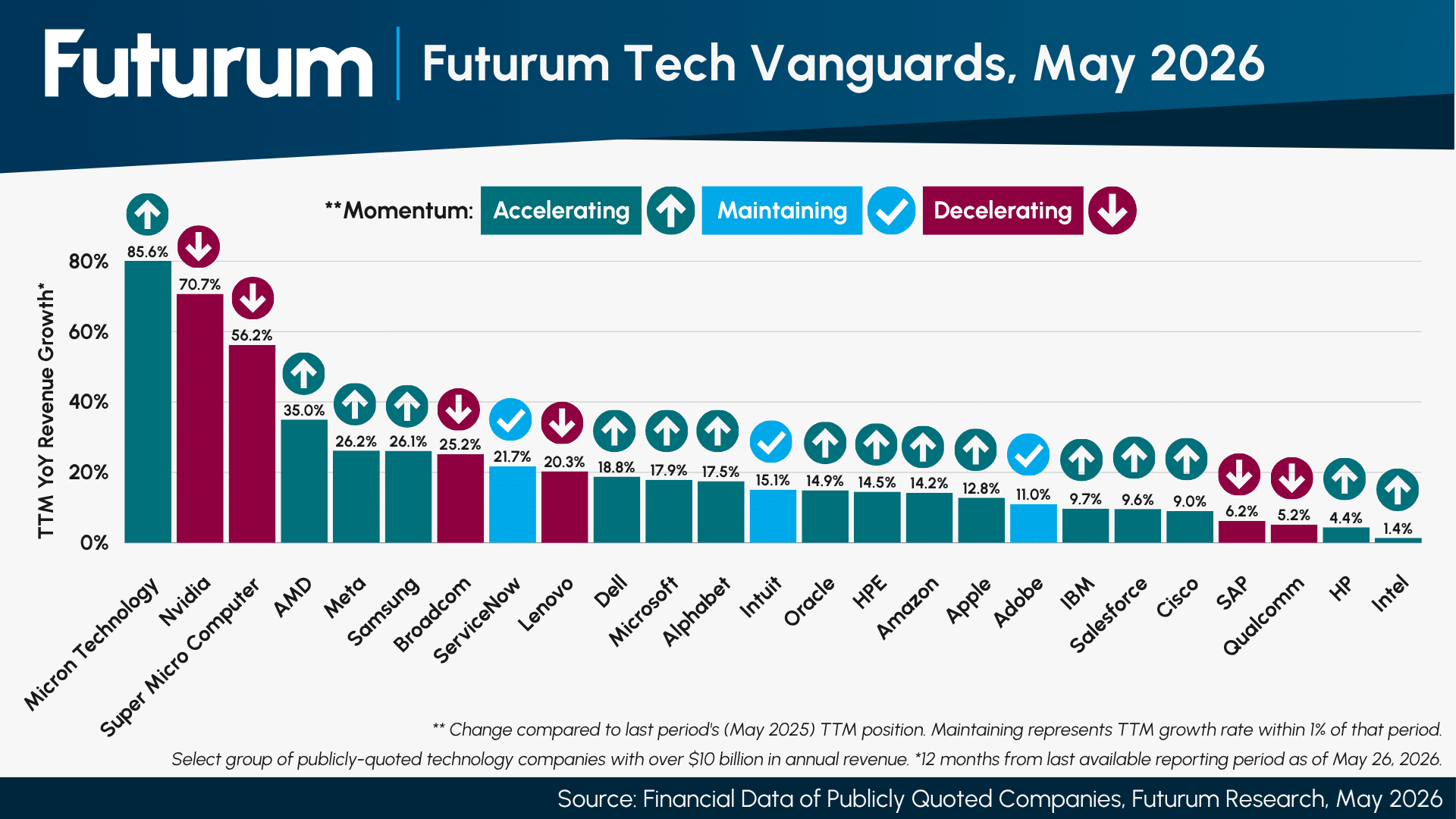
Micron’s ascent to a historic $1 trillion market cap on May 26, 2026, serves as the ultimate market validation of this shift. This massive re-rating was catalyzed by a blockbuster upgrade from UBS, which more than tripled its price target to $1,625 per share. Wall Street is recognizing that generative AI has fundamentally broken the highly volatile legacy DRAM and NAND “boom-and-bust” pricing model. Central to this transformation is a structural shift in how memory is procured: newer long-term agreements (LTAs), spanning three to five years, now feature fixed volume commitments and partially fixed pricing structures. This provides Micron with highly predictable, high-margin revenue visibility while insulating it from historical commodity plunges. Riding this structural wave, Micron leads the entire Tech Vanguards Index with a spectacular 85.6% TTM revenue growth, driven by its industry-leading High Bandwidth Memory (HBM3E) architectures integrated directly into next-generation AI silicon.
Similarly, Samsung is experiencing a strong resurgence with 26.1% TTM growth. Samsung’s growth is propelled by a broader rebound in the memory market, alongside its aggressive scaling of advanced HBM products and next-generation DRAM to feed thirsty hyperscale data centers and client-side AI devices. Together, the stellar trajectories of Micron and Samsung prove that the structural center of gravity in hardware has shifted; the raw processing speed of GPUs and CPUs is increasingly defined by the speed, proximity, and capacity of the memory systems that feed them.
The Established Giants Strike Back
Another important narrative in this index cycle is the acceleration among tech’s most established companies: Apple, Cisco, IBM, and Oracle.
Apple has accelerated to 12.8% TTM growth, driven by a record-breaking Services flywheel and the early stages of a consumer device refresh cycle powered by NPU-enabled “Apple Intelligence” hardware. This hardware-led AI strategy is already showing success, leveraging Apple’s custom silicon superiority to convert its active install base into higher-margin recurring revenues. The next phase of this growth strategy will be guided by newly announced leadership, with hardware engineering chief John Ternus set to succeed Tim Cook as CEO in September 2026.
Cisco has returned to accelerating momentum after a period of digestion following massive post-pandemic enterprise networking backlogs. This resurgence is somewhat anchored by the successful integration of Splunk, which has created a massive enterprise observability and security platform. But what is truly fueling Cisco now is the soaring demand for high-performance Ethernet switching in AI-adjacent data centers; the cycle that has previously favored compute has gradually worked its way to networking, where Cisco’s realm has long reigned.
Meanwhile, IBM’s structural turnaround has graduated to a new phase with the company posting a strong 9.7% TTM growth. This trajectory is powered by robust software annuities, Red Hat OpenShift hybrid-cloud orchestration, and expanding enterprise consulting engagements around the watsonx generative AI platform, showing that complex, regulated industries prefer IBM’s governed approach to AI deployment.
Oracle is turning in some of the most impressive numbers in the index with 14.9% TTM growth, proving that its database legacy has translated into modern AI leadership. It has simultaneously pursued a multi-cloud strategy (deploying Oracle Database on AWS, Azure, and Google Cloud) while also investing in hosting massive AI workloads (such as OpenAI’s Stargate on Oracle Cloud Infrastructure), transforming OCI into a tier-one alternative.
The Hyperscale Engine Defies Gravity
Perhaps the most consistent stabilizer in the entire tech economy is the hyperscaler trio of Microsoft, Alphabet, and Amazon. Over the past 12 months, all three have not only maintained stable growth but have actually accelerated their trajectories, defying the law of large numbers.
Microsoft leads the cohort with an impressive 17.9% TTM growth, driven by the compounding scale of Azure AI Services and the broad commercial rollout of Copilot subscriptions across the enterprise workspace. Alphabet follows closely at 17.5% TTM growth, powered by Google Cloud Platform (GCP) reaching high-margin scale alongside a robust rebound in AI-infused digital advertising and Gemini-integrated search services. Meanwhile, Amazon has re-accelerated to 14.2% TTM growth as corporate IT optimization cycles concluded, replaced by massive cloud-native model training and inference workloads on AWS, coupled with a highly resilient retail and logistics advertising engine. This collective acceleration serves as a powerful reminder that whatever else happens in tech, the hyperscalers remain firmly at the center of the technology universe.
Intel’s Return to Growth
An essential highlight of the May 2026 index is Intel’s return to positive growth, finishing the TTM period with a 1.4% revenue increase (representing twelve months ending March 31, 2026). This reversal of a multi-year trend of structural declines represents a major psychological and operational milestone for CEO Lip-Bu Tan’s turnaround strategy. Since Tan took the helm in early 2025, the company has instituted a leaner, more disciplined engineering and execution focus. This pivot is being driven by the expansion of the artificial intelligence market, which has spiked demand for Intel’s Xeon CPUs in hybrid server environments, the rollout of Core Ultra AI PC processors, and the gradual ramping of its advanced foundry and packaging business to external customers.
The Base-Effect Decelerators
It is crucial to note that only six out of the twenty-five Vanguards are growing more slowly than they were this time last year, yet even those exhibit highly positive structural health.
NVIDIA, with 70.7% TTM growth, and Super Micro Computer, at 56.2%, both remain among the fastest-growing technology companies on Earth. Their minor deceleration is purely a mathematical function of lapping astronomical prior-year comparisons. The underlying demand for Blackwell GPUs and liquid-cooled rack architectures remains structurally supply-constrained.
Similarly, Lenovo is delivering a record-breaking fiscal year across intelligent devices (AI PCs) and hybrid cloud systems despite a fractional deceleration to 20.3% TTM growth, which reflects localized silicon supply logistics rather than a genuine demand slowdown.
The Question Marks: SAP, Qualcomm, and HP Inc.
While the tech landscape is overwhelmingly positive, three companies in the Vanguards carry looming question marks and strategic hurdles that require close monitoring. SAP, Qualcomm, and HP are among the slowest growth companies (on a TTM basis) of the Vanguards, but they represent three distinct corners of the technology landscape.
SAP is primarily a packaged application vendor, and cloud migrations like S/4HANA Cloud are progressing well, but the company lacks the raw compute growth engine of Oracle’s Cloud Infrastructure (OCI). This deprives SAP of the high-growth hosting revenues that Oracle is capturing through strategic hyperscaler partnerships and key AI development deals.
Qualcomm, despite securing impressive strategic wins, remains heavily exposed to the cyclical consumer smartphone market, where global upgrade cycles continue to lengthen. Although Qualcomm has captured mindshare with its Snapdragon Elite platforms within the Windows AI PC wave, alongside a massive multi-year automotive AI partnership with Stellantis in May 2026, its core smartphone processor business must navigate persistent headwinds until on-device consumer AI features trigger a true global device refresh supercycle. However, the company is beginning to actively address this mobile concentration by expanding directly into the AI data center. A landmark deal to supply millions of AI ASICs to ByteDance for its massive AI agent infrastructure, alongside securing a multi-generation custom silicon engagement with a leading hyperscaler and introducing its new Dragonwing server CPUs, signals that Qualcomm is starting to establish itself as a credible force in enterprise-scale AI compute.
HP Inc. faces perhaps the most complex transition period of the group. Structurally, the company is operating under Interim CEO Bruce Broussard following Enrique Lores stepping down in February 2026. But this comes at a time when HP is navigating a severe global memory supply crunch. Driven by the explosive demand for high-bandwidth memory (HBM) and DRAM in AI data centers, soaring memory and storage component costs are placing intense pressure on HP’s hardware margins. HP has historically suffered from structural supply chain challenges during component crunches, and because it does not possess the massive global scale, enterprise-infrastructure footprint, or consolidated procurement leverage of major rivals like Lenovo and Dell, its ability to buffer these severe price spikes is significantly constrained. Navigating this market squeeze while steering through a major leadership transition represents a double-headed challenge for HP’s interim executive team.
Future Recommendations
- For Enterprise Buyers: Lean into the hybrid, multi-cloud platforms of the established players. The resurgence of companies like IBM, Oracle, and Cisco proves that legacy architectures can be modernized seamlessly. Do not feel pressured to migrate entirely to the public cloud; hybrid AI engines are proving to be the most cost-effective and secure path forward.
- For Investors: Focus on companies building sticky, recurring subscription services and software-annuity models with AI integrated into the core. High-infrastructure capital expenditures are creating a structural base of software consumption that will yield long-term compounding margins.
- For Technology Vendors: Proactively manage supply-chain exposures. The scramble for AI data center silicon and high-bandwidth memory has downstream cost consequences for consumer and enterprise client devices. Securing strategic supplier agreements is paramount.
Disclosure: Futurum is a research and advisory firm that engages or has engaged in research, analysis, and advisory services with many technology companies, including those mentioned in this article. The author does not hold any equity positions with any company mentioned in this article.
Analysis and opinions expressed herein are specific to the analyst individually and data and other information that might have been provided for validation, not those of Futurum as a whole.
Other Insights From Futurum:
AMD’s Venice Ramping on 2nm: Can AMD Reset the AI Data Center Power Balance?
Google I/O: Did Google Just Ship the Full AI Stack?
NVIDIA Q1 FY2027: Data Center Diversification, Blackwell Scale, CPU Upside
Author Information

Alex is Vice President & Practice Lead, Ecosystems, Channels, & Marketplaces at the Futurum Group. He is responsible for establishing and maintaining the Channels Research program as part of the overall Futurum GTM and Channels Practice. This includes overseeing the channel data rollout in the Futurum Intelligence Platform, primary research activities such as research boards and surveys, delivering thought-leading research reports, and advising clients on their indirect go-to-market strategies. Alex also supports the overall operations of the Futurum Research Business Unit, including P&L segmentation, sales and marketing alignment, and budget planning.
Prior to joining Futurum, Alex was VP of Channels & Enterprise Research at Canalys where he led a multi-million dollar research organization with more than 20 analysts. He played an integral role in helping the Canalys research organization migrate into Omdia after having been acquired in 2023. He is an accomplished research leader, as well as an expert in indirect go-to-market strategies. He has delivered numerous keynotes at partner-facing conferences.
Alex is based in Portland, Oregon, but has lived in numerous places, including California, Canada, Saudi Arabia, Thailand, and the UK. He has a Bachelor in Commerce and Finance Major from Dalhousie University, Halifax Canada.