Analyst(s): Alex Smith, Brendan Burke
Publication Date: April 1, 2026
Ecolab has agreed to acquire CoolIT Systems, a pure-play data center liquid-cooling company, for approximately $4.75 billion in cash, combining CoolIT’s thermal-engineering hardware with Ecolab’s existing water, chemistry, and digital monitoring capabilities. The deal signals that the intensifying power and cooling demands of AI infrastructure are pulling non-traditional technology vendors into the data center supply chain at significant scale.
What is Covered in This Article:
- Ecolab’s $4.75 billion acquisition of CoolIT Systems from KKR
- The strategic logic of aligning with NVIDIA’s liquid cooling roadmap
- Valuation implications at 29x Next Twelve Months adjusted EBITDA
- How the deal reshapes competitive dynamics in data center cooling
- Whether a services-oriented acquirer can execute in a hardware-driven market
The News: Ecolab announced on March 20, 2026, that it had entered into a definitive agreement to acquire CoolIT Systems, a liquid-cooling technology company focused entirely on the data center market, from PE firm KKR. The all-cash transaction is valued at approximately $4.75 billion and is expected to close in the third quarter of 2026, subject to regulatory approvals and customary closing conditions. CoolIT designs and manufactures liquid-cooling systems, including coolant distribution units (CDUs), cold plates, and direct-to-chip cooling technologies, used by major hyperscale and colocation operators.
The company is expected to generate approximately $550 million in sales over the next 12 months. Ecolab stated that the acquisition will double its global high-tech addressable market from $5 billion to $10 billion and accelerate its Global Water division’s organic sales growth rate by 2% and Ecolab’s total organic sales growth rate by 1%.
“By bringing together CoolIT’s engineered cooling technologies with Ecolab’s expertise in water, chemistry, and digital service, we can provide our customers a complete cooling solution that improves performance and reliability while reducing water and energy use,” said Christophe Beck, Ecolab Chairman and Chief Executive Officer.
Will Ecolab’s $4.75B CoolIT Systems Bet Define the Future of GPU Liquid Cooling?
Analyst Take: Ecolab’s acquisition of CoolIT Systems is a cross-industry move into AI data center infrastructure, positioning a water treatment and industrial chemistry company at the center of the liquid-cooling value chain. As AI workloads push data center power densities beyond the limits of traditional air cooling, the organizations that drive fluid cooling innovation will command outsized strategic value. CoolIT Systems has collaborated with NVIDIA across multiple generations, aligning with the data center computing market leader’s continued innovation in direct liquid-cooling technology. CoolIT optimized its OMNI cold plate product for NVIDIA GB200 GPUs and recently launched a CDU that supports 12 NVIDIA GB300 NVL72 racks, positioning it as a utility for the deployment of frontier systems.
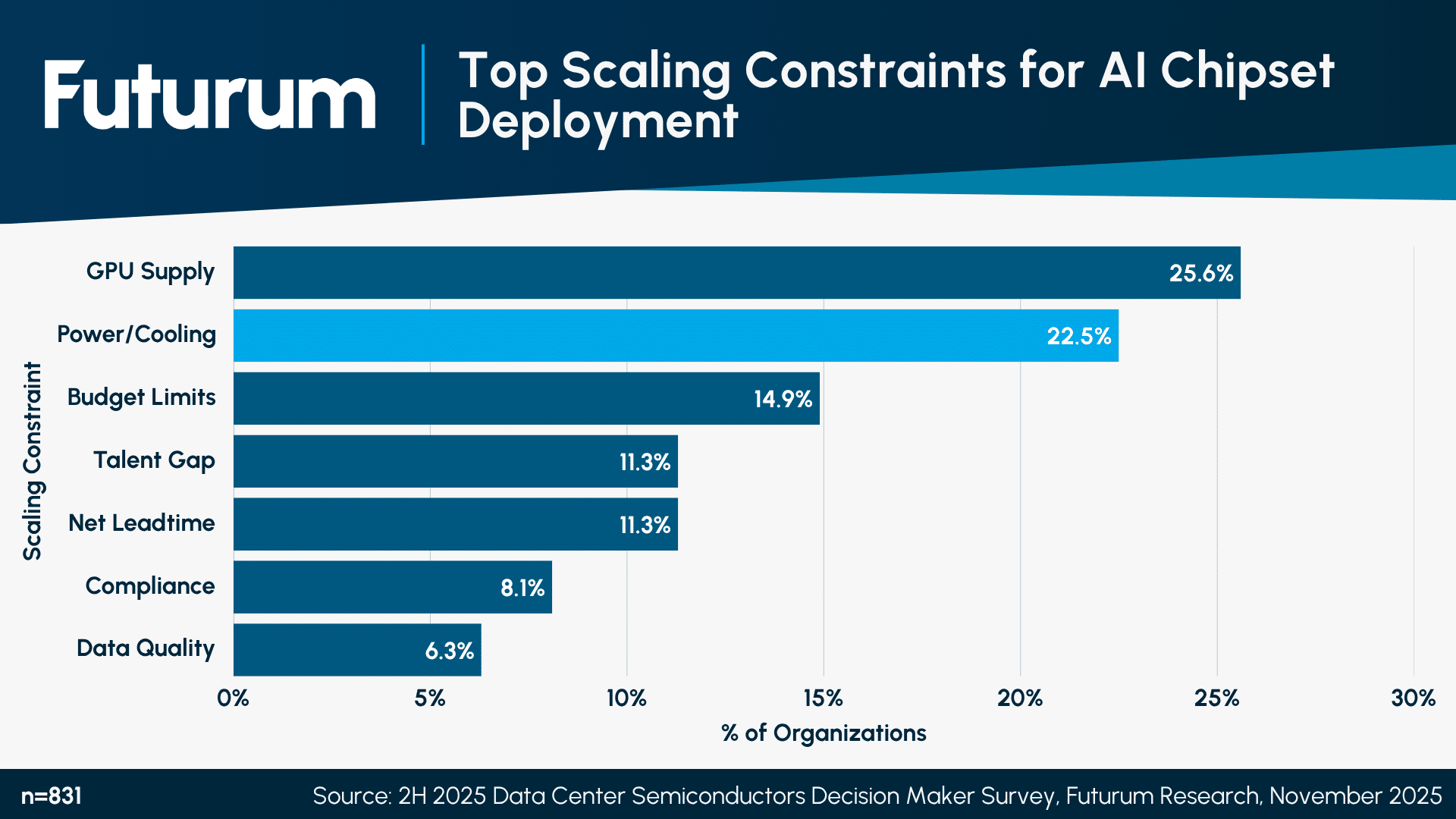
Futurum research has consistently identified power and cooling availability as the second-largest constraint on AI infrastructure scaling, cited by nearly 23% of compute decision-makers, trailing only accelerator and GPU supply shortages. These challenges are connected because liquid cooling saves power, yet can be too costly to justify at low rack densities. Ecolab is betting that its Cooling-as-a-Service model, now anchored by CoolIT’s hardware, can address that constraint more holistically than any pure-play thermal vendor or any incumbent server original equipment manufacturer (OEM) operating alone. The open question is whether a company rooted in industrial services can match the engineering velocity and customer intimacy that data center cooling demands in a market defined by rapid product cycles and hyperscaler expectations.
Figure 1: Top Scaling Constraints for AI Chipset Deployment
A Valuation That Prices in Infrastructure Scarcity
Ecolab is paying approximately $4.75 billion for a business generating roughly $550 million in NTM revenue, implying a valuation of 29x estimated adjusted Next Twelve Months EBITDA and 24x estimated 2027 adjusted EBITDA. These multiples are elevated for industrial companies, reflecting the premium the market is assigning to pure-play liquid-cooling exposure amid accelerating demand from hyperscalers and colocation operators. CoolIT’s high-growth, high-margin profile, combined with its custom-designed solutions for leading AI chip developers such as NVIDIA and AMD, positions it among a small number of scaled, independent cooling platforms available for acquisition.
The transaction will be financed entirely with new debt, pushing Ecolab’s pro forma net debt to approximately 3x adjusted EBITDA at close, with management targeting a return to 2x leverage within two years. For Ecolab, the deal is accretive to organic sales growth immediately but not to adjusted diluted earnings per share (EPS) until 2028, creating near-term earnings dilution that investors will scrutinize. The valuation bet only pays off if CoolIT’s revenue trajectory holds in a market where cooling demand is rising in lockstep with AI infrastructure buildouts.
Converging the Fluid Lifecycle Into a Single Platform
The strategic rationale for this acquisition extends beyond hardware acquisition into what Ecolab frames as an end-to-end fluid management and cooling platform. CoolIT brings the anchor thermal technologies — CDUs, cold plates, liquid loops, and rack manifolds — while Ecolab contributes water treatment, chemical management, digital monitoring, and global field service capabilities. The combination is designed to create a Cooling-as-a-Service offering that spans the entire fluid lifecycle in a data center, from chip-level thermal interfaces to facility-level water loops.
This convergence is notable because liquid cooling, unlike air cooling, introduces operational variables that traditional cooling hardware vendors have not historically managed. Ecolab’s existing presence across more than 1,000 data centers, primarily in water treatment and facility services, provides a distribution and customer access layer that CoolIT lacked as a standalone entity. The question is whether hyperscalers and colocation operators will value an integrated fluid platform enough to consolidate their cooling procurement with a single vendor, or whether they will continue to source hardware, chemistry, and monitoring from separate specialized providers.
Competitive Dynamics in a Fragmenting Cooling Market
The data center liquid cooling market is decades old but remains highly fragmented, with established infrastructure vendors such as Vertiv, Schneider Electric, and Mitsubishi competing alongside server OEMs such as Lenovo, HPE, Dell, and Supermicro, each of which has invested in proprietary direct liquid cooling (DLC) solutions. Ecolab’s entry via CoolIT introduces a unique competitive profile: a services-led acquirer with deep operational relationships but no server or infrastructure hardware heritage. This move may prompt other industrial or facilities management companies to pursue similar acquisitions, accelerating consolidation in a market where independent cooling specialists such as LiquidStack, Submer, and Asperitas have attracted venture capital and private equity interest.
CoolIT’s existing alliances with NVIDIA and AMD for custom cold plate designs, along with its partnership with HPE for high-performance computing (HPC) systems, give Ecolab immediate credibility in chip-level thermal design. However, Ecolab will need to demonstrate that it can maintain and deepen these engineering partnerships within a corporate structure fundamentally oriented toward recurring services rather than hardware innovation. The deal reshapes the competitive landscape, but it also raises the stakes for Ecolab to prove that a services-first company can keep pace with a hardware-driven market.
Execution Risk in a Hyperscaler-Driven Market
Ecolab’s existing data center business has been built on water treatment and facility management contracts that are operationally important but rarely mission-critical to compute performance. Acquiring CoolIT elevates Ecolab’s role to the thermal management layer, where product failures or performance shortfalls can directly affect server uptime, chip reliability, and workload throughput. Hyperscalers and colocation operators evaluate cooling vendors against stringent engineering, manufacturing, and supply chain criteria that differ substantially from the procurement frameworks applied to water and chemistry services.
CoolIT’s manufacturing and supply chain capabilities, including its recent capacity expansion to support the NVIDIA Blackwell platform ramp, will need to scale under Ecolab’s ownership without disrupting the product development cadence that large customers depend on. The integration challenge is compounded by the cultural distance between a global industrial services company and a pure-play technology hardware firm, where engineering talent retention and product roadmap continuity are existential concerns. If Ecolab can preserve CoolIT’s engineering autonomy while partnering with NVIDIA on its data center design roadmap, the combined entity could occupy a defensible position in the data center cooling supply chain. If NVIDIA pursues vertical integration of the liquid-cooling value chain, the premium it pays will be difficult to justify.
See the complete press release on Ecolab’s website.
Disclosure: Futurum is a research and advisory firm that engages or has engaged in research, analysis, and advisory services with many technology companies, including those mentioned in this article. The author does not hold any equity positions with any company mentioned in this article.
Analysis and opinions expressed herein are specific to the analyst individually and data and other information that might have been provided for validation, not those of Futurum as a whole.
Other Insights from Futurum:
Can AMD Strengthen Both Logic and Memory Supply Chains With Samsung?
Will Supermicro’s Legal Crisis Shift Server Market Share to New Dell and HPE GPU Platforms?
Mistral Forge Takes Aim at RAG. But Who Actually Needs Custom Models?
Author Information

Alex is Vice President & Practice Lead, Ecosystems, Channels, & Marketplaces at the Futurum Group. He is responsible for establishing and maintaining the Channels Research program as part of the overall Futurum GTM and Channels Practice. This includes overseeing the channel data rollout in the Futurum Intelligence Platform, primary research activities such as research boards and surveys, delivering thought-leading research reports, and advising clients on their indirect go-to-market strategies. Alex also supports the overall operations of the Futurum Research Business Unit, including P&L segmentation, sales and marketing alignment, and budget planning.
Prior to joining Futurum, Alex was VP of Channels & Enterprise Research at Canalys where he led a multi-million dollar research organization with more than 20 analysts. He played an integral role in helping the Canalys research organization migrate into Omdia after having been acquired in 2023. He is an accomplished research leader, as well as an expert in indirect go-to-market strategies. He has delivered numerous keynotes at partner-facing conferences.
Alex is based in Portland, Oregon, but has lived in numerous places, including California, Canada, Saudi Arabia, Thailand, and the UK. He has a Bachelor in Commerce and Finance Major from Dalhousie University, Halifax Canada.

Brendan is Research Director, Semiconductors, Supply Chain, and Emerging Tech. He advises clients on strategic initiatives and leads the Futurum Semiconductors Practice. He is an experienced tech industry analyst who has guided tech leaders in identifying market opportunities spanning edge processors, generative AI applications, and hyperscale data centers.
Before joining Futurum, Brendan consulted with global AI leaders and served as a Senior Analyst in Emerging Technology Research at PitchBook. At PitchBook, he developed market intelligence tools for AI, highlighted by one of the industry’s most comprehensive AI semiconductor market landscapes encompassing both public and private companies. He has advised Fortune 100 tech giants, growth-stage innovators, global investors, and leading market research firms. Before PitchBook, he led research teams in tech investment banking and market research.
Brendan is based in Seattle, Washington. He has a Bachelor of Arts Degree from Amherst College.