Analyst(s): Brad Shimmin
Publication Date: June 3, 2026
CEO Sridhar Ramaswamy framed Snowflake Summit 2026 around a single thesis: the era of the Snowflake agentic enterprise. The success of this vision rests entirely on four underlying infrastructure announcements—Cortex Sense, Iceberg v3, Snowflake Datastream, and Adaptive Compute—that create a closed-loop architecture for real-time action.
What is Covered in This Article:
- Snowflake’s four most consequential infrastructure announcements at Summit 2026 — Cortex Sense and Horizon Context, Iceberg v3 with Polaris bi-directional writes, Snowflake Datastream, and Adaptive Compute — and the closed-loop logic connecting them.
- Why Snowflake Intelligence and Cortex Code (CoCo) represent a genuine rethinking of how enterprise work gets done, and why that vision rests entirely on the infrastructure stack beneath it.
- What Iceberg v3 reaching general availability with bi-directional writes actually means for enterprise data architecture and the competitive dynamic with Databricks and the hyperscalers.
- The structural tension in building a Snowflake agentic enterprise layer atop three clouds that are simultaneously partner, host, and rival.
- What enterprise architects should track as these capabilities move from private preview to general availability across the rest of 2026.
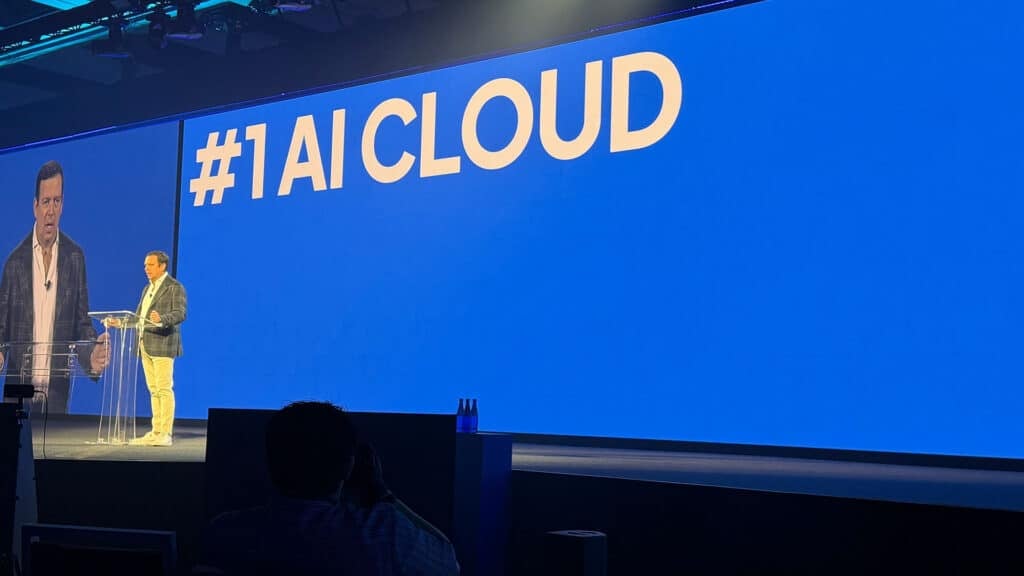
The Event—Major Themes & Vendor Moves: Snowflake Summit 2026 drew roughly 20,000 customers, 200 partners, 700 speakers, and 500 sessions to a show floor that felt less like a data warehouse user conference and more like a declaration of platform identity. CEO Sridhar Ramaswamy organized his keynote around a single thesis carried by three go-to-market phrases — “Turning Insight into Action,” “Make AI Real for Your Business,” and a recurring insistence that this is the era of the agentic enterprise. The framing was deliberate. Snowflake is no longer content to be described as the place your data lands.
That ambition arrived with a tidy four-part model for what an agentic enterprise actually requires: unified enterprise data, AI models, the enterprise applications where work lives, and an agent control plane to coordinate the whole arrangement. The headline product moments mapped neatly onto it. Snowflake positioned Snowflake Intelligence as a personal work agent for knowledge workers, pulling context from Salesforce, Microsoft 365, Slack, and Google Workspace through MCP connections. Snowflake pitched Cortex Code — affectionately branded CoCo — as an agentic coding and data engineering partner capable of compressing migration timelines from months to days. The company also announced its intent to acquire an MCP-focused vendor to bring that connectivity in-house. Commercially, leadership reaffirmed guidance north of $5.5 billion in revenue for the fiscal year and pointed to a freshly inked $6 billion committed-spend agreement with AWS.
The agents earned the standing ovations. But the announcements that will determine whether any of this works at one layer down. Four infrastructure moves — Cortex Sense, Iceberg v3 with Polaris bi-directional writes, Snowflake Datastream, and Adaptive Compute — quietly tell a single architectural story: data gets opened to outside engines, streamed in real time, automatically interpreted by AI, and run without manual tuning. That closed loop, not the chatbots, is the real news.
Snowflake Summit 2026: Four Infrastructure Bets That Determine Whether the Agentic Enterprise Delivers
Analyst Take: For years, Snowflake has been described, sometimes unkindly, as a cloud data warehouse that wishes it were a platform. At Summit 2026, the wish became explicit and specific. Yet the credibility of the Snowflake agentic enterprise vision lives almost entirely in four infrastructure announcements that collectively received a fraction of the stage time the agents enjoyed. That imbalance is worth correcting, because the structural problem these announcements address is the one most likely to sink an AI program. According to Futurum’s 1H 2026 Data Intelligence, Analytics, and Infrastructure Decision Maker Survey, MLOps complexity and integration difficulties remain the two leading documented causes of AI project failure, and that pattern has held flat year over year. These are architectural problems, not budget or model problems. No frontier model release fixes them. A coherent infrastructure stack might.
Cortex Sense and Horizon Context — The Two Layers That Make Agents Stop Guessing
Every enterprise that has tried to deploy agents has hit the same wall. The models are certainly capable. But they simply do not understand the full expanse of the typical enterprise data estate. What does revenue mean across 47 dashboards? Which tables are stale? How does the customer schema relate to the billing schema? Snowflake’s answer is not one layer but two, announced in tandem today: Horizon Context defines and governs the truth; Cortex Sense makes that truth immediately consumable by agents.
Horizon Context, part of the broader Horizon Catalog, functions as the foundational semantic and governance layer. It provides the context layer for AI and BI, ensuring data has the same meaning everywhere and AI-driven decisions are reliable. Traditional semantic layers live apart from the data itself, making it difficult to maintain consistent definitions across systems. This is one of the core reasons AI projects stall between proof of concept and production.
Horizon Context attacks that issue directly with three capabilities:
- It collects trusted business context across databases, data lakes, and BI tools into one shared foundation
- It maintains that context through Semantic Studio (define shared business logic without SQL) and Semantic View Autopilot (automatically creates and refines semantic views over time)
- And it extends trusted definitions to external AI agents, BI tools, and the broader ecosystem via the Open Semantic Interchange (OSI) standard — an explicit play for vendor neutrality.
During the show, Snowflake demonstrated how its customer, BlackRock, is already using Horizon Context to ensure AI operates on a shared definition of enterprise truth, calling it essential for “delivering accurate insights and managing risk across global markets.”
Cortex Sense sits on top of this foundation, on the agent side. It scans the data estate and automatically transforms raw metadata across thousands of tables into a global ontology and skills layer that every agent — CoWork (formerly Snowflake Intelligence), CoCo, and Cortex Agents — shares from day one. No hand-curated ontologies, no manual setup.
Where Horizon Context is the governed system of record for what data means, Cortex Sense is the agent-facing delivery mechanism that auto-builds context into a form agents consume immediately, delivering what Snowflake claims is 3.5x better performance than Claude Code paired with MCP alone. To illustrate, Snowflake showed attendees how companies can use this approach to build production-grade agents in days rather than weeks. The company also discussed prebuilt finance and sales plugins that bundle skills, business logic, and MCP connectors. Notably, Cortex Sense ships included with all Cortex AI products rather than as an upsell.
Why the architectural split? Horizon Context is where humans and governance teams curate, define, and extend business semantics. It functions as a durable, auditable, and explicitly designed for cross-vendor portability via OSI. Conversely, Cortex Sense is where agents automatically ingest that context and operationalize it without human intervention. Together, they form a two-stage pipeline where companies can govern once and deploy everywhere.
This philosophy lands squarely on a real budget line. Futurum’s 1H 2026 Data Intelligence, Analytics, & Infrastructure Market Sizing & Five-Year Forecast Report projects that this semantic layer sub-segment will grow at 19% during 2026 and accelerate toward 30% by 2031, with a large share of surveyed organizations planning to increase semantic layer spending specifically to tame AI accuracy and hallucination risk. Snowflake is now competing for that money from both directions: Horizon Context targeting the traditional semantic-layer buyer (the data governance team) and Cortex Sense targeting the AI/agent buyer (the application team). The value Snowflake espouses is that neither requires the manual labor traditionally associated with building and maintaining these systems.
Still, honest caveats remain. Cortex Sense is still in private preview, so the company’s stated 3.5x figure is unproven against the genuinely messy, undocumented, historically accumulated data estates that characterize most real enterprise environments. Horizon Context’s Semantic View Autopilot promises automatic maintenance, but “automatic” in the context of enterprise semantics has historically been a word that precedes disappointment. And the OSI standard, while philosophically sound, will only matter if it achieves broad ecosystem adoption. This is a political as much as a technical challenge. The company’s ambition is sound, and the two-layer architecture is more intellectually coherent than a single product trying to be both governance layer and agent runtime. The execution is the as-yet-unanswered question.
Iceberg v3 and Polaris — Opening the Garden, With Governance Intact
This one is generally available today, not a roadmap promise. External engines — Spark, Trino, any Iceberg-compatible compute — can now write back to Snowflake-managed tables through open, standards-based access controls, with governance applied and zero data duplication. Affirm migrated thousands of financial tables with no downtime; Samsung Ads cut processing costs. Polaris is the governance wrapper that makes that openness operationally safe, which matters enormously for regulated industries where open interoperability and enterprise access control must coexist rather than compete. This is Snowflake’s clearest answer yet to the open lakehouse challenge from Databricks, and it arrives as shipping capability rather than a strategy slide. Read that way, Snowflake’s embrace of open writes tracks a durable enterprise preference — not a concession wrung out by a competitor. Analytical investment and format portability are now interlinked demands, and organizations forced to choose between an open lake and a governed platform tend to choose neither.
Datastream and Adaptive Compute — Collapsing Complexity Inward
Snowflake Datastream, in private preview, is a fully managed, Kafka-compatible streaming service built natively into the platform. Existing Kafka producers connect with zero code changes, and data flows into Snowflake tables with governance applied on arrival. The intent is unmistakable — fold the streaming layer into the data platform and treat what Snowflake characterizes as a $128 billion market as fair game. That is a direct challenge to Confluent’s standalone position. Adaptive Compute, slated for GA soon, determines the optimal mix of compute and software resources in real time, eliminating warehouse sizing and manual tuning entirely. The finance team that has long struggled to model and predict Snowflake consumption is the real beneficiary here, far more than the data engineer who already knows how to size a warehouse. Together, these two address the two most stubborn adoption frictions in the category: integration complexity and cost unpredictability.
The Platform-Above-a-Platform Problem
All of this places Snowflake in direct architectural competition with Databricks on one axis and the three hyperscalers on another, even as roughly 70% of its business runs on AWS, and a fresh $6 billion AWS commitment underscores that dependency. The tension is real: the same clouds supplying Snowflake’s compute substrate are building full-stack AI systems from inference silicon to chat interface. Differentiation here has to be continuous rather than positional. Ramaswamy frames multi-cloud as a deliberate product strategy rather than the residue of sequenced expansion, and Christian Kleinerman went so far as to claim Snowflake’s Microsoft Fabric integration outperforms Fabric’s integration with its own native tooling. The counterargument to the vulnerability is the instinct visible across all four announcements: simplify what hyperscalers make complex. That has worked for Snowflake in the past, and there’s reason to believe it will serve the company well in the future. Cortex Sense removes the expert ontology builder, Adaptive Compute removes the expert warehouse sizer, and Iceberg v3 removes the obligation to pick a single engine. Layered atop a tiered model economics philosophy — frontier models for planning, smaller and open-source models for routine classification and summarization — Snowflake retains genuine flexibility against closed-source model businesses. As Ramaswamy put it, no tech company should feel secure about its future, even the frontier labs.
What to Watch:
- Cortex Sense at real enterprise scale. The automated ontology claim is architecturally compelling, but the test is whether it survives contact with poorly documented, historically accreted data estates. Early private-preview case studies will be the first honest signal.
- Iceberg v3 ecosystem adoption and competitive response. Bi-directional writes reaching GA are meaningful, but the value hinges on Apache Iceberg deployments working together seamlessly. Watch how Databricks and the hyperscalers respond, and whether procurement calculus shifts.
- Datastream against entrenched Kafka. Kafka clusters are deeply embedded and migration inertia is real. Track whether organizations with complex streaming topologies find native integration worth the operational transition.
- The AWS concentration dynamic. With a sizable majority of all Snowflake businesses running on AWS and a $6 billion commitment in place — and no comparable Azure or Google Cloud deals announced — monitor whether multi-cloud balance holds in practice or whether commercial gravity creates asymmetric dependency across platforms.
- Readiness for agentic engineering. Ramaswamy’s picture of data professionals (and increasingly business “builders”) acting as technical leads for fleets of agents is the operating assumption beneath the whole vision. Watch whether the skills gap becomes the binding constraint that neither Cortex Sense nor CoCo can fully offset.
You can read more about the Snowflake open framework for interoperable enterprise data and AI on Snowflake’s website.
Disclosure: Futurum is a research and advisory firm that engages or has engaged in research, analysis, and advisory services with many technology companies, including those mentioned in this article. The author does not hold any equity positions with any company mentioned in this article.
Analysis and opinions expressed herein are specific to the analyst individually and data and other information that might have been provided for validation, not those of Futurum as a whole.
Other Insights From Futurum:
Can Databricks Out-Iceberg the Competition?
Author Information

Brad Shimmin is Vice President and Practice Lead, Data Intelligence, Analytics, & Infrastructure at Futurum. He provides strategic direction and market analysis to help organizations maximize their investments in data and analytics. Currently, Brad is focused on helping companies establish an AI-first data strategy.
With over 30 years of experience in enterprise IT and emerging technologies, Brad is a distinguished thought leader specializing in data, analytics, artificial intelligence, and enterprise software development. Consulting with Fortune 100 vendors, Brad specializes in industry thought leadership, worldwide market analysis, client development, and strategic advisory services.
Brad earned his Bachelor of Arts from Utah State University, where he graduated Magna Cum Laude. Brad lives in Longmeadow, MA, with his beautiful wife and far too many LEGO sets.