Analyst(s): Brendan Burke
Publication Date: August 13, 2026
Silicon Labs’ Q2 FY 2026 earnings show revenue, gross margin, and profitability all improving sequentially over Q1 FY 2026, extending the low-power wireless recovery that took hold earlier in the year. The more important signal sits beneath the print. The company is moving up-market from basic sensors toward complex, compute-heavy, and gateway-class designs built on its new 22nm Series 3 platform. With the pending Texas Instruments acquisition expected to close in the first half of 2027, the durability of that pivot now matters more to customers and investors than any single quarter of standalone results.
What Is Covered in This Article:
- Silicon Labs’ Q2 FY 2026 results compared with Q1 FY 2026
- Sequential margin expansion and operating leverage
- The Series 3 platform and the up-market strategy
- Multi-protocol connectivity and deliberate roadmap omissions
- The 22nm process move and edge machine learning
- Security positioning and PSA Level 4
- Outlook for Series 3 ahead of the TI close
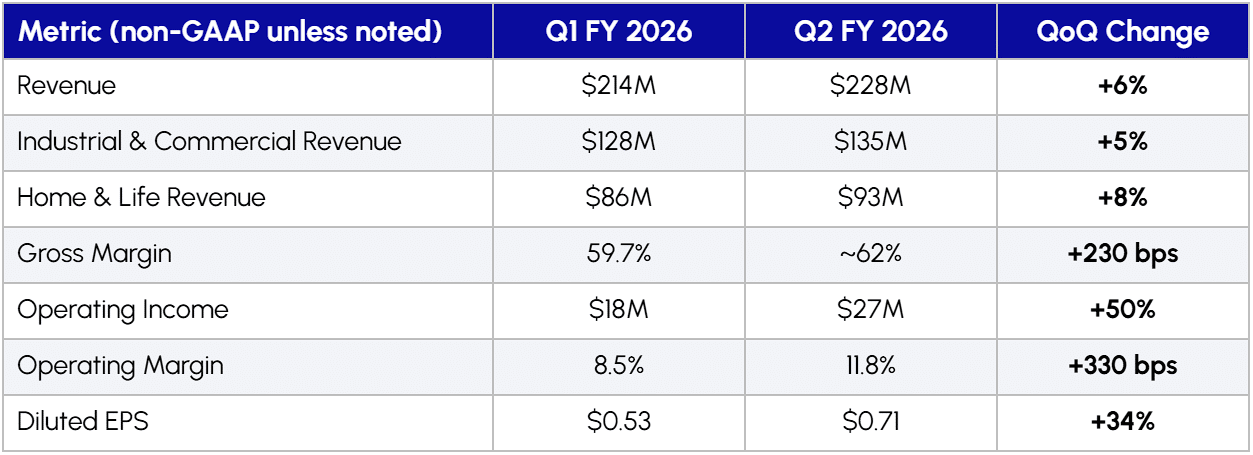
The News: Silicon Labs (NASDAQ: SLAB) reported Q2 FY 2026 revenue of $228 million, up 18% year over year (YoY) and up 6% sequentially from $214 million in Q1 FY 2026. Industrial & Commercial revenue was $135 million, up 23% YoY and up from $128 million in Q1. Home & Life revenue was $93 million, up 12% YoY and up from $86 million in Q1. Non-GAAP operating income rose to $27 million from $18 million in Q1, and non-GAAP operating margin expanded to 11.8% from 8.5%. Non-GAAP gross margin reached roughly 62%, about 230 basis points above the 59.7% posted in Q1. Non-GAAP diluted earnings per share was $0.71, up from $0.53 in Q1 and up 545% YoY. The company again reported that bookings and new orders accelerated while distributor and end-customer inventory declined.
“We delivered revenue of $228 million, continuing our strong sequential and year-over-year growth, a testament to the execution and dedication of the Silicon Labs team,” said Matt Johnson, President and Chief Executive Officer. “Overall profitability improved meaningfully in the quarter, demonstrating the operating leverage inherent in our model. Gross margin was nearly 62%, reflecting the value customers place on our industry-leading solutions.”
Silicon Labs continues to operate without formal guidance. The company suspended forward-looking guidance after agreeing in February 2026 to be acquired by Texas Instruments for $231 per share in an all-cash transaction valued at roughly $7.5 billion. Texas Instruments expects the deal to close in the first half of 2027, subject to regulatory approvals and Silicon Labs stockholder approval.
Silicon Labs Quarter-Over-Quarter Summary
Silicon Labs Q2 FY 2026: IoT Recovery Builds Momentum for Series 3 Platform
Analyst Take: Silicon Labs’ Q2 FY 2026 results show a business that has moved past the inventory correction that pressured the Internet of Things (IoT) semiconductor sector, and they show the first clean quarter of operating leverage in the recovery. The forward story, though, is about the platform. Series 2 remains the revenue engine, while the 22nm Series 3 family is the up-market bet that reframes what Texas Instruments is actually buying. The three tiers of evidence in this quarter, vendor claims, reported financials, and Futurum’s independent read, point in the same direction, with the usual caveat that design-win momentum converts to revenue slowly in these end markets.
Sequential Results Show the Operating Leverage in the Model
The clearest story in the quarter is sequential. Revenue grew about 6% over Q1 while non-GAAP operating income rose roughly 50%, from $18 million to $27 million. That gap between top-line and profit growth is the operating leverage management has pointed to, and it showed up in a non-GAAP gross margin near 62% and a non-GAAP operating margin of 11.8%, up from 8.5% a quarter earlier. Silicon Labs attributes the margin strength to product mix and the value customers place on its integrated solutions, which is vendor framing.
Futurum’s view is that the sequential improvement is more convincing than the YoY comparison because it is not flattered by the depressed 2025 base, and because bookings and inventory moved in the right direction at the same time. The company generated roughly 75% of first-half revenue through distributors, so declining channel inventory alongside accelerating orders points to genuine sell-through rather than channel refill. Demand visibility remains structurally limited because Silicon Labs sells largely on purchase orders rather than long-term commitments, and it builds some product to customer forecasts ahead of firm orders.
Series 3 Anchors the Move Up-Market
Silicon Labs’ strategic pivot is the move beyond basic sensors into complex electronics and gateway-class designs, and Series 3 is the vehicle. The company began shipping the first Series 3 SoCs, the SiMG301 and SiBG301 in the SiXG301 family, in late 2025, and it plans customer sampling of the battery-optimized SiXG302 family during 2026. Series 3 is not a single chip. It is a family of purpose-built devices, with multiprotocol “M” parts and Bluetooth-optimized “B” parts, each tailored to specific up-market applications. The platform’s defining architectural choice is the separation of application, wireless, and security workloads onto dedicated cores. That split gives the application processor headroom to run customer code and heavier compute without stalling on protocol-stack overhead, and it lets device makers scale communication and compute independently.
For gateways and hubs that must manage dense traffic, that modularity is the wedge, because it allows a wireless co-processor to handle connectivity while a host processor handles application logic. Futurum views Series 3 as part of the story that justifies the acquisition premium and may be waiting for integration with the TI portfolio, because it repositions Silicon Labs from a supplier of endpoint radios toward a platform for the intelligent edge.
Multi-Protocol Is the Strategy, and the Omissions Are Deliberate
Silicon Labs is concentrating on the seamless coexistence of Zigbee, Thread, Matter, and Bluetooth LE on a single device rather than chasing adjacent radio markets. The SiMG301 runs concurrent Zigbee, Bluetooth LE, and Matter over Thread, which is the interoperability profile that smart home and industrial mesh designs increasingly require. Just as telling is what the roadmap leaves out. There is no cellular, and ultra-wideband and NFC are off the table. Futurum reads these omissions as a decision to win the home and industrial mesh markets rather than compete in the crowded mobile and automotive connectivity space, where Silicon Labs would face far larger analog and RF incumbents.
Continued ecosystem work reinforces the focus, including support for Philips Hue devices over both Zigbee and Matter over Thread through concurrent multiprotocol. Silicon Labs also keeps extending Series 2 for ultra-low-power endpoints, including the recently detailed BG2B Bluetooth LE SoC that the company says will reach production hardware in FY 2027, so the near-term revenue engine and the up-market platform run in parallel.
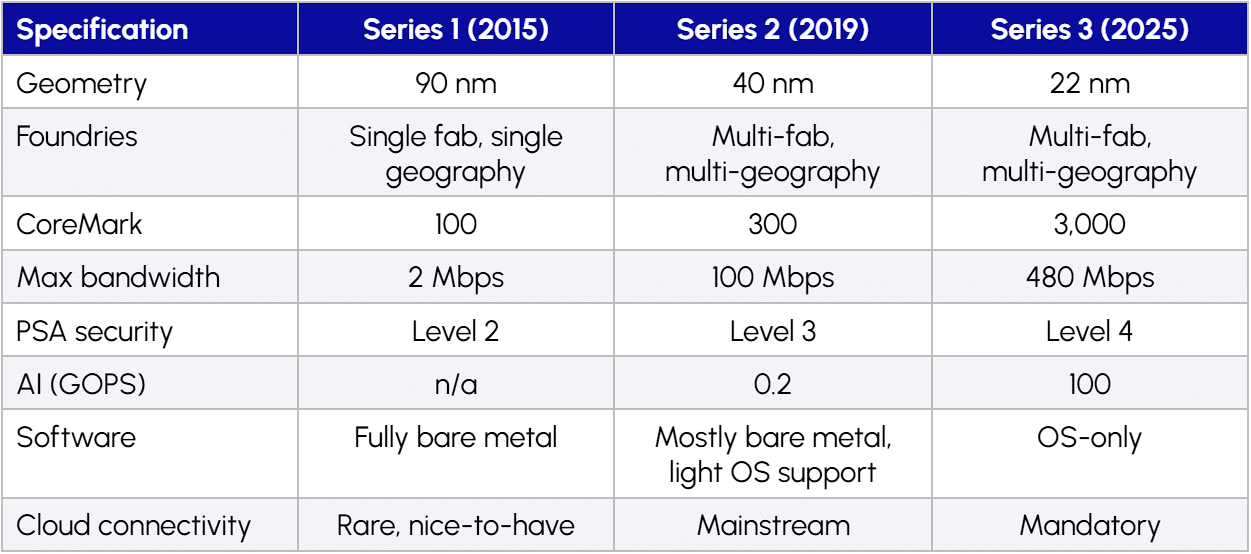
Series 2 Versus Series 3 at a Glance
The step from a 40nm process on Series 2 to 22nm on Series 3 is usually described as a density and power improvement, and it is both. The generational data shows the scale of the jump. CoreMark performance rises roughly 10x from Series 2 to Series 3, on-chip AI throughput moves from a fraction of a GOPS to triple digits, PSA security climbs from Level 3 to Level 4, and the software model shifts from mostly bare metal to OS-only. That last change matters because running local models and managing dense gateway traffic is an OS problem, not a bare metal one. Cloud connectivity also moves from mainstream to mandatory, which is consistent with the shift from endpoints to always-connected hubs.
SoC Specifications by Generation
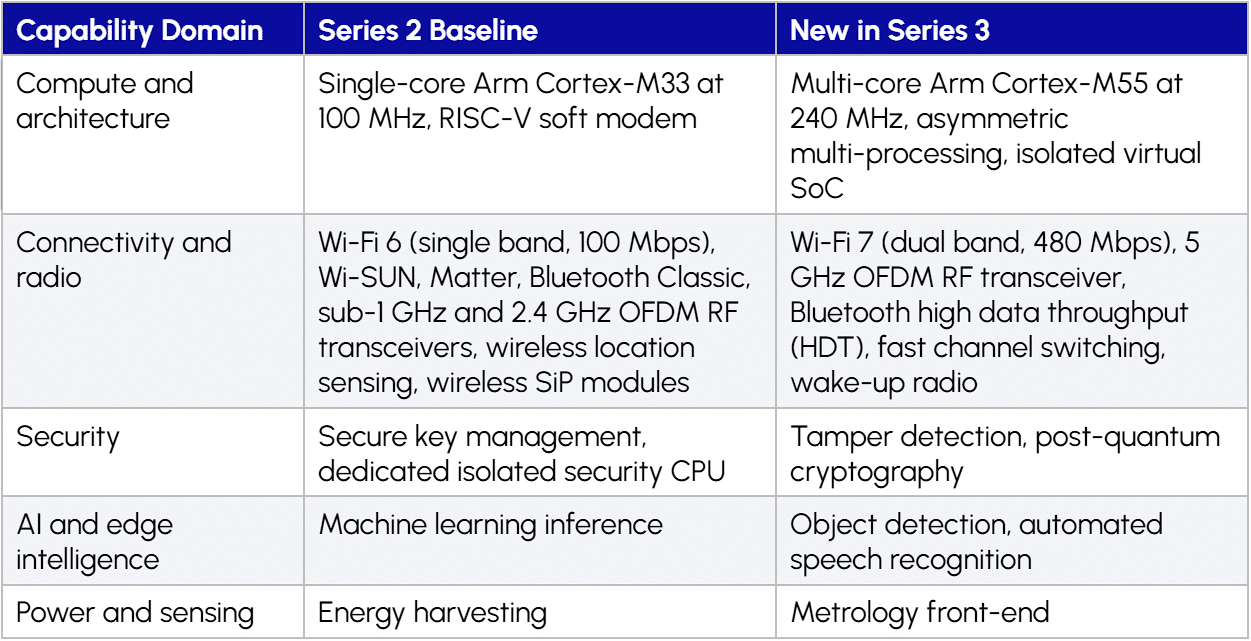
The capability map frames Series 3 as a superset of Series 2 rather than a replacement. Series 2 carries forward as the ultra-low-power baseline, and Series 3 layers on multi-core compute, higher-end radio, hardened security, and edge AI. The additions cluster in exactly the areas that support the up-market move into gateways, industrial hubs, and connected medical devices.
Series 3 vs. Series 2 Feature Comparison
Security Reflects a Half-Decade of Investment
Silicon Labs positions Series 3 security as best-in-class, and the specific proof point is PSA Certified Level 4 through its Secure Vault technology, which the company describes as a first for this class of device. Futurum views security as a credible claim because it compounds over time. The Secure Vault hardware and the surrounding certification work reflect five to six years of sustained investment rather than a feature bolted on for a single product cycle. As Silicon Labs moves up-market into line-powered gateways and industrial hubs, which present a larger and more persistent attack surface than battery endpoints, hardened security shifts from a differentiator to a gating requirement, and a credible security story is part of what lets the company command higher prices for Series 3.
Connected Healthcare and Matter Define the Up-Market Applications
The applications that best illustrate the pivot are regulated and reliability-sensitive. Silicon Labs is targeting continuous glucose monitoring and wearable diagnostics, where Series 3 can both monitor and run local analytics that trigger immediate actions such as automated medication delivery. Medical revenue reached a company record in Q2 and grew 78% YoY, up sharply from 21% YoY growth in Q1, which is early evidence that the healthcare push is already translating into revenue on Series 2. In the smart home, Silicon Labs is positioning Series 3 as the backbone for Matter-certified devices that handle local voice processing and presence detection without cloud latency. Futurum’s caution is that these markets carry long qualification cycles, often six months or more before purchasing and another six months or more before volume production, so the design-in activity visible now will convert to revenue over a multi-year window rather than in the next few quarters.
Outlook and Final Thoughts
Silicon Labs enters H2 FY 2026 with improving demand indicators, sequential margin expansion, and a design-win pipeline that management describes as running at record levels. The near-term revenue engine remains Series 2 and its ultra-low-power endpoints, while Series 3 is still early in its ramp, with the SiXG301 shipping and the battery-optimized SiXG302 sampling during 2026. Because industrial and medical qualification cycles are long, most of the Series 3 opportunities will show up as design wins now and revenue later, likely around and after the Texas Instruments close in the first half of 2027.
That timing is the crux of the story. Texas Instruments is not paying roughly $7.5 billion for a quarter of margin recovery. It is buying a low-power wireless franchise moving up-market into compute-heavy, secure, gateway-class designs, and pairing it with TI’s analog portfolio and owned 300mm manufacturing. If Silicon Labs sustains bookings momentum and converts its Series 3 pipeline through the interim period, it hands Texas Instruments a stronger and higher-value platform than the standalone financials suggest. The risk is execution and continuity through a long regulatory review, during which customers weigh integration uncertainty against the appeal of the roadmap.
See the full press release on Silicon Labs’ Q2 FY 2026 financial results on the company website.
Disclosure: Futurum is a research and advisory firm that engages or has engaged in research, analysis, and advisory services with many technology companies, including those mentioned in this article. The author does not hold any equity positions with any company mentioned in this article.
Analysis and opinions expressed herein are specific to the analyst individually and data and other information that might have been provided for validation, not those of Futurum as a whole.
Other Insights From Futurum:
Silicon Labs Q1 FY 2026: Industrial Demand and Design Wins Support Recovery
Texas Instruments Q1 FY 2026: Data Center and Industrial Demand Lift Outlook
Texas Instruments Buys Silicon Labs To Fuel Edge AI Scale
Author Information

Brendan is Research Director, Semiconductors, Supply Chain, and Emerging Tech. He advises clients on strategic initiatives and leads the Futurum Semiconductors Practice. He is an experienced tech industry analyst who has guided tech leaders in identifying market opportunities spanning edge processors, generative AI applications, and hyperscale data centers.
Before joining Futurum, Brendan consulted with global AI leaders and served as a Senior Analyst in Emerging Technology Research at PitchBook. At PitchBook, he developed market intelligence tools for AI, highlighted by one of the industry’s most comprehensive AI semiconductor market landscapes encompassing both public and private companies. He has advised Fortune 100 tech giants, growth-stage innovators, global investors, and leading market research firms. Before PitchBook, he led research teams in tech investment banking and market research.
Brendan is based in Seattle, Washington. He has a Bachelor of Arts Degree from Amherst College.