Analyst(s): Alastair Cooke
Publication Date: February 16, 2026
IBM has launched its next-generation FlashSystem portfolio, powered by agentic AI, marking a major leap toward autonomous storage management and cyber resilience. The new FlashSystem 5600, 7600, and 9600 models promise up to 90% reduction in manual storage administration and sub-minute ransomware detection, positioning IBM as a strategic AI partner for enterprises facing mounting data, compliance, and security challenges.
What is Covered in This Article:
- IBM’s integration of agentic AI into FlashSystem for autonomous storage management and security
- How FlashSystem.ai transforms storage from a static repository to an adaptive, intelligent platform
- Competitive implications for vendors like Dell Technologies, Pure Storage, and NetApp as AI-driven storage becomes table stakes
- The impact of real-time ransomware detection and compliance automation on enterprise risk postures
- What the new FlashCore Module means for performance, efficiency, and operational cost reduction
The News: On February 10, 2026, IBM introduced its latest FlashSystem portfolio, comprising the FlashSystem 5600, 7600, and 9600, each powered by agentic AI and the new fifth-generation FlashCore Module. These systems deliver up to 40% greater data efficiency, sub-minute ransomware detection, and up to 11.8 PBe of effective capacity in a 2U form factor. FlashSystem.ai, a suite of intelligent data services, acts as an AI co-administrator, automating management, compliance, and security tasks across the storage stack. IBM claims up to a 90% reduction in manual storage management effort and up to 57% in operational costs for the FlashSystem 9600 compared to the previous generation. The portfolio will be generally available on March 6, 2026.
IBM’s New FlashSystem Might Be the Blueprint for AI-Driven Storage Resilience
Analyst Take: IBM’s new FlashSystem portfolio exemplifies the convergence of AI and storage, moving beyond incremental improvements to deliver a fundamentally autonomous, resilient, and adaptive platform. As data volumes and cyber threats escalate, this launch sets a new bar for what enterprises should expect from storage: continuous optimization, explainable AI-driven operations, and proactive risk mitigation.
Agentic AI: From Storage Automation to Autonomous Operations
The introduction of FlashSystem.ai marks a strategic pivot for IBM, as storage shifts from a managed asset to an intelligent, self-improving layer within the IT stack. Unlike traditional automation, agentic AI enables the system to learn from tens of billions of telemetry points, adapt to workload behaviors in hours, and execute thousands of operational decisions daily without human intervention. This is especially relevant, as 76% of executives report scaling agentic AI to drive intelligent workflows across their organizations. For enterprise buyers, this means less time spent on routine administration and compliance documentation and more focus on strategic initiatives. IBM’s approach also raises the competitive bar for storage vendors such as Dell Technologies, Pure Storage, and NetApp, who must accelerate their AI-driven storage roadmaps or risk being perceived as lagging in autonomous operations.
Resilience and Security: Real-Time Ransomware Detection as a Differentiator
IBM’s new fifth-generation FlashCore Module is engineered to detect ransomware in under one minute, using hardware-accelerated analytics that operate on every I/O without impacting performance. With false positives reportedly kept below 1% and autonomous recovery actions at the hardware layer, IBM positions itself as a leader in storage-based cyber resilience. In a market where cyberattacks and compliance scrutiny are intensifying, such capabilities are no longer optional. The ability to cut audit and compliance documentation time in half, coupled with proactive anomaly detection, should appeal to heavily regulated sectors like financial services, healthcare, and government. This also puts pressure on competitors, such as Pure Storage’s Evergreen//One and Dell’s PowerStore, to match IBM’s blend of AI-driven threat detection, operational transparency, and explainable AI for compliance.
Efficiency and Scalability: Redefining the Economics of Enterprise Storage
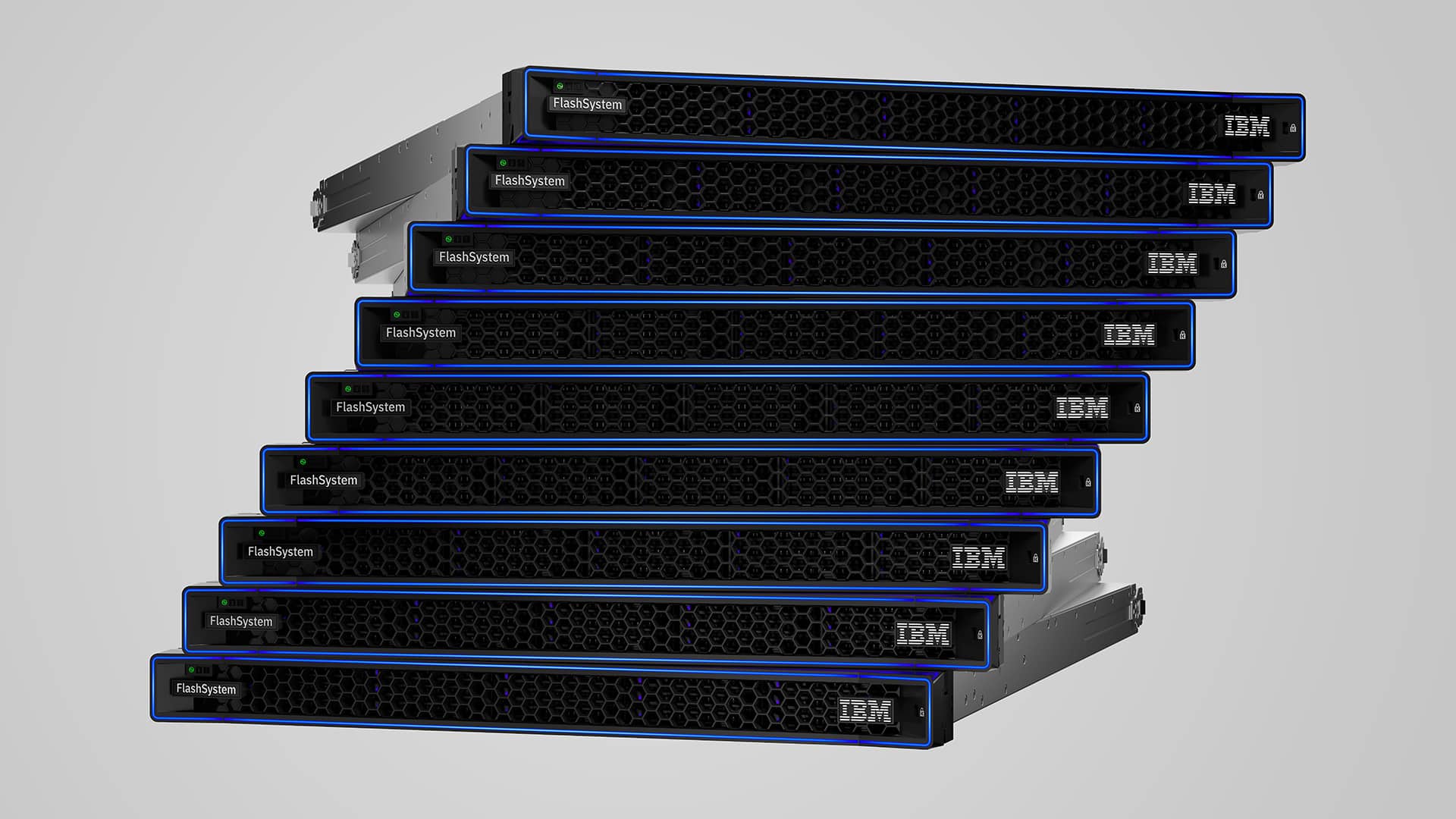
The FlashSystem 5600, 7600, and 9600 models set new benchmarks for storage density, performance, and cost efficiency. The 5600’s ultra-dense 1U design targets edge and remote deployments, while the 9600 delivers up to 11.8 PBe of effective capacity in a 2U form factor, reducing operational costs by up to 57% compared to the previous generation. Data reduction ratios of 30–75% and the ability to consolidate workloads across third-party arrays further enhance the value proposition. For enterprises grappling with data sprawl and rising TCO, these advances support both sustainability and digital transformation agendas. The inclusion of interactive LED bezels for physical state monitoring on the 7600 and 9600 also reflects IBM’s attention to operational usability, a differentiator in large-scale, multi-site environments.
What to Watch:
- Adoption rates of FlashSystem.ai and measurable reductions in manual storage management effort among enterprise customers
- How competitors like Dell Technologies, Pure Storage, and NetApp respond with their own AI-driven storage automation and cyber resilience features
- Incidence and response times for ransomware and anomaly detection in real-world FlashSystem deployments, especially the “less than 1%” false positives.
- Uptake of FlashSystem 5600 in edge and remote office scenarios versus traditional midrange offerings
- Customer feedback on compliance automation and audit readiness improvements enabled by FlashSystem.ai
Read the full press release on IBM’s Newsroom.
Disclosure: Futurum is a research and advisory firm that engages or has engaged in research, analysis, and advisory services with many technology companies, including those mentioned in this article. The author does not hold any equity positions with any company mentioned in this article.
Analysis and opinions expressed herein are specific to the analyst individually and data and other information that might have been provided for validation, not those of Futurum as a whole.
Other insights from Futurum:
IBM Q4 FY 2025: Software and Z Cycle Lift Growth and FCF
Five Key Reasons Why Confluent Is Strategic To IBM
Is 2026 the Turning Point for Industrial-Scale Agentic AI?
Image Credit: IBM
Author Information
Alastair has made a twenty-year career out of helping people understand complex IT infrastructure and how to build solutions that fulfil business needs. Much of his career has included teaching official training courses for vendors, including HPE, VMware, and AWS. Alastair has written hundreds of analyst articles and papers exploring products and topics around on-premises infrastructure and virtualization and getting the most out of public cloud and hybrid infrastructure. Alastair has also been involved in community-driven, practitioner-led education through the vBrownBag podcast and the vBrownBag TechTalks.