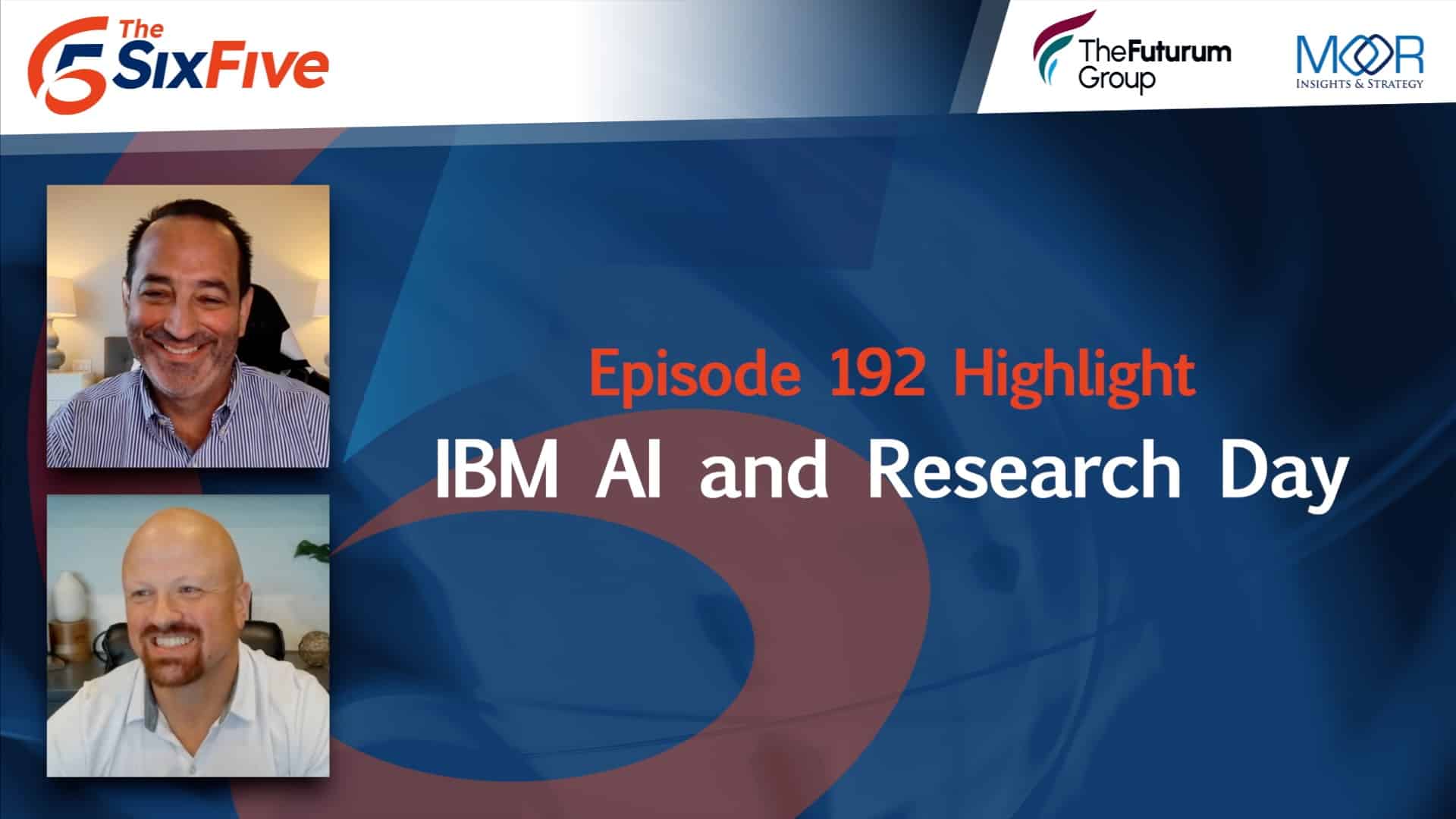
The Six Five team discusses IBM AI and Research Day.
If you are interested in watching the full episode you can check it out here.
Disclaimer: The Six Five Webcast is for information and entertainment purposes only. Over the course of this webcast, we may talk about companies that are publicly traded and we may even reference that fact and their equity share price, but please do not take anything that we say as a recommendation about what you should do with your investment dollars. We are not investment advisors and we ask that you do not treat us as such.
Transcript:
Patrick Moorhead: Dan, you and I attended IBM’s AI and Research Day in Yorktown, New York, and I don’t know, there might have been 20, 25 industry analysts there. Two L1s were there, Rob Thomas and Dario Gill who runs research. And obviously Rob runs the commercial side of the entire house. I have to say, I hate to be fan boyish, Dan, and I don’t applaud everything, but I think they absolutely knocked it out of the park for enterprise AI. And what I was most impressed about was their articulation of their client, the way that they see this playing out, what their client needs are, where they’re starting in the journey to solve all of this, and real customers. Okay? Now, that was the public side. We can’t talk about the embargoed or NDA side. They are going to make a lot of announcements coming up, and we were pre-briefed on that, but I want to stick to the public stuff.
First off, IBM is a company that AI was an adder to AI being the business. And I know a lot of people are talking like that, but I’m convinced that IBM turned the entire company upside down. Not when it happened, but when Arvin started, right? Arvin was very clear. He’s like, “This company is going to be a hybrid cloud and AI company.” And I remember thinking, okay, totally get … This was before generative AI popped on everybody’s radar. So I’m like hybrid cloud, I get, but AI for IBM? So to make a long story longer, they’ve made hundreds and millions of dollars of investment. They’ve made 500 million venture fund for enterprise AI. They’ve gone GA, they were the first to GA, true GA, not fake GA as we see with multiple feature sets and multiple countries on the AI side, and then the data side and governance is coming up there.
But yeah, a really good explanation of all of that. And it was not like limited. It’s not, hey, this is in theory. This was we are working with clients to solve customer facing function and experience problems. HR, finance and supply chain, IT development and operations, core business operations, and then putting real numbers. Now, I haven’t tested these numbers. I haven’t talked to these customers on numbers, haven’t run this in my lab or your lab, but the output is staggering. And by the way, it’s something you and I have holistically believed in the opportunity, but reducing costs per invoice by up to 50%, reducing application support tickets by 70%, automating answers with 95% accuracy in customer service, reducing content creation costs up to 40%. This is classic IBM focusing on the enterprise. And I’ve got to tell you, the one thing I have to learn more about Dan is when it comes to Watson, which I liked Rob Thomas’s explanation of it being the IDE for AI was a good one, and it said they’re the only one that can do on-prem and public cloud.
I need to learn, I need to research more about on-prem and how they’re deploying this with companies like Dell, not only in data centers, but also on the edge. It’s the end-to-end stack, Dan, that I’ve been looking for forever. VMware broached it with private AI, and I was all excited about this, but I just didn’t get enough details out of it. And I think IBM has definitely figured out different elements. I need to do more research on it, which by the way, could put IBM again in another leadership zone of itself being end to end.
Daniel Newman: Yeah, I mean, look, first of all, this was a great event. Some of the best slideware I’ve seen, and if you want to check out some more of that, at least the publicly available parts of it posted on my Twitter. X, do I have to call it X? Is that a thing?
Patrick Moorhead: No, I rarely call it X. You don’t have to either. I mean, bringing X back.
Daniel Newman: But look, I thought there was some great one-liners and quips, the nutrition label for AI, governance. I think right now we’re all about building, we’re all about productivity and all about efficiency, but governance is going to be where a lot of the war’s won for companies that want to compete. And in the enterprise space, hearing about chief legal officers and basically being incredible roadblocks for companies implementing generative AI because trust, it’s trust, it’s safety, it’s privacy, there’s huge risk, get it wrong. And then of course, culture, the ability for companies to implement this in a way that upskills its personnel and concurrently takes advantage of value that can be created quickly. But Pat, I’ll tell you something else. This was probably some of the best material as it pertains to use case and customer value. So they had the consulting team come in.
I mean, Rob Thomas probably showed five or six slides of very specific in-depth work and what the returns are in areas like digital labor, in areas like supply chain, where you’re seeing 20, 30, 40% of incremental value improvements, whether that’s cost reductions, whether that’s productivity gains, doing the measurements, doing the testing, doing the validation. And to your point, I know we haven’t done this testing yet, but the methodology seemed to be comprehensive and it seemed to be well-thought-out. And now the question I’m asking is, well, if the numbers are so good, why doesn’t everyone run down the path immediately? And I asked that question, I think it’ll-
Patrick Moorhead: Yeah, it was a good question.
Daniel Newman: It was on the record and it’ll come back out. But the answer in short was it’s a slow move to get culture. It’s a slow move to get budget. And despite the fact that we think that once it’s obvious everyone would do it, it still has some selling to do inside of companies and the allocation of budget. I like those numbers. The six to 16% of spend roughly of, sorry, revenue is spent on it. I think AI is going to force that number upward more substantially if companies want to be able to compete with the capabilities of generative AI.
But there was just a ton of depth there, Pat, and some of the best presentations, unfortunately, we can’t really talk about some of the vision around Quantum. But I think broadly we can say IBM showed a very impressive vision there, and I look forward to that being. I think they have a research day that’ll come up public on quantum, so you’ll all have to wait on that. But Pat, I thought it was a great for analysts event where they really did a good job, maybe the best job I’ve seen IBM do with business value and use case, meaning it wasn’t just … Especially at a research event. For me, usually after the first segment, I get glossy eyed at some of these when they start getting too into the technical weeds.
But even just showing some of the code capabilities, just some of the stuff it can do to enable someone to take code and update it to different code using its generative capabilities, all grounded, all governed. So I’m not going to say fanboy, but I’m going to say a significant uptick in the quality of an event like this. And by the way, great stable of analysts. They kept the numbers small, they kept the executive interactions high and look for our Six Five episode to come out because we got the exclusive with the two L1s that were there. And so you’ll be hearing what could be shared more in depth from Darrio and Rob Thomas probably in the next couple of days, right?
Patrick Moorhead: Yep, absolutely. Great analysis, Dan.
Daniel Newman: Rock and roll.
Patrick Moorhead: It really is IBM’s to lose here, right? They’ve got to continue executing, they have to continue doing, first, sales and marketing is paramount. Some of the comments I can’t share that Rob used, I’ve loved. I mean, there is a cultural shift here at IBM and I know everybody talks about it, but this is reality. I can feel it. I can tell you as an analyst that it is real. Arvin is just a completely different leader and leads in a different way. His team, he’s brought in an all-star team to make it happen.
Author Information

Daniel is the CEO of The Futurum Group. Living his life at the intersection of people and technology, Daniel works with the world’s largest technology brands exploring Digital Transformation and how it is influencing the enterprise.
From the leading edge of AI to global technology policy, Daniel makes the connections between business, people and tech that are required for companies to benefit most from their technology investments. Daniel is a top 5 globally ranked industry analyst and his ideas are regularly cited or shared in television appearances by CNBC, Bloomberg, Wall Street Journal and hundreds of other sites around the world.
A 7x Best-Selling Author including his most recent book “Human/Machine.” Daniel is also a Forbes and MarketWatch (Dow Jones) contributor.
An MBA and Former Graduate Adjunct Faculty, Daniel is an Austin Texas transplant after 40 years in Chicago. His speaking takes him around the world each year as he shares his vision of the role technology will play in our future.