The News: Honeywell recently introduced Honeywell Smart Pay, a payments software system that will accept contactless mobile payments anywhere a business operates. The new software works with its two popular processing terminals, CT30 XP and CT40 XP. Read the full Press Release from Honeywell here.
Honeywell Enters Payments Arena with Honeywell Smart Pay, Turning Its Mobile Computers into Processing Terminals
Analyst Take: Honeywell’s newest product is a move by the company to enter into the payments arena, a fast-growing sector and one that makes perfect sense for the rapidly growing and diversifying technology company.
Honeywell Smart Pay is designed to work with two of Honeywell’s existing processing terminals called CT30XP and CT40. These are handy mobile devices that allow businesses of various sizes to close sales, whether on the field or in the store, and which are already in use in hundreds of thousands of locations.
While not in innovative solution in and of itself in the payments arena, Honeywell Smart Pay set out with the intention of differentiating itself from its rivals. Honeywell’s Smart Pay software is designed to help customers:
- Use equipment they already have
- Eliminate the use of card readers and encryption keys, thereby helping customers reduce operations cost
- Accept chip-embedded credit cards
- Improve mobility by getting rid of extra accessories
- Allow service employees to process payments anytime, anywhere
In other words, when today’s customers expect ease of checkout — and mobile pay is at the the veritable definition of ease for most consumers — Honeywell’s Smart Pay software is designed to make it easier and cheaper for businesses to both meet customer expectations and get into the mobile payments game in a more affordable manner than ripping and replacing existing POS checkout systems.
The Mobile Payment Space is Big, and Getting Bigger
A recent study from Pew Research Center on the cashless economy indicated that the number of Americans opting for mobile or credit card payments increased by double digits in less than 10 years. In fact, 41% of the respondents in the Pew study shared they did not use cash for any of their purchases over the course of a two week period. That completely jives with my own personal experience. These days, I carry my phone, my ID, and one credit card. I expect to be able to use my phone or my watch to make cashless, touchless purchases wherever I go and find it incredibly annoying when I’m not able to do that. Sound familiar? If so, you are most definitely not alone. Here’s a look at the Pew data —
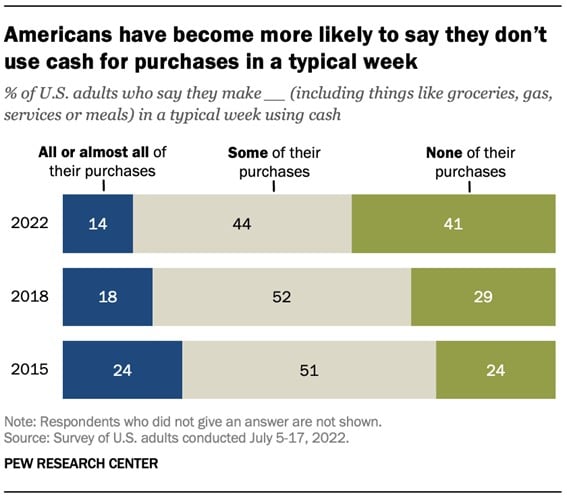
I see this as a timely move on the part of Honeywell. And while you might not naturally think of the company beyond its well-known work in aerospace, industrial manufacturing, building technologies, and safety solutions arenas, the company has a wealth of products designed for the retail sector, and this payments solution is a savvy addition to the company’s already broad range of offerings as part of its Honeywell Safety and Productivity Solutions (SPS) suite of offerings.
Speaking of the payments sector, the market opportunity for digital payments is growing at a rapid pace. According to Fortune Business Insights, the market size for digital payments could hit a compound annual growth rate (CAGR) of 24.4% by 2026, at which time the market size is expected to be worth USD $18.89 Trillion in 2026.
For merchants, mobile point of sale accessories can be expensive, often requiring considerable upfront investment. Honeywell’s Smart Pay software is designed to eliminate these costs, but also keep customer data security as foundational to the mobile payments process. Designed in collaboration with Amadis, a leading payment software and consulting provider, Honeywell Smart Pay’s software solution was designed to provide a software based secure platform that can be deployed on traditional payment terminals, reducing costs and providing the security compliance required in today’s retail environments.
Disclosure: Futurum Research is a research and advisory firm that engages or has engaged in research, analysis, and advisory services with many technology companies, including those mentioned in this article. The author does not hold any equity positions with any company mentioned in this article.
Analysis and opinions expressed herein are specific to the analyst individually and data and other information that might have been provided for validation, not those of Futurum Research as a whole.
Other insights from Futurum Research:
Honeywell Revenue Hits $8.95B in Q3 2022, Up 6% from Q3 2021
Image Credit: PYMNTS.com
Author Information

Shelly Kramer is a serial entrepreneur with a technology-centric focus. She has worked alongside some of the world’s largest brands to embrace disruption and spur innovation, understand and address the realities of the connected customer, and help navigate the process of digital transformation.