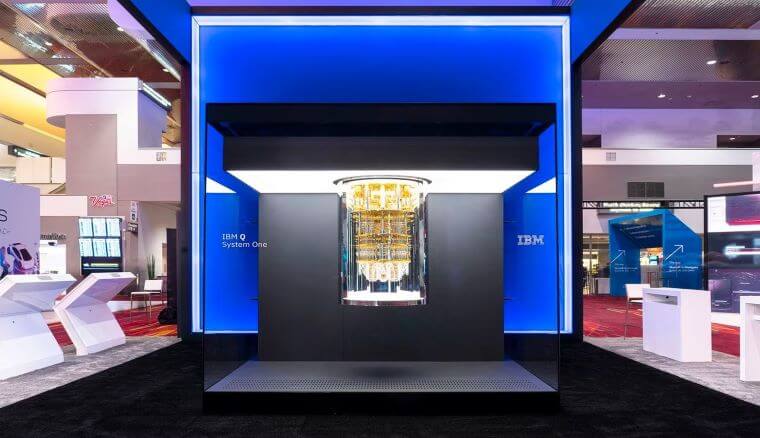
The News: A healthcare quantum computer that is being billed as the first onsite private sector IBM-managed quantum computer in the U.S. dedicated to solving healthcare challenges was unveiled March 20 by the Cleveland Clinic and its technology partner, IBM. The powerful machine aims to help the Cleveland Clinic accelerate discoveries across a wide range of biomedical fields. Read the full Press Release about the Cleveland Clinic’s new quantum computer on the IBM web site.
Healthcare Quantum Computer Debuts for Cleveland Clinic, IBM
Analyst Take: The healthcare quantum computer built by IBM for the Cleveland Clinic is a technological milestone for still-nascent quantum hardware that is coming slowly to fruition in the real world, far beyond labs. And as the Cleveland Clinic and IBM announce the system’s deployment after its construction began last October, this could be considered as the very beginning of quantum computing in the sciences and business.
Dubbed IBM Quantum System One, this powerful machine and other quantum computers to come are fueled by the laws of quantum mechanics to create massive computing capabilities that are not possible from today’s classical computers. And using this system along with new capabilities from IBM in AI, cloud computing, supercomputing, and other computing advancements, a broad and exciting new era of innovation and discovery in healthcare is being imagined and brought to life.
For the Cleveland Clinic, that is what makes this breakthrough so momentous – using the immense powers of quantum computing, the healthcare system will now be able to do intense research much more quickly, potentially delivering new treatments, medicines, and vaccines in months or years instead of decades. I believe these possibilities could be endless, which is exciting.
IBM Quantum System One, which was built at the Cleveland Clinic’s Main Campus, is also seen by healthcare researchers as a powerful tool that can help them finally resolve some of the most challenging computing science bottlenecks that have long stymied new treatments for aggressive and debilitating diseases including cancer, Alzheimer’s, and diabetes.
IBM’s Healthcare Quantum Computer is Part of 10-Year Partnership
Plans for a healthcare quantum computer for the Cleveland Clinic were first announced in March of 2021 when IBM and the Cleveland Clinic revealed the start of a 10-year partnership to fundamentally advance the pace of biomedical research using high-performance computing. The partnership, known formally as the Cleveland Clinic-IBM Discovery Accelerator, was developed to help reduce the 17 years that it typically takes for a scientific discovery in a research lab to become an approved test or therapy for patients.
The collaborative Discovery Accelerator at Cleveland Clinic also involves many other IBM high performance computing tools, including a Generative AI Toolkit for Scientific Discovery, a cloud-based RXN platform that combines AI models and direct control of robotic labs to foster the design and synthesis of new chemical compounds, and Deep Search from IBM Research, which is a next-generation AI tool for generating insight from large amounts of structured and unstructured technical literature.
The Cleveland Clinic-IBM partnership has already created several biomedical research projects that are using quantum computing and other IBM specialties for in-depth research that is generating massive amounts of research data, according to the partners.
Quantum computers process information in vastly accelerated new ways compared to classical computers, which promises significant scientific breakthroughs across the sciences. Today’s classical computers use informational units known as bits, which can be in only one of two states: 0 or 1, off or on, or false or true. Vastly more complex and powerful quantum computers use quantum bits, also called qubits, which can uniquely place information into a state of superposition, a principle of quantum mechanics that allows a qubit to exist in both states.
It is through the harnessing of these vast capabilities that quantum computing outperforms classic computers and drives heretofore unknown computing possibilities.
Healthcare Quantum and Its Promise
As I have followed the efforts and fruition of this Cleveland Clinic partnership over the last two years, I keep thinking about how the organizers of this work continue to talk about how the greatest promise of these efforts is they will dramatically accelerate the speed of today’s biomedical research.
“The current pace of scientific discovery is unacceptably slow, while our research needs are growing exponentially,” Lara Jehi, M.D., Cleveland Clinic’s chief research information officer, said in the press release. “We cannot afford to continue to spend a decade or more going from a research idea in a lab to therapies on the market. Quantum offers a future to transform this pace, particularly in drug discovery and machine learning.”
We hear this in many industries, that time to market must be reduced.
But that usually relates to widgets or packaged goods, vehicle or other material things.
Here, in the case of the Cleveland Clinic and IBM, they are talking about reducing the time it takes by using quantum computing to find medicines, vaccines, treatments and help for some of the most horrible human diseases and medical issues facing people around the world.
I believe that this first huge effort, this brave attempt by Cleveland Clinic and IBM to harness the immense power of quantum to help mankind, is a brilliant first step for quantum computing and one that could cement its legacy, importance, and influence for a wide variety of other uses in business and for consumers.
We will be watching these efforts carefully to see where this research and work proceed from here.
Disclosure: Futurum Research is a research and advisory firm that engages or has engaged in research, analysis, and advisory services with many technology companies, including those mentioned in this article. The author does not hold any equity positions with any company mentioned in this article.
Analysis and opinions expressed herein are specific to the analyst individually and data and other information that might have been provided for validation, not those of Futurum Research as a whole.
Other insights from Futurum Research:
IBM and Cohesity Partner to Battle Hybrid Cloud Cyberattacks
IBM and Nokia Collaborate on Private 5G Managed Offering
IBM’s Latest Supercomputer is Cloud-Based and AI-Focused