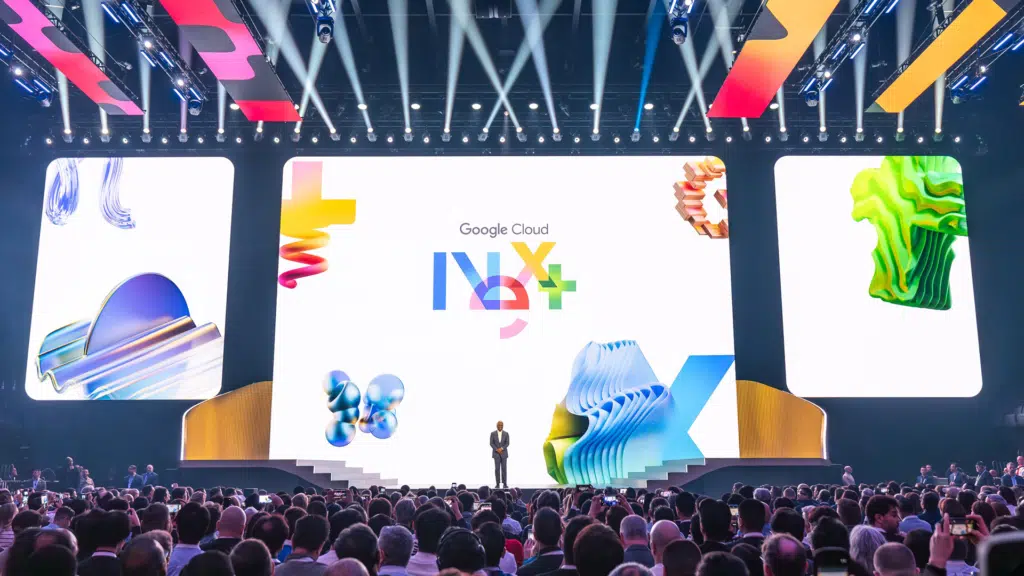
The News: At today’s opening keynote of Google Cloud Next ’23, Google announced several new enhancements to Google Meet and Google Chat that leverage Duet AI in Google’s communication and collaboration products.
In Google Meet, Duet AI will take notes during video calls, send meeting summaries, and automatically translate captions in 18 languages. In addition, to ensure every meeting participant is clearly seen, heard, and understood, Duet AI in Meet announced studio look, studio lighting, and studio sound. And, for Duet AI in Google Chat, you can chat directly with Duet AI to ask questions about your content, get a summary of documents shared in a space, and catch up on missed conversations. These updates also include a refreshed UI and other Chat features, such as new shortcuts, enhanced search, and huddles in Chat, which allow teams to start meetings from where they are already collaborating. Read the product announcement from Aparna Pappu, GM and Vice President, Google Workspace, on the Google blog.
Duet AI for Google Workspaces Enhances Google Meet and Google Chat
Analyst Take: The introduction of Duet AI into Google Workspace represents a significant leap in productivity tools, melding AI seamlessly into everyday tasks and communication for both individual users and organizations. Google’s ambitious integration positions AI as a collaborative partner that not only streamlines mundane tasks but also offers value-added services like real-time translation, intelligent note-taking, and actionable insights, all while preserving user control over data.

This move could redefine how we perceive productivity, moving it from a mere task-oriented approach to an intelligent, context-aware collaboration with technology.
Of particular interest to me is the integration of Duet AI into Google Meet and Google Chat. This could be a game-changer for all users of Google’s collaboration products, addressing some of remote meetings’ most common pain points. By leveraging AI for real-time note-taking, language translation, and even “attending” meetings on behalf of the user, Google is fundamentally transforming the meeting experience from a sometimes cumbersome necessity to a more streamlined, productive, and inclusive event.

These features have the potential to alleviate “meeting fatigue,” improve global communication, and allow for a more engaged and effective meeting dynamic.
The integration of Duet AI into Google Chat suggests a significant evolution in real-time corporate messaging and collaboration tools. The AI’s capability to provide on-the-go summaries, answer content-related queries, and even engage in “huddles” without needing a separate meeting promotes an agile and dynamic work environment. Moreover, the “smart reply” feature powered by Duet AI in Gmail indicates that the technology is being designed as an intelligent assistive layer across multiple platforms, amplifying its utility for users who are often mobile or multitasking.

Why Does This Matter in World Becoming Quickly Full of AI Options?
From my point of view, I see AI in communication and collaboration activities as a very practical use for everyday knowledge workers. Admittedly, the allure of a ChatGPT and Bard providing synthesized information from human-entered questions or prompts has value, but this still requires a detour within the typical workflows of research, writing, or distilling of information. It also lacks the personalized data on which to build its responses.
However, when integrated into a unified communications (UC) workflow, Duet AI shows how it can leverage content created in near real time by you and others on the collaboration session to synthesize data, draw conclusions, and recommend next steps. The power of your ongoing Chat or meeting is fueling the AI data being processed.
Do you need more rationale to like this implementation of Duet AI? Here are a few other reasons I find this to be a great application of Duet AI.
Human-AI Collaboration: The most striking feature of Duet AI is its role as a “real-time collaborator” who can perform as a coach, productivity enhancer, and even an inspirational source. This moves AI from being a mere tool to an active participant in problem-solving and decision-making processes.
Comprehensive Productivity Solution: By integrating Duet AI into Google Meet and Google Chat, Google is addressing the holistic needs of a work environment, including meetings, real-time communication, and document collaboration. It is not just about making tasks easier but about making the entire workflow smarter and more efficient.
Data Privacy and Control: The announcement emphasizes user privacy and data control, which are increasingly significant concerns in an era where AI systems could potentially access sensitive information. Google assures that interactions with Duet AI are private, and that data is not used to train models without user permission.
Future Developments to Watch
One aspect to watch would be how Google plans to allow third-party integrations with Duet AI. Given that Google Workspace is already an open ecosystem, the potential for Duet AI to interact with a range of third-party applications could create a ripple effect, enhancing productivity across different platforms and industry-specific tools. This could open avenues for customized AI solutions tailored to the unique needs of various sectors, thereby expanding Duet AI’s impact beyond Google Workspace.
To help end users and enterprises experience the power of Duet AI alongside these tools, Google is currently offering a no-cost trial.
Disclosure: The Futurum Group is a research and advisory firm that engages or has engaged in research, analysis, and advisory services with many technology companies, including those mentioned in this article. The author does not hold any equity positions with any company mentioned in this article.
Analysis and opinions expressed herein are specific to the analyst individually and data and other information that might have been provided for validation, not those of The Futurum Group as a whole.
Other Insights from The Futurum Group:
Google Cloud’s TPU v5e Accelerates the AI Compute War
Previewing Google Cloud Next ’23 – Six Five On the Road
Adults in the Generative AI Rumpus Room: Google, DynamoFL, and AWS
Author Information

Craig holds a Master of Business Administration from the Texas McCombs School of Business as well as a Bachelor of Science in Business Administration from Tulane University.