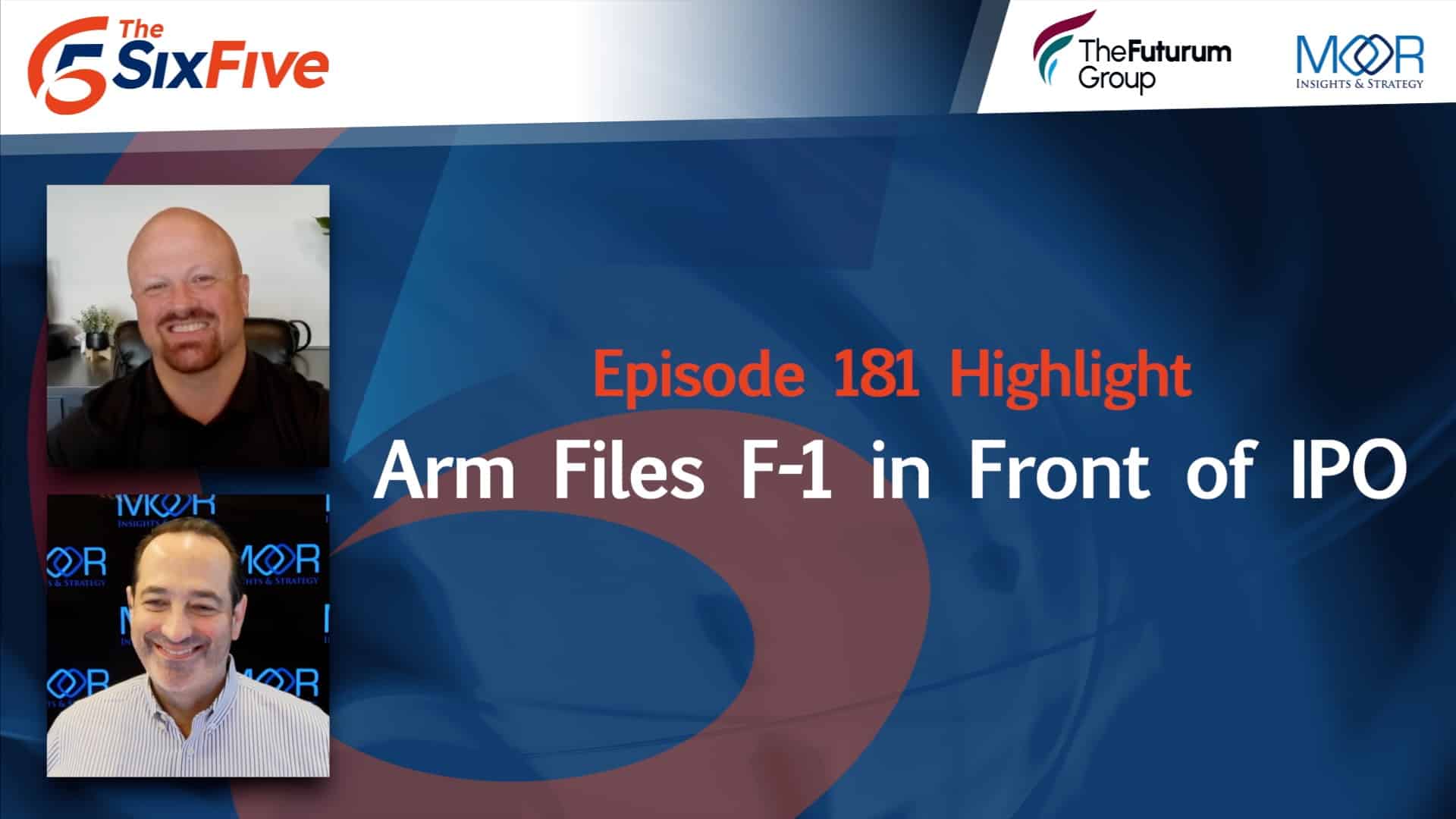
The Six Five Team discusses chip architecture design company Arm, and their recent F-1 filing.
If you are interested in watching the full episode you can check it out here.
Disclaimer: The Six Five Webcast is for information and entertainment purposes only. Over the course of this webcast, we may talk about companies that are publicly traded and we may even reference that fact and their equity share price, but please do not take anything that we say as a recommendation about what you should do with your investment dollars. We are not investment advisors and we ask that you do not treat us as such.
Transcript:
Daniel Newman: Is there an appetite for an IPO right now?
So, we’re in this weird inflection where the market’s done better. We’ve seen tons of growth in some tech names in terms of growth off the bottom. We’ve also seen a pretty healthy pullback, we’ve got prolonged inflation, prolonged expected high interest rates. Homes are unaffordable, rents are still very high, cars are still barely being produced, but you can get laptops now. And Arm, interestingly enough, is set out to go at $60 to seven $70 billion, which again is almost 50% to 75% premium over what NVIDIA had intended to pay.
Patrick Moorhead: Crazy, right?
Daniel Newman: And here, get this Pat, it’s smaller than it was a year ago. So, it’s not growing. So, what is Arm? Well Arm basically creates designs and instruction sets for silicon makers. So, pretty much every company on the planet is using Arm right now and almost every device that you would use has Arm based components in them. But their business model is interesting because it’s not that good. Their profitability hasn’t been that good, their growth hasn’t been all that good, their CAGR is like 16%. So, Pat, I’m going to actually play host a little bit here.
I think this is the biggest inflection in a long time to see is, are we warm for another IPO? Arm is pretty cool, it was obviously on the NVIDIA shopping list and NVIDIA’s pretty cool right now. But is the market ready to pay these huge premiums for an IPO right now just because it’s been so long since we’ve had one?
Patrick Moorhead: So, I may or may not answer your question directly.
Daniel Newman: Oh, come on. Then I’m not the world’s best, anyway.
Patrick Moorhead: So, the things that people need to understand about the Arm revenue growth and profits is that what was in there is what I consider a failed attempt at IoT. So, if you pull out the IoT stuff, their growth is exceptional and there were ways they could have written that off. But Arm ended up taking the brunt of that write-off when to me it was mostly a SoftBank thing. I like to look at what they’re doing, let’s say in the server market. Where it used to be that Arm probably 10 years ago was just trying to get people to use supersized smartphone chips for servers and storage controllers.
And they also didn’t really have any leadership over the ecosystem. It is freaking black and white at this point. They have multiple platforms and the way they do that, they built an ecosystem all the way down to consistent boot logging up the stack. Operating systems are there, middleware applications, and if nothing else, AWS and Apple have shown what you can do with optimized Arm silicon. They’ve also changed the model where it’s not just about the architectural license. You can move up and get multiple flavors of the IP where the company is likely 20% market share in the data center. A lot higher market share in automotive, but not 50%.
So, the company has a heck of a lot of room here to move. I also am very confident in the leadership with Rene Haas, I think I’ve known Rene for 15 years. Gotten to know his management style not only in NVIDIA but also at Arm. So, I’m looking at the growth opportunity and yeah, I do think RISC-V will take a little bit of a bite out of it, but primarily at the low end of the stack. I think the biggest risk could be how China views Arm and what they can do. But also remember folks, it takes 10 years to build a software ecosystem if you want to go in and compete.
And I would say RISC-V is probably six or seven years into a 10-year period. And Arm taught the ecosystem how to move off x86 and move to something different and RISC-V is able to take advantage of that. So, we’re going to have to see what happens. I’m very optimistic about this and all of semiconductors are down, so why would we expect Arm to be up in 2020, like massively up? The only companies that are massively up is NVIDIA and Lattice.
Daniel Newman: Lattice, in the semi space. Yeah, that might be true.
Patrick Moorhead: ADI doing well too. So, there’s a lot of people doing not as well as they could be and we shouldn’t expect Arm to be any different.
Daniel Newman: But the timing is important. So, they’ve decided to do this now and like I said, they’re year over year down. You cannot underestimate the impact for SoftBank that they’ve been trying to sit on this, after just, monumental stupid from MASA. Between WeWork and some of the other things though, the vision fund has just been hammered. This is one of the better assets right now Pat, but you got to be pretty clear. It’s hard to go public when you’re not growing and it’s really hard to convince the market to pay a huge premium when you’re not growing. Having said-
Patrick Moorhead: Well, I got to tell you, 70 versus 40. I mean-
Daniel Newman: No, it’s a great story if they can get it, but I’m just saying that’s what they’re trying to get. The question is, is the appetite there? I tend to think it will be. I tend to think just the drafting off of its role in these Grace Hopper systems is going to create a lot of momentum because people are going to see that tie to NVIDIA. And of course, Apple, they’ve got a very strong story. All the Apple silicon is based on Arm and of course if Apple gets its iPhone off Qualcomm, now either way they get Arm. But people will be excited because of Apple, it’s just a thing, it’s not necessarily even strategic, it’s just the way people feel.
Again, this is going back to the emotions, not the fundamentals.
Author Information

Daniel is the CEO of The Futurum Group. Living his life at the intersection of people and technology, Daniel works with the world’s largest technology brands exploring Digital Transformation and how it is influencing the enterprise.
From the leading edge of AI to global technology policy, Daniel makes the connections between business, people and tech that are required for companies to benefit most from their technology investments. Daniel is a top 5 globally ranked industry analyst and his ideas are regularly cited or shared in television appearances by CNBC, Bloomberg, Wall Street Journal and hundreds of other sites around the world.
A 7x Best-Selling Author including his most recent book “Human/Machine.” Daniel is also a Forbes and MarketWatch (Dow Jones) contributor.
An MBA and Former Graduate Adjunct Faculty, Daniel is an Austin Texas transplant after 40 years in Chicago. His speaking takes him around the world each year as he shares his vision of the role technology will play in our future.