Analyst(s): Brendan Burke
Publication Date: February 20, 2026
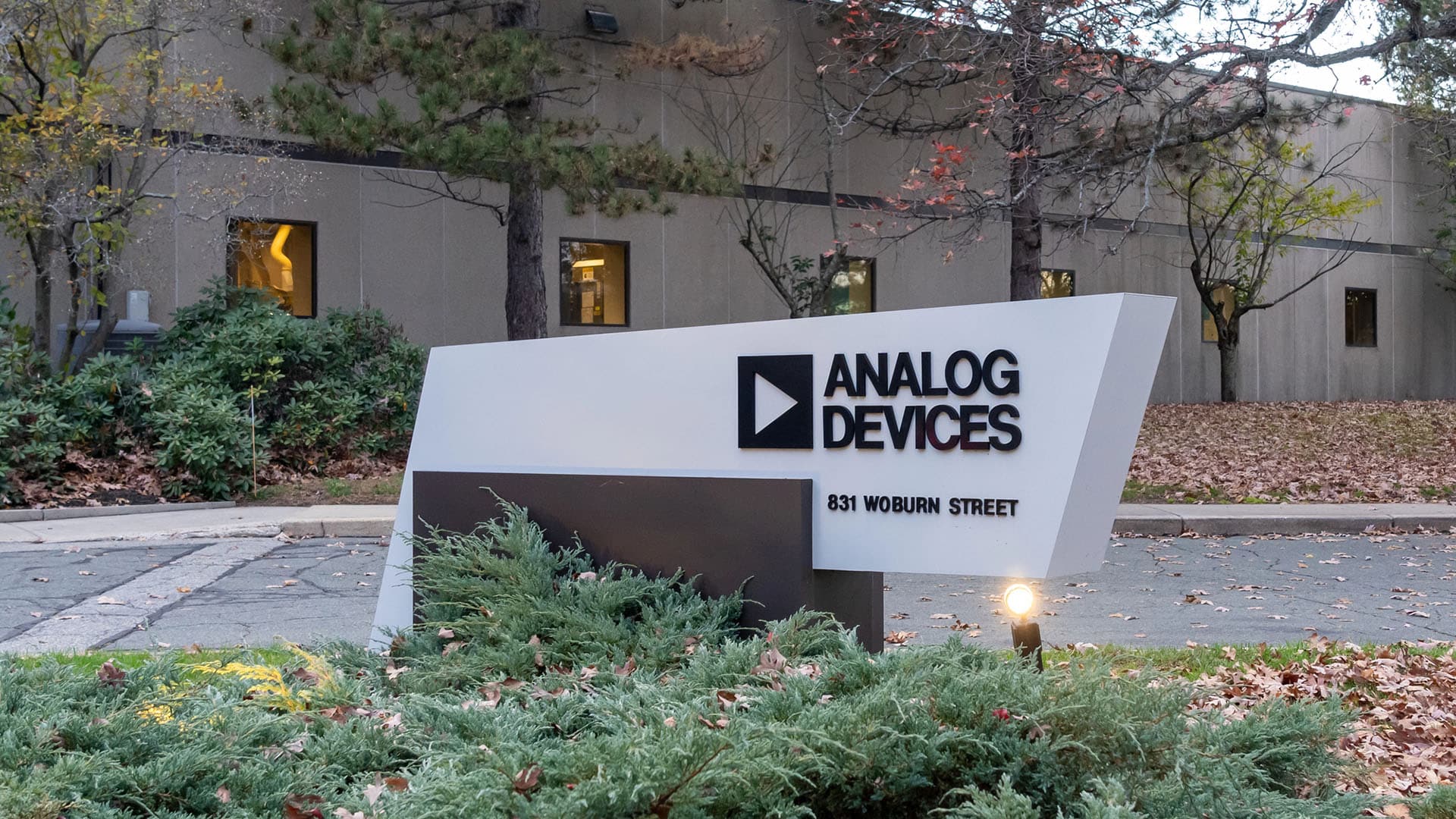
Analog Devices’ Q1 FY 2026 update highlights broad demand recovery in Industrial and Communications, alongside expanding AI data center content. Management outlines pricing dynamics, test/defense tailwinds, and data center power/optical gains, with a stronger second-half setup.
What is Covered in This Article:
- Analog Devices’ Q1 FY 2026 financial results
- Industrial, ATE, and A&D growth mix
- AI data center power and optics momentum
- Pricing actions and margin durability
- Guidance and Final Thoughts
The News: Analog Devices (NASDAQ: ADI) reported Q1 FY 2026 revenue of $3.2 billion, up 30% year over year (YoY), versus Wall Street consensus of $3.1 billion (+1.3%). Industrial revenue was $1.5 billion (up 38% YoY), Communications was $476.8 million (up 63% YoY), Automotive was $794.4 million (up 8% YoY), and Consumer was $399.8 million (up 27% YoY). Adjusted operating income was $1.4 billion with an adjusted operating margin of 45.5%, up 500 basis points YoY. Net income was $830.8 million and diluted EPS was $1.69, up 117% YoY. Adjusted diluted EPS was $2.46, up 51% YoY.
“ADI’s robust first quarter built upon the strong position and momentum with which we entered the year,” said Vincent Roche, CEO and Chair. “Our investments in R&D and the customer experience from design to delivery continue to position us to create outstanding value for shareholders and customers alike.”
Analog Devices Q1 FY 2026: Broad-Based Recovery with AI Data Center Upside
Analyst Take: Analog Devices’ quarter reflects a durable mix shift toward AI infrastructure and mission-critical industrial applications, supported by disciplined pricing and long-lifecycle portfolios. Industrial strength is increasingly shaped by Automated Test Equipment (ATE) and Aerospace & Defense (A&D), while data center growth is underpinned by power delivery/control and optical system content. Management clarified the cadence and composition of pricing, separating one-time channel effects from run-rate impact, implying underlying demand health. With bookings trending higher and record data center orders, Q2 guidance points to continued acceleration and a setup for a stronger second half.
Industrial, Test, and Defense Mix Re-accelerate
Management guided Industrial up 20%+ sequentially into Q2, citing broad-based regional and application strength with a book-to-bill above 1, even excluding pricing impact. Roughly one-third of Industrial is ATE and A&D, both at record or near-record levels, with clear end-demand drivers. Leadership emphasized price resiliency and long product lifecycles across core segments such as Instrumentation, Automation, Energy, and Healthcare, supporting sustained margins. ADI’s ATE content per tester is in the “tens of thousands” of dollars, with solutions that increase platform density, throughput, and energy efficiency, reinforcing stickiness and share. These dynamics suggest both cyclical recovery and secular content gains are contributing to the Industrial trajectory. The mix and visibility in ATE and A&D provide a stable foundation for continued Industrial outperformance.
AI Data Center Power and Optics Tailwinds
Data Center revenue grew approximately 50% in FY 2025 and accelerated in Q1 FY 2026, driven by AI server deployments and new architectures. ADI highlighted power delivery, representing about one-third of data center power revenue today, and DC power control (e.g., power system management ICs, multi-phase controllers), contributing another one-third. ADI shipped its smart power stage to its first vertical power customer and is seeing accelerating adoption of intermediate bus converter modules for 48/54-volt distribution. On connectivity, operators are re-architecting networks toward optical circuit switches (OCS), elevating the value of ADI’s precision control, monitoring, thermal regulation, and compact high-performance power solutions around the optical chain. By enabling higher bandwidth density and lower power in smaller form factors, ADI is positioned to benefit from faster AI upgrade cycles. These vectors expand ADI’s system-level content in AI data centers and support multi-quarter growth.
Pricing Actions: One-Time vs. Run-Rate
Management indicated that about one-third of the quarter-over-quarter Q2 revenue increase is price-related, with underlying sequential growth of roughly 7% versus 11% headline. Approximately half of the price uplift is tied to one-time channel inventory repricing, while the remainder reflects direct customer negotiations largely completed entering Q2. Looking ahead, pricing is expected to add around 50 basis points of incremental growth in each of Q3 and Q4, indicating a modest sustained tailwind. Leadership underscored ADI’s dynamic pricing model anchored in value delivery, premium system performance, and total cost of ownership, alongside investments that enhance supply optionality. The combination of innovation premium and long-lifecycle portfolios supports durable margin structure even as inflationary pressures persist. Taken together, pricing should modestly support top-line and margin durability without masking underlying demand recovery.
Guidance and Final Thoughts
For Q2 FY 2026, ADI guided revenue to $3.5 billion ± $100 million, adjusted operating margin of approximately 47.5% ± 100 bps, and adjusted EPS of $2.88 ± $0.15. Bookings strength continued in Q1, including record orders for Data Center, providing improved visibility into near-term demand. Management continues to expect headwinds in the first half to abate, with a stronger second half set-up. Automotive is expected to grow in FY 2026 versus a record FY 2025, aided by strong positions in connectivity and functionally safe power. The combination of secular AI infrastructure demand and resilient Industrial mix positions ADI for continued momentum.
See the full press release on Analog Devices’ Q1 FY 2026 financial results on the company website.
Declaration of generative AI and AI-assisted technologies in the writing process: This content has been generated with the support of artificial intelligence technologies. Due to the fast pace of content creation and the continuous evolution of data and information, The Futurum Group and its analysts strive to ensure the accuracy and factual integrity of the information presented. However, the opinions and interpretations expressed in this content reflect those of the individual author/analyst. The Futurum Group makes no guarantees regarding the completeness, accuracy, or reliability of any information contained herein. Readers are encouraged to verify facts independently and consult relevant sources for further clarification.
Disclosure: Futurum is a research and advisory firm that engages or has engaged in research, analysis, and advisory services with many technology companies, including those mentioned in this article. The author does not hold any equity positions with any company mentioned in this article.
Analysis and opinions expressed herein are specific to the analyst individually and data and other information that might have been provided for validation, not those of Futurum as a whole.
Other Insights from Futurum:
Texas Instruments Q4 FY 2025 Earnings Highlight Industrial, Auto, DC Traction
Lattice Launches New FPGA for Quantum Security
Author Information

Brendan is Research Director, Semiconductors, Supply Chain, and Emerging Tech. He advises clients on strategic initiatives and leads the Futurum Semiconductors Practice. He is an experienced tech industry analyst who has guided tech leaders in identifying market opportunities spanning edge processors, generative AI applications, and hyperscale data centers.
Before joining Futurum, Brendan consulted with global AI leaders and served as a Senior Analyst in Emerging Technology Research at PitchBook. At PitchBook, he developed market intelligence tools for AI, highlighted by one of the industry’s most comprehensive AI semiconductor market landscapes encompassing both public and private companies. He has advised Fortune 100 tech giants, growth-stage innovators, global investors, and leading market research firms. Before PitchBook, he led research teams in tech investment banking and market research.
Brendan is based in Seattle, Washington. He has a Bachelor of Arts Degree from Amherst College.