Analyst(s): Brendan Burke
Publication Date: May 7, 2026
AMD’s Q1 FY 2026 earnings show data center revenue becoming the main growth engine as server CPU demand expands alongside AI deployments. The quarter also surfaced a near-term tension between AI build-outs and memory-driven cost pressure in PCs and gaming.
What is Covered in This Article:
- AMD’s Q1 FY 2026 financial results
- Server CPU demand resets assumptions
- Instinct MI450 and Helios pipeline
- Enterprise and cloud EPYC traction
- Guidance and Final Thoughts
The News: Advanced Micro Devices (NASDAQ: AMD) announced financial results for Q1 FY 2026. Revenue was $10.3 billion, up 38% year-on-year (YoY), versus Wall Street consensus revenue of $9.9 billion. Data Center segment revenue was $5.8 billion, up 57% YoY, while Client and Gaming segment revenue was $3.6 billion, up 23% YoY, and Embedded segment revenue was $868.4 million, up 6% YoY. Non-GAAP operating income was $2.5 billion, up 43% YoY, with a non-GAAP operating margin of 25%, up 1 percentage point YoY. Non-GAAP net income was $2.3 billion, up 45% YoY. Non-GAAP diluted earnings per share was $1.37, up 43% YoY.
“We delivered an outstanding first quarter, driven by accelerating demand for AI infrastructure, with Data Center now the primary driver of our revenue and earnings growth,” said Dr. Lisa Su, AMD chair and CEO. “We are seeing strong momentum as inferencing and agentic AI drive increasing demand for high-performance CPUs and accelerators.”
AMD Q1 FY 2026: Data Center Momentum Builds as AI Deployments Scale
Analyst Take: AMD used Q1 FY 2026 to tighten the narrative around two connected growth vectors: server CPUs as AI infrastructure control points, and accelerators as inference deployments move from pilots to production. The quarter reinforced that data center demand is expanding beyond GPU procurement into system-level planning, where CPU capacity, memory availability, and power provisioning set deployment pace. AMD also signaled that enterprise adoption is broadening, not staying confined to hyperscalers, which matters for the durability of volumes. At the same time, memory and component inflation introduce an H2 FY 2026 risk factor for PC and gaming demand that could influence mix and channel strategy.
Server CPU Becomes the AI Control Point
AMD reframed server CPU growth as an AI-driven capacity event, not a standard share cycle, and tied it directly to inferencing and agentic workloads that increase orchestration and data movement needs. The company now expects the server CPU total addressable market to grow at greater than 35% annually and reach over $120.0 billion by 2030. EPYC-powered cloud instances increased nearly 50% YoY to more than 1,600, which signals broader standardization of EPYC for AI-adjacent compute roles. The company also pointed to accelerating enterprise traction, with record revenue and sell-through, as well as new wins across financial services, healthcare, industrial, and digital infrastructure. These factors shift competitive focus toward full-portfolio CPU planning rather than single-socket performance claims.
Instinct Engagements Move Toward Multi-Generation Commitments
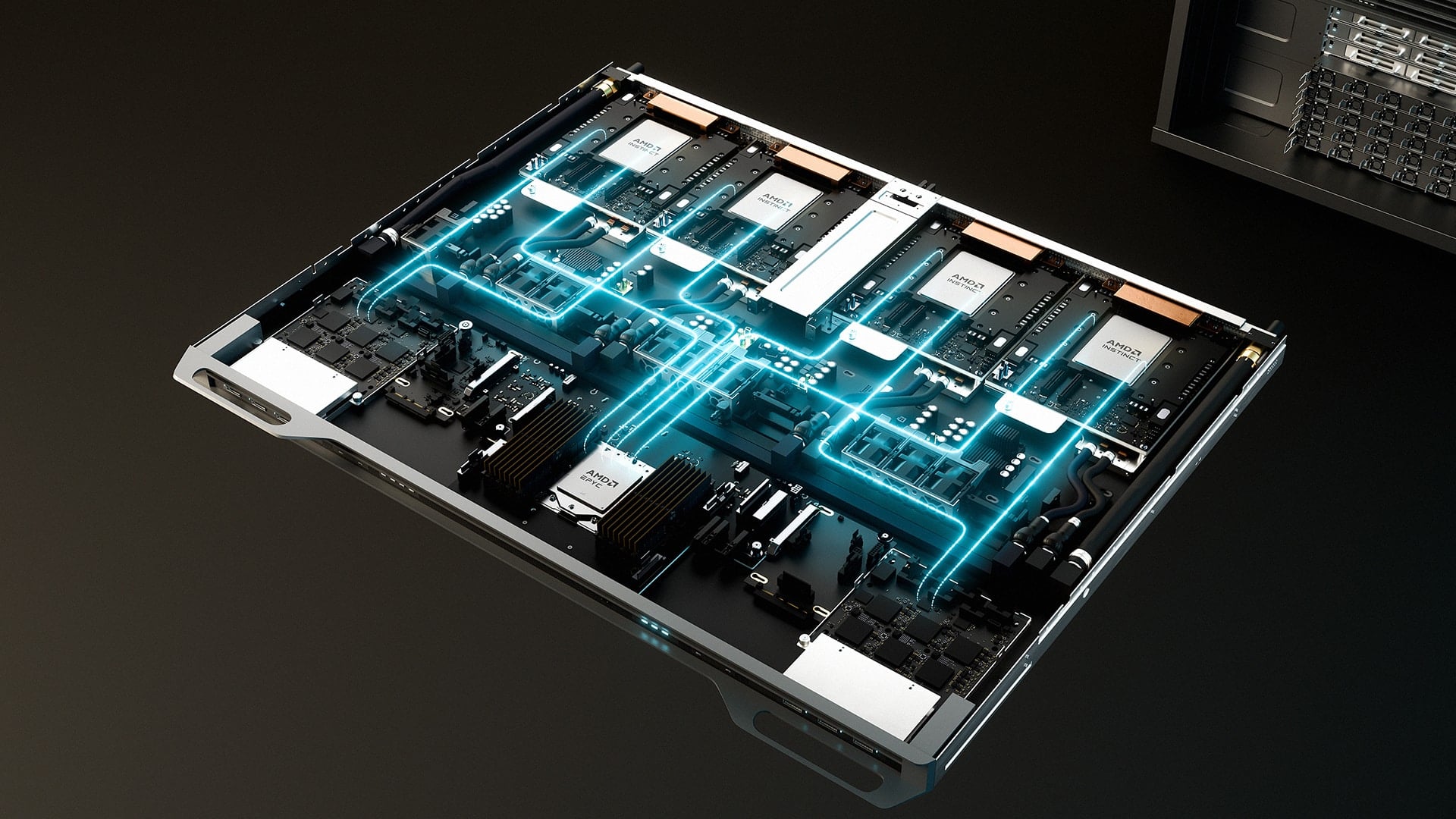
AMD positioned Instinct momentum around large-scale, multi-generation deployments, with inference leading the largest deployments and a widening set of customers engaging at scale. The company cited an expanded partnership with Meta to deploy up to 6 gigawatts of AMD Instinct GPUs spanning several generations, including a custom accelerator based on MI450 architecture and tied to Helios rack-scale systems. Helios integrates Instinct GPUs with EPYC Venice CPUs, reinforcing AMD’s intent to compete in integrated rack-scale deployments rather than point accelerators. AMD also stressed software readiness by pointing to ROCm progress, MLPerf performance for MI355X, and day-zero support for leading open models, including Gemma, Qwen, and Kimi families. This creates a clearer test for H2 FY 2026: customers will validate whether AMD can translate engagement depth into repeatable production ramps.
Client, Gaming, and Embedded Show Mixed Second-Half Setup Signals
AMD’s client momentum leaned toward premium notebooks and commercial adoption, with Ryzen PRO PC sell-through up more than 50% YoY as Dell, HP, and Lenovo expanded offerings. The company signaled that it expects H2 FY 2026 PC shipments to be lower due to higher memory and component costs, even as it expects client revenue to grow YoY and outpace the market. Gaming carried a similar cost-pressure message, with AMD planning for an H2 FY 2026 gaming demand impact from higher memory and component costs and expecting H2 FY 2026 gaming revenue to decline by more than 20% sequentially. Embedded returned to growth with strength in test, measurement, emulation, aerospace and defense, and communications, alongside expanding adaptive and embedded x86 positioning. AMD will need tighter supply coordination across memory and components to prevent AI-driven constraints from becoming demand leakage in consumer-adjacent categories.
Guidance and Final Thoughts
For Q2 FY 2026, AMD guided revenue of approximately $11.2 billion (consensus estimate $10.52 billion), plus or minus $0.3 billion, implying about 46% YoY growth at the midpoint and about 9% sequential growth. AMD guided non-GAAP gross margin of approximately 56%. The company also indicated it expects server CPU revenue to grow more than 70% YoY in Q2 FY 2026, supported by increased wafer and back-end capacity planning. The company described Helios as an H2 FY 2026 ramp, with initial volume in Q3 and a larger ramp in Q4.
The outlook reinforces that AMD’s growth profile is increasingly tied to data center infrastructure build-outs, where CPUs, accelerators, and rack-scale systems are converging into a single buying cycle. The stronger server CPU trajectory provides a margin and volume counterbalance as accelerator deployments scale through lower-margin early ramps. If AMD executes on Helios and MI450 deployments while sustaining EPYC adoption across enterprise and hyperscale customers, it has a credible path to expanding share across both AI compute and adjacent infrastructure layers.
See the full press release on AMD’s Q1 FY 2026 financial results on the company website.
Declaration of generative AI and AI-assisted technologies in the writing process: This content has been generated with the support of artificial intelligence technologies. Due to the fast pace of content creation and the continuous evolution of data and information, The Futurum Group and its analysts strive to ensure the accuracy and factual integrity of the information presented. However, the opinions and interpretations expressed in this content reflect those of the individual author/analyst. The Futurum Group makes no guarantees regarding the completeness, accuracy, or reliability of any information contained herein. Readers are encouraged to verify facts independently and consult relevant sources for further clarification.
Disclosure: Futurum is a research and advisory firm that engages or has engaged in research, analysis, and advisory services with many technology companies, including those mentioned in this article. The author does not hold any equity positions with any company mentioned in this article.
Analysis and opinions expressed herein are specific to the analyst individually and data and other information that might have been provided for validation, not those of Futurum as a whole.
Other Insights From Futurum:
Can AMD’s Edge Silicon Scale to the Trillion Dollar Orbital Opportunity?
AMD Q4 FY 2025: Record Data Center And Client Momentum
Can AMD Strengthen Both Logic and Memory Supply Chains With Samsung?
Image Credit: AMD
Author Information

Brendan is Research Director, Semiconductors, Supply Chain, and Emerging Tech. He advises clients on strategic initiatives and leads the Futurum Semiconductors Practice. He is an experienced tech industry analyst who has guided tech leaders in identifying market opportunities spanning edge processors, generative AI applications, and hyperscale data centers.
Before joining Futurum, Brendan consulted with global AI leaders and served as a Senior Analyst in Emerging Technology Research at PitchBook. At PitchBook, he developed market intelligence tools for AI, highlighted by one of the industry’s most comprehensive AI semiconductor market landscapes encompassing both public and private companies. He has advised Fortune 100 tech giants, growth-stage innovators, global investors, and leading market research firms. Before PitchBook, he led research teams in tech investment banking and market research.
Brendan is based in Seattle, Washington. He has a Bachelor of Arts Degree from Amherst College.