Analyst(s): Brendan Burke
Publication Date: May 1, 2026
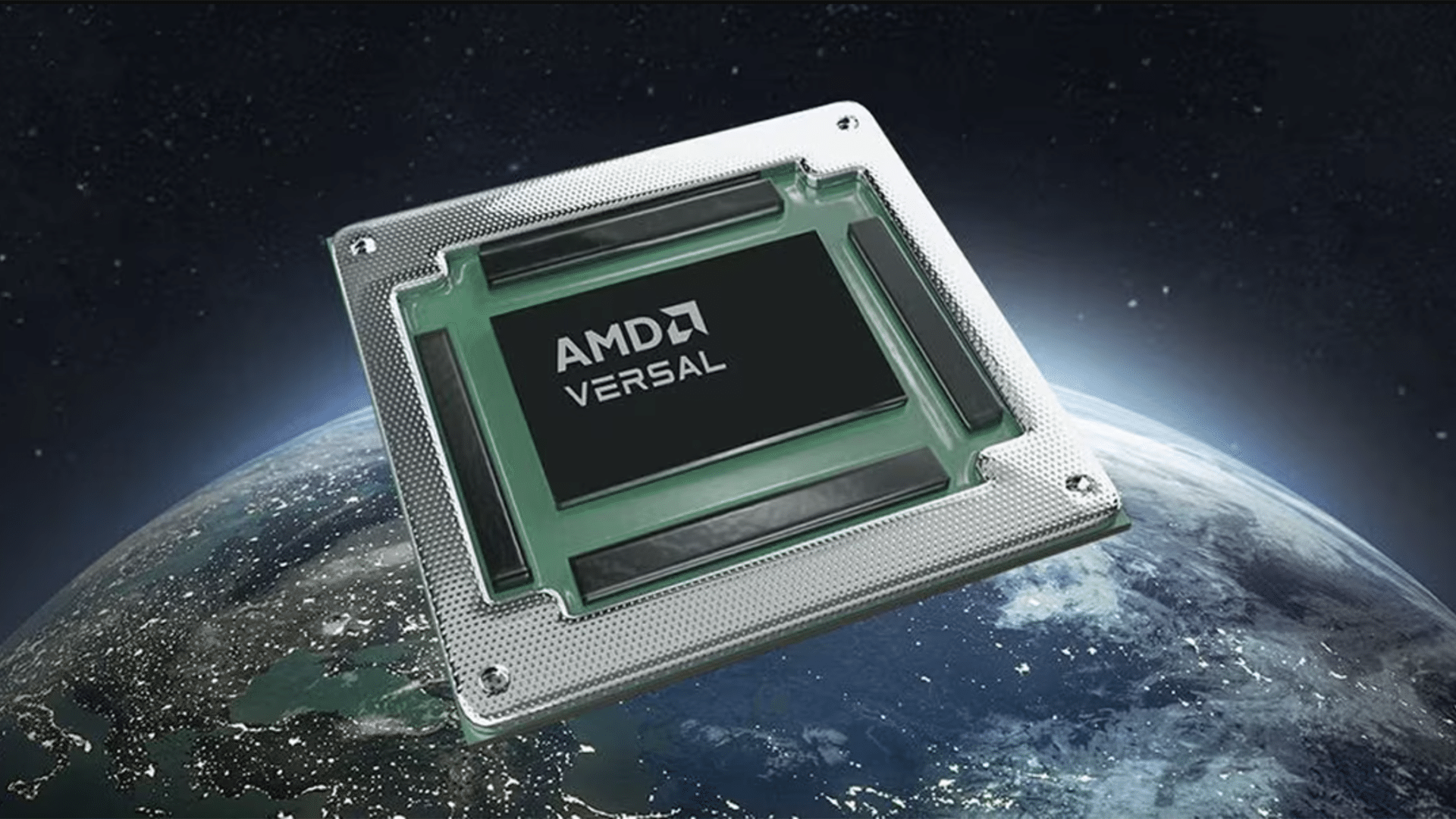
AMD has articulated a strategic vision connecting its terrestrial edge AI computing heritage to the emerging orbital infrastructure opportunity, positioning adaptive SoCs, FPGAs, and open software as foundational building blocks. The announcement signals a deliberate effort to extend AMD’s performance-per-watt engineering discipline into a market where power and thermal constraints transform from optimization targets into existential mission requirements.
What is Covered in This Article:
- AMD CTO’s strategic framing of space as edge computing’s next frontier
- The structural role of performance-per-watt in orbital compute viability
- How terrestrial grid constraints create demand for space-deployed AI
- AMD’s open ecosystem approach to multi-vendor space missions
- The architectural gap between edge processing and orbital data centers
The News: AMD CTO and Executive Vice President Mark Papermaster published a strategic blog on April 27, 2026, defining the company’s approach to AI in space across two timeframes: near-term on-board edge intelligence for satellites and spacecraft, and longer-term orbital data center infrastructure. Papermaster framed space as “the next and most demanding frontier for edge computing,” emphasizing that AMD’s existing focus on performance-per-watt, heterogeneous compute, and mission-critical reliability directly extends to orbital workloads where power is constrained, connectivity is intermittent, and autonomy is essential.
The blog outlined AMD’s architectural vision for orbital data centers as modular, serviceable systems operating in sun-synchronous orbits, requiring multimegawatt-class power generation, high-speed optical interconnects, and fleet-style replacement models. Papermaster emphasized AMD’s commitment to open software through ROCm and open standards for security, interconnect, and infrastructure, stating that “space missions are assembled from many specialized suppliers, and no single vendor can (or should) dictate the full solution.”
Can AMD’s Edge Silicon Scale to Orbit?
Analyst Take: Papermaster’s blog represents a deliberate strategic positioning of AMD at the intersection of two converging forces: the company’s established edge compute discipline and the structural emergence of orbital infrastructure as a credible extension of terrestrial AI capacity. Futurum Research estimates that in a $3 trillion AI compute capital expenditure scenario in 2030, approximately $1 trillion represents workloads where orbital deployment is economically justified, driven by multi-year grid queues, sovereign compute mandates, and incremental demand beyond terrestrial absorption capacity.
AMD’s framing is notable for its architectural specificity, describing modular orbital systems rather than monolithic deployments, and for its insistence on open ecosystems over proprietary lock-in. The key tension in this announcement is whether AMD’s proven edge heritage, built on adaptive SoCs and FPGAs for mission-specific deployments, can credibly scale to serve orbital data centers requiring sustained GPU-class inference at megawatt scale. This is not merely a product extension but a potential redefinition of AMD’s addressable market.
Performance-Per-Watt Transforms from Metric to Mandate in Orbit
Papermaster’s characterization of space as a vacuum with no natural cooling elevates performance-per-watt from an engineering optimization to a first-principles architectural constraint that determines whether orbital compute is viable at all. In orbit, power efficiency determines whether heat can be physically dissipated through radiators within the thermal budget of a given spacecraft module. This distinction is strategically significant because AMD has invested decades in optimizing compute efficiency for power-constrained environments, from embedded systems to AI PCs, creating institutional knowledge that transfers directly to orbital requirements.
Futurum Research has documented that terrestrial power constraints are already pushing over 33% of data centers toward 100 percent on-site power generation by 2030, as grid-connected capacity cannot keep pace with AI infrastructure buildout. The same physics that make performance-per-watt critical on Earth make it existential in orbit, giving vendors with deep efficiency heritage a structural advantage over those optimized purely for peak throughput. AMD’s positioning suggests the company views its efficiency-focused engineering culture as a competitive moat that becomes more valuable as compute expands into environments where every watt of waste heat must be mechanically radiated into space.
The Open Ecosystem Imperative for Multi-Vendor Space Missions
Papermaster’s emphasis on openness, specifically citing ROCm and open standards for security, interconnect, and infrastructure, reflects a strategic calculation that space computing will resist vendor consolidation more forcefully than terrestrial markets. Space missions are inherently multi-vendor ecosystems where specialized suppliers provide propulsion, communications, power generation, thermal management, and compute, making end-to-end proprietary stacks impractical and undesirable for mission architects. AMD’s open approach positions the company as an integrable building block rather than a platform dictator, which aligns with how space programs have historically procured technology through best-of-breed selection across subsystems.
The ROCm open software stack becomes strategically important in this context because orbital compute developers need the ability to optimize across diverse hardware configurations without accepting single-vendor dependency for systems that must operate autonomously for years. AMD’s open ecosystem bet is that space will reward interoperability and choice over vertical integration. This is material given our view that vertical integration of space is unlikely given the diversity of componentry and variable R&D timelines in the industry.
Modular Architecture as the Design Pattern for Orbital Scale
Papermaster’s description of orbital data centers as “many elements operating together, each managing its own power generation and thermal dissipation” reveals an architectural philosophy fundamentally different from terrestrial hyperscale facilities. This modular, fleet-based approach, where individual compute elements can be de-orbited and replaced rather than repaired, aligns with how AMD has historically approached heterogeneous compute by providing right-sized building blocks that can be composed into larger systems. The fleet operations model Papermaster describes implies that orbital data centers will function more like distributed satellite constellations than centralized facilities, requiring compute nodes that can operate independently while communicating through high-throughput optical links.
Futurum Research notes that launch capacity will remain supply-constrained, with Starship slots contested across Starlink V3 deployment, lunar missions, and commercial payloads, suggesting that modular deployments capable of incremental scaling will be favored over monolithic launches requiring massive single-payload capacity. AMD’s adaptive SoC architecture is structurally well-suited to this modular paradigm because reconfigurable compute can be updated post-deployment as mission requirements evolve, extending useful life without maintenance. The modular vision positions AMD to serve orbital infrastructure through a repeatable platform approach rather than bespoke mission engineering, potentially creating a scalable revenue model if orbital deployment achieves commercial velocity.
The Gap Between Edge Heritage and Data Center Ambition
The most significant unstated tension in Papermaster’s blog is the distance between AMD’s proven space-edge capabilities and the full orbital data center opportunity that Futurum Research sizes at approximately $1 trillion. AMD’s current space-grade portfolio centers on adaptive SoCs and FPGAs validated for radiation tolerance and autonomous edge processing, capabilities demonstrated on Mars rovers, asteroid missions, and satellite constellations. However, orbital data centers capable of sustaining AI inference at commercial scale will require GPU-class compute hardened for continuous operation in radiation environments, a capability AMD has not yet publicly articulated in its space roadmap.
The thermal challenge Papermaster describes, where excess heat must be conducted to radiators in a vacuum, becomes exponentially more complex when scaling from milliwatt-scale FPGA deployments to kilowatt GPU clusters operating continuously in orbit. AMD’s blog carefully avoids committing to a specific timeline for space-grade GPU products, instead emphasizing the platform journey from edge to orbit as a progression rather than a discrete product launch. This measured approach suggests AMD recognizes the engineering gap while positioning its existing heritage as the credible foundation from which orbital data center silicon could eventually emerge.
What to Watch:
- Whether AMD announces radiation-tolerant GPU or accelerator products specifically designed for sustained orbital AI inference workloads beyond current FPGA capabilities.
- How SpaceX Starship launch cost trajectory toward sub-$100 per kilogram affects the economic viability timeline for orbital compute deployments that AMD’s silicon would serve.
- The degree to which AMD’s ROCm open software stack gains traction among orbital compute developers relative to NVIDIA’s CUDA ecosystem in space applications.
- Whether competing semiconductor vendors accelerate their own space-grade qualification programs, potentially eroding AMD’s heritage-based competitive advantage.
- How AMD integrates its space computing narrative into investor communications and whether it begins quantifying the orbital market as a component of its total addressable market.
See the full press release on AMD’s AI in space strategy announcement on the company website.
Disclosure: Futurum is a research and advisory firm that engages or has engaged in research, analysis, and advisory services with many technology companies, including those mentioned in this article. The author does not hold any equity positions with any company mentioned in this article.
Analysis and opinions expressed herein are specific to the analyst individually and data and other information that might have been provided for validation, not those of Futurum as a whole.
Other Insights From Futurum:
Orbital Computing Can Reach $1 Trillion Addressable Market by 2030
Will Starcloud’s Orbital Data Centers Solve NVIDIA’s Terrestrial Energy Crisis?
North Africa’s Cloud Revolution Led by Oracle
Image Credit: AMD
Author Information

Brendan is Research Director, Semiconductors, Supply Chain, and Emerging Tech. He advises clients on strategic initiatives and leads the Futurum Semiconductors Practice. He is an experienced tech industry analyst who has guided tech leaders in identifying market opportunities spanning edge processors, generative AI applications, and hyperscale data centers.
Before joining Futurum, Brendan consulted with global AI leaders and served as a Senior Analyst in Emerging Technology Research at PitchBook. At PitchBook, he developed market intelligence tools for AI, highlighted by one of the industry’s most comprehensive AI semiconductor market landscapes encompassing both public and private companies. He has advised Fortune 100 tech giants, growth-stage innovators, global investors, and leading market research firms. Before PitchBook, he led research teams in tech investment banking and market research.
Brendan is based in Seattle, Washington. He has a Bachelor of Arts Degree from Amherst College.