Breakthroughs Quantum Can Deliver, the TAM Each One Opens, and Use Cases AMD, AWS, Google, IBM, IonQ, Microsoft, and NVIDIA Are Targeting
Analyst(s): Brendan Burke
Publication Date: October 28, 2026
Document #: AIOBB202610
What You Need to Know
- AI Has Conquered Knowledge Work and Stalled at the Boundary of Physics: Generative AI learns from recorded human output and knowledge work is almost entirely recorded while science is not. The behavior of electrons in a catalyst or an enzyme cannot be learned from data that does not exist and cannot be computed classically at scale. That is the barrier AI has run into in science, and the barrier quantum computing is built to cross.
- The Quantum TAM Will Reach $1.51 Trillion a Year by 2040: About $650 billion a year will come from productivity gains in the parts of existing industries that depend on computation. About $860 billion will come from new product markets that do not exist until a scientific barrier falls. Those include catalysts that replace Haber-Bosch, solid state battery materials, drugs against undruggable targets, materials that AI can propose but cannot validate, and healthcare decisions that depend on biology, classical models cannot simulate.
- The Market Has Underestimated Quantum’s Impact: Prevailing expectations size quantum as a niche accelerator worth tens of billions in vendor revenue. The $860 billion new market layer in this forecast consists of products that will exist only because quantum made the underlying discovery. The same mistake was made with AI in 2012, when the technology was priced as a better image classifier rather than as a restructuring of knowledge work. Futurum’s view is that quantum is being priced today as a better simulator rather than as a restructuring of the physical economy.
- Seven Vendors Have Already Declared Their Use Cases: AMD, AWS, Google, IBM, IonQ, Microsoft, and NVIDIA have each named the problems they will attack first. The list covers catalysis, battery and materials discovery, drug targets, healthcare, and optimization. The first breakthroughs will land between 2029 and 2033 and the products they enable will reach the market between 2033 and 2040.
- 2029 Will Be Quantum’s ChatGPT Moment, but QPU Output Will Not Ramp Like AI Chips: The first validated quantum chemistry result on an industrial molecule is expected alongside the first systems with a few hundred logical qubits in 2029. Demand will inflect the way AI demand did in late 2022. Adoption will be slower because AI accelerators rode an existing 300mm foundry and memory supply chain while QPUs depend on wafer lines, cryogenics, and lasers that are only now being industrialized at Anderon, SkyWater, and GlobalFoundries.
- AI and Quantum Are Both/And, Not Either/Or: AI proposes candidates, and quantum validates them. GPUs decode quantum error correction in real time, and quantum results become the training data AI in science has lacked. Every full-stack vendor is building hybrid systems rather than choosing a side.
The Futurum View
Futurum’s view is that quantum computing in 2026 sits where AI sat in 2012 and that the next 15 years will rhyme. AI did not disrupt knowledge work in a single step. Deep learning proved itself in image recognition in 2012. The transformer arrived in 2017 and made scale the strategy. ChatGPT turned a research capability into an enterprise habit in late 2022. By 2026, agentic systems will write code, draft contracts, and run analyses as routine. The cumulative effect redrew the economics of every profession that works with words, numbers, and images.
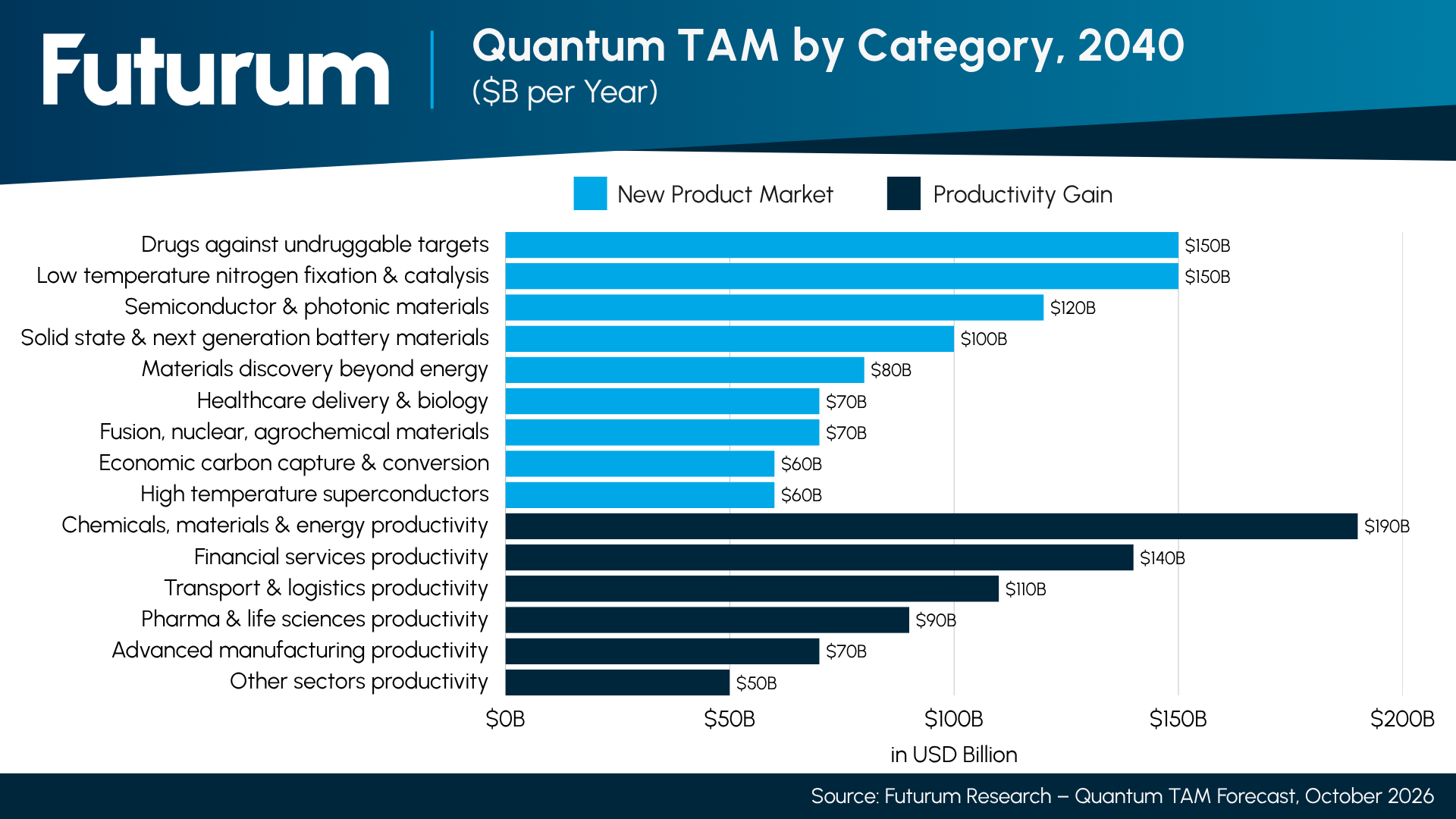
Quantum has just produced its equivalent of the “AI 2012 moment” on several fronts at once. Google’s Willow showed that adding qubits reduces logical error rather than adding noise. Quantinuum’s Helios shipped with 48 error-corrected logical qubits. Google’s Quantum Echoes ran a verifiable physics calculation roughly 13,000 times faster than the Frontier supercomputer. IBM moved quantum advantage from roadmap to demonstration, and Microsoft produced a second-generation topological device. Enterprises outspent governments on quantum for the first time, and the United States funded a merchant quantum wafer foundry. None of these alone is the breakthrough. Together, they are the pattern that preceded AI’s takeoff. The physics question has been answered. What remains is engineering, manufacturing, and adoption. AI reorganized the third of economic activity that is recorded information work. Quantum will reorganize the third, which depends on the physics of materials, molecules, and complex systems. Figure 1 sets out where that addressable market will sit in 2040.
Figure 1: Quantum TAM by Category, 2040 ($B per Year)
Where AI Stops at the Science Barrier
AI’s impact has concentrated in knowledge work because language, code, images, and transactions are abundantly recorded, so models can learn the mapping from input to output without understanding the mechanism. Science works in the opposite direction. The governing equations of chemistry and materials are known. They cannot be solved exactly once more than a few dozen electrons interact, because the number of states to track doubles with each additional particle. Classical computers approximate instead. Machine-learned surrogates inherit the error of those approximations, which is often large enough to misjudge whether a reaction will proceed. GPU acceleration has made the approximation faster, not more accurate.
The results show where AI in science has and has not delivered. It has delivered where the task is pattern recognition over existing data, as in protein structure prediction. It has stalled where the task is the physics of strongly interacting electrons, as in catalysis, battery interfaces, and enzyme-active sites. Those are the problems whose solutions open new markets and that quantum computers simulate natively. AI is the front end that proposes and screens and quantum is the back end that can compute what AI cannot learn.
The Breakthroughs and the Markets They Open
The forecast starts from world output. Global output is roughly $115 trillion in 2026, and Futurum carries it to roughly $175 trillion in 2040 on a 3% nominal growth path. Six sector groups where quantum’s problem classes recur make up about $35 trillion of the 2026 total. Chemicals, materials, and energy and financial services contribute about $10 trillion each, transport and logistics about $7 trillion, advanced manufacturing about $6 trillion, pharma about $1.8 trillion, and insurance, telecom, and public services the rest. Within each group, Futurum isolates the share of output that depends on computation in research, engineering, risk analytics, and network planning. Those shares run from 12% in advanced manufacturing to 40% in pharma and sum to about $6.8 trillion. A 10% productivity uplift on that pool, calibrated to the level effect of the 1995 to 2005 information technology wave and phased over 12 years from 2030, yields the $650 billion productivity layer. Information and communications technology enters through telecom in that group and through the semiconductor row in Table 1. Cryptography is excluded on purpose because breaking encryption is a threat rather than a market, and post-quantum migration is a classical upgrade that will proceed regardless. Media has no computation-dependent pool large enough to separate.
The new market layer is built differently. Table 1 lists the barriers Futurum judges most likely to fall to quantum computation between 2029 and 2038, the market each opens, and the 2040 size of that market, drawn from sector forecasts. The quantum TAM is the share of each market’s 2040 size that depends on a design or discovery classical methods cannot produce, phased for the five- to eight-year lag between a validated breakthrough and a shipping product. The $8.2 trillion in the market size column is the collective size of the markets quantum will reach into, and the $860 billion in the quantum TAM column is the part that will exist only because quantum made the underlying discovery.
Table 1: Breakthroughs Quantum Can Deliver by Total Addressable Market
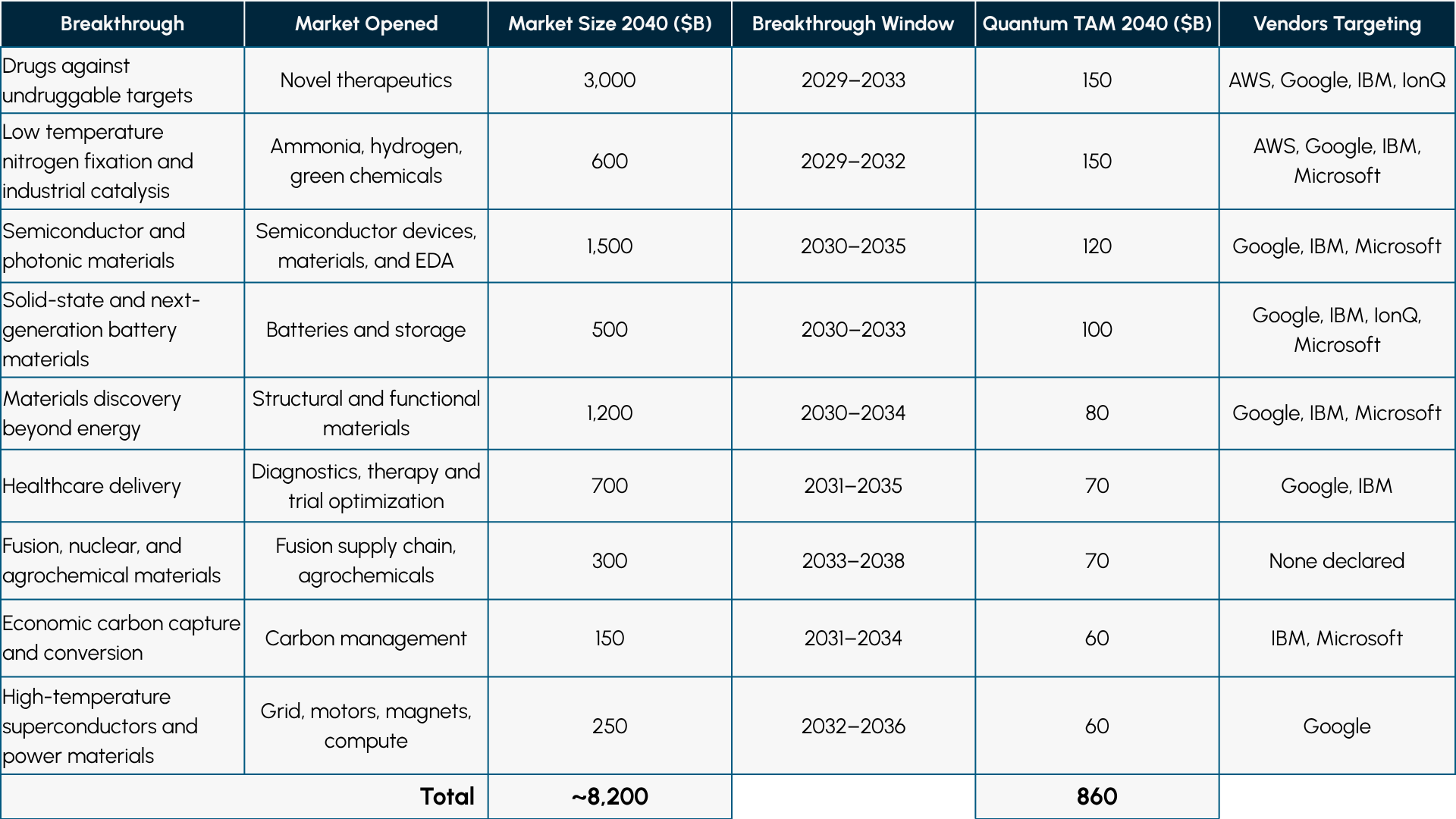
Four of these lead the field. Haber-Bosch consumes 1% to 2% of global energy because no one has resolved the enzyme that fixes nitrogen at ambient conditions. A few percent of a $3 trillion pharmaceutical market is larger than the entire simulation budget that quantum will displace. Semiconductors are the largest industrial base in the table because dopant and defect physics, 2D channels, memory cell chemistries, and photonic materials all sit in the regime that classical process simulation approximates. Every automaker and cell maker already pays for battery simulation that cannot reach the accuracy the interface chemistry demands. Materials discovery and healthcare widen the aperture. Quantum will validate the millions of candidates that generative AI now proposes and will shift healthcare from molecules to care decisions. Both will mature later than catalysis because they depend on data and regulatory pathways as well as on qubits.
Productivity Gains Come First and New Markets Compound Longer
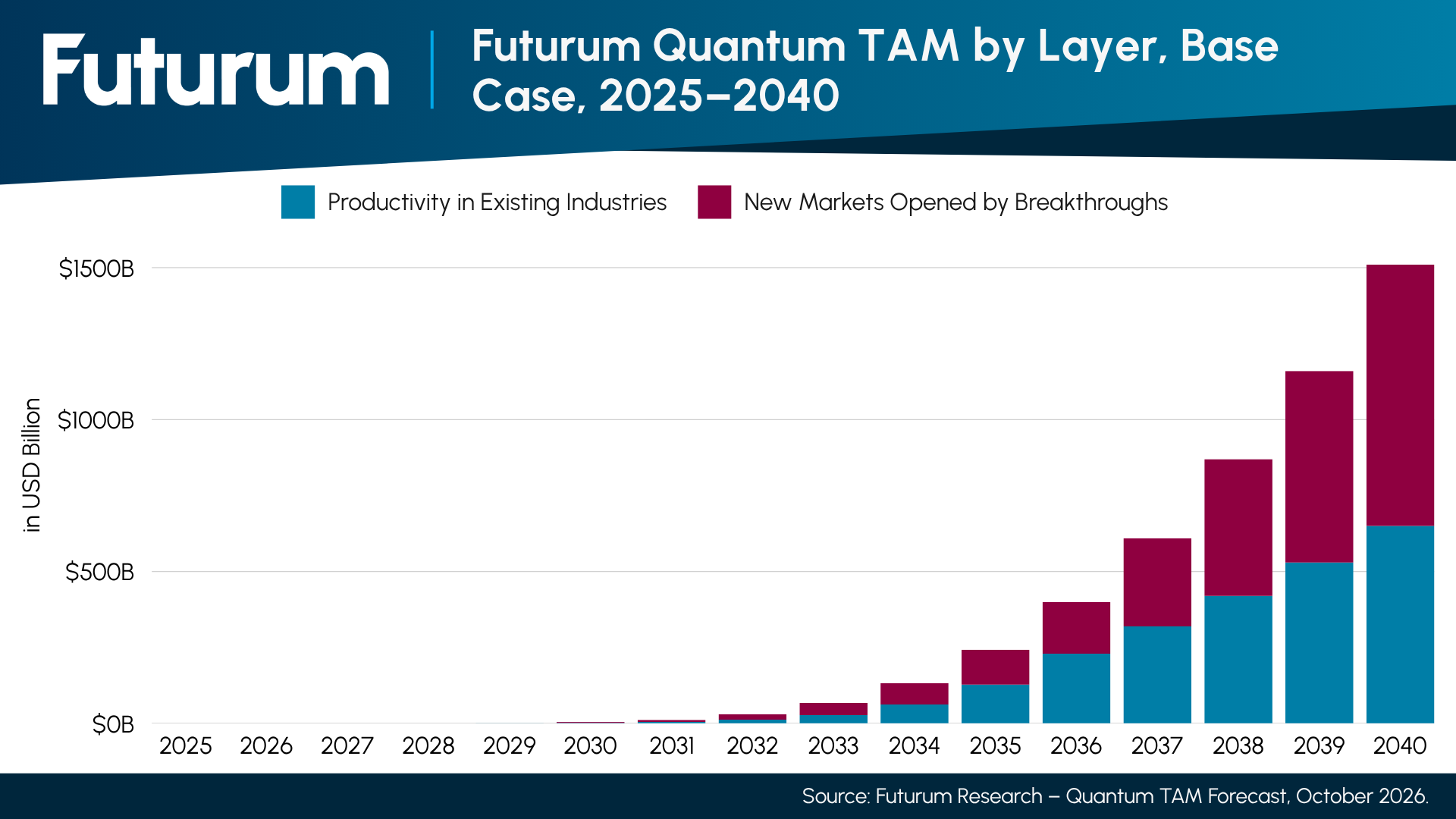
Figure 2 sets out both layers by year. The productivity layer starts in 2030 and reaches $650 billion in 2040. The new market layer lags it by two to three years because a validated breakthrough must become a patent, a pilot plant, or a clinical candidate before it becomes a market. It will still be accelerating in 2040.
Figure 2: Futurum Quantum TAM by Layer, Base Case, 2025–2040
2029 Will Be the ChatGPT Moment and the Ramp Will Be Supply Constrained
Through 2029, the addressable market will be close to zero, though many pilots are already active. Futurum expects 2029 to be Quantum’s ChatGPT moment. It is the year the first systems with a few hundred logical qubits ship against vendor roadmaps, and a quantum chemistry result on an industrial molecule is validated beyond classical reach. Demand will inflect the way AI demand did in late 2022. Supply will not. AI accelerators scaled at roughly 78% a year because they rode an existing 300mm foundry, memory, and packaging supply chain. QPUs have no such inheritance. Qubit wafers, cryogenic readout chains, dilution refrigerators, and ultra-stable lasers are all produced at research volumes today.
That constraint is why the industry is building a quantum foundry layer now. IBM’s Anderon is a standalone 300mm quantum wafer foundry in Albany that finalized a $1 billion CHIPS Act award in September 2026, matched by $1 billion from IBM. The same program put $375 million into GlobalFoundries and roughly $100 million each into six hardware companies, with the government taking equity in each. IonQ bought SkyWater outright. Anderon and SkyWater are the first merchant 300mm lines open to QPU vendors in general, and their yield ramp, rather than enterprise demand, will set how fast the market in Figure 2 opens from 2030 to 2035.
What the Vendors Plan to Attack and the TAM Each Use Case Unlocks
Seven vendors have each named their first targets, and there is high overlap. IBM has committed to demonstrating quantum advantage in 2026, starting with chemistry and then optimization, with Starling’s 200 logical qubits in 2029 aimed at materials and drug development alongside Boeing and the Cleveland Clinic. Google has set a five-year horizon for materials, medicine, and energy applications possible only on quantum computers. IonQ is attacking drug discovery with AstraZeneca, battery chemistry with Hyundai, and logistics with Einride. AWS has said chemistry and materials simulation is where quantum will shine first and is building Ocelot to cut the cost of error correction. Microsoft is pairing Majorana with an agentic discovery platform already used by BHP, Syensqo, and Ginkgo Bioworks. NVIDIA and AMD are positioning themselves as the classical host for all of the above. Table 2 maps those declared use cases to the TAM each one unlocks and to the year each will first produce validated results.
Table 2: Declared Vendor Use Cases, and the Quantum TAM Each Unlocks
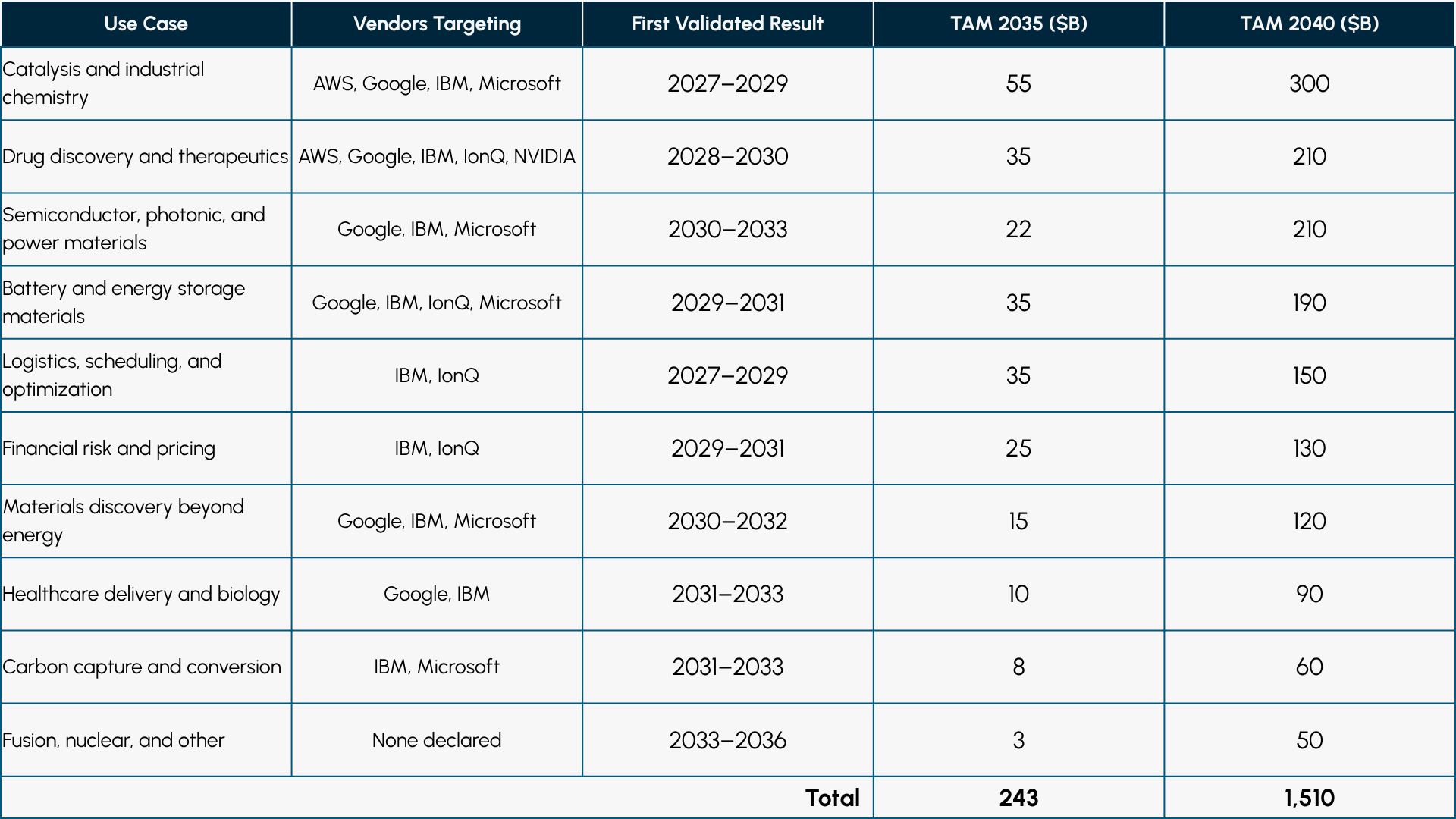
Catalysis, batteries, and therapeutics will account for roughly half of the TAM in both 2035 and 2040, and they are the three every full-stack vendor is targeting. Optimization and finance will open earliest but plateau soonest because classical heuristics and AI will keep narrowing the gap there, while materials discovery and healthcare will start later and compound longer.
What to Watch:
- The First Industrial Chemistry Result: A quantum calculation of a catalyst or enzyme active site validated against experiment and beyond the reach of the best classical method will move quantum from research budgets to product budgets. IBM’s 2026 advantage demonstrations and Google’s verifiable algorithms are the first candidates.
- Discovery Contracts, Not Compute Contracts: The new market layer will show up first as milestone and royalty agreements between quantum vendors and pharma, chemical, and battery companies. The first such deal with disclosed economics will mark its start.
- Quantum Wafer Yield at Anderon, SkyWater, and GlobalFoundries: Value realization after 2029 will be gated by QPU output rather than demand. Yield on schedule will support the base case, and a stall will push toward the delayed case regardless of error-correction progress.
- Hybrid Workflows That Close the Loop: The first disclosed pipeline in which AI-proposed candidates are validated on a QPU and fed back to retrain the model will confirm that the two technologies compound. If AI surrogates keep closing the accuracy gap alone, the new market layer will shrink.
- Delivery Against 2029 Roadmaps: IBM Starling, Microsoft’s 2029 target, AWS’s five- to seven-year window, and IonQ’s 2030 roadmap cluster on the same inflection. Slippage of more than a year on two of them would move the inflection to 2032 or later and cut the 2035 TAM by roughly two-thirds.
Disclosure: Futurum is a research and advisory firm that engages or has engaged in research, analysis, and advisory services with many technology companies, including those mentioned in this article. The author does not hold any equity positions with any company mentioned in this article.
Analysis and opinions expressed herein are specific to the analyst individually and data and other information that might have been provided for validation, not those of Futurum as a whole.
Other Insights From Futurum:
The Foundry Bet: IonQ, SkyWater, and the Industrialization of Quantum
AMD Acquires World Labs for $8.2 Billion to Design Silicon Around World Models
IBM Links Modular Cryogenic Systems. Is the Fridge Quantum’s Real Bottleneck?
Author Information

Brendan is Research Director, Semiconductors, Supply Chain, and Emerging Tech. He advises clients on strategic initiatives and leads the Futurum Semiconductors Practice. He is an experienced tech industry analyst who has guided tech leaders in identifying market opportunities spanning edge processors, generative AI applications, and hyperscale data centers.
Before joining Futurum, Brendan consulted with global AI leaders and served as a Senior Analyst in Emerging Technology Research at PitchBook. At PitchBook, he developed market intelligence tools for AI, highlighted by one of the industry’s most comprehensive AI semiconductor market landscapes encompassing both public and private companies. He has advised Fortune 100 tech giants, growth-stage innovators, global investors, and leading market research firms. Before PitchBook, he led research teams in tech investment banking and market research.
Brendan is based in Seattle, Washington. He has a Bachelor of Arts Degree from Amherst College.