
Analyst(s): Keith Kirkpatrick
Publication Date: July 20, 2026
Document #: AIOKK202607
Key Points
- ETR’s May 2026 AI Product Series survey shows only 6.3% of enterprises evaluating Salesforce Agentforce report “significant value – likely to expand or purchase,” down from 11.8% in November 2025, even as the product shows up in more deals.
- Futurum Research’s 1H 2026 AI Platforms Decision Maker Survey (n=820) finds only 13.3% of organizations have reached their most advanced AI maturity stage, and even inside that leading group, legacy-system integration and workforce readiness, rather than model reliability, are what separate leaders from laggards.
- The evaluation question enterprises should be asking has shifted from whether an agent works in a demo to whether the vendor can help redesign the process it automates; reference architectures, change management, and process-redesign consulting are becoming the real differentiators.
Recommendations
- Require a Documented Redesign Methodology: Enterprise buyers should require vendors to show a documented process-redesign methodology and named customer outcomes before signing a pilot, beyond a list of supported use cases.
- Fund the Boring Layer: Vendors should invest as much in change management, reference architectures, and integration tooling as in the agents themselves. Futurum’s 1H 2026 AI Platforms Decision Maker Survey found organizations that rate themselves behind competitors are far more likely to cite legacy-system integration as a barrier (a 13.1-point gap) than organizations further ahead, which instead report higher rates of agent reliability concerns.
- Make Pilot-to-Production Rate the Headline Metric: Both sides should benchmark agentic AI investments on how many pilots reach production, ahead of seat counts or demo performance.
What You Need to Know
- Agentic AI has moved from novelty to embedded feature across enterprise software in roughly a year, with Salesforce, ServiceNow, SAP, Microsoft, and Workday all shipping agent products inside core platforms.
- ETR’s May 2026 AI Product Series survey (Sales/Finance/HR/Productivity theme) finds evaluators of Salesforce Agentforce (n=79), ServiceNow AI Agents (n=63), Microsoft Copilot Studio (n=110), and SAP Joule (n=32) mostly land in “moderate value” or “mixed results” categories, with only 4.5%–11.1% reporting an unambiguous “significant value” outcome.
- Futurum Research’s 1H 2026 AI Platforms Decision Maker Survey (n=820 enterprise AI decision-makers) finds just 13.1% of organizations outside its most mature cohort have reached orchestrating or autonomous-ecosystem agentic maturity, compared with 78.0% of the Stage 5 organizations that have.
- The same survey finds organizations that rate themselves behind competitors face a different set of barriers than those ahead: legacy-system integration and workforce adaptation are the leading gaps for laggards, while more advanced organizations report agent reliability concerns at a higher rate still (58.5% vs. 50.5%).
- ETR Insights panelists describe agentic AI failing when it is “thrown on top of” an unchanged operating model, and succeeding when vendors help redesign the underlying process and change-manage the people using it.
Analysis
Agentic AI process redesign is now the variable separating vendors that convert pilots into renewals from those stuck running demos. In barely a year, agents have gone from a keynote slide to a shipped feature inside Salesforce, ServiceNow, SAP, Microsoft, and Workday, and the technology reliably handles the bounded tasks it was built for. ETR’s May 2026 data on these products shows a market still parked in “moderate value” and “mixed results,” and the recommendations above point to why: methodology, integration, and measurement are lagging the capability.
The Evaluation Bar Has Moved to Process Redesign
Vendors have little incentive to volunteer a redesign methodology unless buyers make it a purchase requirement, and Futurum’s 1H 2026 Enterprise Software Decision Maker Survey shows why that requirement matters: 56.0% of enterprise decision-makers say they still prefer to build most applications in-house rather than buy off the shelf, a figure essentially unchanged from the prior half-year.
Figure 1: Application Deployment Practices
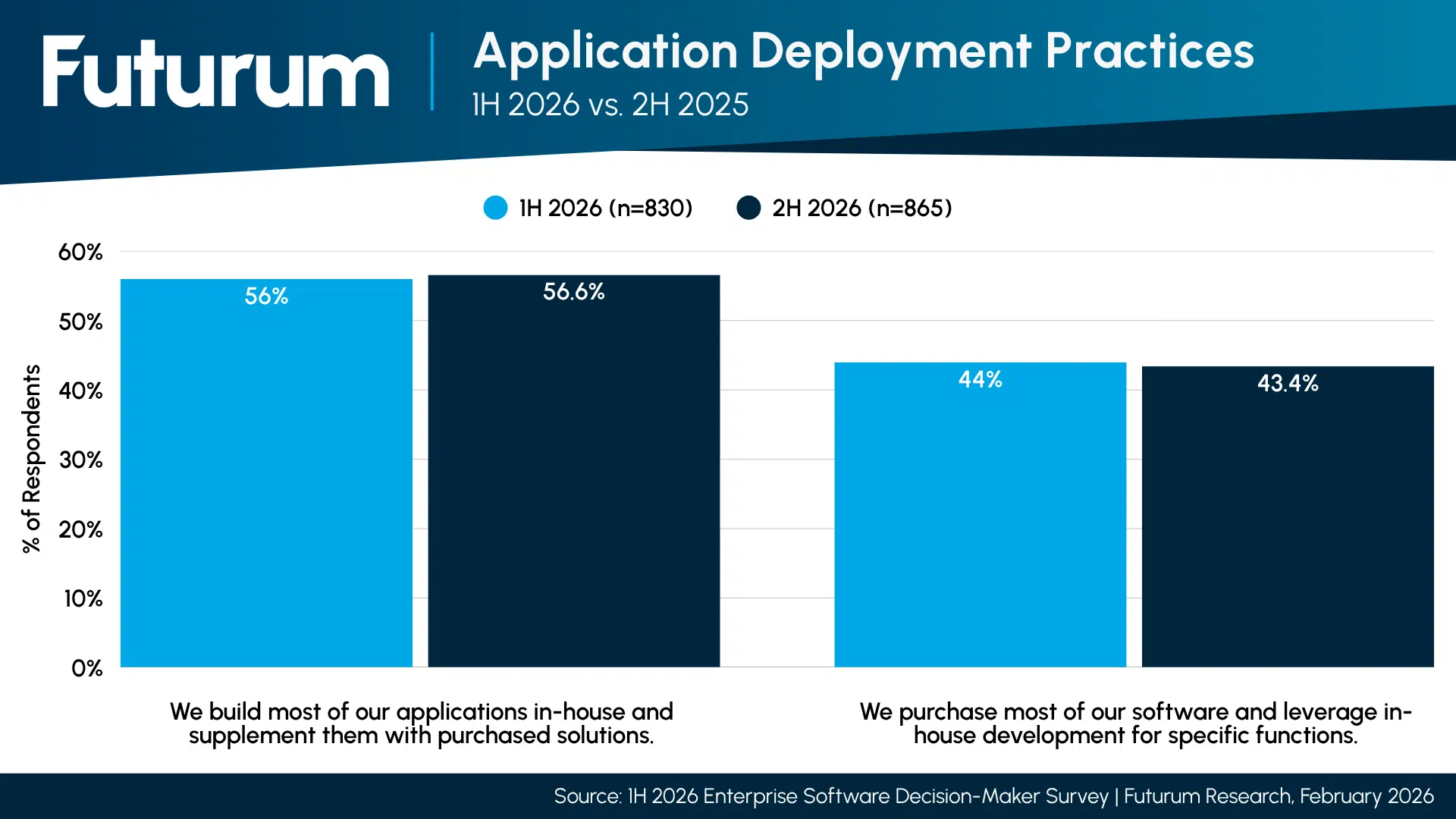
That preference describes buyers who don’t trust an off-the-shelf product to fit their workflow without significant adaptation. In fact, ETR Insights panelists describe the failure mode when that adaptation doesn’t happen: an IT decision maker on ETR’s Model Context Protocol panel warned that many rollouts skip change management even though deploying an agent means “we’re driving a process change, and we’re driving a people change as well.”
As such, buyers should treat a documented redesign methodology and named customer references as a gating requirement before a pilot begins, the same way they gate on security certifications or service-level agreements.
The “Boring Layer” Is What Buyers Are Actually Rewarding
Futurum’s 1H 2026 AI Platforms Decision Maker Survey puts a number on what separates AI leaders from laggards, and it isn’t raw model quality: organizations that rate themselves behind their competitors are far more likely than those ahead to cite legacy-system integration (a 13.1-point gap) and workforce adaptation (a 12.4-point gap) as distinguishing barriers.
Reliability and hallucination concerns run the other way, reported by 58.5% of organizations ahead of their peers versus 50.5% of those behind, suggesting reliability challenges intensify with scale rather than block the starting line.
Vendors whose roadmaps lead with agent intelligence ahead of integration tooling, such as Zendesk’s Action Builder or Oracle’s re-architected back-end hooks, are solving the problem that separates leaders from laggards; SAP’s Agent Hub, built specifically for governance, permissioning, and monitoring across an agent fleet, is the same bet on the governance side.
Pilot-to-Production Rate Deserves Its Own Scorecard
ETR’s AI Product Series survey already shows what an unmeasured conversion rate looks like in practice. Among enterprises evaluating or piloting Salesforce Agentforce, the share landing in ETR’s top evaluation category, “significant value,” fell from 11.8% in November 2025 to 6.3% in May 2026; ServiceNow AI Agents moved the other direction over the same period, from 7.0% to 11.1%.
Neither trend shows up in adoption or seat-growth figures, since both products kept appearing in more pilots over the same window. Some of this is likely early-cycle evaluation friction, since ETR’s data shows 15%–24% of respondents still describe evaluation as early-stage across these same products.
Futurum’s 1H 2026 AI Platforms Decision Maker Survey points to something more structural than timing, though: just 13.1% of organizations outside its most advanced cohort have reached orchestrating or autonomous-ecosystem agentic maturity, compared with 78.0% of the Stage 5 organizations that have, even as a CIO at a large global financial services organization told ETR’s Agentic AI Insights panel that agentic AI is scaling rapidly across their industry and agreed the category is headed for a “major expansion phase” within two to four years.
Confidence about the category’s trajectory and the current maturity split are different measurements, and only one is verifiable today. Analysts, buyers, and vendors comparing agentic AI platforms should track pilot-to-production rate as a standing metric that can be used to assess how well AI works in real-world deployments.
What to Watch
- Pilot-to-Production Conversion Rates, Tracked over Time: Watch whether Salesforce Agentforce’s declining “significant value” share (11.8% to 6.3% in six months) continues or reverses; a further decline would point to vendor-specific trouble rather than category-wide friction.
- Vendor Investment in Process-Redesign Services: Watch which vendors formalize, rather than informally staff, methodology and change-management offerings alongside their agent products, since that is the differentiator this piece argues will separate winners from demo-runners.
- Regulated-Industry Adoption Pace: Watch whether financial services, healthcare, and government adoption of autonomous, rather than merely assistive, agent workflows lags the broader market, given ETR Insights commentary on reliability and explainability concerns in business-critical systems.
- Procurement Criteria Shifting Toward Integration and Governance: Watch whether the maturity gap between AI leaders and laggards, currently concentrated in legacy-system integration and workforce readiness rather than model reliability, narrows or widens across future waves of Futurum’s AI Platforms and Enterprise Software Decision Maker surveys.
Other Insights from Futurum
SAP’s Dremio Acquisition Provides Agentic AI Data Foundation
Oracle Makes the Case for AI Inside Everyday Leadership Workflows
Salesforce’s Agentforce Help Agent Bets on Pay-Per-Resolution, Will Enterprises Trust the Model?
Author Information

Keith Kirkpatrick is VP & Research Director, Enterprise Software & Digital Workflows for The Futurum Group. Keith has over 25 years of experience in research, marketing, and consulting-based fields.
He has authored in-depth reports and market forecast studies covering artificial intelligence, biometrics, data analytics, robotics, high performance computing, and quantum computing, with a specific focus on the use of these technologies within large enterprise organizations and SMBs. He has also established strong working relationships with the international technology vendor community and is a frequent speaker at industry conferences and events.
In his career as a financial and technology journalist he has written for national and trade publications, including BusinessWeek, CNBC.com, Investment Dealers’ Digest, The Red Herring, The Communications of the ACM, and Mobile Computing & Communications, among others.
He is a member of the Association of Independent Information Professionals (AIIP).
Keith holds dual Bachelor of Arts degrees in Magazine Journalism and Sociology from Syracuse University.